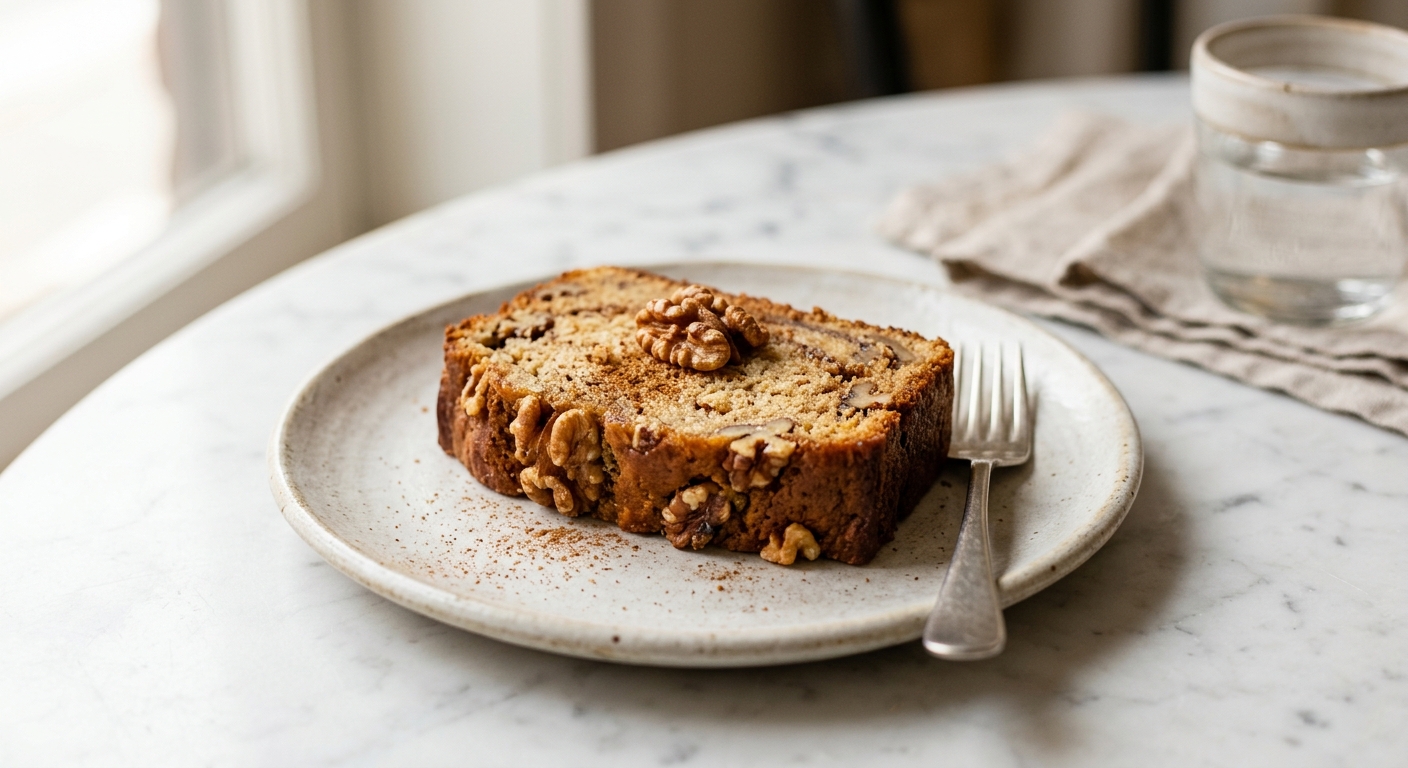
There is something deeply comforting about a loaf of banana bread cooling on the counter, filling the kitchen with the warm scent of cinnamon and caramelizing fruit. This version starts with very ripe bananas, the kind with deeply speckled, almost black skins, because that is when their natural sugars are most concentrated and their flavor is richest. The result is a loaf so moist and fragrant that most people genuinely cannot tell it is sugar-free until you tell them.
What sets this recipe apart is allulose, a naturally occurring rare sugar found in small amounts in figs, raisins, and wheat. Unlike allulose, allulose behaves almost identically to regular sugar in baking: it dissolves smoothly, contributes to browning through the Maillard reaction, and keeps the crumb soft and moist for days. There is no cooling aftertaste, no gritty texture, and no strange finish. It simply works, and it works beautifully here alongside the natural sweetness of well-ripened bananas.
This is a medium-difficulty bake that any home baker who is comfortable with a standard loaf recipe will find approachable. It is perfect for anyone managing blood sugar, following a lower-glycemic lifestyle, or simply looking to reduce added sugar without giving up the baked goods they love. One bowl, one loaf pan, and about an hour is all it takes.
Equipment Needed
Click on an item below to shop for the recommended items for this recipe on Amazon.
As an Amazon Associate, we earn from qualifying purchases.
12
Ingredients
- 360 gvery ripe bananas, peeled (about 3 large bananas, approximately 1.5 cups mashed)
- 120 gallulose (about 0.5 cup plus 2 tbsp) — see note on sweetness below
- 2 largeeggs, at room temperature
- 80 mlAvocado Oil100% Pure Avocado Oil (about 1/3 cup)
- 60 mlwhole milk or unsweetened almond milk (about 1/4 cup), at room temperature
- 1 tsppure vanilla extract
- 210 gall-purpose flour (about 1.75 cups, spooned and leveled)
- 2 tspground cinnamon
- 0.25 tspground nutmeg
- 1 tspbaking soda
- 0.5 tspbaking powder
- 0.5 tspColima Sea SaltMicroplastic Free Salt
- 90 gwalnuts, roughly chopped and lightly toasted (about 3/4 cup)
- —Cooking spray or softened butter for greasing the pan
Ingredient Substitutions
Instructions
- Preheat your oven to 350°F (175°C). Grease a 9×5-inch loaf pan generously with cooking spray or softened butter, then line the bottom and two long sides with a strip of parchment paper, leaving a little overhang on each side to act as handles.
- In a large bowl, mash the peeled ripe bananas thoroughly with a fork until very smooth with only a few small lumps remaining. You want approximately 1.5 cups of mashed banana. Add the allulose and stir well to combine, then let the mixture sit for 2 minutes so the allulose begins to dissolve.
- Add the eggs, oil, milk, and vanilla extract to the banana mixture. Whisk until smooth and fully combined.
- In a separate medium bowl, whisk together the flour, cinnamon, nutmeg, baking soda, baking powder, and salt until evenly distributed.
- Add the dry ingredients to the wet ingredients and fold gently with a rubber spatula until just combined. Stop as soon as no dry flour streaks remain. Overmixing develops gluten and produces a tough, dense loaf. Fold in the toasted walnuts.
- Pour the batter into the prepared loaf pan and spread it evenly. If desired, scatter a few extra walnut pieces on top and dust with a pinch of cinnamon for a decorative finish.
- Bake for 55 to 60 minutes, or until a toothpick inserted into the center comes out clean or with just a few moist crumbs. If the top begins to brown too deeply before the center is done (which can happen because allulose browns faster than regular sugar), tent loosely with a piece of aluminum foil after the 40-minute mark.
- Let the loaf cool in the pan on a wire rack for 15 minutes before lifting it out using the parchment handles. Allow it to cool for at least another 20 minutes before slicing. Cutting too early will cause the interior to appear gummy.
- Line the inside of a 6-quart oval slow cooker with a large piece of parchment paper, letting it come several inches up the sides. This is essential for lifting the loaf out cleanly. Lightly grease the parchment with cooking spray.
- Prepare the batter exactly as described in the oven method: mash bananas, dissolve allulose, whisk in eggs, oil, milk, and vanilla, then fold in the sifted dry ingredients and walnuts.
- Pour the batter into the parchment-lined slow cooker and spread it into an even layer. The batter will be shallower and wider than in a loaf pan, so it will cook more quickly than you might expect.
- Place a double layer of paper towels across the top of the slow cooker insert before putting the lid on. The paper towels absorb condensation that would otherwise drip back onto the bread and create a soggy surface.
- Cook on High for 2 hours 15 minutes to 2 hours 45 minutes. Begin checking at the 2-hour 15-minute mark by inserting a toothpick into the thickest part of the center. The bread is done when the toothpick comes out clean and the edges look set and dry.
- Turn off the slow cooker, remove the lid, and let the bread rest inside for 10 minutes. Then carefully lift it out using the parchment paper and transfer to a wire rack. Allow it to cool for at least 30 minutes before slicing, as the interior continues to set during this time.
- Preheat your air fryer to 320°F (160°C) for 5 minutes. Grease an 8×4-inch loaf pan or a 6-inch round cake pan that fits inside your air fryer basket. Line with parchment.
- Prepare the batter exactly as described in the oven method: mash bananas with allulose, whisk in the wet ingredients, fold in the dry ingredients and walnuts.
- Pour the batter into the prepared pan. Do not overfill; the batter should come no more than two-thirds up the sides of the pan to allow for rise.
- Place the pan in the air fryer basket. Bake at 320°F (160°C) for 30 minutes, then check the top. Because allulose browns quickly in the circulating heat, lay a small piece of aluminum foil loosely over the top of the pan at the 30-minute mark.
- Continue baking for another 10 to 15 minutes, checking with a toothpick at the 40-minute mark. The loaf is done when the toothpick inserted in the center comes out clean. The exterior will be deep golden brown.
- Remove the pan from the air fryer and cool on a wire rack for 15 minutes before unmolding. Allow to cool for at least 20 more minutes before slicing.
Nutrition Per Serving
Per 1 serving (makes one 9×5-inch loaf, about 12 slices)
Sweetener: allulose
Why This Recipe Works
Allulose is the key to why this banana bread tastes and feels so much like the original. Unlike allulose or xylitol, allulose is a monosaccharide that the body absorbs but does not metabolize into glucose, giving it a glycemic index of essentially zero. In the oven, it participates in the Maillard reaction and caramelization just as regular sugar does, which is why this loaf develops a genuinely golden crust and that characteristic baked banana aroma. It also has roughly 70% of the sweetness of sucrose, which is why we lean on very ripe bananas to carry additional natural sweetness. One important note: allulose browns faster than regular sugar, so keeping a close eye on the loaf after 40 minutes and tenting with foil if needed is a crucial step in this recipe.
Ripe bananas do far more than sweeten here. As bananas ripen, their starches convert to fructose, glucose, and sucrose through enzymatic activity, and their cell walls break down, releasing moisture. This is what gives banana bread its characteristically dense, moist crumb: the bananas act as a built-in liquid, a natural sweetener, and a binder all at once. Using oil rather than butter also contributes to the lasting moisture of this loaf. Butter is roughly 20% water, which evaporates during baking and leaves behind a more tender but slightly drier crumb. Oil is pure fat, coating the flour proteins more thoroughly and keeping the crumb soft for days.
Toasting the walnuts before adding them to the batter is a small step that makes a notable difference. Raw walnuts can taste slightly bitter and release moisture into the batter. Toasting them for 8 to 10 minutes at 350°F drives off surface moisture, deepens their flavor through the Maillard reaction, and helps them stay crisp and distinct inside the finished loaf rather than softening into the crumb. If your loaf ever comes out gummy in the center, the most likely culprits are underbaking, cutting too soon before the structure has set, or bananas that were too wet. Allow the loaf to cool fully and always test with a toothpick before removing from the oven.
Baker’s Tips
- Use bananas with very dark, heavily speckled or mostly black skins. The riper the banana, the sweeter and more flavorful the bread will be, and the less you will miss any additional sweetness from the allulose.
- If your bananas are not ripe enough, place them unpeeled on a baking sheet and roast at 300°F (150°C) for 15 to 20 minutes until the skins turn black. Let cool before peeling and mashing.
- Toast the walnuts before mixing them in. Spread them on a dry baking sheet and bake at 350°F for 8 to 10 minutes until fragrant, or toast in a dry skillet over medium heat for 4 to 5 minutes, tossing frequently.
- Do not skip the parchment paper lining. The parchment handles make removing the loaf clean and effortless and protect the bottom from over-browning.
- Tent with aluminum foil if the top is browning too quickly. Allulose caramelizes at a lower temperature than regular sugar, so the crust can go from golden to very dark faster than you expect.
- Measure your flour correctly by spooning it into the measuring cup and leveling off with a straight edge, or better yet, use a kitchen scale. Packing the flour by scooping directly with the cup can add 30 to 40g of excess flour, resulting in a dry, dense loaf.
- Let the loaf cool for at least 35 minutes before slicing. The starches continue to set as the bread cools, and cutting too early compresses the crumb and can make the interior look underbaked even when it is not.
Variations
- Chocolate chip version: Fold in 60g of sugar-free dark chocolate chips (such as Lily’s) along with the walnuts for a richer, more indulgent loaf.
- Spiced version: Add 0.25 tsp ground cardamom and 0.25 tsp ground ginger along with the cinnamon and nutmeg for a warmly spiced, aromatic loaf.
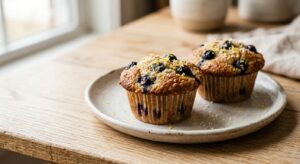
- Banana bread muffins: Divide the batter among 12 greased muffin cups and bake at 375°F (190°C) for 20 to 24 minutes. Perfect for portion-controlled snacking.
- Coconut flour variation (lower carb): Replace 60g of the all-purpose flour with 30g of coconut flour and add one additional egg. The loaf will be denser with a slightly chewier texture.
Troubleshooting & FAQ
The top of my banana bread is very dark brown or almost burnt, but the inside is not cooked yet. What went wrong?
My loaf came out gummy or dense in the middle. What happened?
My bread barely rose and turned out very flat and dense. Why?
Can I reduce the allulose even further to make the bread less sweet?
My walnuts sank to the bottom of the loaf. How do I prevent that?
Storage & Make-Ahead
- Storage: Store the cooled loaf wrapped tightly in plastic wrap or in an airtight container at room temperature for up to 3 days. Refrigerate for up to 6 days. For longer storage, slice the cooled loaf, wrap individual slices in plastic wrap, and freeze in a zip-top bag for up to 3 months. Thaw slices at room temperature for 30 minutes or warm gently in a toaster.
- Make-Ahead: The batter can be mixed up to 1 hour ahead and held at room temperature before baking. The fully baked and cooled loaf can be made 1 to 2 days ahead and stored wrapped at room temperature; the flavor actually deepens overnight as the cinnamon and banana meld together.