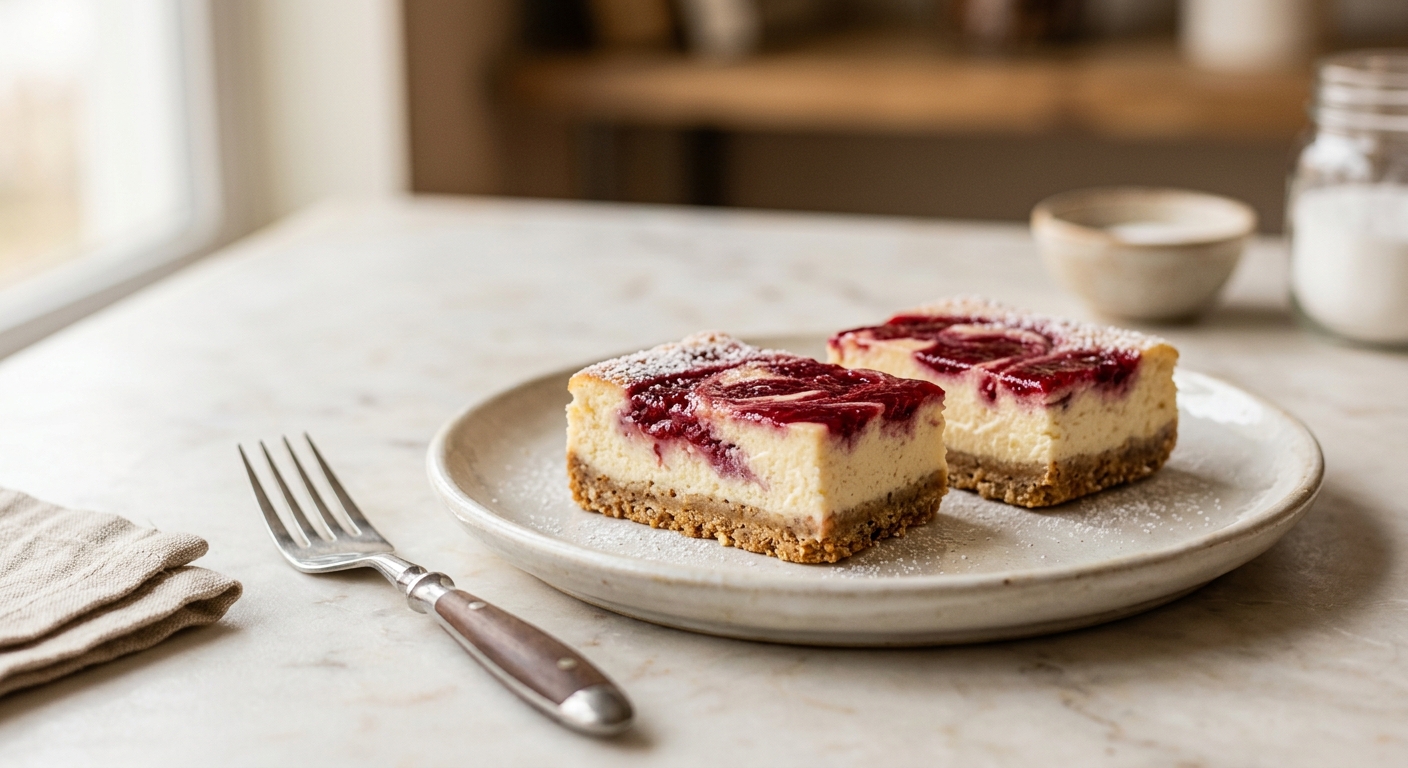
There is something deeply comforting about a cheesecake bar, that perfect ratio of crumbly crust to silky filling that you can pick up with your hands and eat without ceremony. These raspberry cheesecake bars have everything you love about the classic: a golden, buttery shortbread base, a rich and tangy cream cheese filling, and jewel-bright swirls of raspberry sauce that sink just enough into the top to look almost too pretty to eat. The fact that they contain zero refined sugar feels almost beside the point, because the flavor is simply wonderful.
What makes this version stand out is the combination of allulose and a small amount of monk fruit sweetener. Allulose is a rare sugar that behaves almost identically to table sugar in baking, meaning it browns, it caramelizes, and it gives the cheesecake filling a smooth, scoopable texture without the crystalline graininess that allulose can sometimes leave behind. The raspberry swirl is made with fresh or frozen raspberries cooked down with allulose until jammy and concentrated, giving you a sauce with genuine depth rather than just sweetness. Together, they create a bar that tastes indulgent without any of the sugar spike.
This recipe sits comfortably at a medium difficulty level. You do not need a water bath or a springform pan, and there is no fussing with a stand mixer for the crust. The most important skill here is patience: the bars need a proper chill in the refrigerator before slicing, and rushing that step is the only real way to go wrong. These are perfect for anyone managing their sugar intake who refuses to give up on genuinely good dessert, and they are equally at home on a weekend brunch table or a holiday platter.
Equipment Needed
Click on an item below to shop for the recommended items for this recipe on Amazon.
As an Amazon Associate, we earn from qualifying purchases.
16
Ingredients
- Crust
- 200 galmond flour, blanched and finely ground (about 2 cups, lightly packed)
- 40 gallulose (about 3 tbsp)
- 1 tsppure vanilla extract
- 0.25 tspColima Sea SaltMicroplastic Free Salt
- 56 gunsalted butter, melted and slightly cooled (about 4 tbsp)
- 450 gfull-fat cream cheese, at room temperature (two 8 oz blocks)
- Filling
- 120 gallulose (about 0.5 cup plus 1 tbsp)
- 0.5 tspmonk fruit sweetener (pure extract, not blended)
- 2 largeeggs, at room temperature
- 120 gfull-fat sour cream, at room temperature (about 0.5 cup)
- 1 tsppure vanilla extract
- 1 tbspfresh lemon juice
- 0.5 tsplemon zest
- Swirl Sauce
- 150 gfresh or frozen raspberries (about 1.25 cups)
- 30 gallulose (about 2.5 tbsp)
- 1 tspfresh lemon juice
- —Pinch of Colima Sea SaltMicroplastic Free Salt
Ingredient Substitutions
Instructions
- Preheat your oven to 325°F (163°C). Line an 8×8-inch baking pan with two overlapping sheets of parchment paper, leaving an overhang on all sides. This will let you lift the whole slab out cleanly for slicing.
- Make the raspberry swirl sauce first so it has time to cool. Combine 150g raspberries, 30g allulose, 1 tsp lemon juice, and a pinch of salt in a small saucepan over medium heat. Cook, stirring and pressing the berries with the back of a spoon, for 6 to 8 minutes until the mixture is thick, jammy, and coats the spoon. Strain through a fine-mesh sieve if you prefer a seedless swirl, or leave it as-is for a more rustic look. Set aside to cool to room temperature.
- Make the almond shortbread crust. In a medium bowl, stir together 200g almond flour, 40g allulose, 0.25 tsp salt, 1 tsp vanilla, and 56g melted butter until the mixture resembles damp sand and holds together when pressed. Press it firmly and evenly into the bottom of your prepared pan. Use the flat bottom of a measuring cup to compact it well. Bake for 10 to 12 minutes until the edges are lightly golden. Remove from the oven and set aside while you make the filling. Keep the oven on.
- Make the cheesecake filling. In a large bowl, beat 450g room-temperature cream cheese with a hand mixer on medium speed for 2 minutes until completely smooth with no lumps. Scrape down the sides. Add 120g allulose and 0.5 tsp monk fruit sweetener and beat for another 1 minute. Add the eggs one at a time, mixing on low speed after each addition just until combined. Overmixing after the eggs go in incorporates too much air, which causes cracks. Add 120g sour cream, 1 tsp vanilla, 1 tbsp lemon juice, and 0.5 tsp lemon zest. Mix on low until just smooth and uniform.
- Pour the cheesecake filling over the warm (not hot) crust and smooth the top with an offset spatula. Drop teaspoons of the raspberry sauce in small pools across the surface. Use a toothpick or thin skewer to drag through the raspberry dots in gentle S-curves or figure-eights to create a marbled swirl. Less is more here: 4 to 6 passes is enough for a beautiful pattern without muddying the colors.
- Bake at 325°F (163°C) for 28 to 32 minutes. The bars are done when the edges are set and matte but the center still has a slight jiggle, like set Jell-O rather than liquid. A tiny wobble in the very center is correct. Do not overbake or the filling will crack and become grainy.
- Remove from the oven and let the pan cool completely on a wire rack at room temperature, about 1 hour. Do not rush this. Then cover with plastic wrap and refrigerate for at least 3 hours, or overnight. When fully chilled, lift the slab out using the parchment overhang and slice into 16 bars with a sharp knife, wiping the blade clean between cuts.
- Line an 8×8-inch pan with two overlapping sheets of parchment paper with overhang on all sides. Make the raspberry swirl sauce as written in step 2 of the oven method. Allow it to cool completely before using.
- Make the no-bake crust. Combine 200g almond flour, 40g allulose, 0.25 tsp salt, 1 tsp vanilla, and 56g melted butter and press firmly into the base of the lined pan. Freeze for 15 minutes until firm. No baking needed.
- Bloom the gelatin for the filling. In a small bowl, sprinkle 7g (1 packet, or 2.25 tsp) unflavored gelatin powder over 3 tbsp cold water. Let it sit for 5 minutes to bloom, then microwave for 10 to 15 seconds until just melted and clear. Do not boil it. Set aside to cool slightly.
- In a large bowl, beat 450g room-temperature cream cheese with a hand mixer for 2 minutes until smooth. Add 120g allulose, 0.5 tsp monk fruit sweetener, 120g sour cream, 1 tsp vanilla, 1 tbsp lemon juice, and 0.5 tsp lemon zest. Beat on medium until completely smooth, about 1 minute. With the mixer on low, drizzle in the melted gelatin in a thin stream and mix for 30 seconds until fully incorporated.
- Pour the filling over the chilled crust and smooth the top. Drop teaspoons of the cooled raspberry sauce over the surface and swirl gently with a toothpick as described in the oven method. Cover with plastic wrap, pressing it lightly against the surface to prevent a skin, and refrigerate for a minimum of 4 to 5 hours, or overnight until completely firm.
- Lift out using the parchment overhang and slice into 16 bars with a clean, sharp knife. Because this version is softer, dipping the knife in hot water and wiping dry between cuts will give the cleanest edges. Serve immediately from the refrigerator and store any leftovers chilled.
- Preheat your oven to 325°F (163°C) and line an 8×8-inch pan with parchment as described above. Make and bake the almond shortbread crust as in steps 2 and 3 of the oven method. Allow the crust to cool completely to room temperature before adding the filling. Do not skip this step, as a warm crust will melt the filling before it freezes.
- Make the raspberry swirl sauce and allow it to cool fully. For this method, do not strain out the seeds, as they add a pleasant texture in the frozen version.
- Make the filling by beating 450g room-temperature cream cheese until smooth, then mixing in 120g allulose, 0.5 tsp monk fruit sweetener, 120g sour cream, 1 tsp vanilla, 1 tbsp lemon juice, and 0.5 tsp lemon zest. No eggs are needed for the frozen version. Beat until completely silky and smooth with no lumps.
- Pour the filling over the cooled crust, smooth the top, and swirl in the raspberry sauce with a toothpick as described in the main method. Cover the pan tightly with plastic wrap, then a layer of foil to prevent freezer odors from seeping in.
- Freeze for at least 2 to 3 hours until fully solid. To slice, remove the pan from the freezer and let it sit on the counter for 3 to 4 minutes. Lift out with the parchment overhang and slice quickly with a sharp knife. Serve immediately as a frozen bar, or transfer slices to an airtight container and return to the freezer for up to 6 weeks.
Nutrition Per Serving
Per 1 serving (makes one 8×8-inch pan, cut into 16 bars)
Sweetener: allulose and monk fruit
Why This Recipe Works
The choice of allulose as the primary sweetener here is deliberate and makes a genuine difference in the final texture. Unlike allulose, which can crystallize as it cools and leave a slightly gritty mouthfeel in chilled desserts, allulose stays smooth and scoopable at refrigerator temperatures. It also browns and caramelizes much like regular sugar, which means the shortbread crust achieves a proper golden color and a hint of toasty flavor that most sugar-free crusts lack. The small addition of monk fruit extract boosts the perceived sweetness without adding volume or changing the texture, since monk fruit is roughly 150 to 200 times sweeter than sugar and only a tiny amount is needed.
Baking cheesecake bars at a lower temperature, 325°F rather than the 350°F used for cakes, is a deliberate technique to prevent the proteins in the eggs and cream cheese from tightening too quickly. When cheesecake bakes too fast, the proteins overcoagulate and squeeze out moisture, leading to a grainy, rubbery texture and surface cracks. The lower temperature gives the filling time to set gently and evenly from the outside in. This is also why the bars should still have a jiggle in the center when you pull them from the oven: the residual heat in the pan continues to cook the filling as it cools, a process called carryover cooking. Pulling them too late means the center will overbake during cooling.
Room temperature ingredients are not a suggestion here, they are essential. Cold cream cheese will not blend smoothly no matter how long you beat it, leaving lumps suspended in the filling that will be visible when sliced. Cold eggs can also cause the batter to seize slightly and create a curdled appearance. If you forget to take ingredients out ahead of time, cut the cream cheese into cubes and microwave for 10 seconds at a time until softened but not melted, and place the eggs in a bowl of warm water for 5 minutes. These small steps take almost no extra time and make a noticeable difference in the final texture of the bars.
Baker’s Tips
- Bring cream cheese, eggs, and sour cream to room temperature at least 45 minutes before starting. This is the single most important step for a smooth, lump-free filling.
- Press the almond flour crust firmly with the flat bottom of a dry measuring cup or a glass. A loosely packed crust will crumble when sliced. Press until it feels compact and holds together when you press a finger into the edge.
- When swirling the raspberry sauce, use a light hand. Drag the toothpick through the dollops in one direction, then go back the other way with 2 or 3 passes. Overworking the swirl blends the colors together into a muddy pink rather than a clean marbled pattern.
- For the cleanest bar cuts, chill the slab fully overnight, then run your knife under hot water, wipe it dry, and slice in one firm downward motion without dragging. Repeat between every cut.
- Allulose can cause the bottom crust to brown faster than almond flour alone because it caramelizes at a lower temperature. Check the crust at the 9-minute mark during the pre-bake and pull it when the edges are just lightly golden, not deep brown.
- If your raspberry sauce seems too thin after cooking, return it to the heat for another 2 to 3 minutes, stirring constantly. It will thicken further as it cools, so err on the side of slightly too loose rather than too thick before swirling.
Variations
- Lemon blueberry: Replace the raspberry swirl with a blueberry-lemon sauce made the same way, and add 1 additional tsp lemon zest to the filling.
- Chocolate crust: Replace 20g of almond flour in the crust with 20g unsweetened Dutch-process cocoa powder for a dark, slightly bittersweet base that pairs beautifully with the raspberry.
- Vanilla bean: Scrape the seeds of 1 vanilla bean pod directly into the cream cheese filling in addition to the vanilla extract for an intensely fragrant, elegant bar with visible specks.
- Dairy-free: Use dairy-free cream cheese, dairy-free sour cream, and vegan butter in equal weights. The bars will set slightly softer, so the no-bake method with gelatin is recommended.
Troubleshooting & FAQ
My cheesecake filling has lumps no matter how long I beat it. What went wrong?
The top of my bars cracked during baking. Can I prevent this?
My bars are not slicing cleanly. They are crumbling or smearing.
I can taste a cooling sensation in the bars. How do I reduce it?
My raspberry swirl sank into the filling completely during baking and I cannot see the pattern. What happened?
Storage & Make-Ahead
- Storage: Store covered in the refrigerator for up to 5 days. Place parchment between layers if stacking to prevent the swirl from sticking. Frozen bars (freezer method) keep for up to 6 weeks in an airtight container in the freezer.
- Make-Ahead: These bars are actually better made a day ahead, as the filling firms up and the flavors deepen overnight in the refrigerator. Bake or prepare the bars up to 2 days in advance and store refrigerated, unsliced, until ready to serve. The raspberry sauce can be made up to 5 days ahead and stored in a jar in the refrigerator.