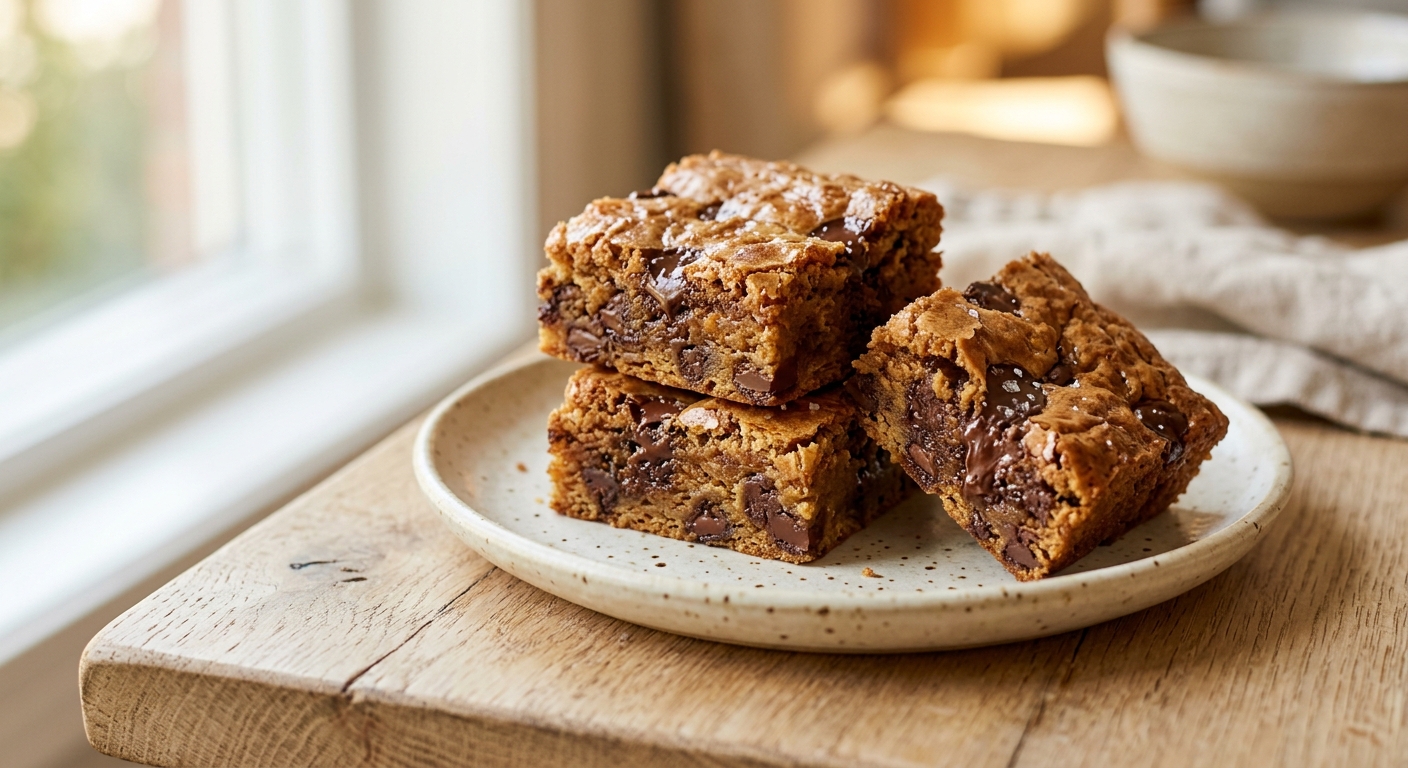
There is a moment, about halfway through browning butter, when your kitchen smells like toasted hazelnuts and warm caramel and you wonder why you do not do this for every single baked good you make. That is exactly where these blondies begin. The butter goes into a saucepan, it foams and sputters, and then it transforms into something golden and deeply fragrant. Combined with allulose and a generous handful of sugar-free chocolate chips, the result is a blondie with a crinkled top, a fudgy pull-apart center, and a flavor that tastes genuinely indulgent rather than a consolation prize.
What sets this recipe apart is the pairing of two ingredients that were almost made for each other: brown butter and allulose. Allulose is a naturally occurring rare sugar found in small amounts in figs and jackfruit. It behaves remarkably like regular sugar in baking, it melts, it caramelizes, it creates that signature chew in blondies, but it is not metabolized by the body the same way, leaving blood sugar essentially unaffected. Because allulose also has a slightly lower sweetness level than sucrose, browning the butter first amplifies the overall depth of flavor so you never feel like something is missing. The combination produces that glossy, crackly top that blondie lovers obsess over.
This is a medium-difficulty recipe, mostly because browning butter requires your full attention for about five minutes, and the batter comes together almost entirely by hand with no mixer required. It is perfect for home bakers who are managing blood sugar, following a lower-glycemic lifestyle, or simply curious about better-for-you baking without sacrificing the textures and flavors that make dessert worth having in the first place.
Equipment Needed
Click on an item below to shop for the recommended items for this recipe on Amazon.
As an Amazon Associate, we earn from qualifying purchases.
16
Ingredients
- 113 gunsalted butter (1 stick / 8 tbsp), cut into pieces
- 200 gallulose (about 1 cup), granulated
- 2 largeeggs, at room temperature
- 1 tsppure vanilla extract
- 150 gall-purpose flour (about 1 1/4 cups, spooned and leveled)
- 0.5 tspbaking powder
- 0.5 tspColima Sea SaltMicroplastic Free Salt
- 0.25 tspground cinnamon
- 140 gsugar-free semi-sweet chocolate chips (about 3/4 cup), such as Lily’s or ChocZero
- —Colima Sea SaltMicroplastic Free Salt, for finishing (optional but recommended)
Ingredient Substitutions
Instructions
- Preheat your oven to 350°F (175°C). Line an 8×8-inch baking pan with parchment paper, leaving an overhang on two sides for easy lifting. Lightly grease the parchment.
- Brown the butter: place the butter pieces in a light-colored saucepan over medium heat. Melt, stirring occasionally. The butter will foam, then the foam will subside, and you will see golden-brown milk solids beginning to appear on the bottom of the pan. The moment it smells nutty and looks deep amber, remove it from the heat immediately and pour it into a large heatproof mixing bowl. Let it cool for 8 to 10 minutes until it is warm but not hot.
- Whisk the allulose into the warm brown butter vigorously for about 90 seconds. The mixture will look grainy at first, then glossy. Add the eggs one at a time, whisking well after each addition. Add the vanilla and whisk for another 30 seconds. This step is important: the vigorous mixing helps create that signature crinkly top by building a light emulsion.
- Add the flour, baking powder, salt, and cinnamon to the bowl. Switch to a rubber spatula and fold until just combined and no dry streaks remain. Do not overmix. Fold in three-quarters of the chocolate chips.
- Spread the batter evenly into the prepared pan. It will be thick. Scatter the remaining chocolate chips over the top and press them in gently. Sprinkle with flaky sea salt if using.
- Bake for 24 to 28 minutes, until the top is set and golden, the edges have pulled slightly from the sides, and a toothpick inserted 2 inches from the center comes out with a few moist crumbs (not wet batter). Allulose browns faster than sugar, so start checking at 22 minutes.
- Let the blondies cool in the pan for at least 20 minutes before lifting out and slicing. They will firm up significantly as they cool. For the cleanest cuts, refrigerate for 30 minutes before slicing with a sharp knife.
- Prepare the brown butter and batter exactly as described in steps 2 through 5 of the oven method. Use a 7-inch round or square baking pan that fits inside your air fryer basket.
- Preheat the air fryer to 320°F (160°C) for 3 minutes. Line your baking pan with parchment and grease lightly.
- Spread the batter into the prepared pan. Top with the remaining chocolate chips and flaky salt. Place the pan into the air fryer basket.
- Bake at 320°F (160°C) for 18 to 22 minutes. Check at 16 minutes: because allulose caramelizes more readily than sucrose and air fryers circulate heat intensely, the top can brown quickly. If the top looks very dark before the center is set, loosely tent a small piece of foil over the pan for the remaining bake time.
- The blondies are done when the top is golden and set and a toothpick inserted near the center comes out with moist crumbs. Cool in the pan for 20 minutes before removing and slicing. The center will look slightly underdone when hot but will firm to a fudgy consistency as it cools.
- Scale the ingredients for one serving: 14g (1 tbsp) unsalted butter, 25g (2 tbsp) allulose, 1 egg yolk only (discard the white or save for another use), 1/4 tsp vanilla extract, 19g (2.5 tbsp) all-purpose flour, tiny pinch each of baking powder, salt, and cinnamon, and 1 to 2 tbsp sugar-free chocolate chips.
- Brown the butter in a small microwave-safe bowl: microwave in 20-second bursts, stirring between each, until the butter is melted and smells nutty with golden-brown bits visible, about 60 to 80 seconds total. Watch it closely. Pour into a large microwave-safe mug and let cool for 2 minutes.
- Whisk the allulose into the warm brown butter in the mug. Add the egg yolk and vanilla and stir briskly for 30 seconds. Add the flour, baking powder, salt, and cinnamon and stir until smooth. Fold in the chocolate chips.
- Microwave on 50% power (medium) for 60 seconds. Check: the center should look just barely set with a slight jiggle. If it is still very liquid in the middle, microwave in 10-second increments at 50% power until just set. Do not overcook or it will turn rubbery.
- Let the mug sit for 2 minutes before eating directly from the mug. Finish with a pinch of flaky salt. The blondie will continue to cook and firm slightly from the residual heat.
Nutrition Per Serving
Per 1 serving (makes one 8×8-inch pan, cut into 16 squares)
Sweetener: allulose
Why This Recipe Works
Browning butter is the most important technique in this recipe, and it does two things at once. First, it drives off the water content of the butter (butter is about 16 to 18% water), which concentrates the fat and produces a denser, fudgier crumb structure. Second, the milk solids in butter undergo the Maillard reaction when heated past the boiling point of water, creating hundreds of new flavor compounds including diacetyl and furanones that smell and taste like toasted nuts and caramel. This deep flavor backbone is what makes allulose-sweetened blondies taste fully satisfying rather than flat.
Allulose is the key to the texture and the crinkly top. Unlike allulose, which has a very high recrystallization tendency and can produce a cooling, gritty mouthfeel, allulose behaves almost identically to sucrose in a batter: it dissolves readily, it holds moisture in the finished product (keeping the blondie fudgy for days), and it caramelizes at around 310°F (154°C), which is actually slightly lower than table sugar. That lower caramelization point is why the edges brown beautifully and the top develops a golden, crackled surface, but it is also why you need to watch your bake time carefully. An extra few minutes in the oven can take allulose from perfectly golden to too dark. The vigorous whisking of allulose into the warm brown butter helps dissolve it thoroughly before the eggs go in, which is what creates that glossy, emulsified batter that sets into a shiny top during baking.
The modest amount of baking powder is intentional. Classic dense, fudgy blondies use very little leavening, relying on the structure of beaten eggs and gluten development (from folding the flour gently) to set the crumb. Too much baking powder would make these cakey. If your blondies come out too dense, the most likely culprit is overmixing after adding the flour, which overdevelops the gluten and creates a tough texture. Fold just until the last streak of flour disappears and stop.
Baker’s Tips
- Use a light-colored saucepan or skillet to brown the butter so you can clearly see the color of the milk solids change from white to golden to amber. Dark pans make it easy to accidentally burn the butter before you notice.
- Allulose looks grainy when first mixed with the brown butter, but this is normal. Keep whisking and it will become glossy and smooth before you add the eggs.
- Do not skip the cooling time for the brown butter before adding the eggs. If the butter mixture is too hot, it will scramble the eggs.
- For the cleanest, most bakery-style slices, refrigerate the fully cooled blondies for 30 minutes and use a sharp chef’s knife wiped clean between each cut.
- Allulose draws moisture from the air slightly more than regular sugar. If you live in a very humid climate, store these in an airtight container from the moment they cool to prevent the top from becoming sticky.
- The blondie center will look slightly underdone and jiggly when you pull it from the oven. This is correct. Carryover heat and cooling time are what set the final fudgy texture. Trust the toothpick test over appearance alone.
Variations
- Espresso brown butter blondies: whisk 1 tsp of instant espresso powder into the brown butter along with the allulose for a mocha-forward depth that pairs beautifully with the chocolate chips.
- Tahini swirl: drop 3 tablespoons of tahini in spoonfuls over the top of the batter before baking and swirl gently with a toothpick. The nutty, slightly bitter tahini balances the sweetness perfectly.
- Pecan crunch: fold 60g (1/2 cup) of roughly chopped toasted pecans into the batter along with the chocolate chips for a classic blondie combination with added texture.
- Coconut lime: replace the cinnamon with 1 tsp lime zest, add 30g (1/3 cup) unsweetened shredded coconut to the batter, and swap the chocolate chips for white sugar-free chocolate chips for a tropical twist.
Troubleshooting & FAQ
My blondies came out dry and crumbly rather than fudgy. What went wrong?
The top of my blondies turned very dark or almost burnt-looking. Did I do something wrong?
My blondies did not develop the crinkly top I see in the photos. Why?
I notice a cooling sensation when I eat these. Is something wrong?
Can I double this recipe for a 9×13-inch pan?
Storage & Make-Ahead
- Storage: Store in an airtight container at room temperature for up to 3 days, or refrigerate for up to 1 week. The texture firms up when cold, so let squares sit at room temperature for 10 minutes before serving if you prefer a softer bite. Freeze individually wrapped squares for up to 2 months and thaw at room temperature for 20 minutes.
- Make-Ahead: These blondies actually improve on day two as the flavors meld and the texture fully sets. Bake up to 2 days ahead and store in an airtight container at room temperature. The unbaked batter can be refrigerated for up to 24 hours; bring it to room temperature for 20 minutes and stir briefly before spreading into the pan.