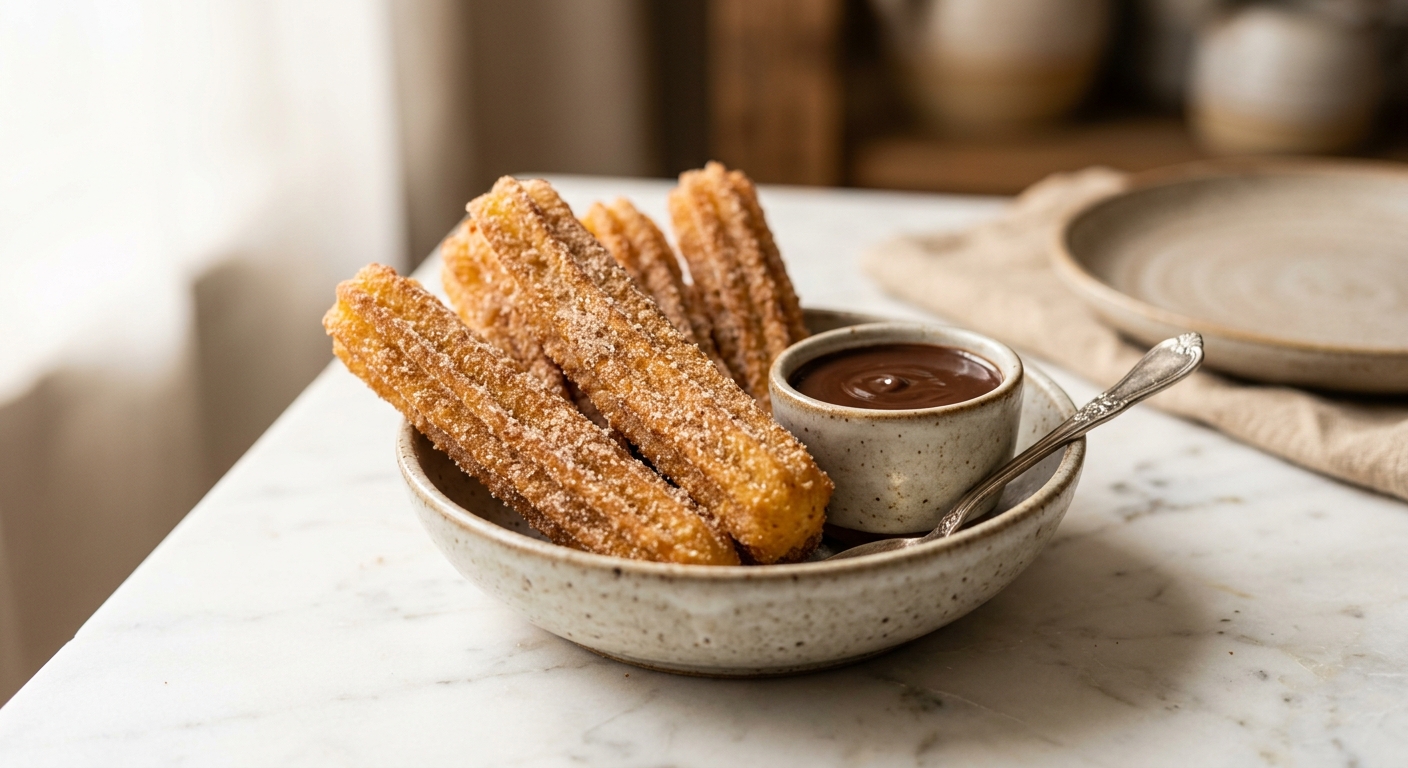
Close your eyes and picture a warm churro fresh from the fryer: shattering crisp ridges giving way to a pillowy, eggy center, dusted in sweet cinnamon sugar that clings to every groove. That’s exactly what we’re making today, only with a clever swap that means you can enjoy every single bite without the sugar rush. These Sugar-Free Churros with Allulose Cinnamon Sugar are the kind of recipe that makes you wonder why you ever needed the original.
The real magic here is allulose, a rare sugar that occurs naturally in figs and raisins. Unlike allulose, allulose actually melts and caramelizes, which means the cinnamon coating on these churros doesn’t just taste sweet, it behaves exactly like cinnamon sugar should: slightly sticky, warmly fragrant, and perfectly golden. The choux-style dough (the same technique behind cream puffs and eclairs) creates a structure that fries up with genuine crunch on the outside while staying moist and tender within. A touch of vanilla and a pinch of nutmeg round out the flavor beautifully.
Don’t be intimidated by the piping and frying steps. If you’ve never made choux dough before, this is one of the most forgiving versions because the smaller churro shape means less time in the oil and a much bigger margin for error. This recipe is perfect for anyone managing blood sugar, following a low-carb lifestyle, or simply cutting back on refined sugar without giving up the foods they love. Expect these to disappear fast.
Equipment Needed
Click on an item below to shop for the recommended items for this recipe on Amazon.
As an Amazon Associate, we earn from qualifying purchases.
16
Ingredients
- Dough
- 240 mlwater (1 cup)
- 56 gunsalted butter, cut into pieces (4 tablespoons / half a stick)
- 15 gallulose granules (1 tablespoon)
- 0.5 tspColima Sea SaltMicroplastic Free Salt
- 0.5 tsppure vanilla extract
- 120 gall-purpose flour (1 cup, spooned and leveled)
- 2 largeeggs, at room temperature
- 1 largeegg yolk, at room temperature
- 960 mlAvocado Oil100% Pure Avocado Oil for frying, such as avocado or sunflower oil (4 cups)
- 80 gallulose granules for the cinnamon coating (about 6 tablespoons)
- 2 tspground cinnamon
- Cinnamon Coating
- —Pinch of Colima Sea SaltMicroplastic Free Salt
- —Pinch of ground nutmeg
Ingredient Substitutions
Instructions
- Make the allulose cinnamon sugar first: combine 80g allulose, 2 tsp cinnamon, a pinch of salt, and a pinch of nutmeg in a wide shallow bowl or baking dish. Stir well and set aside near the stove so you can roll the churros the moment they come out of the oil.
- Combine the water, butter, 15g allulose, and salt in a medium saucepan over medium heat. Stir occasionally and bring to a full rolling boil, making sure the butter is completely melted before the water boils hard.
- Remove the pan from the heat and add all the flour at once. Stir vigorously with a wooden spoon or silicone spatula until a smooth dough forms and pulls away cleanly from the sides of the pan. Return to medium-low heat and stir constantly for 1 to 2 minutes to dry the dough slightly – you want a thin film to form on the bottom of the pan. This step removes excess moisture and is key to a crisp churro.
- Transfer the dough to a stand mixer fitted with the paddle attachment (or a large bowl if using a hand mixer). Let it cool for 3 to 4 minutes, then add the vanilla extract. Beat in the eggs and egg yolk one at a time on medium speed, waiting until each is fully incorporated before adding the next. The finished dough should be smooth, glossy, and thick enough to hold its shape when piped – it will fall slowly in a thick ribbon from the beater.
- Fit a large piping bag with a large open star tip (a 1M or 6B tip works perfectly for classic churro ridges). Fill the bag with the warm dough. Pour the oil into a heavy-bottomed pot or Dutch oven to a depth of at least 3 inches and clip a thermometer to the side. Heat over medium-high heat to 375°F (190°C). Line a baking sheet with a wire rack.
- Once the oil reaches temperature, hold the piping bag directly over the oil and pipe 5-inch lengths of dough, using kitchen scissors or a sharp knife to snip the dough cleanly from the tip. Fry 3 to 4 churros at a time – do not crowd the pot, as this drops the oil temperature and leads to greasy churros. Fry for 3 to 4 minutes, turning once halfway through, until deep golden brown all over.
- Use a slotted spoon or spider to lift the churros and let any excess oil drain for a few seconds, then immediately transfer them to the bowl of allulose cinnamon sugar and roll to coat generously. Set on the wire rack. Repeat with remaining dough, allowing the oil to return to 375°F between each batch. Serve within 20 minutes while still warm and crisp.
- Prepare the allulose cinnamon sugar coating and the choux dough exactly as described in steps 1 through 4 of the deep-fry method above.
- Line the air fryer basket with a small square of perforated parchment paper (sold specifically for air fryers) or lightly spray the basket with avocado oil spray. Preheat your air fryer to 400°F (200°C) for 3 minutes.
- Fit a large piping bag with a large open star tip and fill with the warm dough. Pipe 5-inch churros directly onto the parchment in the air fryer basket, leaving at least 1 inch of space between each. Lightly spray the tops with avocado oil spray – this is important for browning and crispness.
- Air fry at 400°F (200°C) for 10 to 12 minutes, flipping carefully with tongs at the 7-minute mark and spraying the second side lightly with oil. The churros are done when they are golden brown and feel firm when tapped. They will crisp further as they cool slightly.
- Working quickly, transfer the hot churros to the bowl of allulose cinnamon sugar and roll to coat on all sides. Serve immediately. Repeat with remaining dough in batches.
- Preheat your oven to 425°F (220°C). Line two large baking sheets with parchment paper and lightly grease the parchment with avocado oil spray or brush with neutral oil.
- Prepare the allulose cinnamon sugar coating and the choux dough exactly as described in steps 1 through 4 of the deep-fry method above.
- Fit a large piping bag with a large open star tip and pipe 5-inch churros onto the prepared baking sheets, spacing them at least 2 inches apart. You should get 8 churros per sheet. Refrigerate the piped churros for 10 minutes – this helps them hold their shape in the high oven heat.
- Melt 28g (2 tablespoons) of unsalted butter. Brush the chilled churros generously on all exposed sides with melted butter. This is not optional: without fat on the surface, baked churros will be pale and dry.
- Bake at 425°F (220°C) for 22 to 26 minutes, until deep golden brown. Do not open the oven door in the first 15 minutes. If your oven runs uneven, rotate the pans once at the 15-minute mark.
- Remove from the oven and immediately brush the hot churros with another thin layer of melted butter, then roll in the allulose cinnamon sugar while still warm so the coating adheres. Serve within 30 minutes.
Nutrition Per Serving
Per 1 serving (makes about 16 churros, each approximately 5 inches long)
Sweetener: allulose
Why This Recipe Works
Churro dough is a classic pate a choux, which relies on a very specific sequence of steps to build the right structure. Cooking the flour directly in boiling water and fat serves two purposes: it gelatinizes the starch granules, giving the dough its thick, paste-like consistency, and it partially cooks the flour, which deepens the flavor. Drying the dough out further on the heat before adding eggs is equally important – residual moisture in the dough becomes steam during frying, which is wonderful for puff, but too much moisture leads to churros that are soggy inside or burst open at the seams. Those extra 1 to 2 minutes on the heat make a real difference.
Allulose is the standout ingredient here, and it is specifically chosen over other sugar-free sweeteners for one critical reason: it caramelizes. Most sugar alcohols like allulose do not melt or brown the way sugar does, which is why allulose-coated churros often feel gritty and cool rather than sweet and sticky. Allulose behaves chemically much closer to fructose, meaning it browns at high temperatures and dissolves smoothly against warm foods. It also has a glycemic index of essentially zero and is not metabolized by the body in the same way as sugar, making it ideal for low-glycemic baking. In the dough itself, the small amount of allulose adds gentle sweetness and helps with surface browning during frying.
The extra egg yolk beyond the standard two whole eggs is a deliberate choice. Yolks are rich in lecithin, a natural emulsifier that helps the fat and water in the dough stay cohesive and creates a more tender, golden interior. It also contributes to the characteristic glossy sheen of well-made choux. If your finished dough looks greasy or broken, it means the eggs were added too quickly while the dough was still too hot – in that case, the fat begins to separate. The fix: let the dough cool for a full minute longer next time before starting to add eggs, and add them more gradually.
Baker’s Tips
- Oil temperature is everything. If the oil is too cool (below 360°F), the churros absorb oil and turn greasy. If it’s too hot (above 390°F), the outside browns before the inside cooks through. Use a clip-on thermometer and adjust the heat between batches.
- Roll the churros in cinnamon sugar the instant they leave the oil or the air fryer – the residual heat on the surface is what makes the allulose adhere. If they cool even slightly, the coating won’t stick as well.
- The consistency of your finished choux dough matters enormously. It should fall from the spatula in a slow, thick ribbon and hold a visible peak that droops slightly at the tip. If it’s too stiff, the churros will be doughy. If it’s too loose, they will not hold their ridged shape.
- Use a large star tip. A plain round tip will produce churros without ridges, and those ridges are what create maximum surface area for the cinnamon sugar to cling to.
- Snip the dough cleanly when piping into hot oil. Keep a pair of kitchen scissors dedicated to this task and cut with a quick, confident snip. Hesitating will cause the dough to stretch unevenly.
- Do not skip the resting step for the baked version. Chilling the piped churros for 10 minutes before baking helps them hold their star shape in the intense oven heat rather than slumping into rounded tubes.
Variations
- Chocolate dipping sauce: Melt 60g of 85% dark chocolate with 60ml heavy cream and 1 tablespoon allulose over a double boiler, stirring until smooth. Thin with a splash more cream if needed.
- Spiced churros: Add a pinch of cayenne pepper and a quarter teaspoon of cardamom to the cinnamon sugar for a warmly spiced, slightly surprising coating.
- Churro bites: Pipe the dough into 1-inch pieces instead of long ropes for a shareable, snackable version. Reduce fry time to 2 to 2.5 minutes and air fry time to 7 to 9 minutes.
- Filled churros: Once cooled slightly, use a skewer to make a channel through the center and pipe in sugar-free pastry cream or a softened cream cheese filling sweetened with allulose.
Troubleshooting & FAQ
My churros are greasy and soggy inside. What went wrong?
My churros split or burst open during frying. How do I prevent this?
The allulose cinnamon sugar isn’t sticking to my churros. What should I do?
My choux dough is too loose and the churros don’t hold their shape when piped. Can I fix it?
My baked churros are pale and not crisp. What happened?
Storage & Make-Ahead
- Storage: Churros are best enjoyed immediately while still warm and crisp. If you must store them, place cooled churros in a single layer in an airtight container at room temperature for up to 1 day. Reheat in an air fryer at 375°F for 3 to 4 minutes or in a 400°F oven for 5 to 6 minutes to restore crispness. Do not refrigerate, as condensation will make them soggy.
- Make-Ahead: The choux dough can be made up to 24 hours ahead and stored in a piping bag (sealed at both ends) in the refrigerator. Let it sit at room temperature for 15 minutes before piping so it softens slightly and pipes more easily. The allulose cinnamon sugar can be mixed weeks ahead and stored in a sealed jar.