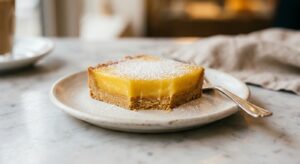
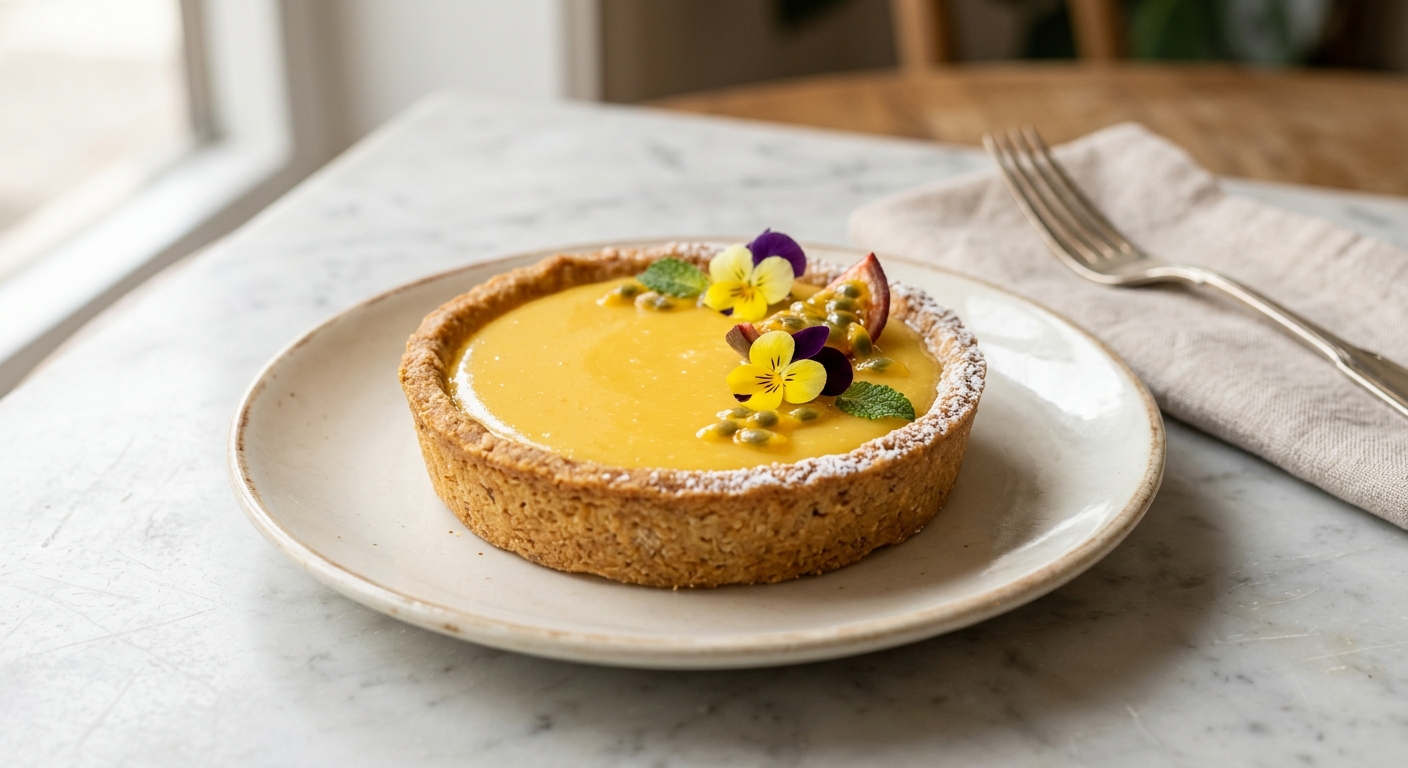
There is something almost theatrical about a passion fruit. You cut through that wrinkled purple skin and find this tumbling, jewel-bright interior that smells like a tropical holiday and tastes like sunshine with an edge. Turning it into a silky, spoonable curd and setting it inside a golden, press-in almond shortcrust feels like a small act of kitchen magic, and the result is a tart that looks every bit as elegant as anything you would find in a French patisserie window. The colour alone, that deep amber-gold, is enough to stop a room.
What makes this version genuinely special is the use of allulose as the sole sweetener throughout both the crust and the curd. Unlike allulose, allulose behaves remarkably like sugar in cooking: it dissolves smoothly, does not recrystallise when chilled, and carries heat without that cooling aftertaste some people notice in other sugar substitutes. In the curd, this matters enormously. The curd sets with that characteristic glossy, lightly trembling texture you want, not grainy, not icy, just luxuriously smooth. In the crust, allulose helps the almond flour shell brown beautifully without drying out.
This tart sits firmly in the medium-difficulty range. The curd requires your full attention for about ten minutes over gentle heat, and the crust needs a brief blind bake, but there are no complicated techniques here that a confident home baker cannot handle. It is ideal for anyone managing blood sugar who still wants to serve something genuinely impressive at a dinner party, or for anyone who simply wants a lighter, naturally sweetened dessert that does not taste like a compromise.
Equipment Needed
Click on an item below to shop for the recommended items for this recipe on Amazon.
As an Amazon Associate, we earn from qualifying purchases.
10
Ingredients
- Binding The Crust
- 200 gblanched almond flour (about 2 cups, lightly packed, not almond meal)
- 30 gtapioca starch (about 3 tbsp)
- Crust
- 60 gallulose (about 4 tbsp)
- 0.25 tspColima Sea SaltMicroplastic Free Salt
- 80 gcold unsalted butter, cut into small cubes (about 5.5 tbsp)
- 1 largeegg, lightly beaten
- 0.5 tsppure vanilla extract
- 160 mlfresh or thawed frozen passion fruit pulp (from about 8 to 10 passion fruits, strained of about half the seeds if preferred, about 2/3 cup)
- 80 mlfresh lemon juice (from about 2 lemons, about 1/3 cup), to balance the curd
- Curd
- 150 gallulose (about 3/4 cup)
- 4 largeeggs
- Extra Richness In The Curd
- 2 largeegg yolks
- Curd
- 120 gunsalted butter, cut into cubes and chilled (about 8.5 tbsp)
- —Pinch of Colima Sea SaltMicroplastic Free Salt
- 60 mlfull-fat coconut cream or heavy whipping cream, lightly whipped, to serve (optional, about 1/4 cup)
- Garnish (optional)
- 2 tbspreserved passion fruit seeds and a little pulp
Ingredient Substitutions
Instructions
- Make the crust: In a large bowl, whisk together the almond flour, tapioca starch, allulose, and salt until evenly combined. Add the cold butter cubes and use your fingertips to rub the butter into the flour mixture until it resembles coarse, sandy crumbs with no large butter pieces visible. This should take about 2 minutes. Add the beaten egg and vanilla extract and stir with a fork until the dough just comes together into a soft, slightly sticky ball. If it feels crumbly, press it between your palms; it should hold. Do not overwork it.
- Press the crust into a 9-inch (23cm) round tart pan with a removable base. Start with the sides, pressing the dough up evenly to about 3/4 inch (2cm) in height, then press the base flat. Aim for an even thickness of about 4 to 5mm throughout. Prick the base all over with a fork (about 20 times) to prevent puffing. Freeze the crust for 20 minutes. This step is not optional; chilling solidifies the butter and prevents the crust shrinking dramatically during baking.
- Preheat your oven to 325°F (165°C). Line the chilled crust with a piece of parchment paper cut to fit and fill with pie weights or dried beans. Blind bake for 15 minutes. Remove the parchment and weights carefully and return the crust to the oven for a further 8 to 10 minutes until the base looks dry and the edges are golden. The centre will look just slightly underdone; this is fine as it will firm up as it cools. Set aside on a wire rack to cool completely.
- Make the passion fruit curd: Combine the passion fruit pulp, lemon juice, allulose, whole eggs, egg yolks, and salt in a medium heavy-bottomed saucepan (not aluminium, which can react with the acidity and give the curd a metallic taste). Whisk until the eggs are fully incorporated and the mixture is smooth.
- Place the saucepan over medium-low heat. Cook the curd, stirring continuously with a silicone spatula or wooden spoon, making sure to scrape the base and corners of the pan constantly. Do not walk away. After 8 to 12 minutes the curd will begin to thicken noticeably; it is ready when it coats the back of the spatula and holds a clear line when you run your finger through it. An instant-read thermometer should read 170°F to 175°F (77°C to 79°C). Remove from heat immediately.
- Strain the curd through a fine-mesh sieve into a bowl or large jug to catch any cooked egg bits and any remaining seeds. Add the cold butter cubes a few at a time, stirring each addition until fully melted before adding the next. This technique, called mounting with butter, creates that characteristic gloss and smooth body. Stir until all the butter is incorporated and the curd is silky. Taste and adjust the passion fruit to lemon ratio if needed.
- Pour the warm curd into the cooled tart shell. Smooth the top with an offset spatula. Press a sheet of cling film directly onto the surface of the curd (to prevent a skin forming) and refrigerate for at least 2 hours, or until fully set and sliceable. Before serving, remove the cling film, transfer to a serving plate, and garnish with reserved passion fruit seeds and a few small clouds of lightly whipped cream if desired.
- Make the no-bake crust: In a food processor, combine 200g blanched almond flour, 80g unsweetened desiccated coconut, 50g allulose, a pinch of salt, and 60g melted coconut oil. Pulse until the mixture clumps together when pressed between your fingers. If it feels dry, add coconut oil one teaspoon at a time. (Omit the tapioca starch, egg, butter, and vanilla from the standard crust; this no-bake version uses coconut oil and coconut for binding instead.)
- Tip the mixture into a 9-inch (23cm) round tart pan with a removable base. Press it firmly and evenly up the sides and across the base, using the flat base of a measuring cup to compact the base as tightly as possible. The more firmly you press, the better the crust will hold when sliced. Place in the freezer for 30 minutes until completely solid.
- While the crust freezes, make the passion fruit curd using exactly the same stovetop method as the oven recipe: combine passion fruit pulp, lemon juice, allulose, whole eggs, egg yolks, and salt in a medium heavy-bottomed saucepan (not aluminium). Whisk well to combine. Cook over medium-low heat, stirring constantly, until the curd reaches 170°F to 175°F (77°C to 79°C) and coats the back of a spoon, about 8 to 12 minutes.
- Strain the curd through a fine-mesh sieve, then mount with cold butter cubes as described in the oven method, stirring until each addition is melted and the curd is glossy and smooth.
- Remove the crust from the freezer and immediately pour the warm curd into the frozen shell. The temperature contrast is fine and actually helps the curd begin setting quickly. Smooth the top, press cling film directly onto the surface, and refrigerate for at least 2 hours before serving. Keep refrigerated right up to serving; unlike the baked crust, this version softens noticeably if left at room temperature for more than 20 minutes.
Nutrition Per Serving
Per 1 serving (makes one 9-inch round tart)
Sweetener: allulose
Why This Recipe Works
Passion fruit curd sets through the same mechanism as any egg-based curd: heat causes the egg proteins to denature and cross-link, creating a network that traps liquid and transforms a thin, pourable mixture into a thick, sliceable gel. The addition of acid (both from the passion fruit and the lemon juice) raises the coagulation temperature slightly, which gives you a wider window to cook the curd without it scrambling. This is why curds made with pure lemon juice alone are relatively forgiving. The fat from the butter is emulsified into this protein network as it is added off the heat, coating the protein strands and creating that extraordinarily smooth, glossy texture. Adding the butter cold and in pieces (rather than all at once while hot) ensures it emulsifies rather than simply melts in, producing a curd with body and sheen rather than a greasy, separated sauce.
Allulose is the standout ingredient in this recipe and the reason the curd behaves so naturally. Unlike allulose, which can recrystallise at refrigerator temperatures and create a sandy mouthfeel in cold desserts, allulose remains fully soluble even when chilled. It also participates in Maillard browning and caramelisation at temperatures close to sucrose, which is why the almond crust browns properly in the oven rather than remaining pale. Because allulose is absorbed by the body but not metabolised for energy, it does not raise blood glucose or insulin levels, making it an ideal choice for this application.
The almond flour crust relies on fat from both the nut flour itself and the added butter for its characteristic crumbly, shortbread-like texture. There is no gluten to develop, so the risk of toughness is essentially zero. However, this also means the crust has no gluten network to hold it together structurally, which is why the tapioca starch and egg are essential. The tapioca starch acts as a binder and, crucially, helps the crust release cleanly from the pan once baked. Freezing the raw crust before blind baking solidifies the fat so the crust holds its shape during the first critical minutes in the oven before the egg sets. Skipping this step is the single most common reason almond flour crusts slump or crack.
Baker’s Tips
- Use a tart pan with a removable base, not a regular pie dish. The removable base makes it possible to unmould the tart cleanly without breaking the fragile almond crust.
- Passion fruit seeds are edible and have a pleasant, mild crunch. You can leave all of them in the curd for texture, strain them all out for a perfectly smooth curd, or strain half for a balance of both. The choice is entirely personal.
- Do not rush the curd over high heat hoping to speed things up. Scrambled egg bits are almost impossible to strain out completely and leave the curd with an unpleasant, faintly sulphurous flavour. Medium-low heat and patience are the only reliable technique.
- If your allulose starts to look like it is browning too quickly in the crust during baking, tent the tart loosely with foil. Allulose browns at a slightly lower temperature than sugar, so your oven may run slightly warm.
- Press a sheet of cling film directly onto the surface of the warm curd the moment it goes into the tart shell. Any air exposure while the curd cools creates a skin that, though harmless, looks dull and can create a lumpy surface.
- Bring your eggs to room temperature before making the curd. Cold eggs can cause the butter to seize slightly when it is added off the heat, making it harder to achieve that perfectly smooth emulsification.
- For the cleanest slices, run a sharp knife under hot water, wipe it dry, and cut. Repeat between slices. The curd slices beautifully when fully chilled.
Variations
- Coconut passion fruit version: Replace 40ml of the passion fruit pulp with full-fat coconut milk and add a 1/4 teaspoon of coconut extract to the curd for a tropical twist that pairs beautifully with a toasted coconut garnish.
- Lemon version: Substitute the passion fruit pulp entirely with fresh lemon juice and increase the allulose in the curd by 20g to account for the higher acidity. Garnish with thin lemon slices and a few thyme sprigs.
- Mini tartlet version: Divide the crust dough between a 12-cup non-stick tartlet pan (about 3-inch cups) and blind bake for 10 minutes, then 5 to 6 minutes uncovered. Fill with curd and chill as directed. Perfect for dinner parties where individual portions are easier to serve.
- Dairy-free version: Use refined coconut oil in the crust (75g, chilled until solid) instead of butter, and replace the butter in the curd with refined coconut oil. The curd will be slightly thinner when warm but sets firmly when chilled.
Troubleshooting & FAQ
My curd did not set and is still runny after chilling for 2 hours. What went wrong?
The curd looks curdled or lumpy. Can I fix it?
My almond flour crust shrank and slumped down the sides of the pan during blind baking. What happened?
The crust is crumbling apart when I try to slice the tart. How do I prevent this?
The curd tastes gritty or slightly icy after chilling. Is this the allulose?
Storage & Make-Ahead
- Storage: Store the finished tart loosely covered in the refrigerator for up to 4 days. The curd will remain silky and the almond crust will soften slightly after day two, which many people prefer. Do not store at room temperature for more than 1 hour. The tart does not freeze well once assembled, as the curd can weep on thawing, but the baked crust shell alone can be frozen (well wrapped) for up to 6 weeks.
- Make-Ahead: The baked tart shell can be made up to 3 days ahead and stored at room temperature in the pan, loosely covered. The passion fruit curd can be made up to 4 days ahead, stored in an airtight jar in the refrigerator, and poured into the shell on the day of serving. The assembled tart is best made the day before serving to allow the curd to fully set and the flavours to mellow beautifully.