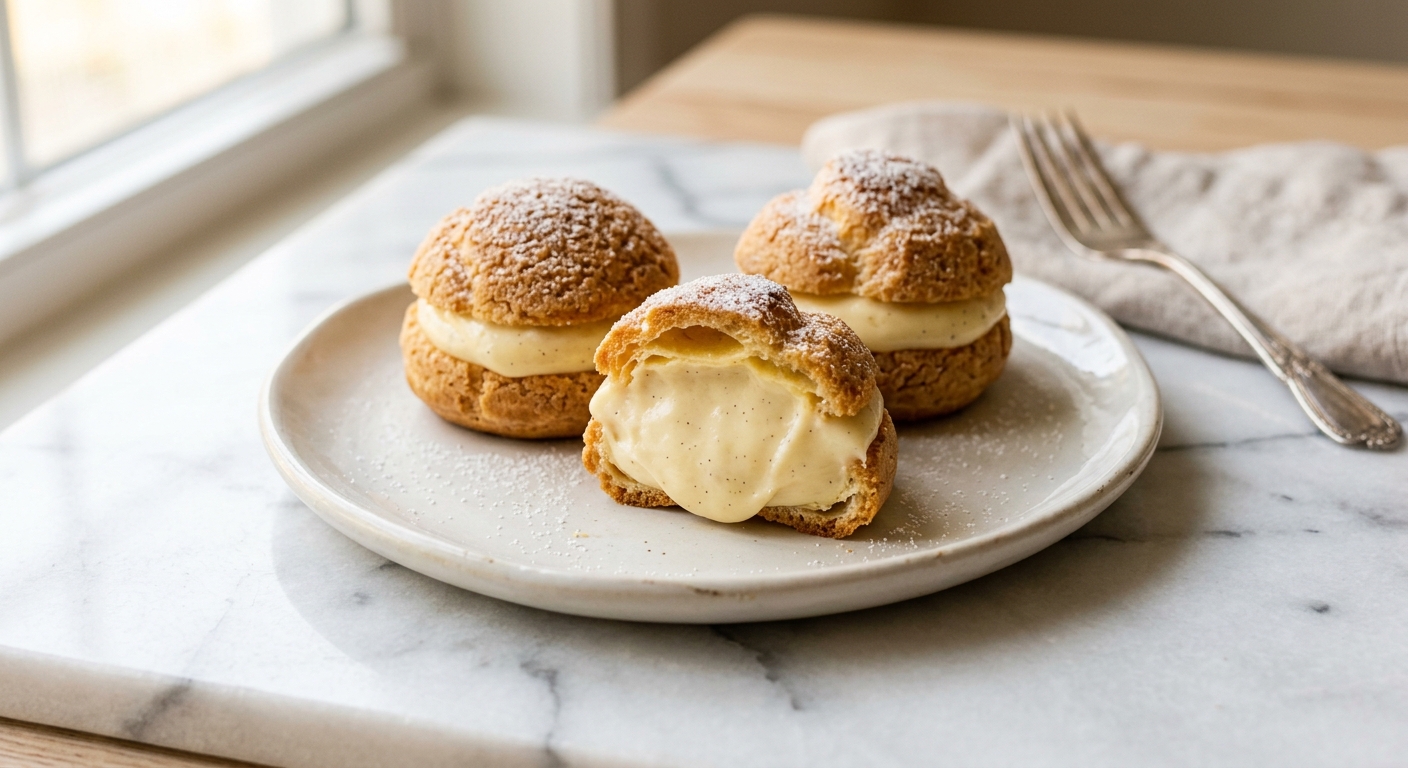
There is something almost magical about choux pastry. You start with a humble pot of butter and water on the stove, stir in flour, beat in eggs, and somehow end up with golden, hollow puffs that seem to defy the laws of baking. Fill those airy shells with a cool, silky vanilla cream and you have one of the most satisfying desserts in the French repertoire. The best part? These monk fruit vanilla cream puffs taste every bit as indulgent as the sugar-laden original, and no one at your table will ever guess they are sugar-free.
What sets this recipe apart is the double use of monk fruit sweetener. The choux pastry itself gets just a touch of granulated monk fruit blend to round out the flavor without any bitterness, while the pastry cream is sweetened with a powdered monk fruit blend that dissolves completely for the smoothest, silkiest texture imaginable. A generous scrape of real vanilla bean paste gives the cream those beautiful flecks and deep floral flavor that extract alone simply cannot match. The result is a filling that is rich, custardy, and fragrant without a single gram of refined sugar.
Choux pastry has a reputation for being tricky, but it is actually very forgiving once you understand a few key principles, which are all explained in the tips and science sections below. This recipe sits comfortably at a medium difficulty level and is perfect for home bakers who have mastered basic cookies and cakes and are ready to try something a little more technique-driven. If you have ever wanted to make cream puffs from scratch, this is your moment.
Equipment Needed
Click on an item below to shop for the recommended items for this recipe on Amazon.
As an Amazon Associate, we earn from qualifying purchases.
16
Ingredients
- Pastry Cream
- 240 mlwater (1 cup)
- 113 gunsalted butter, cut into pieces (1/2 cup or 1 stick)
- 8 ggranulated monk fruit allulose blend, such as Lakanto Classic (2 tsp)
- 2 gColima Sea SaltMicroplastic Free Salt (1/2 tsp)
- 130 gall-purpose flour, spooned and leveled (1 cup)
- 4 wholelarge eggs, room temperature
- 480 mlwhole milk (2 cups)
- 4 wholelarge egg yolks, room temperature
- 80 gpowdered monk fruit allulose blend, such as Lakanto Powdered (1/2 cup, lightly packed)
- 30 gcornstarch (3 tbsp)
- —Pinch of Colima Sea SaltMicroplastic Free Salt
- Pastry Cream)
- 1 tbspvanilla bean paste (or seeds from 1 vanilla bean)
- 28 gunsalted butter, cold and cubed (2 tbsp
- Dusting, Optional
- 240 mlheavy whipping cream, very cold (1 cup, optional for lightened cream)
- 2 tsppowdered monk fruit allulose blend
Ingredient Substitutions
Instructions
- Make the pastry cream first so it has time to chill. In a medium saucepan, warm the whole milk over medium heat until steaming and just beginning to simmer around the edges. Do not boil. Meanwhile, whisk together the egg yolks, powdered monk fruit blend, cornstarch, and pinch of salt in a medium heatproof bowl until the mixture is pale and smooth, about 1 to 2 minutes.
- Slowly pour about half of the hot milk into the egg yolk mixture, whisking constantly to temper the eggs. Pour the tempered mixture back into the saucepan with the remaining milk. Cook over medium heat, whisking constantly and vigorously, until the cream thickens, large bubbles begin to plop at the surface, and it coats the back of a spoon thickly, about 3 to 5 minutes. Do not stop whisking or the bottom will scorch.
- Remove from heat and immediately whisk in the vanilla bean paste and the 28g of cold cubed butter, one or two pieces at a time, until fully melted and incorporated. The butter enriches the cream and gives it a beautiful sheen. Press a piece of plastic wrap directly onto the surface of the pastry cream to prevent a skin from forming. Refrigerate for at least 1 hour, or up to 2 days.
- Preheat your oven to 400°F (200°C). Line two large rimmed baking sheets with parchment paper. In a medium saucepan, combine the water, 113g butter, granulated monk fruit blend, and salt. Bring to a full rolling boil over medium-high heat, stirring occasionally, until the butter is completely melted.
- Remove from heat and add all the flour at once. Stir vigorously with a wooden spoon or silicone spatula until no dry flour remains and the dough comes together in a smooth ball. Return the pan to medium heat and cook, stirring constantly, for 1 to 2 minutes until the dough pulls cleanly away from the sides of the pan and a thin film forms on the bottom of the pot. This step dries out some moisture, which is critical for proper puffing.
- Transfer the dough to the bowl of a stand mixer fitted with the paddle attachment. Beat on medium speed for 1 to 2 minutes to cool the dough slightly, about 140°F (60°C) or warm but not hot to the touch. Add the eggs one at a time, beating well after each addition and scraping down the bowl. The dough will look slippery and separated at first but will come back together with beating. The finished dough should be smooth, glossy, and fall from a spatula in a thick, slow V-shape ribbon. If it seems too stiff, beat in a lightly whisked extra egg a tablespoon at a time.
- Transfer the choux dough to a piping bag fitted with a large round tip (about 1/2 inch or 12mm). Pipe 16 mounds, each about 1.5 inches in diameter and 1 inch tall, onto the prepared baking sheets, spacing them at least 2 inches apart. Dip your fingertip in water and gently press down any peaks on top of each mound, as peaks can burn.
- Bake for 25 minutes until the puffs are deep golden brown and feel hollow and light when tapped on the bottom. Then, without opening the oven, reduce the temperature to 325°F (160°C) and bake for an additional 5 minutes. Remove from the oven and immediately use a thin knife or skewer to pierce a small hole in the side of each puff to let steam escape. Transfer to a wire rack and cool completely before filling, at least 30 minutes.
- To finish the pastry cream, if you want a lighter, mousse-like filling: whip the 240ml heavy cream to stiff peaks and fold it gently into the chilled pastry cream in two additions. If you prefer a denser, classic pastry cream, skip this step and use the cream as is. Transfer to a piping bag fitted with a long bismark tip or a small round tip.
- Pierce the bottom or side of each cooled puff with the piping tip and fill with pastry cream until you feel gentle resistance, about 2 to 3 tablespoons per puff. Alternatively, slice the top third off each puff, spoon in the filling, and replace the top. Dust lightly with powdered monk fruit blend before serving.
- Make the pastry cream following steps 1 through 3 of the oven method. Press plastic wrap directly onto the surface and refrigerate for at least 1 hour.
- Prepare the choux dough following steps 4 through 6 of the oven method. Cut a piece of parchment paper to fit your air fryer basket. Pipe 6 to 8 choux mounds per batch, each about 1.5 inches in diameter, spacing them at least 1.5 inches apart. Smooth any peaks with a dampened fingertip.
- Place the parchment with the piped choux into the air fryer basket. Do not preheat the air fryer. Set to 375°F (190°C) and cook for 18 to 20 minutes, checking at 15 minutes. The puffs should be deep golden brown and feel completely hollow when tapped. Do not open the air fryer during the first 12 minutes or the puffs may deflate.
- Immediately pierce the side of each puff with a thin skewer upon removing from the air fryer basket to release steam. Transfer to a wire rack and cool completely. Cook remaining batches the same way, allowing the air fryer to return to temperature for 2 minutes between batches.
- Fill and finish the cooled puffs exactly as described in steps 9 and 10 of the oven method, using your preferred pastry cream consistency. Dust with powdered monk fruit blend and serve within 2 hours for the crispest shells.
- In a medium heavy-bottomed saucepan, heat the whole milk over medium heat, stirring occasionally, until it is steaming and small bubbles appear around the rim. Do not let it boil vigorously.
- In a medium heatproof bowl, whisk together the egg yolks, powdered monk fruit allulose blend, cornstarch, and pinch of salt until very smooth and slightly pale, about 90 seconds of brisk whisking. A smooth base here means a lump-free cream.
- Ladle roughly half of the hot milk into the egg mixture while whisking constantly. This is tempering: it raises the eggs’ temperature gradually so they cook into a cream rather than scrambled eggs. Pour the tempered egg mixture back into the saucepan, whisking as you pour.
- Cook over medium heat, whisking constantly and making sure to reach into the corners of the pan, until the mixture thickens noticeably, begins to bubble in the center, and a line drawn through the cream on a spatula holds its shape cleanly, about 3 to 5 minutes total. The cream must reach a full bubble to fully activate the cornstarch and ensure food safety.
- Remove from heat. Whisk in the vanilla bean paste and the cold cubed butter piece by piece until the cream is completely smooth and glossy. Taste and adjust vanilla if needed. Press plastic wrap directly onto the surface and refrigerate until cold and fully set, at least 1 hour. Use to fill purchased choux shells, eclairs, profiteroles, or even spread between layers of crepes.
Nutrition Per Serving
Per 1 serving (makes 16 cream puffs, each approximately 2 inches in diameter)
Sweetener: monk fruit allulose blend
Why This Recipe Works
Choux pastry is one of baking’s great scientific wonders. The key to those hollow, crisp shells is steam. When the water in the dough hits the hot oven, it converts to steam rapidly, pushing the dough outward and upward before the egg proteins and flour starches set. This is why the dough is deliberately high in moisture and why the oven must be hot at the start. The initial high-heat bake at 400°F sets the structure quickly, while the brief lower-temperature finish at 325°F drives out residual internal moisture without over-browning, giving you a shell that stays crisp rather than collapsing. Piercing each puff immediately after baking lets the last trapped steam escape, preventing the shells from going soggy from the inside out.
The science of cooking the dough on the stovetop before adding eggs, known as panade, is equally important. Heating the flour gelatinizes the starches, which creates a stable network capable of absorbing an extraordinary amount of egg. More egg means more protein, which means a stronger structure and a better puff. The test for the right dough consistency, that slow V-shaped ribbon, tells you the moisture is balanced: wet enough to pipe smoothly, thick enough to hold its shape and trap steam. Using monk fruit allulose blend in small amounts in the choux does not meaningfully affect the structure since the quantity is so small, but it adds a gentle depth of flavor that makes the shells taste complete rather than bland.
In the pastry cream, cornstarch is the thickener of choice over plain flour because it produces a cleaner, glossier result with a more neutral flavor. The critical moment is letting the cream reach a full, bubbling boil after adding the egg mixture back to the pan. An undercooked cornstarch-thickened cream will thin out as it cools because the starch granules have not fully gelatinized. Powdered monk fruit allulose blend is used here rather than granulated because it dissolves completely into the dairy without any gritty texture, and its cooling sensation on the palate is almost imperceptible when blended into a rich, fat-coated cream. Adding cold butter at the end is a classic technique called monter au beurre, and it creates an emulsified, silky texture while also slightly inhibiting starch retrogradation, keeping the cream smooth and spoonable rather than stiff and rubbery even after chilling.
Baker’s Tips
- Bring your eggs to room temperature before making the choux. Cold eggs can cause the warm dough to seize slightly and may result in a less smooth batter.
- Do not skip the step of cooking the dough in the pot for 1 to 2 minutes before adding eggs. This drying step is essential for proper puff height and crispness.
- Check the dough consistency before adding all the eggs. Depending on the size of your eggs and how much moisture you cooked off, you may not need every bit of the fourth egg. Add the last egg gradually.
- Use powdered monk fruit blend, not granulated, in the pastry cream. Granulated allulose does not dissolve as readily in a dairy-based cream and can leave a slightly grainy mouthfeel.
- Do not open the oven door during the first 20 minutes of baking. The puffs need uninterrupted heat to rise fully. An early opening causes the shells to deflate and they will not recover.
- For the neatest filled cream puffs, use a piping bag fitted with a bismark tip inserted into the bottom of each puff. You will feel the puff become heavier as it fills, which tells you when to stop.
- If your pastry cream has any lumps after cooking, strain it through a fine-mesh sieve while it is still warm and before pressing the plastic wrap onto the surface.
Variations
- Chocolate monk fruit cream puffs: Whisk 2 tablespoons of unsweetened cocoa powder and 30g of sugar-free dark chocolate (finely chopped and melted) into the hot pastry cream along with the butter for a rich chocolate filling.
- Lemon cream variation: Omit the vanilla bean paste and whisk in 2 tablespoons of fresh lemon juice and 1 tablespoon of lemon zest at the end of cooking for a bright, citrusy filling.
- Coffee cream puffs: Dissolve 2 teaspoons of instant espresso powder in 1 tablespoon of hot water and whisk into the finished pastry cream along with the vanilla for a cafe-style filling.
- Profiteroles with sugar-free chocolate drizzle: Melt 60g of sugar-free dark chocolate with 2 tablespoons of heavy cream and drizzle over filled puffs just before serving instead of the powdered sweetener dusting.
Troubleshooting & FAQ
My choux puffs deflated after coming out of the oven. What went wrong?
My pastry cream has lumps in it. Is it ruined?
The pastry cream tastes slightly gritty. How do I fix this?
My choux dough looks separated and curdled after adding the eggs. Did I add them too fast?
My baked choux shells went soft and chewy after a few hours. How do I keep them crisp?
Storage & Make-Ahead
- Storage: Fill cream puffs no more than 2 hours before serving for the crispest shells. Unfilled baked choux shells can be stored in an airtight container at room temperature for up to 2 days, or frozen in a single layer for up to 1 month (re-crisp in a 325°F oven for 5 minutes from frozen). Pastry cream keeps in the refrigerator, tightly covered, for up to 3 days. Once filled, store cream puffs in the refrigerator for up to 24 hours, though the shells will soften over time.
- Make-Ahead: The pastry cream can be made up to 3 days ahead and refrigerated. Choux shells can be baked up to 2 days ahead (store airtight at room temperature) or frozen for up to 1 month. For a party, bake shells and make cream ahead, then fill within 1 to 2 hours of serving.