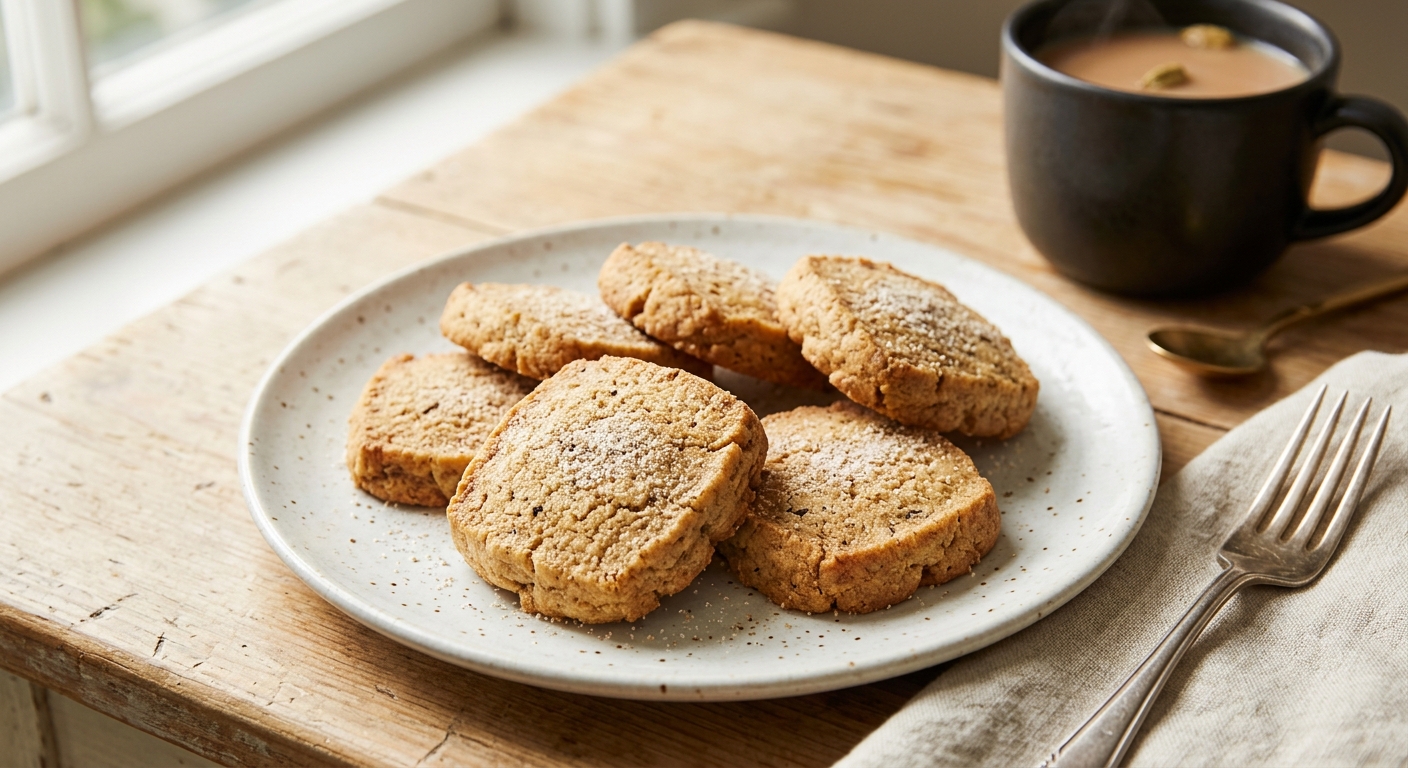
There is something deeply comforting about a tin of shortbread on the counter. That first snap, the way it dissolves on your tongue into pure butter and spice, the gentle warmth that lingers after the last crumb. Now imagine that same experience layered with the cardamom, ginger, cinnamon, and black pepper of a perfectly brewed chai. These Monk Fruit Chai Spiced Shortbread Cookies are exactly that: a little square of quiet luxury that happens to contain zero refined sugar and carry a glycemic load that barely registers on the scale.
What sets this recipe apart is the combination of powdered monk fruit sweetener and a small amount of allulose, which work together in a way that neither could achieve alone. Monk fruit provides clean, true sweetness without any cooling aftertaste, while allulose mimics the way sugar helps shortbread brown gently and hold its shape. The result is a cookie that looks, snaps, and tastes astonishingly close to a traditional Scottish shortbread, with a spice blend that is bloomed briefly in warm butter to coax out every last drop of fragrance from the dried spices before they ever touch the flour.
This is an easy-to-medium recipe, well within reach of any home baker who can cream butter and measure flour. It does require a short chill of the dough, which is non-negotiable for clean edges and that characteristic shortbread crispness. It is perfect for anyone following a low-glycemic, keto, or diabetic-friendly diet, and equally perfect for anyone who simply loves great shortbread and has no interest in a sugar high.
Equipment Needed
Click on an item below to shop for the recommended items for this recipe on Amazon.
As an Amazon Associate, we earn from qualifying purchases.
24
Ingredients
- 225 gunsalted butter, at room temperature (1 cup / 2 sticks)
- 80 gpowdered monk fruit sweetener (about 2/3 cup, such as Lakanto Powdered)
- 30 gallulose (about 2.5 tbsp), adds browning and tender crumb
- 1 tsppure vanilla extract
- 240 gall-purpose flour (about 2 cups, spooned and leveled)
- 30 gcornstarch (about 3.5 tbsp), for a more tender, melt-in-your-mouth crumb
- 1.5 tspground cinnamon
- 1 tspground cardamom
- 0.5 tspground ginger
- 0.25 tspground cloves
- 0.25 tspground black pepper, finely ground
- 0.25 tspColima Sea SaltMicroplastic Free Salt
- —Pinch of ground nutmeg
- 1 tbsppowdered monk fruit sweetener, for dusting after baking (optional)
Ingredient Substitutions
Instructions
- Bloom the spices: In a small saucepan over the lowest possible heat, melt 2 tablespoons of the measured butter (taken from your 225g). Add the cinnamon, cardamom, ginger, cloves, black pepper, and nutmeg. Stir gently for 60 to 90 seconds until intensely fragrant. Do not let the butter brown. Scrape into a small bowl and let cool to room temperature, about 10 minutes. This bloomed spice butter will be incorporated with the rest of the butter.
- In a large bowl using a hand mixer, or in the bowl of a stand mixer fitted with the paddle attachment, beat the remaining room-temperature butter on medium speed for 2 minutes until smooth and creamy. Add the cooled spice butter and beat to combine. Add the powdered monk fruit sweetener and allulose. Beat on medium-low for 3 to 4 minutes, scraping down the bowl twice, until the mixture is pale, fluffy, and completely smooth. Beat in the vanilla extract.
- In a separate bowl, whisk together the flour, cornstarch, and fine sea salt until thoroughly combined. Add the flour mixture to the butter mixture all at once. Mix on the lowest speed until the dough just comes together and no dry streaks remain. Stop as soon as it forms a cohesive dough. Overmixing develops gluten and makes the shortbread tough rather than tender.
- Turn the dough out onto a lightly floured surface and gently press it into a flat rectangle. Divide in half. Shape each half into a log about 6 inches long and 1.5 inches in diameter for rounds, or press into a flat rectangle about 0.5 inch thick and wrap tightly in plastic wrap for cut fingers. Refrigerate for at least 45 minutes, or up to 48 hours. The chill is essential: cold dough holds its shape during baking and prevents spreading.
- When ready to bake, preheat your oven to 325°F (163°C). Line two baking sheets with parchment paper. Slice the logs into rounds about 0.4 inches (1 cm) thick, or cut the rectangle into fingers roughly 1 inch wide and 2.5 inches long. Arrange on the prepared baking sheets, leaving about 1 inch between each cookie. Prick each cookie two or three times with a fork (this is classic shortbread technique and helps moisture escape evenly).
- Bake one sheet at a time on the center rack for 14 to 16 minutes. The cookies should be set and very pale golden at the edges. They will not look dramatically browned, which is correct. Monk fruit and allulose brown differently from sugar, so trust the timer and the edges rather than waiting for a deep golden color. The centers may look slightly underdone but will firm up completely as they cool.
- Let the cookies cool on the baking sheet for 8 minutes before transferring to a wire rack. They are fragile when hot. Once fully cool, dust lightly with powdered monk fruit sweetener if desired. They will crisp up fully within 20 to 30 minutes of cooling.
- Prepare the dough exactly as described in steps 1 through 4 of the oven method, including the full 45-minute chill. Do not skip the chill, as air fryer heat is intense and cold dough is critical for shape retention.
- Cut a round of parchment paper to fit your air fryer basket, leaving the edges uncovered so air can circulate around the sides. Alternatively, use a perforated parchment liner. Do not skip the parchment: shortbread is fragile and high-butter doughs will stick to the basket.
- Preheat your air fryer to 300°F (149°C) for 3 minutes. Slice or cut 6 to 8 cookies and arrange them in a single layer in the basket, leaving at least 0.5 inch between each. Do not overlap. Prick with a fork as with the oven method.
- Air fry for 9 to 11 minutes. Check at 9 minutes. The cookies should be set on top and just barely golden at the very edges. Because air fryers vary significantly in actual temperature, the first batch is your calibration batch. If edges are browning too fast, reduce to 290°F. If the centers are still completely soft at 11 minutes, add 1 to 2 minutes.
- Let the cookies rest in the basket with the air fryer off and the basket pulled out for 5 minutes before carefully lifting them onto a rack. They will be very delicate when hot. Repeat with remaining dough, allowing the basket to cool for 2 minutes between batches.
- Prepare the full dough as in steps 1 through 3 of the oven method. Divide the dough in half and shape each portion into a tight log about 6 inches long and 1.5 inches in diameter. Wrap each log snugly in plastic wrap, twisting the ends tightly to compress the log into a firm, even cylinder.
- Place the wrapped logs in a zip-top freezer bag and freeze for at least 2 hours until completely solid. The logs will keep frozen for up to 3 months. Label with the date and baking instructions so future-you is not guessing.
- When ready to bake, preheat your oven to 325°F (163°C) and line a baking sheet with parchment. Remove a log from the freezer and let it sit at room temperature for exactly 5 minutes. This brief rest makes slicing much easier without letting the dough soften to the point of losing its shape.
- Using a sharp chef’s knife (not serrated), slice the log into rounds about 0.4 inches thick using firm, decisive cuts. If the dough crumbles at the edges, press any cracks back together gently with your fingertips. Arrange on the parchment-lined sheet and prick with a fork.
- Bake from frozen for 16 to 18 minutes, 2 minutes longer than fresh-chilled dough to account for the colder starting temperature. Watch carefully after 15 minutes. Cool on the sheet for 8 minutes before transferring to a rack. The cookies will be just as crisp and beautifully flavored as freshly made dough.
Nutrition Per Serving
Per 1 serving (makes 24 shortbread fingers or rounds)
Sweetener: monk fruit and allulose
Why This Recipe Works
Traditional shortbread is a precise ratio of butter, sugar, and flour, and swapping out the sugar is not as simple as replacing it cup for cup with a sweetener. Powdered sugar in shortbread does three things: it dissolves into the butter to create a smooth, cohesive dough; it provides a small amount of structure and crispness as it bakes; and it influences how the cookie browns via caramelization. Powdered monk fruit sweetener handles the sweetness and the texture of the dough beautifully, because it is ground to a fine powder that integrates smoothly without leaving a gritty bite. However, monk fruit does not caramelize. This is where allulose earns its place. Allulose browns at oven temperatures similarly to regular sugar through the Maillard reaction, giving these cookies their gentle golden edges and a slightly more complex, almost caramel-adjacent flavor note.
The cornstarch in the flour mixture is a time-honored shortbread trick. When mixed with all-purpose flour, cornstarch dilutes the gluten-forming proteins in the wheat flour, producing a more tender, almost melt-in-your-mouth crumb. You get all the snap and structure of proper shortbread without any toughness. The blooming of the spices in warm butter is the other key technique here. Fat is a phenomenal carrier of fat-soluble flavor compounds, and gently warming spices in butter extracts and suspends those aromatic oils far more effectively than simply whisking ground spices into the dry ingredients. The result is a chai flavor that is vivid and warm throughout every bite rather than faint and dusty.
The mandatory chill is not optional and it is not just about convenience. Butter is a plastic fat, meaning it holds its shape when cold and becomes liquid when warm. A well-chilled dough bakes into a cookie that holds crisp edges, does not spread, and has the firm snap that defines shortbread. Room-temperature dough will spread, blur, and lose that characteristic bite. If your kitchen is warm and your dough feels at all soft after chilling, slide the sliced cookies, already arranged on the baking sheet, back into the refrigerator for 10 minutes before baking. This small extra chill makes a noticeable difference.
Baker’s Tips
- Use butter that is genuinely at room temperature, around 65 to 68°F (18 to 20°C). It should leave an indent when pressed but not feel greasy or look shiny. Too-warm butter will not aerate properly when beaten and your cookies will spread.
- Spoon and level your flour rather than scooping directly from the bag. Scooping compacts flour and you can end up with 20 to 30% more flour than intended, resulting in a dry, crumbly dough that cracks when sliced.
- The spice bloom step takes only 2 extra minutes and makes an enormous difference. Do not skip it. Your kitchen will smell absolutely incredible.
- If your dough crumbles when you try to slice the chilled log, it is slightly too cold. Let it sit at room temperature for 3 to 4 minutes, no more, before slicing again.
- A bench scraper or sharp thin-bladed knife gives the cleanest cuts. Serrated knives drag through the dough and cause crumbling.
- These cookies are done when they look almost underdone. Pale and set, not golden all over. Monk fruit and allulose do not brown the same way sugar does, so if you wait for a classic golden color, they will be overbaked and dry.
- For an elegant finish, press a single whole cardamom pod or a small piece of candied ginger into the center of each cookie before baking.
Variations
- Earl Grey version: Replace the chai spice blend with 1 tbsp very finely ground loose-leaf Earl Grey tea and 1 tsp lemon zest for a floral, citrusy shortbread.
- Chocolate-dipped: Melt 60g of sugar-free dark chocolate (such as Lily’s) and dip the cooled cookies halfway. Set on parchment for 20 minutes.
- Brown butter version: Brown all of the butter in a saucepan until nutty and golden, then chill until solid before creaming. Omit the spice-blooming step and simply whisk the spices into the flour instead. The brown butter adds a toasty, caramel-like depth.
- Lemon cardamom variation: Replace all chai spices with 2 tsp ground cardamom and the zest of one large lemon for a simpler, bright, and elegant cookie.
Troubleshooting & FAQ
My dough is too crumbly and will not come together. What went wrong?
My cookies spread out flat in the oven. What happened?
The cookies taste bitter or have a strange aftertaste. Why?
My cookies are soft and not crispy even after they have cooled completely. Can I fix them?
My sliced rounds have cracked or ragged edges. Is that a problem?
Storage & Make-Ahead
- Storage: Store in an airtight tin or container at room temperature for up to 7 days. Shortbread actually improves in flavor on day two as the spices settle and deepen. Do not refrigerate finished cookies as the moisture in a refrigerator can soften the crisp texture. Freeze baked cookies in a single layer, then transfer to a zip bag for up to 2 months. Thaw at room temperature for 20 minutes.
- Make-Ahead: The dough can be refrigerated for up to 2 days before baking. For longer storage, freeze the shaped logs for up to 3 months and slice directly from frozen (see Freezer Slice-and-Bake method above). Baked cookies are also excellent made 2 to 3 days ahead, as the chai flavors deepen beautifully over time.