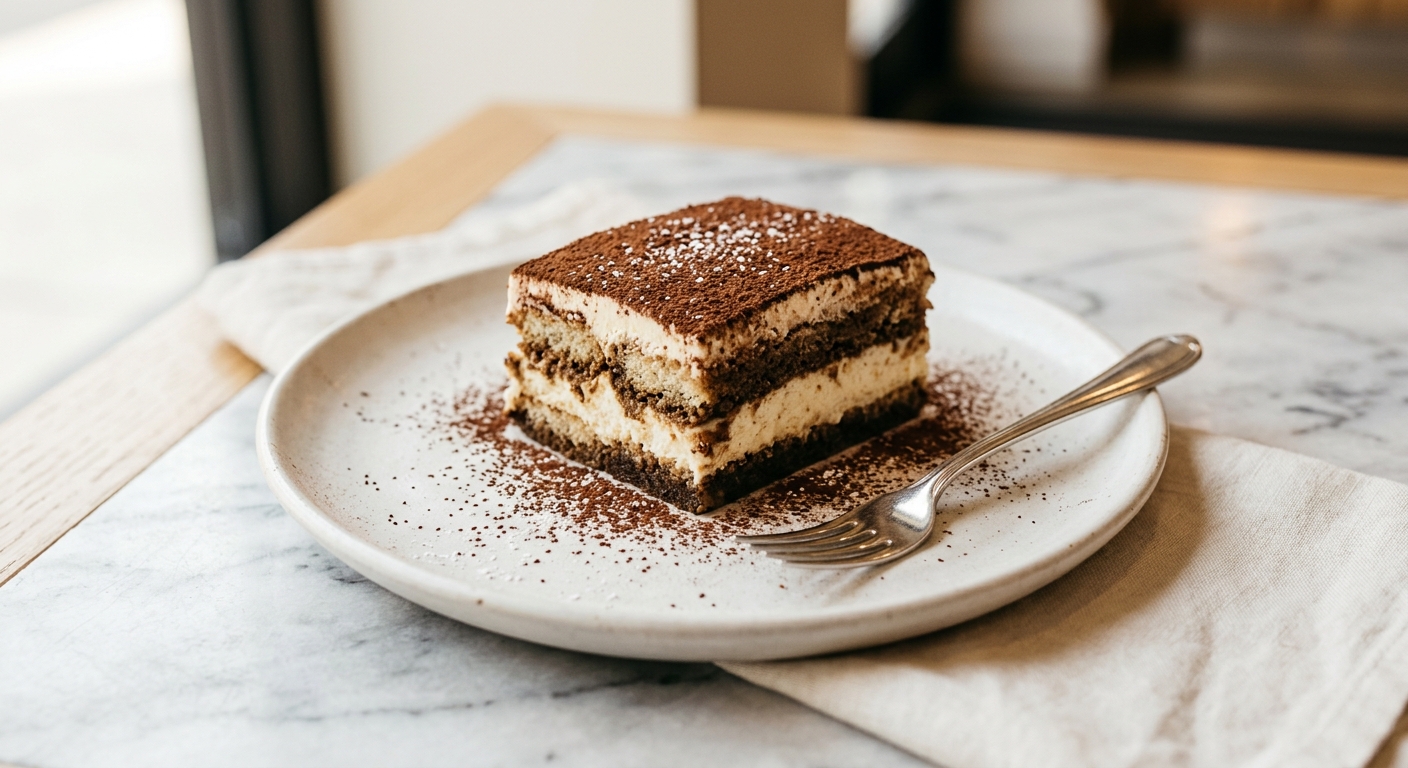
There is something undeniably romantic about tiramisu. A deep, bitter espresso soaking into pillowy sponge, a cream so light it barely holds its shape, and that dusting of dark cocoa that melts on your tongue with the first bite. It is the kind of dessert that belongs on a candlelit table, paired with a small glass of something worth savoring. The trouble is, traditional tiramisu is built almost entirely on ladyfinger biscuits that are pure sugared sponge, and a cream filling sweetened within an inch of its life. For those of us keeping carbohydrates low, it has always felt just out of reach.
This version changes that completely. The ladyfingers are made from almond flour and whipped eggs, giving them a genuinely light, airy crumb that soaks up espresso with the same eagerness as the original. The mascarpone cream is sweetened with allulose, a rare sugar that behaves almost identically to regular sugar in texture and mouthfeel, dissolving smoothly without any cooling aftertaste or crystallization. Allulose is the key choice here over allulose, because it keeps the cream silky and fluid even when chilled, where allulose would turn slightly grainy. The result is a mascarpone layer that is genuinely lush and spoonable.
This recipe sits at a medium difficulty level, mostly because of the almond flour ladyfingers, which require a gentle hand with the folding. The assembly itself is relaxed and forgiving, and the whole dessert benefits enormously from an overnight rest in the refrigerator, making it an ideal recipe to prepare a full day ahead of a dinner party. If you are comfortable with whipping egg whites and folding a batter, you will have no trouble here. It is a wonderful project for a weekend afternoon that pays off at the dinner table the next evening.
Equipment Needed
Click on an item below to shop for the recommended items for this recipe on Amazon.
As an Amazon Associate, we earn from qualifying purchases.
9
Ingredients
- Ladyfingers
- 120 gfine blanched almond flour (about 1 1/4 cups)
- 30 gallulose (about 3 tbsp)
- 4 largeeggs, separated and at room temperature
- 1 tsppure vanilla extract
- 0.5 tspbaking powder
- —Pinch of Colima Sea SaltMicroplastic Free Salt
- 240 mlfreshly brewed strong espresso or very strong coffee (about 1 cup), cooled to room temperature
- 30 mldark rum or Marsala wine (about 2 tbsp), optional
- 500 gfull-fat mascarpone cheese (about 2 cups plus 2 tbsp), at room temperature
- Cream
- 4 largeeggs, yolks and whites separated
- 120 gallulose (about 1/2 cup plus 1 tbsp), for cream, divided
- 1 tsppure vanilla extract
- 240 mlheavy whipping cream (about 1 cup), very cold
- Dusting
- 15 gunsweetened Dutch-process cocoa powder (about 2 tbsp)
Ingredient Substitutions
Instructions
- Preheat your oven to 325°F (165°C). Line two large baking sheets with parchment paper and fit a piping bag with a 3/4-inch round tip (or use a zip-lock bag with the corner snipped).
- Make the ladyfingers: In a large bowl, whisk together the almond flour, baking powder, and salt. In a separate bowl, whisk the 4 egg yolks with 30g allulose and 1 tsp vanilla until the mixture is pale and slightly thickened, about 2 minutes. Gently fold the almond flour mixture into the yolk mixture until a thick paste forms.
- In a clean, grease-free bowl, beat the 4 egg whites with an electric mixer on medium speed until foamy. Increase to high and beat until stiff, glossy peaks form, 2 to 3 minutes. Do not overbeat to a dry, clumpy foam. Fold one third of the egg whites into the almond flour paste to loosen it, then gently fold in the remaining whites in two additions, keeping as much air as possible.
- Transfer the batter to your piping bag and pipe fingers about 3 inches long and 1 inch wide onto the prepared baking sheets, spacing them 1 inch apart. You should get approximately 24 to 28 fingers. Bake for 12 to 14 minutes, until set and lightly golden on the edges. They will be soft when hot but will firm up as they cool. Cool completely on the pan before handling.
- Make the espresso soak: Combine the cooled espresso and rum or Marsala (if using) in a shallow bowl wide enough to dip the ladyfingers. Set aside.
- Make the mascarpone cream: Place the mascarpone in a large bowl and beat briefly until smooth. In a heatproof bowl set over a saucepan of barely simmering water (do not let the bowl touch the water), whisk the 4 egg yolks with 80g allulose until the mixture is pale, thick, and registers 160°F (71°C) on an instant-read thermometer, about 5 to 7 minutes of constant whisking. Remove from heat and let cool for 10 minutes. Fold the cooled yolk mixture and 1 tsp vanilla into the mascarpone until fully combined.
- In a separate clean bowl, beat the cold heavy cream to medium-stiff peaks. In another clean, grease-free bowl, beat the 4 egg whites with the remaining 40g allulose to stiff, glossy peaks. Gently fold the whipped cream into the mascarpone mixture, then fold in the beaten egg whites. The resulting cream should be light, airy, and hold soft mounds.
- Assemble the tiramisu: Quickly dip each ladyfinger in the espresso soak, about 1 to 2 seconds per side. Do not soak them for longer or they will become waterlogged and fall apart. Arrange a single layer of dipped ladyfingers in the bottom of an 8×8-inch dish, breaking pieces to fill gaps. Spread half the mascarpone cream evenly over the top. Add a second layer of dipped ladyfingers, then spread the remaining cream over the top, smoothing it with an offset spatula.
- Dust the top generously with cocoa powder through a fine-mesh sieve. Cover the dish loosely with plastic wrap and refrigerate for at least 6 hours, preferably overnight, before serving. The resting time allows the ladyfingers to fully absorb moisture and the cream to firm into clean, sliceable portions.
- Prepare the espresso soak: Combine 240ml cooled strong espresso with the rum or Marsala (if using) in a shallow dipping bowl. If your store-bought keto ladyfingers are on the drier or crispier side (which is common), let them soak for 2 to 3 seconds per side rather than 1 to 2 seconds. Taste one before assembling to judge how quickly they absorb liquid.
- Make the mascarpone cream: Place the mascarpone in a large bowl and beat briefly until smooth. In a heatproof bowl set over a saucepan of barely simmering water (do not let the bowl touch the water), whisk the 4 egg yolks with 80g allulose until the mixture is pale, thick, and registers 160°F (71°C) on an instant-read thermometer, about 5 to 7 minutes. Remove from heat and cool for 10 minutes. Fold the cooled yolk mixture and 1 tsp vanilla into the mascarpone.
- Beat the cold heavy cream to medium-stiff peaks. Beat the 4 egg whites with 40g allulose to stiff, glossy peaks in a separate clean bowl. Fold the whipped cream into the mascarpone mixture, then gently fold in the egg whites until no white streaks remain.
- Dip the store-bought ladyfingers in the espresso soak and arrange them in a single layer across the bottom of an 8×8-inch dish. Spread half the mascarpone cream over the top. Add a second dipped layer of ladyfingers, then cover with the remaining cream and smooth the surface.
- Dust generously with cocoa powder through a fine-mesh sieve. Cover loosely with plastic wrap and refrigerate for at least 6 hours or overnight before serving.
Nutrition Per Serving
Per 1 serving (makes one 8×8-inch dish, cut into 9 squares)
Sweetener: allulose
Why This Recipe Works
The choice of allulose as the sweetener here is deliberate and important. Unlike allulose, which crystallizes when chilled and can give creams a slightly gritty texture, allulose behaves almost exactly like sucrose in a liquid environment. It dissolves smoothly, does not recrystallize in the refrigerator, and contributes a subtle body to the mascarpone cream that keeps it spoonable and silky. Allulose is also absorbed by the body but not metabolized for energy, which is why it is counted as zero net carbs despite being a real sugar. It has a glycemic index of essentially zero, making it ideal for keto and diabetic-friendly baking.
The mascarpone cream uses two separate aerators working together: whipped heavy cream and beaten egg whites. Each does a different job. The whipped cream adds richness and fat-based stability, helping the cream hold its structure over the long refrigeration time. The egg whites add lightness and volume, giving the cream that characteristic airy, mousse-like quality that distinguishes a great tiramisu from a heavy one. The egg yolks are cooked to 160°F (71°C) in a double boiler, which is the temperature at which salmonella is killed, making this recipe safe without sacrificing the rich, emulsified texture that raw yolks provide. The cooked yolk mixture also acts as an emulsifier, binding the fat from the mascarpone and cream into a cohesive, stable mass.
The almond flour ladyfingers work because almond flour contains enough fat and protein to create a stable foam-set structure when egg whites are folded in and baked. The key is not overbaking them: at 325°F, they set gently without drying out, leaving them firm enough to handle but porous enough to absorb the espresso soak. Baking at a lower temperature than you might expect also prevents the outside from browning and becoming too rigid before the center has a chance to set. If your ladyfingers crack on removal from the baking sheet, they were overbaked or handled before fully cooled.
Baker’s Tips
- Use a scale to measure your almond flour. Scooping from the bag packs the flour and can result in dense, heavy ladyfingers that do not hold air properly when the egg whites are folded in.
- Make sure your bowl and beaters are completely clean and dry before beating egg whites. Any trace of fat (including egg yolk) will prevent the whites from reaching stiff peaks.
- Cool your espresso completely before dipping. Hot liquid will dissolve the ladyfingers immediately and make a soggy, unmanageable layer.
- Dip the ladyfingers quickly, one to two seconds per side. These are more delicate than wheat-based ladyfingers and will become waterlogged if soaked for too long. When in doubt, err on the side of under-soaking.
- Do not skip the overnight rest. After six hours, the tiramisu holds its shape, slices cleanly, and the flavors have had time to meld into something far more than the sum of its parts. Patience here is genuinely rewarded.
- Dust the cocoa powder just before serving if the tiramisu has been refrigerated for more than 24 hours, as the cocoa can absorb moisture and look patchy over time. A fresh dusting takes ten seconds and makes a real visual difference.
- If you want a booze-free but still complex espresso soak, add a tiny pinch of fine sea salt and a drop of pure almond extract to the cooled espresso. It deepens the flavor beautifully without any alcohol.
Variations
- Chocolate keto tiramisu: Add 15g unsweetened cocoa powder and 30g finely chopped 90% dark chocolate (melted and cooled) into the mascarpone cream for a mocha-forward version.
- Berry tiramisu: Swap the espresso soak for a mixture of 180ml strongly brewed hibiscus or raspberry tea cooled with 2 tbsp allulose, and layer fresh raspberries between the cream layers.
- Dairy-free version: Replace mascarpone with 400g raw cashew cream (soaked cashews blended with coconut cream until very smooth), replace heavy cream with chilled full-fat coconut cream, and omit the egg yolk cooked cream step, relying instead on the whipped egg whites and coconut cream for structure.
- Individual cups: Instead of a dish, assemble in 9 individual glasses or ramekins for a more elegant, single-serve presentation. Break the ladyfingers to fit and layer as directed.
Troubleshooting & FAQ
My mascarpone cream turned lumpy or curdled when I added the egg yolk mixture. What happened?
My almond flour ladyfingers spread flat and lost all their shape in the oven. What went wrong?
The tiramisu is too soft and will not hold a clean slice even after overnight chilling. What can I do?
I can taste a cooling or minty aftertaste in the cream. Is this normal?
My ladyfingers stuck to the parchment and fell apart when I tried to lift them. How do I prevent this?
Storage & Make-Ahead
- Storage: Cover the dish tightly with plastic wrap or transfer individual portions to airtight containers. Refrigerate for up to 4 days. The texture actually improves on day two as the layers meld. Do not store at room temperature for longer than 1 hour due to the egg-based cream. Freeze individual portions in airtight containers for up to 6 weeks; thaw overnight in the refrigerator and re-dust with cocoa powder before serving.
- Make-Ahead: This dessert is genuinely better made ahead. Assemble the full tiramisu up to 24 hours before serving and refrigerate, covered. The almond flour ladyfingers continue to absorb moisture and soften beautifully over time. The cream firms into clean, sliceable portions after a full overnight rest. You can also bake the ladyfingers up to 3 days ahead and store them in an airtight container at room temperature.