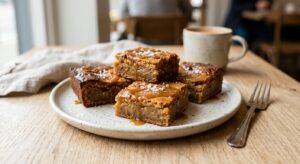
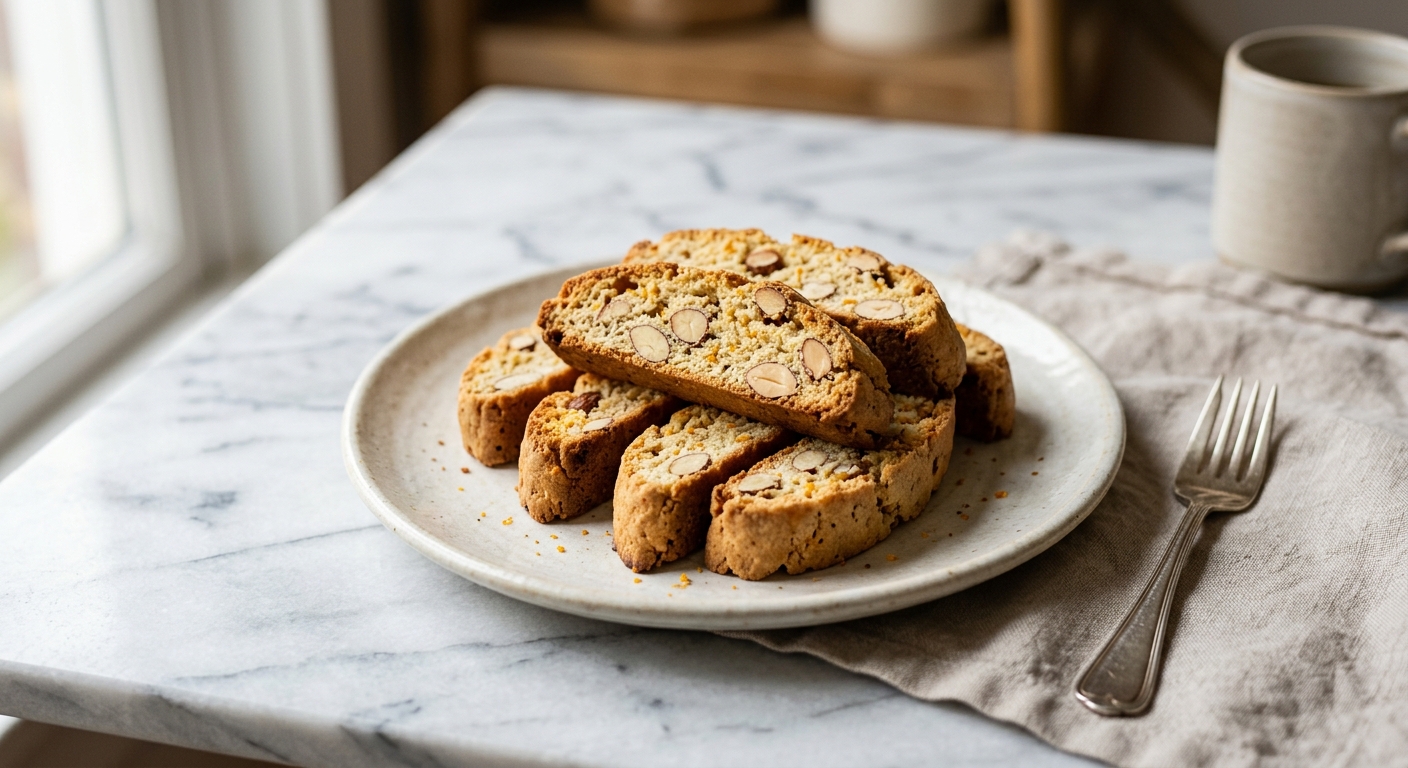
There is something deeply comforting about the sound of a biscotti meeting the rim of a coffee cup, that quiet clink before you take the first dunked bite. These almond and orange biscotti carry all the warmth of the classic Italian bakery version: golden, impossibly crisp, studded with whole toasted almonds, and brightened with the oils of fresh orange zest. Close your eyes and you could be sitting at a small marble table somewhere in Tuscany, except these are entirely sugar-free and you can have two without a second thought.
What sets this recipe apart is the combination of allulose as the primary sweetener and a generous amount of real orange zest rather than extract. Allulose behaves remarkably like sugar in a dry, low-fat dough, providing structure and gentle sweetness without the cooling aftertaste it can have in richer recipes. The zest, taken from two large oranges, delivers bright, fragrant citrus oil that no bottle of extract can truly replicate. A small splash of orange juice and a half teaspoon of almond extract round things out so that every bite tastes layered and intentional, not like a compromise.
Biscotti are genuinely one of the most forgiving bakes in any home baker’s repertoire. The dough comes together in one bowl, the shaping is relaxed and rustic, and the twice-baking process is slow and low enough that you have plenty of time to watch and adjust. If you are new to sugar-free baking, this is an excellent starting point because the texture of the finished cookie is actually improved by the drier nature of allulose. Experienced bakers will appreciate how well these hold up over time and how easily the recipe scales for gifting.
Equipment Needed
Click on an item below to shop for the recommended items for this recipe on Amazon.
As an Amazon Associate, we earn from qualifying purchases.
24
Ingredients
- 240 gall-purpose flour (about 2 cups, spooned and leveled)
- 150 ggranulated allulose (about 3/4 cup; use a fine-grain brand for best results)
- 1 tspbaking powder
- 0.25 tspColima Sea SaltMicroplastic Free Salt
- 3 largeeggs, at room temperature
- 60 mlAvocado Oil100% Pure Avocado Oil (about 1/4 cup)
- 30 mlfreshly squeezed orange juice (about 2 tablespoons)
- 0.5 tsppure almond extract
- 1 tsppure vanilla extract
- 2 tbspfinely grated orange zest (from 2 large navel oranges, packed)
- 150 gwhole raw almonds (about 1 cup), lightly toasted
Ingredient Substitutions
Instructions
- Preheat your oven to 325°F (165°C). Line a large rimmed baking sheet with parchment paper. Spread the whole almonds on the sheet and toast them in the preheating oven for 10 to 12 minutes, until fragrant and lightly golden. Remove and let cool completely. Keep the oven on.
- In a large bowl, whisk together the flour, allulose, baking powder, and salt until evenly combined. Make sure there are no allulose clumps, as they will not dissolve during baking the way sugar does.
- In a medium bowl or large measuring jug, whisk together the eggs, oil, orange juice, almond extract, vanilla extract, and orange zest until smooth and well blended, about 30 seconds.
- Pour the wet ingredients into the dry ingredients and stir with a sturdy spatula until a cohesive, slightly sticky dough forms. Fold in the cooled toasted almonds. The dough will be softer than a traditional biscotti dough due to allulose’s behavior. If it feels unworkably sticky, refrigerate for 15 minutes.
- Divide the dough in half. Using lightly floured hands, shape each portion into a log approximately 12 inches (30 cm) long and 2.5 inches (6 cm) wide on the prepared baking sheet, spacing them at least 3 inches apart. Pat the tops flat and smooth the sides gently.
- Bake for 32 to 35 minutes, until the logs are firm to the touch, pale golden on top, and a toothpick inserted in the center comes out clean. Remove from the oven and allow to cool on the baking sheet for 25 minutes. Do not skip this cooling period – cutting the logs while they are hot will cause them to crumble because allulose re-crystallizes as it cools and firms the structure.
- Reduce oven temperature to 275°F (135°C). Using a sharp serrated bread knife, cut the logs on a slight diagonal into slices about 3/4 inch (2 cm) thick using a gentle sawing motion. Lay the slices cut-side down on the parchment-lined baking sheet.
- Bake for 10 minutes, then flip each biscotti and bake for another 10 minutes, until they are dry, firm, and lightly golden on both cut sides. They will crisp further as they cool. Transfer to a wire rack and allow to cool completely before storing.
- Prepare a half-batch of the dough (halve all ingredient quantities). Toast the almonds in the air fryer basket at 300°F (150°C) for 5 to 6 minutes, shaking halfway, until fragrant. Let cool before folding into the dough.
- Preheat your air fryer to 310°F (155°C) for 3 minutes. Cut a piece of parchment to fit your air fryer basket, leaving a 1-inch border so air can circulate around the edges.
- Shape the dough into a single log, about 10 inches (25 cm) long and 2.5 inches (6 cm) wide, directly on the parchment. Lower it into the basket carefully.
- Air fry at 310°F (155°C) for 20 to 22 minutes, checking at 18 minutes. The log should be firm on top, pale golden, and dry to the touch. Remove the basket and allow the log to cool in the basket for 20 to 25 minutes so the allulose sets fully and the log slices cleanly.
- Reduce air fryer temperature to 250°F (120°C). Slice the cooled log into 3/4-inch (2 cm) slices with a serrated knife. Lay slices flat in the basket in a single layer, working in batches. Air fry for 6 minutes, flip, then fry for another 5 to 6 minutes until dry and crisp. Cool completely on a wire rack before storing.
- Preheat your convection oven to 300°F (150°C). Line a large baking sheet with parchment. Toast the almonds on the sheet for 8 to 10 minutes until golden and fragrant. Cool completely. Leave the oven on.
- Mix the dough as directed: whisk dry ingredients together, whisk wet ingredients separately, combine, and fold in cooled almonds. Shape into two logs, each about 12 inches (30 cm) long and 2.5 inches (6 cm) wide, spaced 3 inches apart on the baking sheet.
- Bake on convection at 300°F (150°C) for 26 to 28 minutes. The fan will speed up surface drying significantly. Watch from 22 minutes onward; the logs should be firm and dry on top with a light golden color. Cool on the pan for 20 minutes.
- Reduce convection oven temperature to 250°F (120°C). Slice the logs diagonally into 3/4-inch (2 cm) slices using a serrated knife. Lay cut-side down on the baking sheet.
- Bake on convection for 8 minutes, flip, and bake for another 7 to 8 minutes. The fan dries the biscotti very efficiently at this stage, so check at the 7-minute mark after flipping to avoid over-browning. Cool completely on a wire rack before storing.
Nutrition Per Serving
Per 1 serving (makes approximately 24 biscotti from two logs)
Sweetener: allulose
Why This Recipe Works
Biscotti are unique among cookies because they are baked twice, and this is precisely what makes them the ideal vehicle for allulose. Most sugar-free baking struggles because allulose does not caramelize or create the same tender crumb that sucrose does, but biscotti are meant to be dry, firm, and crisp. Allulose’s tendency to crystallize as it cools actually works in our favor here, contributing to the satisfying snap of a finished biscotti. The key is allowing the first-baked logs to cool for a full 25 minutes before slicing. During this time, the allulose re-crystallizes throughout the dough, binding everything together and making clean slicing possible. Cut too soon and the structure is not yet set, leading to crumbling.
The oil in this recipe (rather than butter) is deliberate. Biscotti made with fat are more tender and less prone to shattering when sliced, but butter’s water content can create steam during baking, which softens the structure. Oil is 100% fat, no water, so it contributes tenderness and cohesion without interfering with the drying process of the second bake. The eggs provide both structure (from proteins in the whites) and richness (from the yolks), and at three eggs for a 24-biscotti batch, there is enough protein to hold the almonds firmly in the dough even without the crystalline lattice that sugar normally provides.
If your biscotti crumble when you slice them, there are two likely causes: the logs were not cooled long enough, or the allulose brand you used has a very coarse grain that did not distribute evenly. A fine-grain allulose disperses better through the dry ingredients and dissolves more readily into the egg mixture. If crumbling is a persistent problem, try chilling the shaped logs for 30 minutes before the first bake to firm them further, and always use a serrated knife with a slow, sawing motion rather than pressing straight down.
Baker’s Tips
- Toast your almonds before adding them to the dough. Raw almonds taste flat and slightly bitter inside a baked cookie; toasted almonds are fragrant, crunchy, and nutty. Ten minutes at 325°F is all it takes.
- Use the finest grater you have (a Microplane is ideal) for the orange zest, and press down firmly to capture the essential oils in the outermost layer of the peel. Stop before you reach the white pith, which is bitter.
- Weigh your allulose rather than measuring by volume. Different brands have different crystal sizes, which affects how it packs into a measuring cup. Weight gives you consistency every time.
- If the dough feels too sticky to shape comfortably, wet your hands rather than adding extra flour. Extra flour will tighten the dough and may cause cracking during the first bake.
- The slicing step is the most critical. Use a sharp serrated bread knife, a slow sawing motion, and apply very gentle downward pressure. Any rocking or rushing will crack the log rather than slice it cleanly.
- Let biscotti cool completely on the wire rack before tasting. They continue to crisp and dry for 20 to 30 minutes after coming out of the oven, and eating them warm gives a false impression of softness.
Variations
- Dark Chocolate Dip: Melt 60g of 85% dark chocolate (sugar-free if preferred) with 1 tsp coconut oil and dip the base of each cooled biscotti. Set on parchment until firm. Adds richness and visual appeal for gifting or special occasions.
- Cranberry and Pistachio: Replace the almonds with 100g whole pistachios and 50g dried unsweetened cranberries. The sweet-tart cranberry is a beautiful contrast to the orange zest.
- Espresso Almond: Add 2 tsp instant espresso powder to the dry ingredients and replace the orange juice and zest with 1 tsp pure vanilla and 1/2 tsp cinnamon. A deeply aromatic, coffee-forward biscotti.
- Lavender and Lemon: Replace the orange zest with lemon zest and add 1 tsp food-grade dried culinary lavender to the dry ingredients. Elegant and floral, excellent with Earl Grey tea.
Troubleshooting & FAQ
My biscotti crumbled when I tried to slice the log. What went wrong?
My biscotti are soft and chewy after cooling, not crisp. What happened?
My biscotti taste slightly cooling or mentholated. Is that from the allulose?
The logs spread out and flattened during the first bake. How do I prevent this?
Can I use monk fruit sweetener instead of allulose, and do I use the same amount?
Storage & Make-Ahead
- Storage: Store in an airtight tin or container at room temperature for up to 3 weeks. Biscotti actually improve after the first day as they continue to dry and crisp. Do not refrigerate, as moisture from the fridge will soften them. Freeze in a zip-lock bag for up to 3 months and re-crisp in a 275°F (135°C) oven for 8 to 10 minutes.
- Make-Ahead: The dough can be made up to 24 hours ahead, wrapped tightly in plastic wrap, and refrigerated as shaped logs. Bake from cold, adding 3 to 5 minutes to the first bake. Fully baked and cooled biscotti keep so well at room temperature that they are inherently a make-ahead cookie. Bake a double batch on the weekend and enjoy all week.