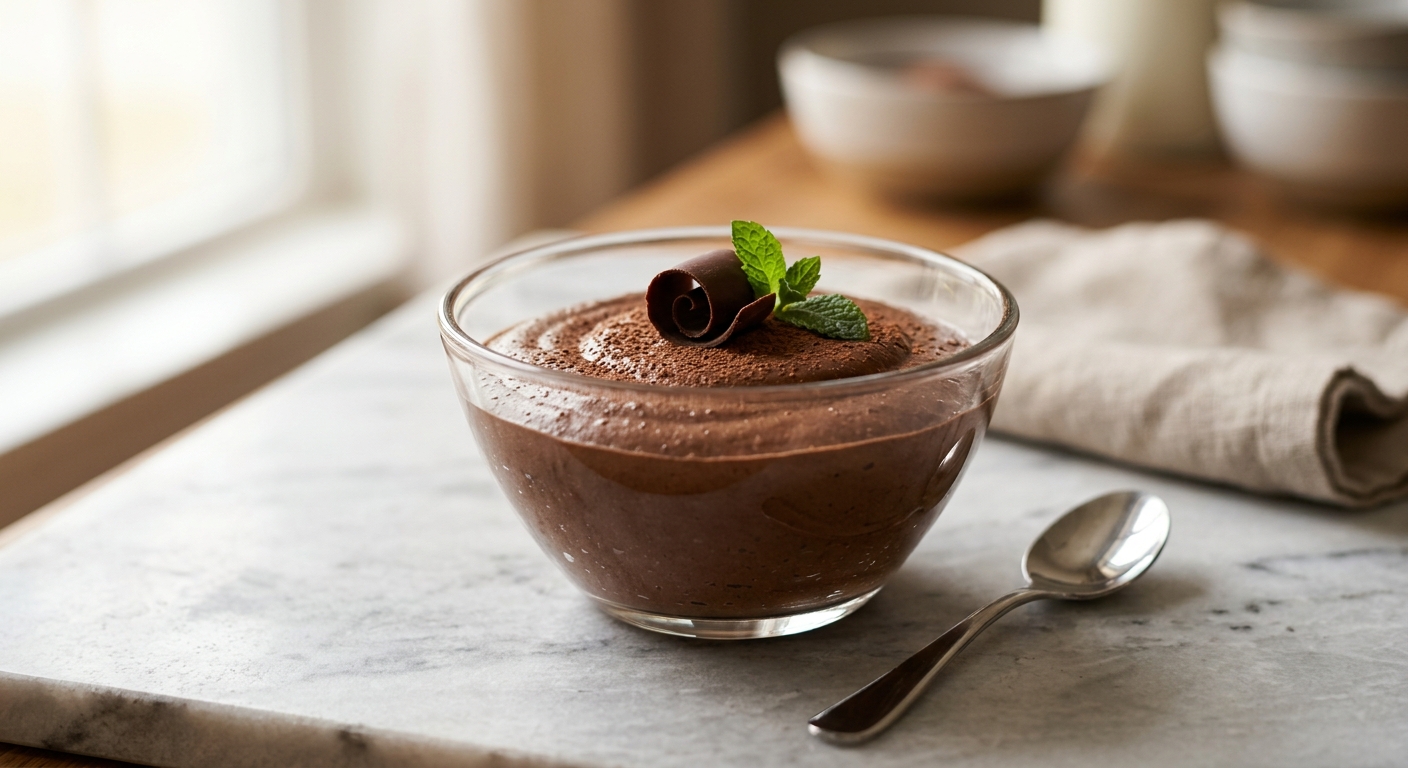
There is something almost magical about chocolate mousse – the way it hovers between solid and air, melting the moment it touches your tongue with a deep, roasted cocoa intensity that feels genuinely indulgent. This version delivers every bit of that experience: dark, bittersweet chocolate folded into clouds of whipped cream and silky whipped egg whites, chilled until it trembles gently in the bowl. It is the kind of dessert that makes people set down their forks and say nothing for a moment, which is really the highest compliment a dessert can receive.
What sets this mousse apart is allulose, a rare sugar that occurs naturally in small amounts in figs, raisins, and maple syrup. Unlike allulose, which can leave a cooling sensation, allulose behaves almost identically to regular sugar in texture and mouthfeel – it dissolves seamlessly, keeps the mousse impossibly smooth, and does not crystallize in the cold. It also has a gentle caramel-friendly sweetness that plays beautifully with good dark chocolate. The result is a mousse that tastes exactly like it should, with zero compromise in texture or flavor.
This recipe sits at a medium difficulty level, mostly because working with folded egg whites and whipped cream requires a little patience and a light hand. If you have made whipped cream before, you are already halfway there. It is a perfect weekend project for anyone managing blood sugar, following a low-carb or keto lifestyle, or simply cutting back on sugar without cutting back on joy. Dress it up in elegant glasses for a dinner party, or spoon it straight from the bowl on a quiet evening – both are equally valid choices.
Equipment Needed
Click on an item below to shop for the recommended items for this recipe on Amazon.
As an Amazon Associate, we earn from qualifying purchases.
6
Ingredients
- Melting With Chocolate (about 1/2 Cup)
- 170 ghigh-quality dark chocolate, 70% cacao or higher, finely chopped
- 120 mlheavy whipping cream
- 80 gallulose (about 6 tablespoons), divided
- 4 largeeggs, separated, at room temperature
- 1 tsppure vanilla extract
- Whipping (about 1 Cup)
- 240 mlheavy whipping cream, cold
- —Pinch of Colima Sea SaltMicroplastic Free Salt
- —Pinch of cream of tartar
- 15 gcocoa powder, for dusting (optional, about 2 tablespoons)
- Garnish (optional)
- 30 gdark chocolate shavings or curls
Ingredient Substitutions
Instructions
- Set up a double boiler by placing a heatproof bowl over a saucepan with about 2 inches of barely simmering water – the bowl should not touch the water. Add the finely chopped chocolate and 120ml of heavy cream. Stir gently with a silicone spatula until the chocolate is fully melted and the mixture is glossy and smooth. Remove from heat and let cool for 10 minutes, stirring occasionally. You want it warm but not hot – around 110°F (43°C) is ideal.
- While the chocolate cools, whisk the 4 egg yolks with 40g of allulose in a medium bowl until the mixture turns pale and slightly thickened, about 2 minutes of vigorous whisking. Add the vanilla extract and the pinch of sea salt. Slowly pour the warm (not hot) chocolate ganache into the egg yolk mixture in a thin, steady stream, whisking constantly. This gradual tempering prevents the yolks from scrambling. Set aside.
- In a clean, completely grease-free bowl, combine the 4 egg whites with the pinch of cream of tartar. Using a hand mixer or stand mixer with a whisk attachment, beat on medium speed until foamy, then increase to high speed. Once foamy, add the remaining 40g of allulose one tablespoon at a time, beating until stiff, glossy peaks form – the peaks should hold their shape and not droop. This takes about 3 to 4 minutes. Do not overbeat to a dry, grainy texture.
- In a separate chilled bowl, whip the cold 240ml of heavy cream with a hand mixer on medium-high speed until it holds firm peaks. It should be thick and billowy but not at all grainy or buttery. Set aside.
- Now fold everything together gently to preserve as much air as possible. First, stir one large spoonful of the whipped egg whites into the chocolate mixture – this lightens it and makes folding easier. Then, using a large rubber spatula, fold in the remaining egg whites in two additions using a wide, sweeping under-and-over motion, rotating the bowl as you go. Stop as soon as no white streaks remain. Finally, fold in the whipped cream in two additions the same way. The finished mousse should be light, airy, and uniformly dark brown.
- Divide the mousse evenly among 6 serving glasses or ramekins (approximately 150g each). Tap each glass gently on the counter once or twice to settle the mousse. Cover loosely with plastic wrap and refrigerate for at least 2 hours 30 minutes, or up to 24 hours, until fully set and chilled through.
- Before serving, dust lightly with cocoa powder through a fine-mesh sieve and top with dark chocolate shavings if using. Serve immediately from the refrigerator.
- Combine the finely chopped chocolate and 120ml of heavy cream in a medium microwave-safe bowl. Microwave on 50% power for 60 seconds. Stir well. Continue microwaving in 20-second bursts at 50% power, stirring between each, until the chocolate is completely melted and smooth. This usually takes 2 to 3 bursts total. Using 50% power is essential – full power will scorch the chocolate and split the cream. Let the ganache cool for 10 minutes, stirring occasionally.
- While the chocolate cools, whisk the 4 egg yolks with 40g of allulose until the mixture is pale and slightly thickened, about 2 minutes. Add the vanilla extract and sea salt. Slowly pour the cooled chocolate ganache into the egg yolk mixture in a thin stream, whisking constantly to temper the eggs gently. Set aside.
- In a clean, grease-free bowl, beat the 4 egg whites with the cream of tartar, starting on medium and increasing to high. Once foamy, add the remaining 40g of allulose one tablespoon at a time, beating to stiff, glossy peaks. In a separate chilled bowl, whip the cold 240ml heavy cream to firm peaks.
- Fold one large spoonful of egg whites into the chocolate base to loosen it. Then fold in the remaining egg whites in two additions, using a large rubber spatula with a gentle under-and-over motion. Finally, fold in the whipped cream in two additions until just combined and no streaks remain.
- Divide evenly among 6 serving glasses, cover loosely, and refrigerate for at least 2 hours 30 minutes. Garnish with cocoa powder and chocolate shavings before serving.
- Follow the classic stovetop or microwave method to make and melt the chocolate ganache, temper in the egg yolks with allulose and vanilla, and set aside to cool.
- Beat the egg whites with cream of tartar to stiff, glossy peaks, adding 40g of allulose gradually. Whip the cold heavy cream in a separate chilled bowl to firm peaks.
- Fold the egg whites into the chocolate base in two additions, followed by the whipped cream in two additions, using the same gentle under-and-over technique. The lighter texture here is especially important – the more air you retain, the creamier the frozen result.
- Line a 9×5 inch loaf pan with plastic wrap, leaving generous overhang on all sides (this makes unmolding easy). Pour and smooth the mousse evenly into the lined pan. Alternatively, divide among 6 individual silicone molds or ramekins lined with plastic wrap.
- Fold the plastic wrap over the top to cover the surface directly. Freeze for a minimum of 4 hours, or until fully solid. For cleanest slices, freeze overnight.
- To serve from the loaf pan, lift out using the plastic wrap overhang, place on a chilled serving platter, and slice with a warm knife (run it under hot water and dry it between slices). Dust with cocoa powder and serve within 10 minutes. Individual ramekins can be turned out onto small plates and garnished the same way.
Nutrition Per Serving
Per 1 serving (makes 6 individual dessert glasses (approximately 150g each))
Sweetener: allulose
Why This Recipe Works
Chocolate mousse is an exercise in building and preserving air. The recipe works through three separately aerated components that are then carefully combined. The egg yolks beaten with allulose form a base called a sabayon-style mixture, which adds richness and emulsification – the lecithin in the yolks helps bind the fat from the chocolate with the water-based components, creating a stable, cohesive texture. The whipped egg whites contribute the majority of the volume and give the mousse its signature light, cloud-like structure. The whipped cream adds richness and body while helping the mousse hold its shape during chilling. Folding rather than stirring is non-negotiable: stirring collapses the air bubbles you have worked hard to create, resulting in a dense, heavy mousse rather than an airy one.
Allulose earns its place here for reasons beyond just sweetness. Unlike granulated allulose, allulose is a monosaccharide that dissolves completely and does not recrystallize when cold, which means your mousse stays silky-smooth straight from the refrigerator with no gritty texture. It also has roughly 70% of the sweetness of regular sugar and only 0.4 calories per gram, with a glycemic index of effectively zero – it is absorbed in the small intestine but not metabolized, so it does not raise blood glucose or insulin. The 80g total used here delivers clean, balanced sweetness that lets a great 70% chocolate shine without any artificial aftertaste.
The most common technical failure in mousse is a grainy or sunken texture, which nearly always comes down to one of three causes: chocolate that was too hot when the yolks were added (which scrambles them), egg whites that were overbeaten to a dry, clumping foam (which creates white specks and a coarse crumb), or too-aggressive folding that deflates the mixture. If your finished mousse looks slightly streaky as you fold, that is fine – stop folding the moment no white streaks remain. A few extra folds beyond that point will cost you more air than a small streak would. Trust the chill to finish the job.
Baker’s Tips
- Use chocolate you genuinely enjoy eating on its own. Since this recipe has only a handful of ingredients, the chocolate is the star and its quality is unmistakable in the final mousse.
- Make sure your bowl and whisk are completely clean and free of any fat or grease before beating the egg whites. Even a small trace of yolk or oil will prevent them from whipping to stiff peaks.
- Separate your eggs while they are cold (the yolks hold together better), then let them come to room temperature before whipping. Room-temperature whites whip to a greater volume.
- The chocolate mixture should feel warm but not hot to the inside of your wrist before you add the egg yolks. If you are unsure, use an instant-read thermometer: aim for 110 to 115°F (43 to 46°C).
- Chill your mixing bowl and beaters in the freezer for 10 minutes before whipping the cream. Cold equipment helps the cream whip faster and hold its peaks longer.
- When folding, use a large, wide rubber spatula and work with confident, sweeping strokes rather than small, timid ones. Fewer, larger folds preserve more air than many small ones.
- If your mousse seems very loose after folding, it is not ruined – the chill firms it significantly. Resist the urge to add more cream or to re-whip; just refrigerate and be patient.
Variations
- Espresso Dark Chocolate: Dissolve 1 teaspoon of instant espresso powder into the warm ganache before tempering the yolks. The coffee deepens the chocolate flavor dramatically without tasting like coffee.
- Raspberry Swirl: Puree 80g of fresh or frozen raspberries with 1 teaspoon of allulose, press through a fine sieve to remove seeds, and swirl gently into the portioned mousse just before chilling.
- Orange Zest and Cardamom: Add the finely grated zest of one large orange and 1/4 teaspoon ground cardamom to the egg yolk mixture. A classic, aromatic combination that elevates the mousse to dinner-party status.
- Dairy-Free Version: Substitute both portions of heavy cream with chilled full-fat coconut cream (refrigerated overnight). The mousse will have a subtle coconut note and will be slightly less stable but still beautifully airy.
Troubleshooting & FAQ
My mousse turned out dense and heavy instead of airy. What went wrong?
My egg whites will not whip to stiff peaks. They just stay foamy and liquid.
My chocolate seized into a grainy, thick paste when I added the cream. Can I fix it?
The mousse has white streaks or lumps of egg white in it after chilling. Is it okay to eat?
Can I taste the allulose – is there any weird aftertaste or cooling sensation?
Storage & Make-Ahead
- Storage: Cover individual glasses with plastic wrap and refrigerate for up to 3 days. The texture is best within the first 48 hours. Do not store at room temperature. The frozen semifreddo version keeps tightly wrapped in the freezer for up to 2 weeks.
- Make-Ahead: This mousse is an ideal make-ahead dessert. Prepare it fully up to 24 hours in advance and keep refrigerated, adding the garnish just before serving. For the frozen version, it can be made up to 2 weeks ahead.