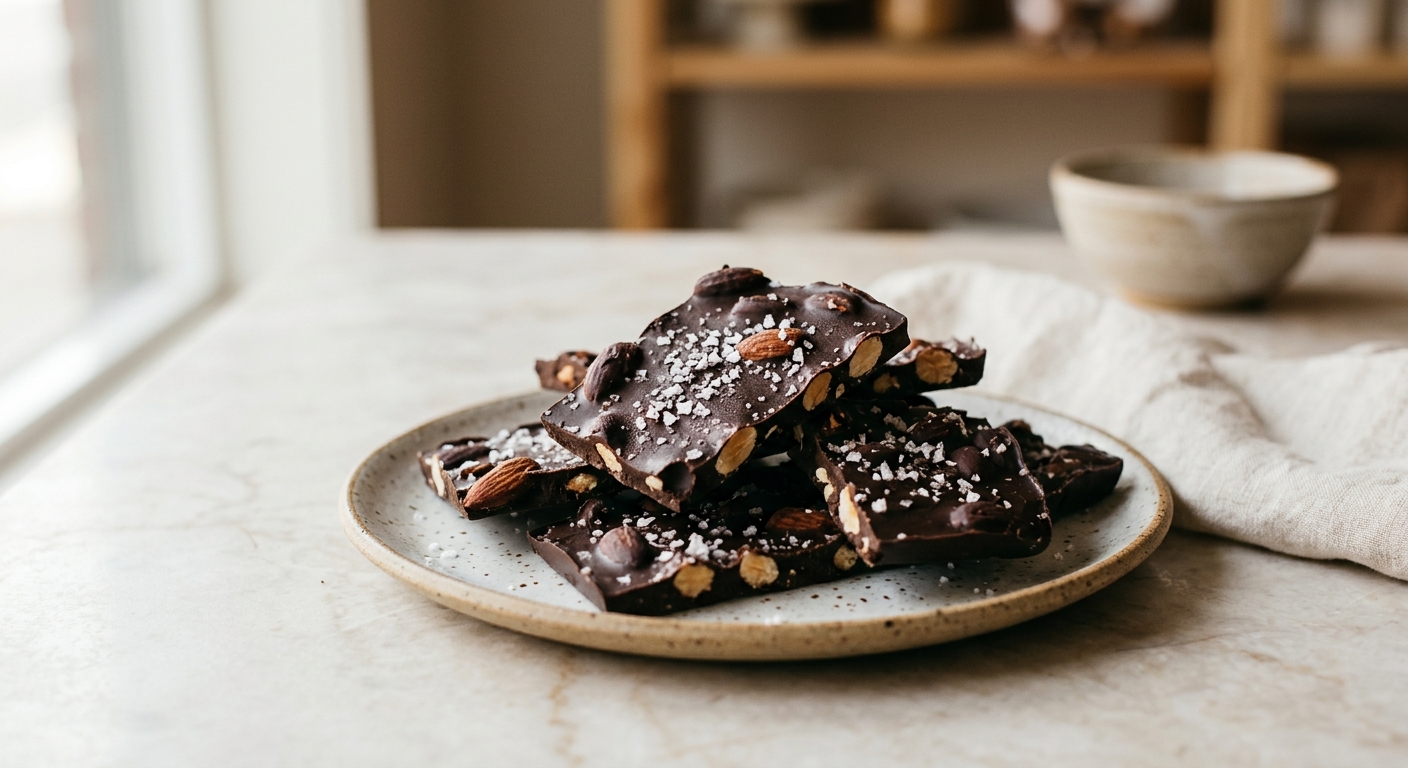
There is something almost magical about a slab of dark chocolate bark. It starts as a puddle of molten chocolate, glossy and warm, and transforms into something crisp and satisfying that shatters cleanly when you break off a piece. Studded with golden toasted almonds and finished with flurries of flaky sea salt, this keto bark delivers every bit of the drama and flavor of a fine chocolatier’s creation, straight from your own kitchen. It is the kind of treat that feels luxurious without requiring a single complicated technique.
What sets this recipe apart is the choice of allulose as the sweetener. Unlike allulose, which can recrystallize and leave a gritty texture or a cooling sensation on the tongue, allulose behaves almost identically to regular sugar in chocolate applications. It melts smoothly, stays smooth as the chocolate sets, and produces a bark with that satisfying clean snap. Combined with a high-quality unsweetened or 100% cacao chocolate base, the result is a deeply bittersweet bark that tastes genuinely indulgent, not like a compromise.
This recipe is firmly in the easy category and is a wonderful starting point for anyone new to sugar-free chocolate making. You do not need a thermometer or any special equipment beyond a sheet pan and a bowl. If you can melt chocolate and spread it on a baking sheet, you can make this bark. It is equally perfect for a weeknight treat, a holiday gift box, or a make-ahead snack to stash in the freezer for when the chocolate craving strikes.
Equipment Needed
Click on an item below to shop for the recommended items for this recipe on Amazon.
As an Amazon Associate, we earn from qualifying purchases.
16
Ingredients
- 225 gunsweetened 100% cacao chocolate, finely chopped (about 8 oz; use a good-quality bar like Pascha or Lily’s 100%)
- 60 gallulose (about 4 tbsp; adjust up to 75g if you prefer a slightly sweeter bark)
- 30 grefined coconut oil, melted (about 2 tbsp; adds gloss and helps the bark set firmly)
- 1 tsppure vanilla extract
- 150 graw whole almonds (about 1 cup)
- —1 to 1.5 tsp Colima Sea SaltMicroplastic Free Salt, such as Maldon, for finishing
- —Pinch of Colima Sea SaltMicroplastic Free Salt (added to the chocolate mixture)
Ingredient Substitutions
Instructions
- Line a large rimmed baking sheet (approximately 13×18 inches, a half-sheet pan) with parchment paper and set aside. Spread the almonds in a single layer on a dry skillet over medium heat. Toast, stirring frequently, for 5 to 7 minutes until fragrant and lightly golden. Transfer immediately to a plate to cool. Do not let them cool on the hot pan or they will continue to cook.
- Set up a double boiler: fill a medium saucepan with about 2 inches of water and bring it to a gentle simmer over medium-low heat. Place a heatproof bowl (glass or stainless steel) on top, making sure the bottom of the bowl does not touch the water. Add the chopped chocolate to the bowl and stir gently with a silicone spatula as it begins to melt.
- Once the chocolate is about two-thirds melted, remove the bowl from the heat. The residual warmth will finish melting the remaining pieces. Stir gently and consistently. This process, called seeding, helps encourage good chocolate structure. Add the melted coconut oil, allulose, vanilla extract, and pinch of fine sea salt. Stir until completely smooth and the allulose is fully dissolved, about 1 to 2 minutes. The mixture should be glossy and fluid.
- Pour the chocolate mixture onto the prepared baking sheet. Using an offset spatula or the back of a large spoon, spread it into an even layer roughly 4mm to 5mm thick (about a quarter-inch). You do not need to fill the entire pan; a smaller, thicker slab is better than a too-thin, fragile one.
- Immediately scatter the toasted almonds over the surface, pressing them gently into the chocolate so they adhere. Finish with a generous, even sprinkle of flaky sea salt. Transfer the baking sheet to the refrigerator and chill for a minimum of 30 minutes, or until the bark is completely firm and set.
- Once fully set, lift the parchment from the pan and break the bark into irregular pieces by hand, or use a sharp chef’s knife to cut it into more uniform squares. Store in an airtight container.
- Toast the almonds first: spread them on a microwave-safe plate and microwave on high in 60-second bursts, stirring between each, for 3 to 4 minutes total until fragrant. They will continue to darken slightly as they cool, so pull them when they are just starting to smell nutty. Set aside to cool. Line a half-sheet pan with parchment paper.
- Place the finely chopped chocolate in a large microwave-safe bowl. Microwave on 50% power for 30 seconds, then stir with a silicone spatula. Repeat at 50% power in 20-second intervals, stirring thoroughly between each interval, until the chocolate is about 80% melted. This typically takes 3 to 4 intervals total. Do not rush with full power or the chocolate will scorch and seize.
- Remove the bowl from the microwave and stir continuously for 1 to 2 minutes. The residual heat will melt the remaining pieces without additional microwave time. Add the melted coconut oil, allulose, vanilla extract, and pinch of fine sea salt. Stir until the mixture is completely smooth and glossy and the allulose has fully dissolved.
- Pour the chocolate onto the parchment-lined baking sheet and spread into an even layer about 4mm to 5mm thick using an offset spatula. Scatter the toasted almonds evenly over the surface and press them gently to adhere. Finish with flaky sea salt.
- Refrigerate for at least 30 minutes until completely firm. Break or cut into pieces and store in an airtight container in the refrigerator or freezer.
- Clear a flat space in your freezer large enough to hold a half-sheet pan before you begin. Toast the almonds using the stovetop or microwave method as described in the primary or microwave methods above. Line your baking sheet with parchment paper.
- Melt the chocolate using either the double boiler or microwave method. Add the coconut oil, allulose, vanilla, and fine sea salt and stir until completely smooth and glossy.
- Pour and spread the chocolate onto the prepared parchment-lined baking sheet in an even layer of 4mm to 5mm thickness. Scatter the toasted almonds over the surface, pressing gently to adhere, and finish with a generous pinch of flaky sea salt.
- Transfer the pan carefully to the flat surface in the freezer. Freeze for 12 to 15 minutes, until the bark is completely solid and firm all the way through. Check by pressing gently near the center; there should be no give at all.
- Remove from the freezer and allow to rest at room temperature for 3 to 5 minutes before breaking into pieces. This brief rest prevents cracking along unintended lines and makes the bark easier to break cleanly. Store in an airtight container in the refrigerator, as the bark softens faster at room temperature after being frozen.
Nutrition Per Serving
Per 1 serving (makes one large sheet of bark, broken into approximately 16 pieces)
Sweetener: allulose
Why This Recipe Works
The foundation of great chocolate bark is good tempering, and while full professional tempering is not required here, the technique used in this recipe borrows the most important principle: controlled temperature. By removing the chocolate from heat while about one-third of it is still unmelted and stirring continuously, you encourage the formation of stable cocoa butter crystals (called Form V or beta crystals). These crystals are responsible for that satisfying snap and glossy finish. Rushing with high heat or melting completely before removing from the burner produces an unstable crystal structure that results in a dull, soft, or streaky bark.
Allulose is the hero ingredient from a food science perspective. Unlike allulose, which has a distinctly different crystalline structure from sucrose and tends to recrystallize in cooled chocolate applications, allulose is a rare sugar that behaves nearly identically to sucrose in both its melting behavior and its interaction with cocoa butter. It dissolves fully at relatively low temperatures, stays dissolved as the chocolate cools, and produces no cooling sensation on the palate. It also has minimal impact on blood sugar, with a glycemic index of approximately 1, making it the gold standard sweetener for keto chocolate work.
The coconut oil plays a dual role: it lowers the viscosity of the chocolate, making it easier to spread into a thin, even slab, and it contributes to a firmer set by adding saturated fat that solidifies at refrigerator temperatures. If your bark seems too thick to spread before it sets, your melted mixture may have cooled too quickly; return it briefly to very gentle heat and stir to restore fluidity. If your bark is soft or tacky after chilling, it likely needs more time in the refrigerator, or the ratio of coconut oil was too high; reduce to 20g next time for a firmer result.
Baker’s Tips
- Chop the chocolate as finely and evenly as possible before melting. Uniform pieces melt at the same rate, reducing the risk of hot spots that can scorch or seize the chocolate.
- Make sure every bowl, spatula, and pan that touches the chocolate is completely dry. Even a single drop of water can cause chocolate to seize into a grainy, unworkable mass.
- Use a kitchen scale rather than volume measurements for the chocolate and allulose. Accurate ratios matter more in chocolate work than in most other baking applications.
- For the cleanest break when portioning the bark, use a heavy chef’s knife and press straight down rather than dragging. Or simply break it by hand for a more rustic, natural look.
- If you live in a warm climate or your kitchen runs hot, keep the bark refrigerated right up until serving. Allulose-sweetened chocolate can soften slightly faster than sugar-sweetened chocolate at temperatures above 75°F (24°C).
- Toast the almonds even if you are in a hurry. This single step dramatically deepens their flavor and adds a crunch that makes the bark taste far more complex and professional.
Variations
- Espresso Almond Bark: Whisk 1 tsp of instant espresso powder into the melted chocolate along with the other additions. Coffee deepens the bitterness of the cacao beautifully and adds a sophisticated edge.
- Coconut and Macadamia: Swap the almonds for 100g roughly chopped macadamia nuts and press 30g of unsweetened toasted coconut flakes into the surface alongside the nuts. Finish with the flaky sea salt as usual.
- Spiced Bark: Add 0.5 tsp of ground cinnamon and a pinch of cayenne pepper to the melted chocolate for a Mexican hot chocolate-inspired bark that has gentle warmth and complexity.
- Peppermint Crunch: Add 0.5 tsp of peppermint extract instead of vanilla and scatter 30g of crushed sugar-free peppermint candy (such as Stevita brand) over the surface along with the almonds. A perfect holiday variation.
- White Chocolate Swirl: Melt 60g of keto white chocolate (such as ChocZero) separately and drizzle it over the dark chocolate layer before it sets. Use a toothpick to swirl the two together for a marbled effect.
Troubleshooting & FAQ
My chocolate seized and turned thick and grainy. What happened?
My bark has white streaks or a dull, matte surface. Did I do something wrong?
My bark is soft and bends instead of snapping cleanly. How do I fix it?
I can taste a gritty or grainy texture in the chocolate. Is this the allulose?
My almonds are sinking into the chocolate instead of sitting on top. What should I do?
Storage & Make-Ahead
- Storage: Store in an airtight container in the refrigerator for up to 3 weeks, or at cool room temperature (below 70°F/21°C) for up to 1 week. For longer storage, freeze in a single layer on a parchment-lined tray until solid, then transfer to a zip-seal freezer bag for up to 3 months. Let frozen pieces sit at room temperature for 5 minutes before eating.
- Make-Ahead: This bark is an ideal make-ahead treat. It can be prepared up to 2 weeks in advance and stored in the refrigerator, or up to 3 months in the freezer. It is perfect for holiday gift boxes: layer pieces between sheets of parchment paper in a tin or box and keep chilled until gifting.