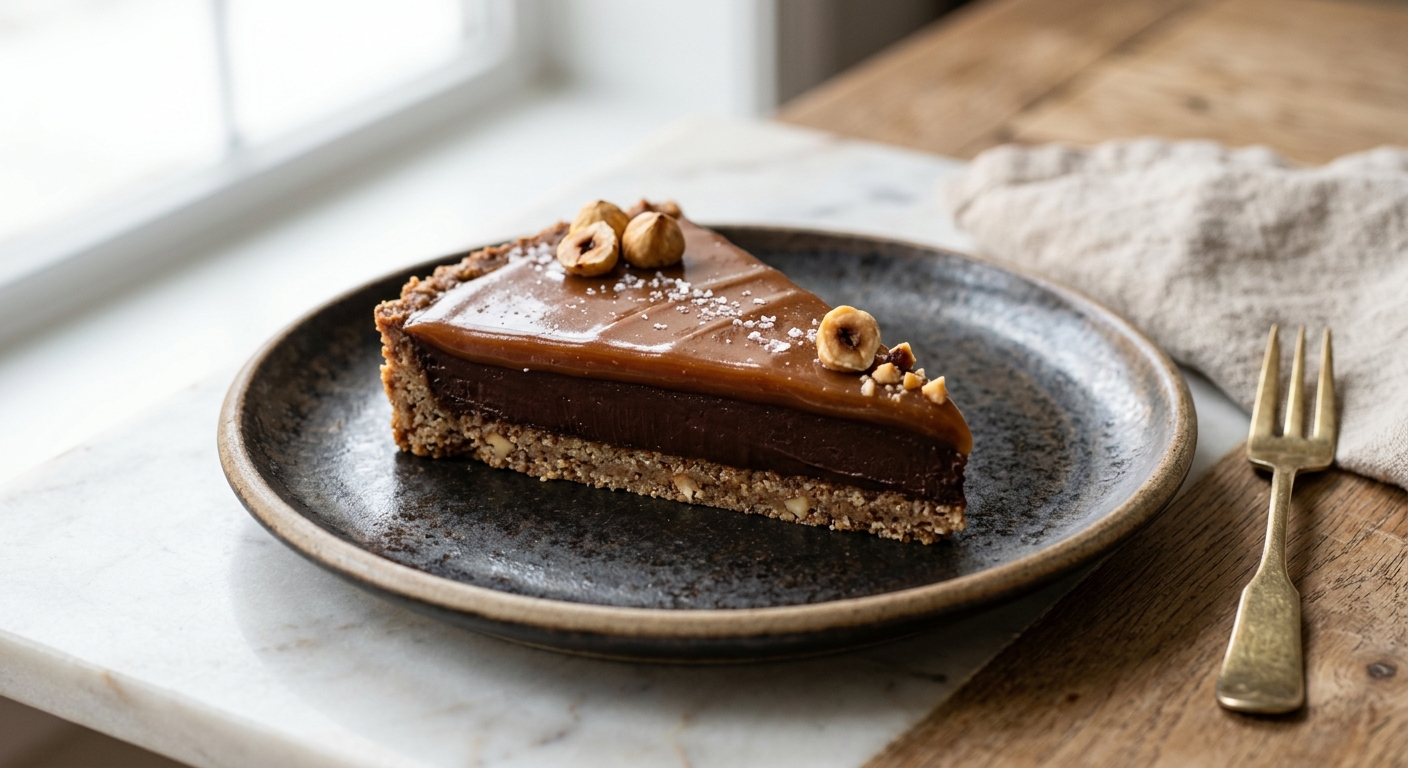
There is something almost theatrical about a salted caramel chocolate tart arriving at the table: the way the ganache catches the light, the ribbon of amber caramel pooling just beneath the surface, and that first crack of the fork through the shell. This tart delivers every bit of that drama without a single gram of refined sugar. The filling is glossy, the caramel is genuinely gooey, and the hazelnut crust shatters in the most satisfying way. It tastes like a patisserie window, not a compromise.
The real breakthrough here is allulose, a rare sugar that occurs naturally in figs and wheat. Unlike allulose, allulose behaves almost identically to table sugar: it dissolves smoothly, browns through the Maillard reaction, and builds a true caramel with real amber color and complex, slightly bitter depth. No grainy texture, no cooling aftertaste, and no crystallization problems that plague other sugar-free caramels. The chocolate ganache uses a high-percentage dark chocolate (85%), which contributes barely any sugar of its own while delivering maximum intensity.
This tart sits at a medium difficulty level. The caramel requires your attention and a candy thermometer, but every other component is straightforward. It is ideal for anyone managing blood sugar who refuses to settle for sad desserts, and it is impressive enough to serve to guests who would never suspect it is sugar-free. Plan ahead: the tart needs at least two hours to set in the refrigerator before slicing.
Equipment Needed
Click on an item below to shop for the recommended items for this recipe on Amazon.
As an Amazon Associate, we earn from qualifying purchases.
10
Ingredients
- Crust
- 150 gblanched hazelnuts (about 1 cup), toasted and cooled
- 100 galmond flour (about 1 cup, lightly packed)
- 40 gpowdered allulose (about 4 tbsp), sifted
- 30 gDutch-process cocoa powder (about 3 tbsp)
- 0.25 tspColima Sea SaltMicroplastic Free Salt
- 85 gcold unsalted butter, cut into small cubes (about 6 tbsp)
- 1 largeegg yolk, cold
- 1 tsppure vanilla extract
- Salted Caramel Filling
- 200 ggranular allulose (about 1 cup)
- 80 mlheavy cream (about 1/3 cup), warm
- 60 gunsalted butter (about 4 tbsp), at room temperature, cubed
- 0.75 tspColima Sea SaltMicroplastic Free Salt, divided (plus extra for garnish)
- 1 tsppure vanilla extract
- Ganache
- 200 g85% dark chocolate, finely chopped (about 1 and 1/4 cups)
- 180 mlheavy cream (about 3/4 cup)
- 20 gunsalted butter (about 1.5 tbsp), at room temperature
- 1 tsppure vanilla extract
Ingredient Substitutions
Instructions
- Preheat your oven to 325°F (165°C). Lightly grease a 9-inch fluted tart pan with a removable bottom. Place hazelnuts on a baking sheet and toast for 8 to 10 minutes until fragrant and skins blister. Let cool completely, then rub off any loose skins with a clean kitchen towel.
- Make the hazelnut crust: pulse the toasted hazelnuts in a food processor until they are a coarse flour with some small pieces remaining, about 15 pulses. Add almond flour, powdered allulose, cocoa powder, and fine sea salt. Pulse to combine. Add the cold butter cubes and pulse 8 to 10 times until the mixture resembles damp sand. Add the egg yolk and vanilla extract. Pulse just until the dough clumps together. If it seems dry, add 1 teaspoon of cold water at a time.
- Press the dough evenly into the bottom and up the sides of the prepared tart pan using the bottom of a flat measuring cup to smooth it. Aim for about 1/4-inch thickness throughout. Freeze the shell for 15 minutes. Then blind bake (no weights needed for this sturdy crust) for 15 minutes until it looks dry and set. Remove and let cool completely in the pan on a wire rack.
- Make the allulose salted caramel: pour the granular allulose into a medium heavy-bottomed saucepan over medium heat. Do not stir. Watch carefully as it begins to melt at the edges after 3 to 4 minutes. Once it starts to melt, gently swirl the pan occasionally to distribute heat evenly. Continue cooking until the caramel reaches a deep amber color and registers 340°F to 350°F (171°C to 177°C) on a candy thermometer, about 7 to 9 minutes total. It will smell nutty and slightly smoky. Note: allulose melts and browns faster than sugar, so watch it closely.
- Remove the pan from heat. Carefully pour in the warm heavy cream in a slow, steady stream (it will bubble vigorously). Whisk constantly. Add the cubed room-temperature butter one piece at a time, whisking until each is fully incorporated. Stir in 1/2 teaspoon of the flaky salt and vanilla. The caramel will be quite loose. Let it cool at room temperature for 10 to 15 minutes, until it thickens to a pourable but not runny consistency. Pour the caramel into the cooled tart shell and spread gently with a small offset spatula. Refrigerate for 30 minutes until the caramel is set but still slightly soft.
- Make the chocolate ganache: place the finely chopped chocolate in a heatproof bowl. Heat the heavy cream in a small saucepan over medium heat until it just begins to simmer, with small bubbles appearing around the edges. Do not boil. Pour the hot cream over the chocolate. Let it sit undisturbed for 2 minutes, then gently whisk from the center outward until perfectly smooth. Add the room-temperature butter and vanilla extract. Stir until the butter is fully melted and the ganache is glossy.
- Pour the warm ganache over the set caramel layer, tilting the tart pan gently to distribute it evenly. Tap the pan lightly on the counter to release any air bubbles. Scatter the remaining 1/4 teaspoon of flaky sea salt over the top, along with a little extra if you love salt. Refrigerate uncovered for at least 2 hours until fully set. To serve, carefully remove the tart from the pan, slice with a warm dry knife, and enjoy at room temperature for the best texture and flavor.
- Line a 9-inch tart pan with removable bottom with a circle of parchment on the base. Lightly grease the sides. Do not toast the hazelnuts if you prefer a fully raw crust, though a quick dry-pan toast for 3 to 4 minutes on the stovetop adds great flavor. Let them cool completely.
- Make the raw crust: process the hazelnuts in a food processor until very finely ground, almost a paste, about 30 seconds. Add almond flour, powdered allulose, cocoa powder, and fine sea salt. Pulse to combine. Add vanilla extract and 2 tablespoons of cold water, one tablespoon at a time, and pulse until the mixture sticks together when pressed between your fingers. It should hold its shape without being wet. Do not add butter or egg yolk for this version.
- Press the crust mixture firmly and evenly into the tart pan using the back of a spoon and the bottom of a flat measuring cup. The crust will be thicker than the baked version. Press firmly up the sides as well. Freeze the crust for 30 minutes until solid and firm.
- Make the allulose salted caramel on the stovetop exactly as described in the oven method steps 4 and 5. This step cannot be skipped or made in the microwave, as allulose needs sustained dry heat to reach the right temperature and develop its flavor. Cool the caramel to a pourable consistency, then pour into the frozen crust. Return to the freezer for 20 minutes until the caramel is firm.
- Make the ganache as described in the oven method step 6. Pour over the set caramel layer, finish with flaky sea salt, and refrigerate for at least 2 hours. Serve cold or at cool room temperature. Note that the no-bake crust softens faster at room temperature, so slice and serve promptly once removed from the refrigerator.
- Prepare and bake the hazelnut crust exactly as described in the oven method steps 1 through 3. Let it cool completely.
- Make the allulose salted caramel exactly as described in the oven method steps 4 and 5. Pour into the cooled crust and refrigerate for 30 minutes.
- Make the microwave ganache: combine the finely chopped 85% dark chocolate and heavy cream in a microwave-safe bowl. Microwave on 50% power for 60 seconds. Stir gently. Microwave again on 50% power in 20-second bursts, stirring between each, until the chocolate is almost fully melted. Do not overheat. The residual heat will finish the melting as you stir. Add the room-temperature butter and vanilla and stir until completely smooth and glossy. If any lumps remain, let the bowl sit over a pot of warm (not boiling) water and stir until smooth.
- Pour the ganache over the set caramel layer. Tilt the pan to level it and tap gently to remove air bubbles. Finish with flaky sea salt. Refrigerate for at least 2 hours before slicing.
Nutrition Per Serving
Per 1 serving (makes one 9-inch round tart)
Sweetener: allulose
Why This Recipe Works
Allulose is the star of this recipe for a very specific reason: it is one of the only low-glycemic sweeteners that undergoes the Maillard reaction and caramelization. Most sugar alternatives like allulose and xylitol simply melt and recrystallize as they cool, producing a grainy, sandy texture rather than a true caramel. Allulose behaves like sucrose because it is a monosaccharide with a nearly identical molecular structure, meaning it breaks down under heat in the same way. Crucially, it reaches caramelization temperature faster than table sugar (around 300°F versus 320°F), so you need to watch the pan and use a thermometer rather than relying on timing alone.
The hazelnut and almond flour crust works without gluten because nut-based flours are naturally high in fat, which provides tenderness and helps the crust hold together. The single egg yolk acts as an emulsifier and binder, coating the flour proteins and fat to form a cohesive dough without any gluten network. Pressing it into the pan rather than rolling it out avoids overworking and keeps the texture short and crisp. Freezing before baking firms the butter, so the crust holds its shape in the oven rather than slumping down the sides.
The ganache ratio here is deliberately slightly lean on cream to ensure a firm, sliceable set even after sitting at room temperature for a short time. Adding room-temperature butter at the end (a technique called monter au beurre) emulsifies additional fat into the ganache, giving it a glossy, velvet-smooth finish and a texture that melts cleanly on the tongue rather than feeling waxy. If your ganache looks split or greasy, it means the temperature difference between the cream and chocolate was too great. Fix it by adding one tablespoon of warm cream and whisking vigorously from the center out until it comes back together.
Baker’s Tips
- Use a candy thermometer for the allulose caramel. Allulose can go from perfect amber to burned in under a minute, especially as the pan retains heat. Pull it off the burner as soon as it hits 345°F and the caramel will continue to cook briefly from residual heat.
- Warm your heavy cream before adding it to the caramel. Cold cream hitting hot caramel creates an explosive steam reaction. Microwave it for 30 to 40 seconds until steaming, then pour slowly.
- Chop the chocolate as finely as possible for the ganache. Finely chopped chocolate melts faster and more evenly, reducing the risk of scorching and giving you a smoother result with fewer lumps.
- For the cleanest slices, dip your knife in hot water and wipe it dry between each cut. The ganache cuts much more cleanly when the blade is slightly warm.
- Let the tart sit at room temperature for 15 to 20 minutes before slicing if it has been refrigerated. Cold ganache can crack under the knife, and the caramel flavor blooms when it is not fridge-cold.
- Do not skip the flaky sea salt. In a sugar-free dessert, salt is doing double duty: it suppresses any lingering aftertaste from the allulose and amplifies the chocolate and caramel notes dramatically.
Variations
- Espresso caramel: add 1 teaspoon of instant espresso powder to the caramel after removing it from the heat. The coffee deepens the caramel flavor and makes the chocolate layer taste even more intense.
- Orange and cardamom: add 1 teaspoon of finely grated orange zest and 1/4 teaspoon of ground cardamom to the ganache along with the vanilla. A stunning flavor combination for the holidays.
- Pecan praline finish: toast 40g of pecans in a dry pan with 2 teaspoons of allulose until the allulose melts and coats the nuts. Let cool on parchment, then break into shards and scatter over the ganache before it fully sets.
- Dairy-free version: use full-fat coconut cream (chilled, solid part only) in place of heavy cream in both the caramel and ganache, and replace butter with refined coconut oil. Use dairy-free dark chocolate. The ganache will be slightly softer.
Troubleshooting & FAQ
My allulose caramel turned very dark and tastes bitter. What went wrong?
My caramel layer is solid and hard, not gooey. How do I fix this?
My ganache is grainy or looks split and oily. What happened?
My crust crumbled and fell apart when I removed it from the tart pan. What did I do wrong?
Can I taste a slight cooling sensation or aftertaste from the sweetener?
Storage & Make-Ahead
- Storage: Store the tart covered in the refrigerator for up to 5 days. The crust will soften slightly after day two but remains delicious. Do not store at room temperature for more than 2 hours due to the cream-based fillings. To freeze, wrap individual slices in plastic wrap and place in an airtight container. Freeze for up to 6 weeks. Thaw overnight in the refrigerator.
- Make-Ahead: This tart is an excellent make-ahead dessert. The baked crust can be prepared up to 3 days in advance and stored tightly wrapped at room temperature. The caramel can be made up to 2 days ahead and refrigerated in a jar, then gently rewarmed until pourable before using. The fully assembled tart (without garnish) can be made up to 2 days ahead and kept refrigerated. Add the flaky sea salt garnish just before serving for the best visual impact.