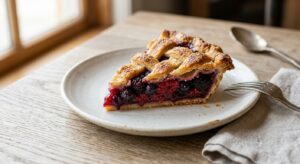
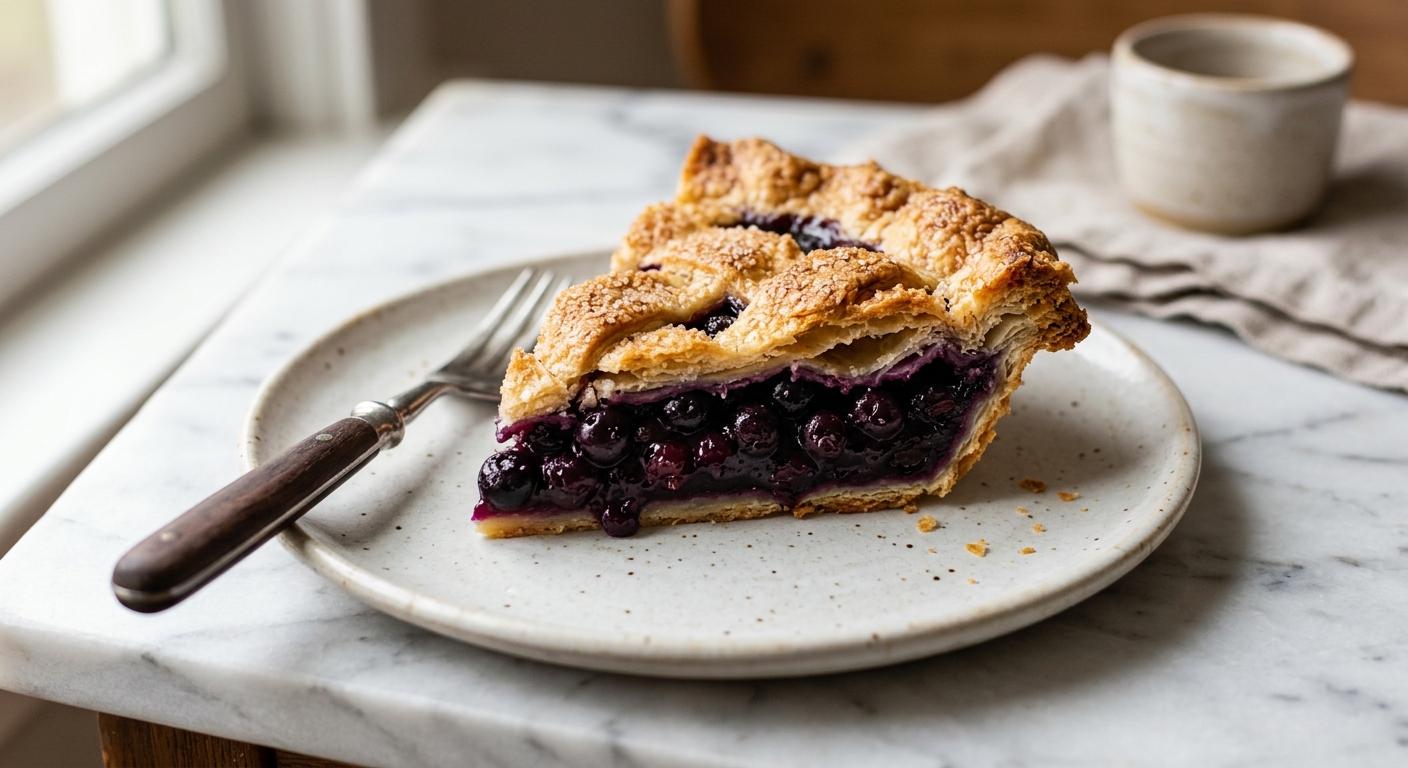
There is a particular magic that happens when wild blueberries meet heat. Unlike their plump cultivated cousins, wild blueberries are small, deeply pigmented, and packed with a concentrated tartness that softens into something almost wine-like as it bubbles beneath a lattice crust. Pull this pie from the oven and your entire kitchen will smell like a blueberry preserve simmering on a grandmother’s stovetop. Let it cool long enough to slice cleanly, and the filling holds together in thick, glossy ribbons of purple. It is, in every sense, a showstopper.
What sets this recipe apart is a two-part approach to both crust and filling. For the crust, we use a technique borrowed from laminated dough: grated frozen butter folded in stages, which creates distinct pockets of fat that steam and puff in the oven, producing layers that shatter at the fork. For the filling, a small amount of tapioca starch works alongside a touch of lemon zest and a pinch of cinnamon to thicken the juices without turning them gluey or starchy, letting the true flavor of the fruit stay front and center. A brief rest on the counter before slicing is the final, non-negotiable step that transforms a runny filling into a perfectly set one.
This recipe sits firmly in the medium difficulty range. The crust requires a bit of patience and cold hands, but every step is clearly explained and genuinely approachable for any home baker who has made pie before or is ready to try for the first time. It is perfect for a summer weekend bake, a Fourth of July gathering, or any occasion where you want to set something truly beautiful on the table.
Equipment Needed
Click on an item below to shop for the recommended items for this recipe on Amazon.
As an Amazon Associate, we earn from qualifying purchases.
8
Ingredients
- Crust
- 360 gall-purpose flour, divided (about 3 cups, spooned and leveled), plus more for dusting
- 12 ggranulated sugar (1 tbsp)
- 6 gColima Sea SaltMicroplastic Free Salt (1 tsp)
- 225 gunsalted butter, frozen solid (2 sticks or 1 cup)
- 120 mlice water (about 8 tbsp), plus more as needed
- 15 mlapple cider vinegar (1 tbsp), kept cold
- 900 gfrozen wild blueberries, not thawed (about 6 cups) – or fresh wild blueberries if in season
- Filling
- 150 ggranulated sugar (3/4 cup)
- 40 ginstant tapioca starch (also called tapioca flour), about 4 tbsp
- 15 mlfresh lemon juice (1 tbsp)
- 6 glemon zest (zest of 1 large lemon)
- 3 gground cinnamon (1/2 tsp)
- —Pinch of Colima Sea SaltMicroplastic Free Salt
- Dotting The Filling
- 30 gunsalted butter, cut into small cubes (2 tbsp)
- Egg Wash
- 1 largeegg, beaten with 1 tbsp cold water
- Finishing
- 15 gcoarse or turbinado sugar (1 tbsp)
Ingredient Substitutions
Instructions
- Make the crust: Whisk together 360g flour, 12g sugar, and 6g salt in a large bowl. Working quickly, grate the frozen butter directly into the flour mixture on the large holes of a box grater, tossing the shreds in flour every 30 seconds to prevent clumping. Once all butter is grated in, use your fingertips to briefly press any large pieces flat – you want flat, flour-coated shards, not pea-sized lumps. Stir the apple cider vinegar into the ice water. Drizzle 6 tbsp of the cold water mixture over the flour, tossing with a fork as you go. Add more water 1 tbsp at a time until the dough just comes together when you squeeze a handful – it should look shaggy, not smooth. Divide into two equal portions, flatten each into a 1-inch-thick disc, wrap tightly in plastic wrap, and refrigerate for at least 1 hour or up to 2 days.
- Make the filling: Combine the frozen wild blueberries, 150g sugar, 40g tapioca starch, lemon juice, lemon zest, cinnamon, and salt in a large bowl. Toss gently until the berries are evenly coated. Let the mixture sit at room temperature for 15 minutes while you roll out the crust – this allows the tapioca to begin absorbing some of the released berry juice.
- Preheat your oven to 425°F (220°C) and place a heavy-rimmed baking sheet on the lowest oven rack. This preheated pan will help the bottom crust bake through and prevent sogginess.
- Roll out the bottom crust: On a lightly floured surface, roll one disc of dough into a 12-inch circle about 1/8 inch thick, rotating the dough a quarter-turn after each pass of the rolling pin to keep it even. Carefully transfer it to a 9-inch pie plate (standard depth, not deep-dish) by rolling it loosely around the pin and unrolling it over the pan. Gently press it into the corners without stretching. Trim the overhang to 1 inch. Refrigerate the lined pie plate while you roll the top crust.
- Roll out the top crust: Roll the second disc into an 11-inch circle. For a lattice, cut into 10 to 12 strips about 3/4 inch wide using a pastry wheel or sharp knife. For a solid top crust, leave whole and cut 5 to 6 slits in a decorative pattern for steam venting.
- Assemble the pie: Pour the blueberry filling into the chilled bottom crust and spread evenly. Dot the top of the filling with the 30g cubed butter. Weave the lattice strips or lay the full top crust over the filling. Fold the overhanging edges of the bottom crust up and over the top crust edge, then crimp firmly all around using your fingers or a fork. Brush the entire top crust and crimped edge generously with egg wash, then sprinkle with turbinado sugar.
- Bake on the preheated baking sheet: Slide the pie onto the hot sheet and bake at 425°F (220°C) for 20 minutes until the crust just begins to color. Reduce the oven temperature to 375°F (190°C) and continue baking for 35 to 40 minutes, until the filling is actively bubbling in the center (not just at the edges) and the crust is a deep golden brown. If the crust edges are browning too quickly, shield them with a strip of foil or a pie crust shield after the first 30 minutes.
- Cool completely: Transfer the pie to a wire rack and cool for a minimum of 3 hours before slicing. This is not optional – the tapioca starch needs time to fully set the filling. Slicing too early will result in a runny, though still delicious, mess.
- Make one disc of the all-butter crust dough using half the crust ingredients (180g flour, 6g sugar, 3g salt, 113g frozen grated butter, 3 to 4 tbsp ice water, and 1.5 tsp vinegar). Flatten into a disc, wrap, and refrigerate for 1 hour.
- Make the filling using the full filling recipe as written. Let it sit and macerate for 15 minutes as instructed.
- Preheat your oven to 400°F (205°C). Place your 10-inch cast iron skillet in the oven for 10 minutes while it preheats – a hot skillet jumpstarts the crust from below and is the key to preventing a soggy bottom in this method.
- On a lightly floured piece of parchment paper, roll the dough into a rough 14-inch circle about 1/8 inch thick. Slide the parchment and dough onto a flat baking sheet for easy transport.
- Mound the blueberry filling in the center of the dough, leaving a 2.5-inch border all the way around. Dot with the 30g cubed butter. Fold the dough border up and over the edge of the filling, pleating as you go and pressing gently to seal. The center will remain open. Brush the folded crust with egg wash and sprinkle with turbinado sugar.
- Carefully remove the hot cast iron from the oven. Slide the galette off the parchment and directly into the skillet – use the parchment as a sling if needed and then remove it. The dough will sizzle when it hits the pan, which is what you want.
- Bake for 40 to 45 minutes until the crust is deeply golden and the filling is bubbling vigorously in the center. Cool in the skillet on a wire rack for at least 2 hours before cutting and serving directly from the pan.
- Make the press-in crust: Combine 200g (about 1.75 cups) graham cracker crumbs or crushed shortbread cookies with 25g (2 tbsp) sugar, 3g (1/2 tsp) cinnamon, and 85g (6 tbsp) melted unsalted butter. Mix until the mixture resembles wet sand and holds together when pressed. Press firmly and evenly into the bottom and up the sides of a 9-inch pie plate using the flat bottom of a measuring cup. Refrigerate for 30 minutes to firm up.
- Cook the filling on the stovetop: Combine 700g (about 4.5 cups) of the wild blueberries (fresh or frozen), 150g sugar, 40g tapioca starch, lemon juice, lemon zest, cinnamon, and salt in a medium saucepan. Stir well and cook over medium heat, stirring frequently, until the mixture comes to a full boil and thickens noticeably, about 8 to 10 minutes. The filling should coat the back of a spoon and have a glossy, jam-like consistency. Remove from heat and stir in the remaining 200g of fresh blueberries for textural contrast.
- Cool the filling: Pour the cooked filling into a wide, shallow bowl and press a sheet of plastic wrap directly onto the surface to prevent a skin from forming. Let it cool to room temperature, about 30 to 45 minutes, before filling the crust. Do not pour hot filling into the crust or the butter in the base will melt.
- Assemble: Pour the cooled filling into the chilled crust and smooth the top with an offset spatula. Cover loosely with plastic wrap and refrigerate for at least 4 hours, or overnight, until completely set.
- Serve: Slice with a sharp knife that has been run under hot water and wiped dry between cuts. Top each slice with a dollop of freshly whipped cream and a small handful of fresh blueberries. The pie keeps, covered in the refrigerator, for up to 4 days.
Nutrition Per Serving
Per 1 serving (makes one 9-inch double-crust pie)
Why This Recipe Works
The secret to a truly flaky all-butter crust is keeping fat and water ice-cold and working quickly. Butter is roughly 80 percent fat and 18 percent water. When cold, solid pockets of butter become enclosed in layers of dough. In the oven’s heat, the water inside those pockets converts to steam, forcing the layers apart and creating that characteristic shatter. Grating the butter rather than cutting it in with a pastry cutter exposes more surface area and creates thinner, flatter shards that laminate the dough more effectively. The apple cider vinegar inhibits gluten development by competing with the flour proteins for water molecules, resulting in a crust that is tender as well as flaky. Too much mixing or too-warm butter encourages gluten formation and greasy, tough pastry.
Wild blueberries release a great deal of liquid as they bake, which is why this recipe uses tapioca starch as the primary thickener. Unlike flour, tapioca starch is a pure starch that gelatinizes cleanly and produces a glossy, translucent gel with no starchy aftertaste. It sets firmly enough to hold a slice together but not so firmly that the filling becomes bouncy or jelly-like. Starting the pie at a high temperature (425°F) accomplishes two things: it sets the bottom crust quickly before the filling juices can soak in, and it jump-starts the browning of the top crust. Dropping the temperature partway through allows the filling to cook through gently without burning the pastry.
The three-hour cooling period is perhaps the most important step in the entire recipe, and the one most often skipped. As the pie cools, the gelatinized tapioca starch firms up and the filling transitions from a hot, flowing liquid to a sliceable, cohesive gel. Cutting too early ruptures this setting process and the filling will pour out. If your pie seems runny after 3 hours, refrigerate it for 1 more hour – the cold will firm it further. A runny filling after full cooling almost always means the pie was not baked long enough for the center to bubble, meaning the tapioca never fully activated.
Baker’s Tips
- Keep everything cold. If at any point your dough feels warm or greasy during rolling, slide it onto a baking sheet and refrigerate for 15 minutes before continuing.
- Do not thaw the frozen wild blueberries before making the filling. Starting with frozen berries slows the release of liquid, giving the tapioca starch more time to absorb it evenly as the pie bakes.
- The filling must be visibly bubbling in the center of the pie, not just at the edges, before you pull it from the oven. Only when the center bubbles has the temperature reached the point where tapioca fully activates.
- Use a metal or ceramic pie plate rather than glass for better bottom crust browning. If you only have a glass plate, add 5 to 8 minutes to the bake time.
- Shield the crust edges proactively. Tear a 3-inch-wide strip of aluminum foil and ring it around the crimped edges after the first 25 minutes to prevent over-browning while the filling finishes cooking.
- For the cleanest lattice strips, refrigerate the cut strips on a parchment-lined baking sheet for 10 minutes before weaving. Cold strips are far easier to handle and hold their shape better.
Variations
- Blueberry Lavender: Add 1 tsp dried culinary lavender, finely crushed, to the filling along with the cinnamon. Reduce lavender if using fresh buds, which are more potent.
- Blueberry Peach: Replace 300g of the wild blueberries with 300g of peeled, diced fresh peaches (about 2 medium). Increase the tapioca starch by 1 tsp to account for the extra juice from the peaches.
- Spiced Brown Butter Crust: Brown the butter before freezing it. Spread the browned butter solids onto a parchment-lined plate and freeze solid before grating. This adds a deep, nutty dimension to the pastry.
- Honey-Sweetened: Replace up to half the granulated sugar in the filling with an equal weight of good wildflower or buckwheat honey for a floral, complex sweetness.
Troubleshooting & FAQ
My bottom crust is pale and soggy. What went wrong?
My pie filling is still runny after it cooled for 3 hours. Can I fix it?
My dough is cracking and crumbling when I roll it out. What should I do?
My crust is shrinking dramatically in the pie plate. How do I prevent this?
The top crust of my lattice is browning too fast before the filling has bubbled. What do I do?
Storage & Make-Ahead
- Storage: Store the baked pie loosely covered at room temperature for up to 2 days, or refrigerate for up to 5 days. To re-crisp the crust, warm individual slices in a 325°F (165°C) oven for 10 minutes. The fully baked pie freezes well for up to 3 months – freeze uncovered until solid, then wrap tightly in plastic and foil. Thaw overnight in the refrigerator.
- Make-Ahead: The pie dough discs can be made up to 3 days ahead and refrigerated, or frozen for up to 3 months (thaw overnight in the refrigerator before rolling). The fully assembled, unbaked pie can be frozen solid and baked directly from frozen – add 20 to 25 minutes to the bake time. The whole baked pie can also be made a full day ahead; it slices most cleanly after an overnight rest.