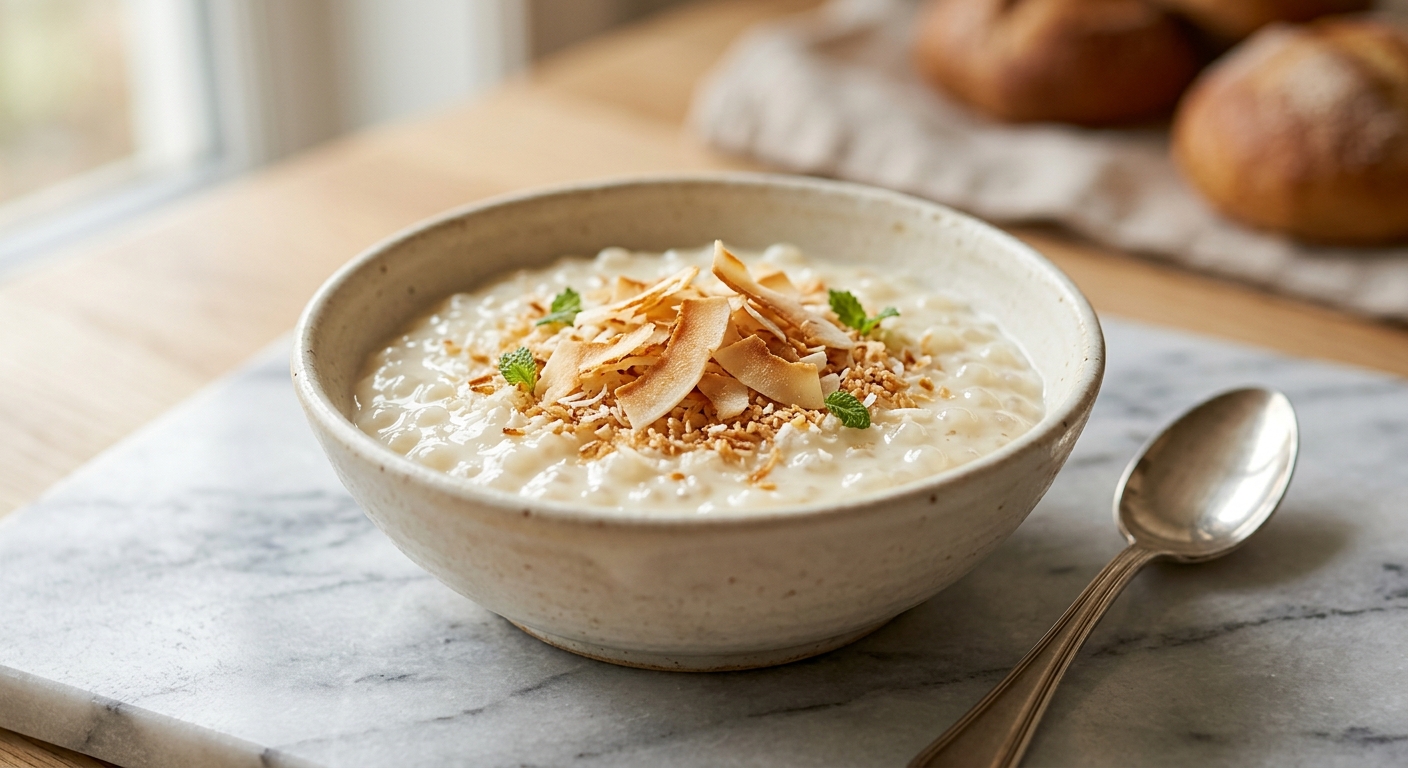
There is something almost meditative about stirring a pot of tapioca pudding. The tiny pearls slowly turn from chalky white to translucent, the mixture thickens into something glossy and yielding, and the whole kitchen fills with a warm, vanilla-sweet fragrance that feels like a hug. This coconut milk version takes that nostalgic comfort and lifts it somewhere genuinely special, the kind of dessert that disappears from the bowl faster than you expect and has people quietly hoping there is more.
What sets this recipe apart is the use of full-fat coconut milk as the primary liquid, whisked together with just enough whole milk to balance richness without making the pudding feel heavy. A second addition of coconut milk is stirred in right at the end, off the heat, which preserves its fresh, fragrant character and gives the finished pudding a silkier finish than cooking it all the way through would allow. The pearls themselves are soaked overnight, which dramatically cuts cook time and ensures every single pearl cooks through to a perfectly soft, jewel-like center with no chalky spots.
This recipe sits firmly in the easy-to-medium range. The technique is forgiving and the ingredient list is short, but it does require your attention at the stove and a little patience during the soak. It is perfect for anyone who loves old-fashioned puddings, for anyone curious about cooking with coconut milk, and for anyone who wants a naturally gluten-free dessert that feels genuinely indulgent without a great deal of effort.
Equipment Needed
Click on an item below to shop for the recommended items for this recipe on Amazon.
As an Amazon Associate, we earn from qualifying purchases.
6
Ingredients
- Soaking)
- 120 gsmall pearl tapioca (about 1/2 cup, NOT instant or quick-cook tapioca)
- 480 mlcold water (about 2 cups
- 400 mlfull-fat coconut milk, divided (one 13.5 oz can)
- 360 mlwhole milk (about 1.5 cups)
- 100 ggranulated sugar (about 1/2 cup)
- —Pinch of Colima Sea SaltMicroplastic Free Salt
- 2 largeeggs
- 1 tsppure vanilla extract
- Serving (about 1/3 Cup)
- 30 gunsweetened shredded coconut, toasted
- Serving (optional)
- —Fresh mango slices or passion fruit
Ingredient Substitutions
Instructions
- The night before (or at least 8 hours ahead): place the pearl tapioca in a medium bowl and cover with 480ml (2 cups) of cold water. The pearls will absorb most of the water and swell considerably. Cover the bowl and refrigerate overnight. When you are ready to cook, drain the pearls through a fine-mesh sieve and set aside.
- In a medium, heavy-bottomed saucepan, combine the drained tapioca pearls, 300ml (just over 1 cup) of the coconut milk (reserve the remaining 100ml for later), all of the whole milk, the granulated sugar, and the pinch of salt. Stir to combine and place over medium heat.
- Cook, stirring frequently with a heatproof silicone spatula or wooden spoon, until the mixture comes to a gentle simmer and the tapioca pearls begin to turn translucent, about 15 to 20 minutes. Reduce the heat to medium-low. The mixture will look quite thin at this stage, and that is normal.
- In a small bowl, whisk together the 2 eggs until smooth. Once the tapioca is mostly translucent (a small white dot at the center is fine), slowly ladle about 120ml (1/2 cup) of the hot tapioca mixture into the eggs while whisking constantly. This is called tempering and it prevents the eggs from scrambling when added to the pot.
- Pour the tempered egg mixture back into the saucepan in a slow, steady stream, stirring constantly. Continue cooking over medium-low heat, stirring gently but continuously, for another 5 to 8 minutes until the pudding has thickened to a soft, flowing consistency that coats the back of a spoon. It will continue to thicken as it cools.
- Remove the pan from the heat. Stir in the reserved 100ml of coconut milk and the vanilla extract. This final addition of cool coconut milk blooms the fragrance without cooking off the delicate flavour.
- Pour or ladle the pudding into individual serving bowls or glasses. Serve warm for a soft, flowing texture, or press a piece of plastic wrap directly onto the surface of each portion (to prevent a skin from forming) and refrigerate for at least 1 hour for a firmer, chilled pudding. Top with toasted coconut and fresh fruit just before serving.
- Soak the tapioca pearls overnight as described in the stovetop method. Drain through a fine-mesh sieve when ready to cook.
- Lightly grease the insert of a 3 to 4 quart slow cooker with a neutral oil or cooking spray to make cleanup easier. Add the drained tapioca pearls, 300ml of the coconut milk (reserving 100ml), all of the whole milk, sugar, and salt. Stir to combine.
- Cook on High for 2 to 2.5 hours, stirring once halfway through. The pearls should be completely translucent and the mixture should have thickened noticeably. If you lift the lid and the mixture looks very soupy after 2 hours, continue cooking in 15-minute increments.
- In a small bowl, whisk the 2 eggs thoroughly. Temper them by slowly ladling about 120ml of the hot tapioca mixture into the eggs while whisking constantly, then pour the egg mixture back into the slow cooker, stirring well to combine.
- Replace the lid and cook on High for a further 15 to 20 minutes, stirring once at the 10-minute mark, until the pudding is thick and the eggs are fully cooked through. Turn off the heat.
- Stir in the reserved 100ml of coconut milk and the vanilla extract. Serve warm directly from the slow cooker, or transfer to individual bowls, cover the surface with plastic wrap, and refrigerate until chilled. Top with toasted coconut and fruit before serving.
- Soak and drain the tapioca pearls as described in the stovetop method.
- In a large, deep microwave-safe bowl (at least 2-quart capacity), combine the drained pearls, 300ml of the coconut milk (reserving 100ml), all of the whole milk, sugar, and salt. Stir well.
- Microwave on High in 3-minute intervals, stirring thoroughly between each interval, for a total of 15 to 18 minutes. After each interval the mixture will look thinner than expected until around the 12-minute mark, when it will begin to thicken and the pearls will turn mostly translucent. Watch carefully in the last few intervals as the mixture can bubble up quickly.
- Once the pearls are mostly translucent and the mixture has thickened slightly, whisk the eggs in a separate small bowl. Slowly ladle about 3 tablespoons of the hot tapioca into the eggs while whisking to temper them, then stir the egg mixture back into the bowl.
- Microwave in 1-minute intervals, stirring after each, for 3 to 4 more minutes until the pudding is thick and creamy and the eggs are fully cooked. Do not walk away during this stage.
- Remove from the microwave and stir in the reserved 100ml of coconut milk and vanilla extract. Divide among serving bowls and serve warm, or chill as described in the stovetop method. Top with toasted coconut and fruit just before serving.
Nutrition Per Serving
Per 1 serving (makes about 6 half-cup servings)
Why This Recipe Works
Tapioca pearls are made from cassava starch, which is composed almost entirely of amylopectin, a highly branched starch molecule that swells dramatically when hydrated and heated. Soaking the pearls overnight accomplishes two things: it pre-hydrates the outer starch layers so they cook evenly all the way to the center, and it cuts the stovetop time almost in half. Skipping the soak leads to the frustrating situation where the outside of the pearl is soft and gluey while the center remains a hard, chalky nub. The long, gentle soak is the single most important step in this recipe.
Tempering the eggs before adding them to the hot pudding is non-negotiable if you want a smooth result. Eggs begin to coagulate (scramble) at around 70 to 75 degrees Celsius. By gradually raising their temperature with a ladleful of hot liquid before adding them to the pot, you bring them up to a safe range without shocking them into curds. Once in the pot, the eggs provide additional body and a custard-like richness that tapioca starch alone cannot give. Stirring continuously after the eggs are added keeps the temperature even and prevents any localized hot spots from cooking the eggs too quickly.
Splitting the coconut milk into two additions is a small but meaningful technique. The bulk goes in at the start to cook alongside the tapioca, contributing body and richness. The reserved portion goes in off the heat at the very end. Coconut milk contains aromatic volatile compounds that dissipate with extended heat, so this late addition preserves that fresh, floral coconut fragrance in the finished pudding. If your pudding ends up thicker than you would like after chilling, simply stir in a little extra coconut milk, one tablespoon at a time, until you reach your preferred consistency.
Baker’s Tips
- Do not skip the overnight soak. It is the most important step for achieving perfectly cooked, evenly translucent pearls. A minimum of 8 hours is ideal, but up to 16 hours in the fridge is perfectly fine.
- Use a heavy-bottomed saucepan to prevent scorching on the stovetop. A thin pan will create hot spots that can cause the tapioca to stick and the eggs to scramble.
- Stir consistently but gently. Aggressive stirring can break the pearls apart, giving you a gluey, starchy texture rather than distinct, jewel-like spheres.
- The pudding will look quite thin when you pour it into the bowls. Resist the urge to cook it until it looks thick in the pot. It sets up significantly as it cools, and an over-thickened pudding straight from the stove will become solid and gluey once chilled.
- To toast the shredded coconut, spread it in a single layer in a dry skillet over medium heat and stir frequently for 3 to 4 minutes until golden. Watch it closely as it goes from perfectly toasted to burnt very quickly. Transfer to a plate immediately once golden.
- For the most elegant presentation, serve chilled pudding in clear glasses so the glossy, pearl-studded layers are visible.
Variations
- Pandan Coconut: Add 2 to 3 drops of pandan extract (or steep 2 fresh pandan leaves, tied in a knot, in the milk mixture over low heat for 10 minutes before adding the tapioca). The pudding turns a soft jade green with a fragrant, grassy sweetness.
- Mango and Lime: Stir the zest of 1 lime into the finished pudding along with the vanilla. Serve topped with diced fresh mango and a squeeze of lime juice for a bright, tropical dessert.
- Lightly Spiced: Add 1/4 teaspoon ground cardamom and a pinch of ground ginger to the milk mixture along with the sugar. Top with a dusting of ground cinnamon and crushed pistachios.
- Dairy-Free: Replace the whole milk with full-fat oat milk or a second can of coconut milk (use 200ml to avoid making it too rich) and use coconut oil-greased equipment. The pudding will be dairy-free and vegan if you also omit the eggs, adjusting texture expectations accordingly.
Troubleshooting & FAQ
My tapioca pearls still have a hard, chalky center after cooking. What went wrong?
My pudding turned out gluey and stodgy rather than creamy. How do I prevent this?
I see white streaks or lumps in my pudding. Did I scramble the eggs?
My pudding is too thick after chilling. Can I fix it?
My coconut milk has separated into a thick solid layer and a watery liquid in the can. Should I shake it or use just one layer?
Storage & Make-Ahead
- Storage: Store leftover pudding in an airtight container in the refrigerator for up to 4 days. The pudding will thicken considerably as it chills. To loosen it, stir in a splash of coconut milk or whole milk before serving. Tapioca pudding does not freeze well, as the pearls become rubbery and the texture breaks down on thawing.
- Make-Ahead: The pudding can be made up to 2 days ahead and stored, covered, in the refrigerator. For the freshest presentation, hold off on the toasted coconut and fresh fruit garnishes until just before serving. If making ahead for a gathering, you can portion it into individual glasses and press plastic wrap directly on the surface of each one to prevent a skin forming.