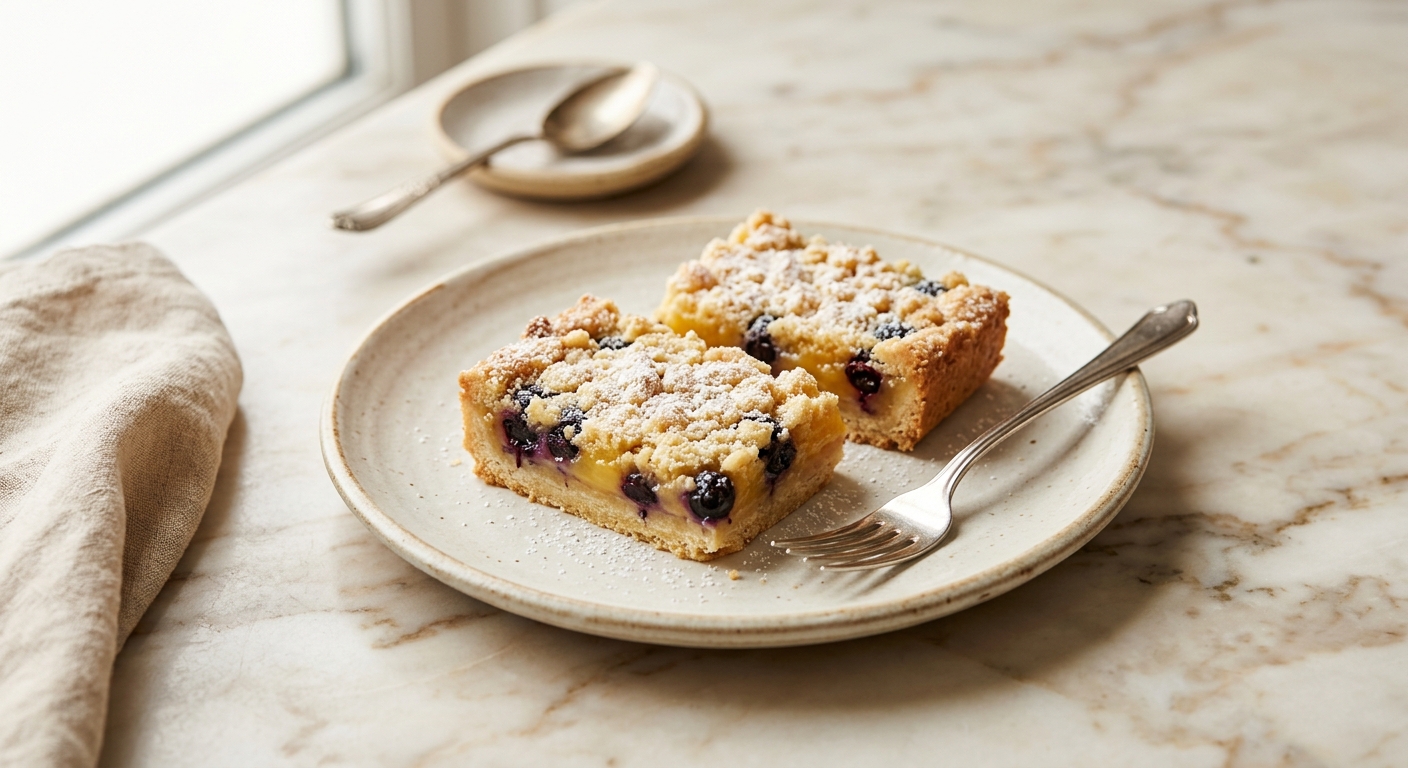
There is something almost magical about the combination of lemon and blueberry. The sharp, floral brightness of fresh lemon zest against the sweet-tart pop of blueberries is one of those pairings that just makes sense, the way old friends do. These shortbread bars capture that magic in every layer: a golden, melt-in-your-mouth butter crust pressed into the pan, a silky lemon curd that sets to a gentle wobble, and a crown of blueberries that bubble and burst in the oven into something deeply jammy and gorgeous. Cut into neat squares, they look like something from a patisserie window. Nobody has to know how straightforward they were to make.
What sets these bars apart from a standard lemon bar is the shortbread base, which uses a higher ratio of butter to flour than a typical pastry crust, along with a touch of powdered sugar and cornstarch for that signature snap-and-crumble texture. The lemon curd filling is thickened with whole eggs and egg yolks rather than cornstarch alone, which gives it a rich, custardy body that slices cleanly instead of weeping. A handful of fresh blueberries scattered over the top before the final bake creates a rustic, jewel-toned layer that caramelizes gently at the edges and adds a fruity contrast to the tart lemon beneath.
These bars sit comfortably in the medium difficulty range. There is no complicated technique involved, but there are a few key steps, like pre-baking the crust and tempering the curd, that are worth doing properly. They are ideal for anyone who has mastered basic cookies and wants to try something with a bit more layered complexity. They travel well, keep beautifully in the fridge, and are equally at home at a summer picnic, a baby shower, or a quiet Tuesday afternoon with a cup of tea.
Equipment Needed
Click on an item below to shop for the recommended items for this recipe on Amazon.
As an Amazon Associate, we earn from qualifying purchases.
16
Ingredients
- Crust
- 280 gall-purpose flour (about 2 1/4 cups, spooned and leveled)
- 40 gcornstarch (about 5 tablespoons), divided: 30g for the crust and 10g for the curd
- 80 gpowdered sugar, sifted (about 2/3 cup)
- 0.5 tspColima Sea SaltMicroplastic Free Salt
- Lemon Curd Filling
- 225 gunsalted butter, cold and cut into 1-cm cubes (1 cup or 2 sticks)
- 2 tsppure vanilla extract
- 200 ggranulated sugar (1 cup)
- Curd
- 120 mlfresh lemon juice (about 3 to 4 large lemons, approximately 1/2 cup)
- 2 tbspfinely grated lemon zest (from about 3 large lemons)
- 3 largewhole eggs, at room temperature
- 2 largeegg yolks, at room temperature
- 0.25 tspColima Sea SaltMicroplastic Free Salt
- Tossing The Blueberries
- 200 gfresh blueberries (about 1 1/3 cups), rinsed and dried thoroughly
- 1 tbspgranulated sugar
- Dusting Before Serving (optional)
- —Powdered sugar
Ingredient Substitutions
Instructions
- Preheat your oven to 325°F (160°C). Grease a 9×13-inch metal baking pan and line it with parchment paper, leaving a 2-inch overhang on the two long sides. This overhang acts as handles for easy removal later. Grease the parchment lightly as well.
- Make the shortbread crust: In a large bowl, whisk together 250g of the flour (reserve 30g for the crust binder), all of the 30g cornstarch for the crust, the 80g powdered sugar, and 0.5 tsp sea salt. Scatter the cold butter cubes over the flour mixture and add the vanilla extract. Use your fingertips or a pastry cutter to work the butter into the flour until the mixture resembles coarse, damp sand with pea-sized butter pieces throughout. It should just hold together when you squeeze a handful. Do not overwork it or the crust will be tough.
- Press the shortbread crust firmly and evenly into the prepared pan using the bottom of a flat measuring cup or a straight-sided glass. Pay special attention to the corners. Prick the surface all over with a fork, about 20 times, to allow steam to escape and prevent puffing. Refrigerate the crust for 15 minutes while the oven finishes preheating.
- Bake the crust for 18 to 22 minutes, until it is pale golden at the edges and the center looks dry and set, not shiny. It should not be deeply browned. Remove from the oven and set aside while you prepare the filling. Leave the oven on.
- Make the lemon curd filling: In a medium bowl, whisk together the 200g granulated sugar, the remaining 10g cornstarch, and the 0.25 tsp salt. Add the 3 whole eggs, 2 egg yolks, lemon juice, and lemon zest. Whisk vigorously for about 1 minute until the mixture is completely smooth and slightly frothy. Pour the curd mixture through a fine-mesh sieve directly over the warm (not hot) shortbread crust. Straining removes any cooked egg strands and produces a silky smooth filling.
- Toss the dried blueberries with the 1 tablespoon of granulated sugar in a small bowl, then scatter them evenly over the lemon curd. Some will sink slightly, which is perfectly fine and creates beautiful pockets of fruit throughout the filling.
- Bake at 325°F (160°C) for 22 to 28 minutes, until the edges of the curd are set and the center has just a slight jiggle, similar to a gently set custard. The blueberries will have burst slightly and turned jammy. Do not overbake or the curd will become rubbery and may crack.
- Remove from the oven and allow the bars to cool completely in the pan at room temperature, about 1 hour. Then transfer to the refrigerator and chill for at least 2 hours, or preferably overnight. The filling will firm up significantly as it chills. Use the parchment handles to lift the slab out of the pan, then cut into 16 bars with a sharp knife wiped clean between each cut. Dust with powdered sugar just before serving if desired.
- Make the no-bake crust: Pulse 250g of graham crackers (about 2 sleeves or 16 full crackers) in a food processor until you have fine crumbs, about 30 seconds. You should have roughly 300g of crumbs. Add 60g granulated sugar, 0.5 tsp fine sea salt, and 115g melted unsalted butter. Pulse until the crumbs look like wet sand and hold together when pinched. Press firmly into a parchment-lined 9×13-inch pan, building the crust about 1 cm thick. Refrigerate while you prepare the filling.
- Make the stovetop lemon curd: In a medium heavy-bottomed saucepan, whisk together the 200g granulated sugar, 10g cornstarch, and 0.25 tsp salt. Whisk in the 3 whole eggs, 2 egg yolks, and 120ml fresh lemon juice until smooth. Set over medium-low heat and cook, stirring constantly with a silicone spatula or wooden spoon, for 8 to 12 minutes until the curd thickens enough to coat the back of the spoon and holds a line when you run your finger through it. Do not let it boil. Remove from heat and stir in the lemon zest and 30g cold unsalted butter cut into cubes for extra richness and gloss.
- Pour the warm lemon curd through a fine-mesh sieve directly over the chilled crust and spread into an even layer with an offset spatula. Press a sheet of plastic wrap directly onto the surface of the curd to prevent a skin from forming. Refrigerate for at least 3 hours until fully set and firm.
- Make the blueberry compote topping: Combine 175g of the fresh blueberries with 2 tablespoons of granulated sugar and 1 tablespoon of fresh lemon juice in a small saucepan. Cook over medium heat for 5 to 7 minutes, stirring occasionally, until the berries burst and the mixture thickens slightly. Stir in the remaining 25g fresh blueberries off the heat for texture contrast. Let the compote cool completely to room temperature, about 30 minutes, before using.
- Once the lemon curd layer is fully set, remove the plastic wrap and spoon the cooled blueberry compote evenly over the top. Spread gently with a spatula. Refrigerate for another 30 minutes to allow the topping to set slightly before slicing. Cut into 16 bars with a hot, clean knife for the neatest edges.
Nutrition Per Serving
Per 1 serving (makes one 9×13-inch pan, cut into 16 bars)
Why This Recipe Works
The secret to a shortbread crust that holds together under a wet filling without becoming soggy lies in two key ingredients: powdered sugar and cornstarch. Powdered sugar contains a small percentage of cornstarch itself, and together with the additional cornstarch in the crust, these absorb excess moisture and create a barrier that slows the transfer of liquid from the curd into the base. Using cold butter and working it in quickly also means you are creating a dough with very little gluten development, which is exactly what you want for that signature sandy, melt-away texture rather than a chewy or tough base.
The lemon curd filling uses both whole eggs and extra yolks deliberately. Egg whites set firmly when cooked, while yolks are rich in fat and emulsifiers that create a smooth, creamy texture. Using a combination gives you a curd that is rich and custardy but still sets firmly enough to slice cleanly. The small amount of cornstarch acts as an insurance policy, providing additional stability without making the filling starchy or gluey. Baking at the lower temperature of 325°F (160°C) is essential: high heat would cause the eggs to overcook and scramble, resulting in a grainy, curdled filling rather than a silky one.
The blueberries are tossed in a tablespoon of sugar before going on top, which draws out their natural juices through osmosis and helps them burst and caramelize more evenly in the oven. Patting them completely dry before tossing is critical: excess surface water would dilute the curd and prevent the crust from crisping properly at the edges. If your curd cracks after baking, it almost always means the oven was too hot or the bars were overbaked. A gentle jiggle in the center when you pull the pan out is your goal, not a fully set, rigid surface.
Baker’s Tips
- Dry your blueberries thoroughly after rinsing. Even a small amount of excess water on the berries can water down the lemon filling. Spread them on a clean kitchen towel for 10 minutes before using.
- Zest your lemons before juicing them. It is much easier to zest a whole lemon than a squeezed one, and warm lemons release more juice, so roll them firmly on the countertop before cutting.
- Use a metal pan, not glass, for the best results. Metal conducts heat more efficiently and evenly, which helps the crust crisp up properly and the filling set without overcooking.
- Strain the lemon curd through a fine-mesh sieve before pouring it over the crust. This removes any bits of cooked egg white or zest solids and guarantees a smooth, glossy filling.
- Chill the bars for at least 2 hours before cutting, and use a sharp chef’s knife wiped clean with a damp cloth between each cut. Pulling a blunt knife through cold curd will tear rather than slice.
- If your crust cracks around the edges while pre-baking, simply press it back together gently with your fingertips while still warm. The curd will seal any gaps when it bakes over the top.
Variations
- Lavender lemon bars: Add 1 teaspoon of culinary-grade dried lavender to the shortbread crust dough for a floral, Provencal twist. The lavender perfumes the butter beautifully as it bakes.
- Lemon cream cheese bars: Beat 115g softened cream cheese into the lemon curd mixture before pouring it over the crust. The result is richer, slightly tangy, and creamier, similar to a lemon cheesecake bar.
- Meyer lemon and blackberry: Substitute Meyer lemons for regular lemons for a sweeter, less acidic curd, and use fresh blackberries in place of blueberries for a more deeply flavored, dramatic result.
- Brown butter shortbread base: Brown the butter before making the crust (then cool it until solid in the fridge) for a nutty, caramel-forward base that adds wonderful complexity to the lemon filling.
Troubleshooting & FAQ
My lemon curd is still liquid after baking. What went wrong?
The lemon filling cracked on top after baking. Can I fix it?
My shortbread crust is crumbling and will not hold together when I cut the bars.
Why are the blueberries sinking to the bottom of the filling?
The crust is pale and soft even after 20 minutes of baking. Should I keep baking it?
Storage & Make-Ahead
- Storage: Store the bars in a single layer (or with parchment between layers) in an airtight container in the refrigerator for up to 5 days. The shortbread crust will soften slightly after the second day as it absorbs moisture from the curd, which many people actually prefer. For the no-bake version, store covered in the refrigerator for up to 4 days. Do not store at room temperature for longer than 2 hours due to the egg-based filling.
- Make-Ahead: The shortbread crust can be pressed into the pan and refrigerated, unbaked, up to 24 hours ahead. The baked bars (without powdered sugar dusting) can be made up to 2 days ahead and kept refrigerated. For freezing: cut the fully chilled bars, place them on a parchment-lined baking sheet, and freeze until solid, about 1 hour, then transfer to a zip-top bag. Freeze for up to 2 months. Thaw overnight in the refrigerator.