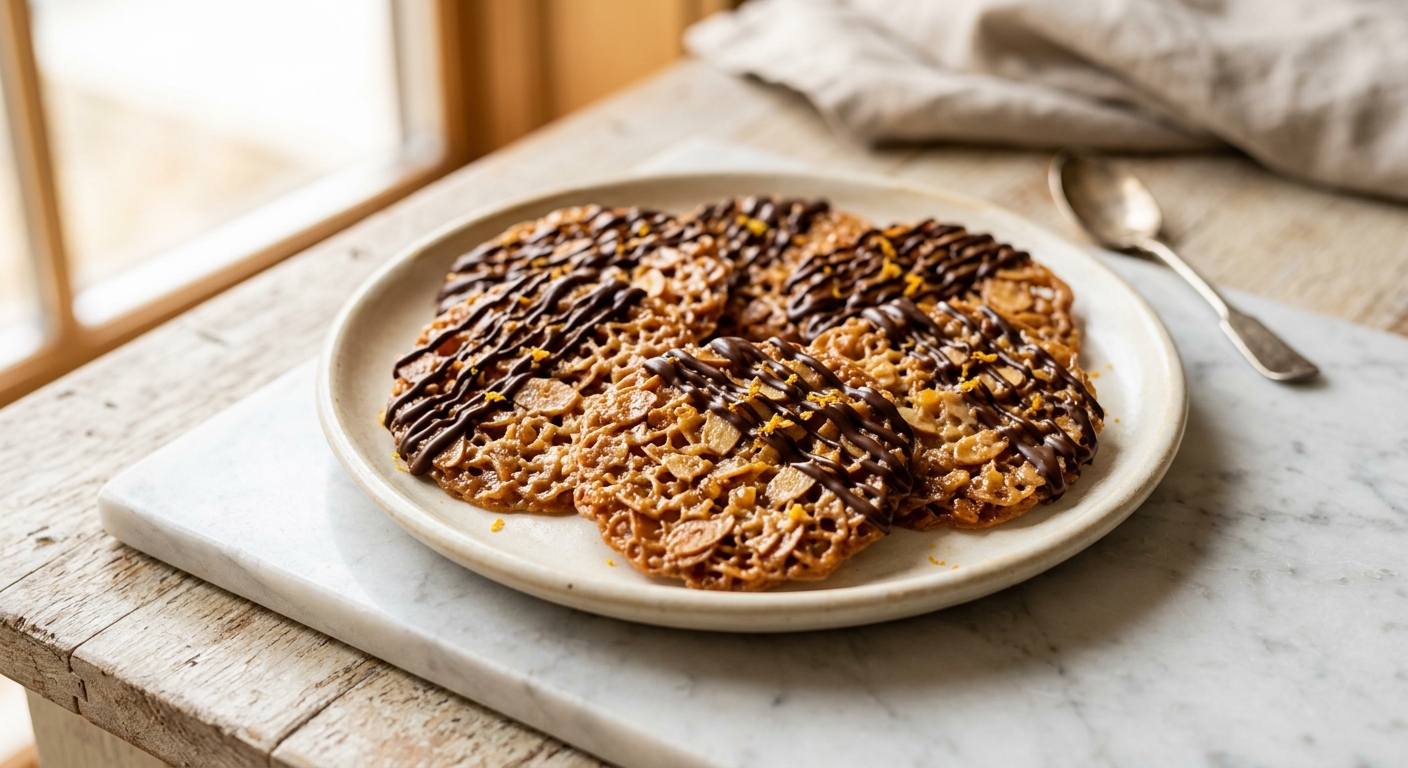
There is a moment, right as a Florentine cookie emerges from the oven, where it looks almost too beautiful to be real. A molten, golden-amber disc, lacy with holes, perfumed with caramel and orange, it spreads across the parchment like spun sugar solidifying into something delicate and crunchy and extraordinary. Once cooled and striped with dark chocolate, these little cookies are genuinely show-stopping, the kind of thing that makes people ask if you bought them from a bakery.
What sets this version apart is the ratio of candied orange peel to almonds and the deliberate use of heavy cream alongside butter in the caramel base. The cream slows the caramelization just enough to give you a deeper, more complex toffee flavor without tipping into bitterness. The orange peel is chopped finely so every bite carries a bright citrus note that cuts through the richness. And rather than dipping the bottoms in chocolate, we drizzle the tops in a loose zigzag pattern, which keeps the snap and lets the lace pattern stay visible.
These cookies sit firmly in the medium difficulty range. There is no complex technique, but the caramel base requires attention and the spreading behavior of the batter can surprise first-timers. That said, any baker comfortable making cookies from scratch will handle these with confidence. They are ideal for holiday cookie boxes, dinner party dessert plates, or gifting, and they keep beautifully for days, which makes them a joy to bake ahead.
Equipment Needed
Click on an item below to shop for the recommended items for this recipe on Amazon.
As an Amazon Associate, we earn from qualifying purchases.
24
Ingredients
- 100 gunsalted butter (7 tbsp), cut into pieces
- 100 ggranulated sugar (1/2 cup)
- 60 mlheavy cream (1/4 cup)
- 30 ghoney (1.5 tbsp), a mild variety like clover or acacia
- 150 gsliced or slivered almonds (1.5 cups), lightly toasted
- 80 gfinely chopped candied orange peel (about 1/2 cup)
- 40 gall-purpose flour (about 5 tbsp), spooned and leveled
- 1 tspfinely grated fresh orange zest
- —Pinch of Colima Sea SaltMicroplastic Free Salt
- 120 gdark chocolate (70% cocoa), finely chopped (about 4 oz)
Ingredient Substitutions
Instructions
- Preheat your oven to 350°F (175°C). Line two large baking sheets with parchment paper or silicone baking mats. Silicone mats are preferred as the caramel releases cleanly without sticking.
- In a medium heavy-bottomed saucepan, combine the butter, granulated sugar, heavy cream, and honey over medium heat. Stir gently until the butter melts, then bring to a boil. Let it boil, stirring constantly, for exactly 2 minutes. The mixture will turn a pale golden color and thicken slightly. Remove from heat immediately.
- Stir in the toasted almonds, finely chopped candied orange peel, flour, orange zest, and the pinch of salt. Mix until everything is evenly coated. The batter will look wet and loose. This is correct.
- Drop level tablespoons of batter onto the prepared baking sheets, spacing them at least 3 inches apart. They will spread significantly. Bake only 6 to 8 cookies per sheet. Press the mounds down very gently with the back of a spoon to flatten them slightly into rough discs.
- Bake one sheet at a time on the center rack for 10 to 12 minutes, until the cookies are deeply golden amber and bubbling across the entire surface. The edges should be slightly darker than the center. Do not underbake: pale Florentines will be chewy rather than crisp.
- Let the cookies cool on the baking sheet for 5 full minutes before attempting to move them. They are molten when they first come out. After 5 minutes, use an offset spatula to transfer them to a wire cooling rack. If they stick, return the sheet to the warm oven for 30 seconds to loosen.
- Once all cookies are completely cool (at least 20 minutes), melt the dark chocolate in a heatproof bowl set over a saucepan of barely simmering water, stirring until smooth. Alternatively, microwave in 20-second bursts, stirring between each. Let the chocolate cool for 2 to 3 minutes until slightly thickened.
- Transfer the melted chocolate to a small piping bag or a zip-lock bag with a tiny corner snipped off. Drizzle back and forth over the cooled cookies in a loose zigzag pattern. Let the chocolate set completely at room temperature for 20 minutes, or in the refrigerator for 8 minutes, before serving or storing.
- Prepare the caramel batter exactly as described in steps 1 through 3 of the oven method, combining butter, sugar, cream, and honey in a saucepan, boiling for 2 minutes, then stirring in the almonds, candied orange peel, flour, zest, and salt.
- Cut parchment paper to fit the base of your air fryer basket. Lightly grease the parchment with cooking spray or a thin smear of butter. This step is critical as Florentine caramel will bond aggressively to an unlined basket.
- Drop 3 to 4 level tablespoons of batter onto the parchment, spacing them at least 2.5 inches apart. Gently flatten each one into a rough disc. Do not crowd the basket: the circulating hot air needs space to move around each cookie.
- Air fry at 325°F (160°C) for 7 to 9 minutes. Check at 7 minutes. The cookies should be deeply golden amber with bubbling across the entire surface. Because air fryers vary significantly in power, the first batch is your test batch. Adjust time by 1-minute increments if needed.
- Let the cookies rest in the basket with the air fryer off and the drawer open for 4 minutes before lifting with an offset spatula. They are extremely fragile when hot. Transfer to a wire rack and cool completely before drizzling with melted dark chocolate as described in steps 7 and 8 of the oven method.
- Line an 8×8-inch (20×20 cm) square baking pan with parchment paper, leaving an overhang on all sides for easy lifting. Lightly grease the parchment.
- Prepare the caramel base: combine butter, sugar, heavy cream, and honey in a medium heavy-bottomed saucepan over medium heat. Stir until melted, then bring to a boil and cook, stirring constantly, for 3 full minutes (1 minute longer than the oven version to thicken the base more, since there is no further drying in the oven). The mixture should look like thick, glossy butterscotch.
- Remove from heat and stir in the toasted almonds, candied orange peel, flour, orange zest, and salt until fully combined. The mixture will be very thick and sticky.
- Immediately scrape the hot mixture into the prepared pan. Working quickly with a lightly greased spatula or the back of a greased spoon, press and spread it into an even layer about 1/4 inch thick. It will be sticky and resistant. Dampen your fingertips slightly if needed to help smooth the surface.
- Melt the dark chocolate as described in step 7 of the oven method. Pour the melted chocolate over the almond mixture in an even layer, spreading gently with an offset spatula to cover completely.
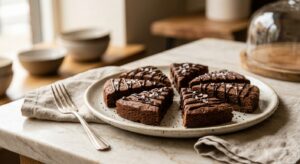
- Refrigerate the pan for at least 30 minutes, until the chocolate is fully set and firm. Lift out using the parchment overhang, place on a cutting board, and use a sharp chef’s knife to cut into bars or squares. For the cleanest cuts, warm the blade briefly under hot water and wipe dry between cuts. Serve cold or at cool room temperature.
Nutrition Per Serving
Per 1 serving (makes about 24 cookies (3 to 3.5 inches each))
Why This Recipe Works
The structure of a Florentine cookie is built almost entirely on caramelized sugar. When the butter, cream, sugar, and honey cook together and then bake in the oven, the sugar undergoes caramelization and the water evaporates, leaving behind a glassy, rigid sugar matrix that holds the almonds and orange peel in a thin, crisp lattice. The small amount of flour plays a supporting role, helping to bind the mixture so it holds together during the initial drop and spread, but it is the sugar that does the structural work. This is why baking to a deep amber color matters so much: a pale Florentine is one where not enough water has evaporated and not enough caramelization has occurred, producing a cookie that stays chewy or sticky instead of snapping cleanly.
The heavy cream in the caramel base serves two purposes. First, the fat content slows the rate of caramelization by buffering heat, which gives you a more even, controlled toffee rather than a sharply bitter one. Second, the milk proteins in the cream participate in Maillard browning reactions that add a deeper, more complex flavor beyond simple sugar caramel. This is the same reason caramel made with cream tastes richer than caramel made with just butter and sugar. The honey is not just sweetness: it contains invert sugars that resist crystallization, which helps keep the finished cookie glossy and smooth rather than grainy.
If your cookies come out of the oven misshapen or irregular, do not panic. While they are still warm (within the first 3 minutes), you can use a round cookie cutter slightly larger than the cookie to gently push and nudge the edges into a perfect circle. This is a classic patisserie trick and it works beautifully. If your cookies are too thick and not spreading enough, your caramel may have been cooked slightly too long and thickened too much, or your oven temperature may be running low. If they spread into one giant puddle, the caramel was not cooked quite long enough. Use the first batch as your test batch and adjust from there.
Baker’s Tips
- Toast your almonds before using them, even if the package says pre-toasted. A quick 5 to 8 minutes at 325°F (160°C) deepens their flavor dramatically and makes a noticeable difference in the finished cookie.
- Chop the candied orange peel into small, uniform pieces no larger than 5mm. Large chunks create uneven spreading and can make the cookies fragile at the edges.
- Use a silicone baking mat rather than parchment if you have one. The caramel releases more cleanly from silicone, and the cookies develop a slightly more even bottom color.
- Bake one sheet at a time on the center rack. Florentines are sensitive to heat from below and above; the center rack gives you the most even radiant heat from both elements.
- Your first batch is always your calibration batch. Ovens vary, so note whether your cookies needed more or less time and adjust accordingly for subsequent batches.
- To get clean, professional-looking chocolate drizzles, let the melted chocolate cool for 2 to 3 minutes until it thickens slightly to the consistency of heavy cream. Chocolate that is too hot will flood rather than drizzle.
- If you want to give these as gifts, wait until the chocolate has fully set, then layer them between sheets of parchment in a tin. They travel well and stay crisp for days.
Variations
- Espresso Florentines: Add 1 tsp instant espresso powder to the caramel base along with the butter and sugar. The coffee deepens the caramel flavor and pairs magnificently with dark chocolate.
- Spiced Florentines: Add 1/4 tsp ground cardamom and a tiny pinch of ground cloves along with the orange zest for a warmly spiced, almost Moroccan flavor profile.
- Pistachio and Rose Water: Replace the almonds with finely chopped pistachios and swap the orange zest for 1/2 tsp rose water and 2 tbsp finely chopped dried rose petals. Drizzle with white chocolate.
- Hazelnut and Lemon: Replace almonds with toasted hazelnuts (roughly chopped), and substitute the orange peel and zest with candied lemon peel and fresh lemon zest. Pair with milk chocolate for a Ferrero Rocher-adjacent experience.
Troubleshooting & FAQ
My Florentines came out chewy instead of crisp. What went wrong?
My cookies spread into one enormous flat puddle and merged together on the sheet.
The cookies are sticking to the parchment and tearing when I try to remove them.
My cookies are not round. They have irregular, uneven shapes.
My chocolate drizzle is clumping or seizing rather than flowing smoothly.
Storage & Make-Ahead
- Storage: Store cooled, chocolate-set cookies in a single layer in an airtight container at room temperature for up to 5 days. If stacking is necessary, place a sheet of parchment between layers. Avoid humid environments, as the caramel will absorb moisture and soften. Do not refrigerate finished cookies as condensation will make them sticky.
- Make-Ahead: The caramel batter can be made up to 24 hours ahead and stored in an airtight container in the refrigerator. Gently reheat in a saucepan over low heat, stirring until just fluid again, before portioning and baking. Baked and cooled undecorated cookies can be stored in an airtight tin for up to 3 days before adding the chocolate drizzle.