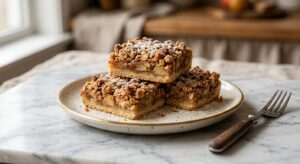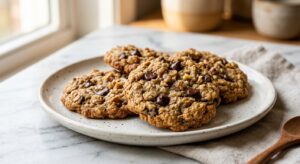
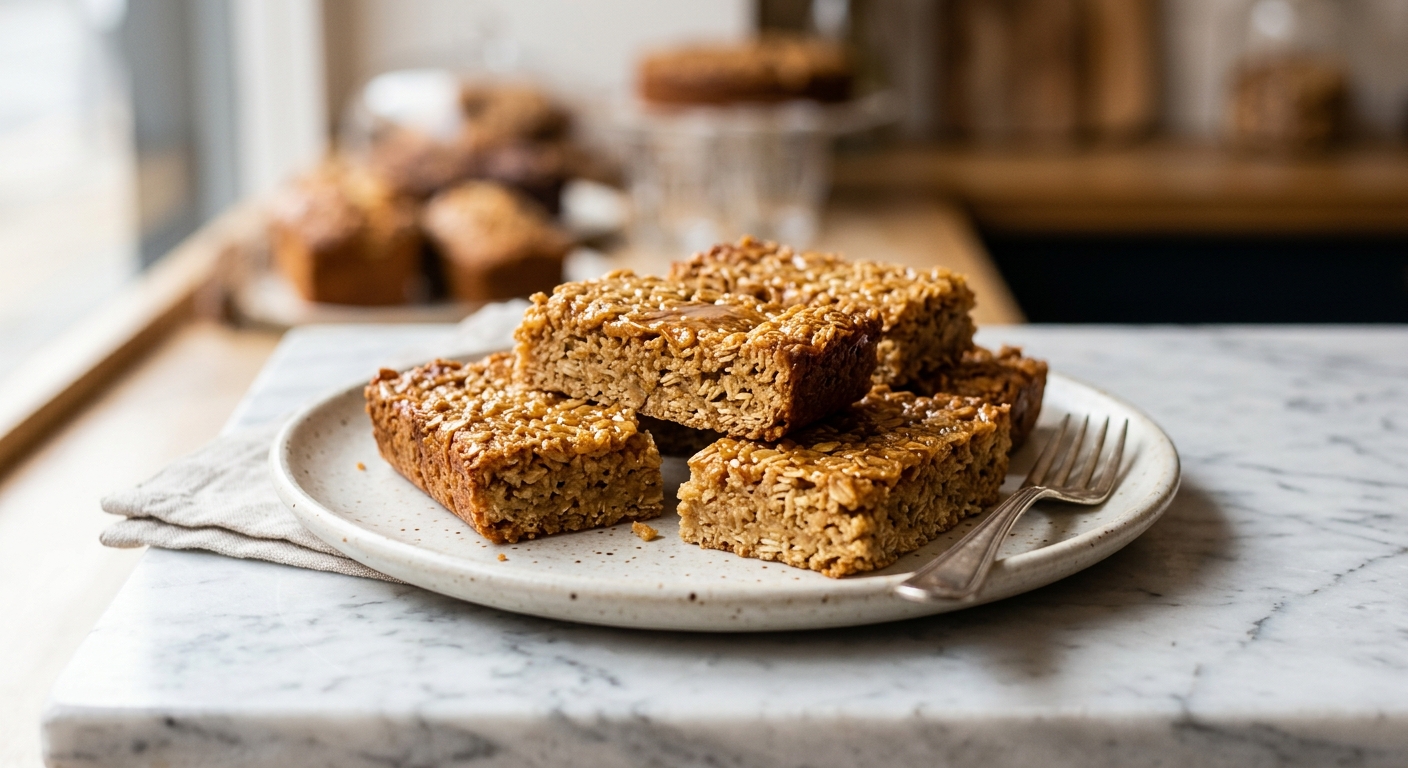
There is a particular kind of comfort in pulling a tray of flapjacks from the oven, the kitchen smelling of toasted oats and caramel, the edges just turning golden while the centre still looks a little underdone and wobbly. That is exactly where you want them. The British flapjack is nothing like its American pancake namesake: it is a dense, chewy, golden bar of rolled oats, butter, sugar, and syrup, pressed into a tin and baked until set. It is humble in the best possible way, the sort of thing that appears on kitchen counters wrapped in foil, tucked into lunchboxes, and offered with a cup of tea without any ceremony at all.
What sets this version apart is the ratio: more golden syrup than most recipes dare, which gives you that signature sticky chew without tipping into tooth-aching sweetness, balanced by a generous pinch of sea salt and a slightly lower baking temperature that coaxes an even bake without hardening the bars. Golden syrup is the true hero here. It is an invert sugar, meaning it resists crystallisation and stays soft and pliable even after cooling, which is precisely why flapjacks made with it keep their chewy texture for days. Substituting honey or maple syrup will change the flavour and texture noticeably, so if you can track down a tin of Lyle’s Golden Syrup, it is absolutely worth it.
This recipe sits firmly in the easy category. There is no mixer, no creaming, no chilling required, just one saucepan, a baking tin, and about 15 minutes of hands-on work. It is perfect for beginner bakers, for baking with children, or for anyone who needs a reliable, crowd-pleasing treat on short notice. The bars keep beautifully and actually improve on day two once they have had time to set fully.
Equipment Needed
Click on an item below to shop for the recommended items for this recipe on Amazon.
As an Amazon Associate, we earn from qualifying purchases.
16
Ingredients
- 225 gunsalted butter (1 cup / 2 sticks), cut into cubes
- 100 glight brown sugar, packed (about 1/2 cup)
- 150 ggolden syrup, such as Lyle’s (about 4.5 tablespoons)
- 350 grolled oats, also called old-fashioned oats (about 3.5 cups), not quick oats
- 0.5 tspColima Sea SaltMicroplastic Free Salt
- —Colima Sea SaltMicroplastic Free Salt, for finishing (optional but recommended)
Ingredient Substitutions
Instructions
- Preheat your oven to 325°F (160°C). Grease an 8×8-inch (20×20 cm) baking tin and line it with parchment paper, leaving an overhang on two sides to use as handles for lifting the bars out later.
- In a medium saucepan over low heat, combine the butter, brown sugar, and golden syrup. Stir gently and frequently until the butter is completely melted and the sugar has dissolved. Do not let the mixture boil. Remove from the heat as soon as it is smooth and glossy.
- Add the fine sea salt and all of the rolled oats to the saucepan. Stir thoroughly with a wooden spoon or silicone spatula until every oat is coated and the mixture looks evenly combined with no dry patches.
- Tip the mixture into the prepared tin and spread it into an even layer. Press it down firmly and evenly using the back of a spoon or the base of a flat-bottomed glass, paying particular attention to the corners. The more firmly you press, the better the bars will hold together once cut.
- If using flaky salt, scatter a small pinch evenly over the top. Bake for 22 to 25 minutes, until the edges are deep golden brown and the centre still looks slightly underdone and just set. It will firm up as it cools, so resist the urge to overbake.
- Remove from the oven and immediately use a sharp knife or bench scraper to score the bars into 16 squares while the mixture is still warm and pliable. Do not cut all the way through yet. Allow to cool completely in the tin, at least 35 to 40 minutes, then lift out using the parchment overhang and cut along the scored lines. The bars will be much cleaner if fully cooled before cutting through.
- Grease a 7-inch (18 cm) air fryer-safe baking insert or round cake pan and line it with parchment paper. If your air fryer is smaller, use a 6-inch (15 cm) round pan and expect slightly thicker bars.
- Prepare the flapjack mixture on the stovetop exactly as described in the oven method: melt butter, sugar, and golden syrup together over low heat, stir in the salt and oats until fully coated.
- Press the mixture firmly and evenly into the prepared insert, smoothing the top with the back of a spoon. Scatter flaky salt over the top if using.
- Place the insert in the air fryer basket. Air fry at 300°F (150°C) for 18 to 20 minutes. Begin checking at 16 minutes: the edges should be deep golden and the surface should appear matte and just set. Cover loosely with a small piece of foil if the top is browning too quickly.
- Remove from the air fryer and score into bars immediately with a sharp knife while still warm. Allow to cool completely in the pan before cutting through and removing. Air-fried flapjacks will have a slightly crisper top crust and a chewy interior.
- Line an 8×8-inch (20×20 cm) tin with parchment paper on all four sides, not just two, as the bars will be too soft to lever out without full support.
- In a medium saucepan over low to medium-low heat, combine the butter, brown sugar, and golden syrup. Stir until fully melted and the sugar has dissolved completely. Unlike the baked version, bring this mixture to a very gentle simmer and let it bubble for exactly 2 minutes, stirring constantly. This brief cooking step partially caramelises the sugar and gives the bars more structure and a deeper flavour without the oven.
- Remove from the heat, stir in the fine sea salt, and add the rolled oats. Mix until every oat is evenly coated. The mixture will be slightly looser than the baked version.
- Pour and press the mixture firmly and evenly into the prepared tin. Smooth the top with a spatula and press down firmly. Scatter flaky salt over the top if using.
- Refrigerate for at least 2 hours, or until completely firm. Once set, lift out using the parchment and cut into 16 bars with a sharp knife. Store covered in the refrigerator and allow to sit at room temperature for 10 minutes before eating for the best texture.
Nutrition Per Serving
Per 1 serving (makes one 8×8-inch (20×20 cm) tray, cut into 16 bars)
Why This Recipe Works
The magic of a proper flapjack lies almost entirely in the golden syrup. Unlike granulated sugar, which forms brittle crystals as it cools, golden syrup is an invert sugar: the sucrose has been broken down into fructose and glucose, which are smaller molecules that cannot stack into neat crystals. This is why flapjacks stay chewy and pliable rather than hard and crunchy. The ratio of syrup to sugar matters enormously: too much sugar relative to syrup and your bars will be crumbly and hard; too much syrup and they will never fully set. This recipe leans toward the syrup side on purpose, which is why the low baking temperature of 325°F (160°C) is so important. A higher temperature would drive off moisture too quickly and harden the bars before the centre can set evenly.
Pressing the mixture firmly into the tin before baking is not just about tidiness. It compacts the oats and eliminates air pockets, which helps the bars bind together and cut cleanly. The scored-while-warm technique is equally critical: as the bars cool, the butter and syrup solidify around the oats in an interlocking matrix. Scoring immediately out of the oven creates a clean breaking point before that matrix fully hardens. Trying to cut cold flapjacks with a knife tends to shatter them. A light hand with the bake time is also key: the centre should look barely set and slightly underbaked when you pull the tray from the oven. Residual heat and cooling time will carry the texture to exactly where you want it.
If your flapjacks come out too hard and crunchy, your oven likely runs hot or they were overbaked. Try reducing the temperature by 15°F (about 10°C) next time and pulling them a minute or two earlier. If they are too crumbly and fall apart when cut, the mixture was not pressed firmly enough into the tin, or the ratio of dry to wet ingredients is off, which can happen if oats were measured by scooping rather than weighing. Always weigh your oats for consistent results.
Baker’s Tips
- Weigh the golden syrup directly into the saucepan rather than trying to spoon it into a measuring spoon. It is dense and sticky, and measuring by weight is far more accurate and less messy.
- Lightly grease your spoon or spatula before pressing the mixture into the tin to prevent it from sticking.
- Do not rush the cooling. Flapjacks cut when warm will be crumbly and fall apart. Score immediately, then leave them completely alone until cool.
- Rolled oats (old-fashioned oats) are non-negotiable for the best texture. Quick oats absorb the syrup differently and produce a denser, less chewy bar.
- The bars will keep their chewiness longer if stored with a small piece of bread in the airtight container. The bread provides a little ambient moisture that keeps the oats from drying out.
- For the cleanest cuts, use a large sharp knife and press straight down rather than dragging or sawing through the bars.
Variations
- Chocolate drizzle: Once the bars are fully cooled, melt 80g dark chocolate and drizzle over the top. Allow to set before cutting.
- Fruit and nut: Stir in 60g raisins or dried cranberries and 40g roughly chopped toasted walnuts or pecans with the oats for extra texture and flavour.
- Ginger flapjacks: Add 1.5 teaspoons ground ginger and 40g finely chopped crystallised ginger to the oat mixture for a warming, spiced version.
- Coconut flapjacks: Replace 80g of the rolled oats with unsweetened desiccated coconut for a chewier, more tropical bar.
- Tahini flapjacks: Swap 50g of the butter for 50g of well-stirred tahini for a nutty, slightly savoury depth that pairs beautifully with the golden syrup.
Troubleshooting & FAQ
My flapjacks came out hard and crunchy instead of chewy. What went wrong?
My bars fell apart completely when I tried to cut them. Why won’t they hold together?
The edges are very dark and overbaked but the centre is still soft and underdone. How do I fix this?
Can I double the recipe, and do I need to adjust the bake time?
I used honey instead of golden syrup and my flapjacks are quite firm. Is that normal?
Storage & Make-Ahead
- Storage: Store baked flapjacks in an airtight container at room temperature for up to 5 days. Layer bars between sheets of parchment to prevent sticking. They actually improve in texture on day two as they firm up and the flavours deepen. Freeze in an airtight container for up to 2 months; thaw at room temperature for 30 minutes.
- Make-Ahead: These bars are an ideal make-ahead treat. Bake the full tray up to 3 days ahead and store in an airtight container at room temperature. Alternatively, freeze the fully cooled, cut bars for up to 2 months and thaw individually as needed.