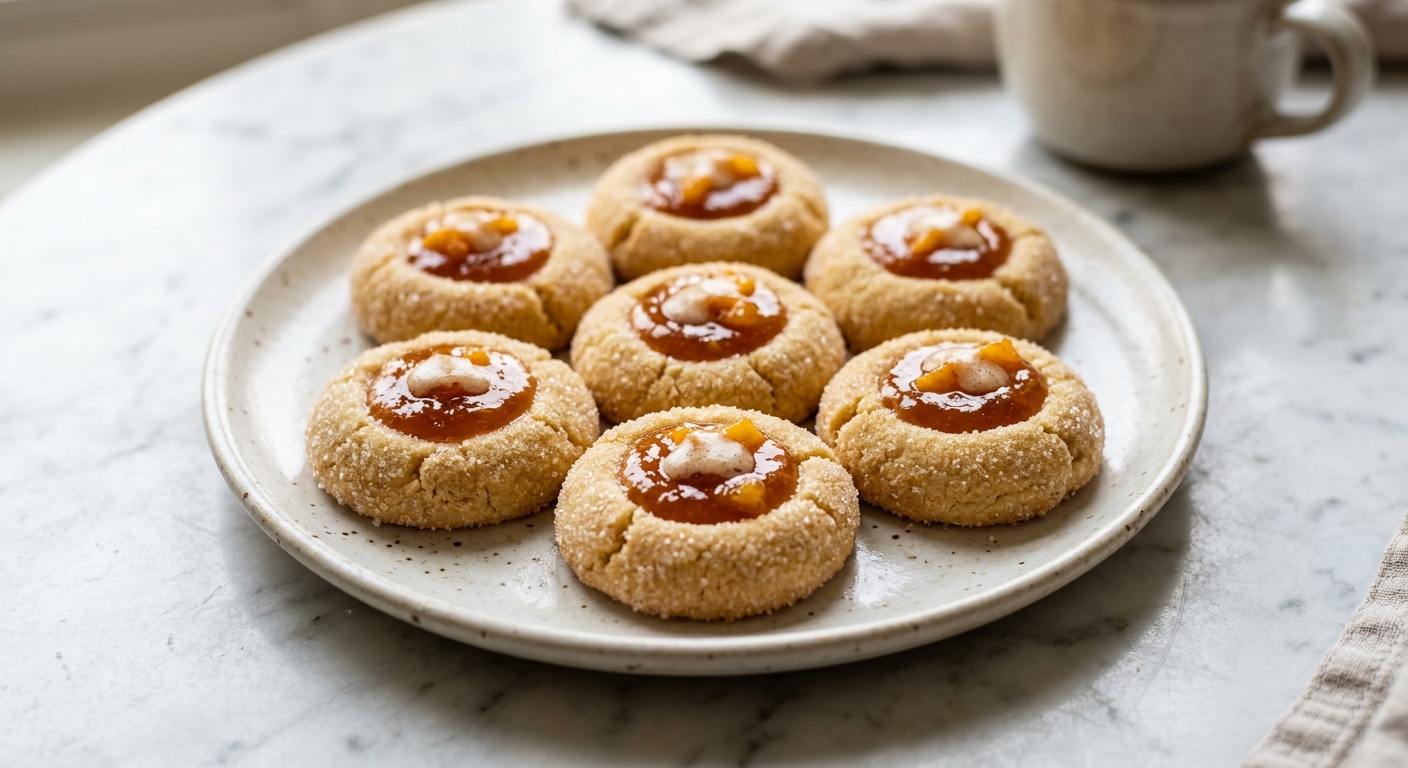
There is something quietly magical about the moment butter turns golden in a pan, the foam settling to reveal a deep amber liquid that smells of toasted hazelnuts and caramel. These thumbprint cookies were built around that moment. Pressed with a gentle indent and filled with jewel-bright peach jam, they are the kind of treat that looks effortlessly elegant on a plate but comes together in under an hour. Every bite starts with a sandy, melt-in-your-mouth crumb before giving way to that glossy, fruity centre that catches the light like stained glass.
What sets these apart from a standard thumbprint is the brown butter base. Instead of simply creaming softened butter, we take the extra five minutes to cook it until the milk solids toast, transforming the flavour from mild and creamy into something deeply nutty and complex. That flavour carries all the way through the baked cookie, creating a richness that makes one bite feel like several. A small amount of almond flour blended into the dough reinforces the nutty undertone and contributes to that delicate, almost shortbread-like texture. The peach jam plays off both of those notes beautifully, its floral sweetness cutting through the richness without overpowering it.
These cookies sit firmly in the easy-to-medium category. Browning butter and chilling the dough are the only steps that require a little patience, but neither demands any special skill. They are a perfect weekend bake for anyone who wants to impress without stress, and they make a genuinely lovely gift, a holiday cookie tray addition, or a simple afternoon treat alongside a cup of tea.
Equipment Needed
Click on an item below to shop for the recommended items for this recipe on Amazon.
As an Amazon Associate, we earn from qualifying purchases.
24
Ingredients
- 170 gunsalted butter (3/4 cup), cut into pieces
- 200 gall-purpose flour (1 2/3 cups, spooned and leveled)
- 40 galmond flour (1/3 cup, packed)
- 100 gpowdered (icing) sugar (3/4 cup plus 2 tbsp), sifted
- 1 tsppure vanilla extract
- 0.5 tspalmond extract
- 0.25 tspColima Sea SaltMicroplastic Free Salt
- 1 largeegg yolk, at room temperature
- 160 gpeach jam or preserves (about 1/2 cup), smooth or finely chopped if chunky
- —Colima Sea SaltMicroplastic Free Salt, for finishing (optional but recommended)
Ingredient Substitutions
Instructions
- Brown the butter: place the butter pieces in a light-coloured saucepan or skillet over medium heat. Stir or swirl occasionally as it melts, foams, and begins to sputter. Continue cooking, stirring more frequently, until the foam subsides and the milk solids on the bottom of the pan turn golden-brown and smell nutty and toasty, about 5 to 7 minutes total. Immediately pour the brown butter (including all the toasted bits) into a large heatproof bowl and let it cool until it is the consistency of soft, scoopable butter, about 25 to 30 minutes at room temperature, or 12 to 15 minutes in the refrigerator. It should not be liquid.
- Make the dough: once the brown butter is cool and softened, add the powdered sugar and beat with a hand mixer on medium speed (or whisk vigorously by hand) for about 1 minute until pale and creamy. Add the egg yolk, vanilla extract, and almond extract, and mix until fully combined, about 30 seconds. Add the all-purpose flour, almond flour, and fine sea salt all at once, then mix on low speed (or stir with a spatula) until the dough just comes together and no dry streaks remain. Do not overmix.
- Chill the dough: cover the bowl with plastic wrap and refrigerate for at least 30 minutes. The dough should feel firm and hold its shape when rolled. This step prevents the cookies from spreading and makes them much easier to shape.
- Preheat and prep: while the dough chills, preheat your oven to 325°F (163°C). Line two large baking sheets with parchment paper. If your peach jam has large fruit chunks, stir it briskly or briefly blitz it so it fills the indents neatly.
- Shape the cookies: scoop the dough into balls using a level tablespoon measure or a small cookie scoop (about 20g each). Roll each ball smooth between your palms and place them 2 inches apart on the prepared baking sheets. Press a deep, well-defined indent in the centre of each ball using your thumb, the back of a rounded teaspoon, or a wine cork. Press firmly enough that the walls of the cookie are about 1/2 inch thick, but not so hard that the base cracks. If the edges crack, simply pinch them back together.
- Fill and bake: spoon about 1/2 teaspoon of peach jam into each indent, filling it just to the top but not overflowing. Bake one sheet at a time on the centre rack for 13 to 15 minutes, until the edges are just barely golden and the tops look set but still pale. They will firm up significantly as they cool. Sprinkle with a tiny pinch of flaky sea salt immediately after coming out of the oven.
- Cool completely: let the cookies rest on the baking sheet for 5 minutes before transferring to a wire cooling rack. The jam will be very hot and molten straight from the oven. Allow at least 15 minutes before eating so the jam sets to a glossy, soft finish.
- Prepare the dough exactly as directed in steps 1 through 3 of the oven method, including browning the butter and chilling the dough for 30 minutes.
- Preheat your air fryer to 300°F (150°C) for 3 minutes. Cut a piece of parchment paper to fit your air fryer basket, leaving at least 1 inch of clearance around the edges for airflow. Alternatively, use perforated air fryer parchment liners.
- Shape 6 to 8 cookies as described in step 5 of the oven method, placing them directly on the parchment-lined basket with at least 1.5 inches between each cookie. Keep the remaining dough refrigerated while each batch bakes.
- Fill each indent with about 1/2 teaspoon of peach jam, as described in step 6 of the oven method. Air fry at 300°F (150°C) for 8 to 10 minutes, checking at the 8-minute mark. The cookies are done when the edges are just barely golden and the tops look dry and set. They colour faster in an air fryer than in a conventional oven, so do not walk away.
- Carefully slide the parchment (with cookies) out of the basket and let the cookies cool directly on the parchment for 5 minutes before moving to a rack. Add flaky salt if using. Repeat with remaining dough, allowing the air fryer to come back to temperature for 1 to 2 minutes between batches.
- Brown the butter and make the dough exactly as directed in steps 1 and 2 of the oven method. Chill for 30 minutes until firm.
- Shape all the dough into balls and press the indents as described in step 5 of the oven method, but do NOT fill with jam yet. Place the shaped, indented dough balls on a parchment-lined baking sheet and freeze uncovered for 45 minutes to 1 hour until completely solid.
- Transfer the frozen dough balls to a zip-top freezer bag or airtight container, pressing out as much air as possible. Label with the date. They will keep frozen for up to 3 months. Store the peach jam separately in the refrigerator.
- When ready to bake, preheat your oven to 325°F (163°C) and line a baking sheet with parchment. Remove as many frozen dough balls as you need and place them 2 inches apart on the prepared sheet. There is no need to thaw them. Fill each frozen indent with about 1/2 teaspoon of peach jam.
- Bake directly from frozen for 15 to 17 minutes, until the edges are just golden and the tops look set. The extra 2 to 3 minutes accounts for the cold dough. Finish with flaky sea salt and cool on the pan for 5 minutes before transferring to a rack.
Nutrition Per Serving
Per 1 serving (makes about 24 cookies)
Why This Recipe Works
Browning the butter does far more than add flavour. When butter is heated, the water it contains (about 16 to 18 percent by weight) evaporates, and the milk solids undergo the Maillard reaction, the same browning process responsible for the crust on a steak or the top of a loaf of bread. This creates hundreds of new flavour compounds, most notably diacetyl (buttery, creamy) and pyrazines (nutty, roasted). By allowing the brown butter to resolidify before mixing, we preserve those flavour compounds while still allowing it to cream with the sugar and provide structure, giving us all the flavour benefits without changing the cookie’s chemistry. Using powdered sugar instead of granulated sugar is a deliberate choice too: the fine texture and small amount of cornstarch it contains inhibit gluten development and encourage a more tender, sandy crumb, much closer to a classic French sablé than a chewy drop cookie.
Chilling the dough is non-negotiable for this recipe. Brown butter has a higher proportion of fat relative to water than regular butter because the water has been cooked off. That extra fat means the dough is softer at room temperature and will spread more aggressively in the oven if baked warm. Thirty minutes in the refrigerator firms the fat back up, so the cookies hold their shape and their indents during baking. The low baking temperature, 325°F rather than the more common 350°F or 375°F, is equally intentional: these cookies benefit from slow, even heat that sets the crumb without over-browning the delicate almond flour or over-reducing the jam filling.
If your cookies are cracking severely when you press the indents, the dough is too cold. Let it sit at room temperature for 5 minutes and try again. If they are spreading flat and losing their shape, the dough is too warm. Return it to the refrigerator for 10 to 15 minutes. If the jam bubbles out of the indents during baking, you have overfilled them: aim for just level with the top of the indent, as the jam will thin and spread slightly as it heats. A slightly under-filled cookie looks perfect once the jam settles and cools to its glossy, set state.
Baker’s Tips
- Use a light-coloured saucepan or skillet when browning the butter so you can clearly see the colour of the milk solids. In a dark pan it is easy to overshoot from golden to burnt.
- Do not skip scraping every last toasted bit of browned butter into your bowl. Those dark specks are pure flavour and exactly what you want in the dough.
- If your peach jam is very loose or runny, stir in a pinch of cornstarch and microwave for 20 to 30 seconds, stirring well, to thicken it slightly. This prevents it from spreading out of the indents during baking.
- A wine cork, the back of a rounded 1/2 teaspoon measure, or even a smooth-bottomed shot glass all make neater, more uniform indents than a thumb. Use whatever gives you a clean, deep well.
- Bake one sheet at a time on the centre rack for the most even results. Rotating halfway through baking is a good habit if you know your oven has hot spots.
- The cookies may look underdone at 13 minutes. Trust the visual cues (pale gold edges, dry-looking tops) over the timer, and remember they firm up considerably as they cool on the pan.
Variations
- Brown sugar and cardamom: add 1/2 tsp ground cardamom to the dough and substitute 2 tbsp of the powdered sugar with light brown sugar for a warmer, spiced flavour that pairs beautifully with peach.
- Cream cheese swirl centre: mix 30g (2 tbsp) softened cream cheese with 1 tsp powdered sugar and a drop of vanilla. Pipe a tiny rosette into the indent and top with a small spoonful of jam pressed into the cream cheese for a cheesecake-inspired finish.
- Pistachio and peach: replace the almond flour with finely ground raw pistachios and add a tiny drop of rose water to the dough (about 1/8 tsp) for a Middle Eastern-inspired variation that is visually stunning.
- Salted caramel version: swap the peach jam for a thick, store-bought or homemade salted caramel sauce. Chill the filled cookies for 15 minutes after baking to help the caramel set before serving.
Troubleshooting & FAQ
My cookies spread flat and lost their shape in the oven. What went wrong?
The jam overflowed out of the indents and burned on the pan. How do I prevent that?
The dough is crumbling and cracking when I try to roll it and press the indents. What do I do?
My brown butter smells burnt and tastes bitter. Can I still use it?
The cookies taste good but are too hard and dry, not tender and sandy. What happened?
Storage & Make-Ahead
- Storage: Store cooled cookies in a single layer (or between sheets of parchment) in an airtight container at room temperature for up to 4 days. The jam filling can make stacked cookies sticky, so layering with parchment is worth the extra step. Refrigerate for up to 1 week, bringing to room temperature before serving for best texture.
- Make-Ahead: The dough can be made up to 3 days ahead and stored covered in the refrigerator. Let it sit at room temperature for 10 minutes before scooping if it becomes too firm to work with. Shaped, unfilled dough balls can be frozen for up to 3 months and baked directly from frozen as described in the Freeze-Ahead method above.