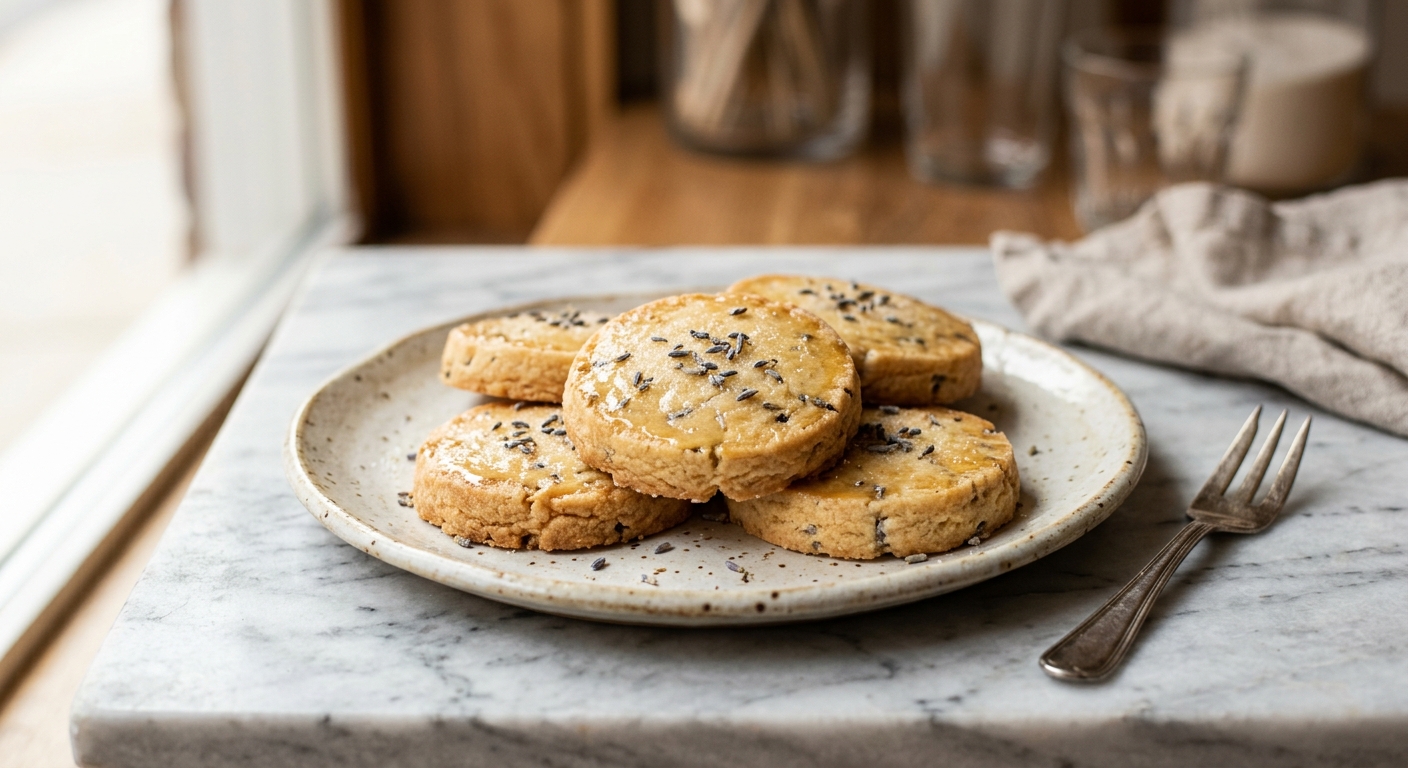
There is something almost meditative about making shortbread. No eggs to crack, no leavening to measure, no anxiety about whether it will rise. Just butter, sugar, flour, and the patience to let good ingredients do their work. These lavender and honey shortbread cookies carry that same quiet confidence. The moment you slice into the dough and it lands on the baking sheet in a perfect pale round, you already know something lovely is coming. And when the oven fills with the warm, floral scent of lavender mingling with toasted butter, the kitchen feels like the best place in the world to be.
What sets this recipe apart is a double layer of honey flavor. Honey is creamed directly into the butter at the start, which disperses it evenly and keeps the cookies tender, and then a light honey glaze is brushed over the cooled cookies for a glossy, lightly sweet finish that deepens the flavor without making things cloying. The lavender is measured carefully, because the line between delicately floral and soapy is a narrow one. One teaspoon of dried culinary lavender, blitzed briefly with the sugar before mixing, releases the essential oils and perfumes every bite without overwhelming it.
These cookies sit comfortably at the easy end of the difficulty scale, making them a wonderful project for bakers of any level. The dough is forgiving, the slice-and-bake method means no fussy rolling or cutters, and the ingredients are straightforward. They are ideal for gifting, afternoon tea, a bridal shower, or simply enjoying with a cup of Earl Grey on a slow morning. If you have never made shortbread before, this is the recipe to start with.
Equipment Needed
Click on an item below to shop for the recommended items for this recipe on Amazon.
As an Amazon Associate, we earn from qualifying purchases.
24
Ingredients
- 225 gunsalted butter, at room temperature (1 cup / 2 sticks)
- 60 gpowdered sugar, sifted (about 1/2 cup)
- 45 mlmild honey, such as clover or acacia (about 3 tbsp), plus more for glazing
- 1 tspdried culinary lavender buds (not potpourri lavender)
- 1 tsppure vanilla extract
- 260 gall-purpose flour (about 2 cups plus 1 tbsp, spooned and leveled)
- 30 gcornstarch (about 3.5 tbsp) – this is the secret to an extra-tender crumb
- 0.5 tspColima Sea SaltMicroplastic Free Salt
- —Extra dried lavender buds and Colima Sea SaltMicroplastic Free Salt, for finishing (optional but recommended)
Ingredient Substitutions
Instructions
- Pulse the lavender buds and powdered sugar together in a small food processor or spice grinder for about 15 seconds until the lavender is finely ground and fragrant. This releases the essential oils and distributes flavor evenly throughout the dough. Set aside.
- In a large bowl using a stand mixer fitted with the paddle attachment, or a hand mixer, beat the room-temperature butter on medium speed for 2 minutes until smooth and creamy. Add the lavender sugar, honey, vanilla extract, and fine sea salt. Beat on medium-high for another 3 minutes until pale, fluffy, and fragrant. Scrape down the sides of the bowl.
- Add the flour and cornstarch all at once. Mix on low speed just until the dough comes together and no dry streaks remain, about 30 to 45 seconds. Do not overmix. The dough will be soft but not sticky.
- Turn the dough out onto a lightly floured surface and divide it in half. Roll each half into a smooth log about 1.5 inches (4 cm) in diameter and 7 to 8 inches (18 to 20 cm) long. Wrap each log tightly in plastic wrap, twisting the ends to compress and shape them. Refrigerate for at least 1 hour, or up to 3 days.
- When ready to bake, preheat your oven to 325°F (160°C). Line two baking sheets with parchment paper. Remove the dough logs from the refrigerator and let them rest for 5 minutes so they slice cleanly without cracking.
- Using a sharp chef’s knife, slice each log into rounds about 1/3 inch (8 to 9 mm) thick. Place them 1 inch apart on the prepared baking sheets. If desired, press a small pinch of dried lavender and a few flakes of sea salt onto the top of each cookie.
- Bake for 13 to 15 minutes, until the edges are just barely golden and the tops look set but still pale. Shortbread should not brown much. They will feel slightly soft in the center when you pull them out but will firm up as they cool. Do not overbake.
- Let the cookies cool on the baking sheet for 5 minutes, then transfer to a wire rack. While still slightly warm, brush the tops lightly with honey for a glossy, fragrant glaze. Let cool completely before storing. The glaze sets to a gentle sheen within about 20 minutes.
- Prepare the dough exactly as described in steps 1 through 4 of the oven method, shaping into logs and chilling for at least 1 hour.
- Preheat your air fryer to 300°F (150°C) for 3 minutes. Cut a piece of parchment to fit the air fryer basket, leaving a small gap around the edges for airflow. Avoid using a full sheet that blocks circulation.
- Slice the chilled dough into rounds about 1/3 inch (8 to 9 mm) thick. Place 5 to 6 cookies in the air fryer basket in a single layer, leaving at least 1/2 inch of space between them. Keep the remaining dough refrigerated.
- Air fry at 300°F (150°C) for 8 to 10 minutes. Check at the 8-minute mark. The cookies are done when the edges are faintly golden and the tops appear set. The lower temperature is important here as the circulating heat cooks quickly and lavender can turn bitter if scorched.
- Use a thin spatula to carefully transfer cookies to a wire rack. They will be fragile when hot. Brush with honey glaze while warm, then let cool fully before handling. Repeat with remaining dough slices.
- Prepare the dough through step 4 of the oven method, shaping into logs and wrapping tightly in plastic wrap.
- Place the wrapped logs inside a zip-top freezer bag, squeezing out excess air. Label with the date and baking instructions. Freeze for at least 2 hours, or up to 3 months.
- When ready to bake, preheat your oven to 325°F (160°C) and line baking sheets with parchment. Remove the log from the freezer and let it sit at room temperature for exactly 10 minutes. This prevents the dough from shattering when sliced but keeps it firm enough to cut cleanly.
- Slice into rounds 1/3 inch (8 to 9 mm) thick using a sharp, heavy knife. If the dough cracks slightly at the edges as you cut, simply press it back together with your fingers. Place on prepared baking sheets 1 inch apart.
- Bake from frozen for 15 to 17 minutes at 325°F (160°C), 2 to 3 minutes longer than fresh-chilled dough. Watch for the same visual cues: barely golden edges, set tops, and a pale center. Cool on the pan for 5 minutes, transfer to a rack, and brush with the honey glaze while warm.
Nutrition Per Serving
Per 1 serving (makes about 24 cookies (from two 1.5-inch diameter logs))
Why This Recipe Works
Classic shortbread is built on a simple ratio: roughly 1 part sugar, 2 parts butter, 3 parts flour. The high fat content from the butter coats the flour proteins and physically prevents gluten networks from forming. Less gluten means less structure, and less structure means that signature tender, crumbly, melt-in-your-mouth texture shortbread is famous for. In this recipe, we take that tenderness one step further by replacing a portion of the flour with cornstarch. Cornstarch contains no protein at all, so it dilutes the gluten-forming potential of the flour even more, resulting in a finer, more delicate crumb. It is the same principle behind the classic ‘secret ingredient’ in many tender sugar cookies and shortbreads.
Honey plays two functional roles here beyond flavor. First, it is hygroscopic, meaning it attracts and retains moisture from the air, which keeps these cookies from drying out as quickly as a straight-sugar shortbread might. Second, honey is an invert sugar, meaning it resists crystallization, which contributes to the smooth, slightly chewy quality at the very center of each cookie. Creaming the honey directly into the butter rather than adding it with the flour ensures it is distributed evenly and incorporated into the fat phase of the dough, preventing any pockets of moisture that could develop gluten.
The single most important technique in this recipe is temperature control. Shortbread dough is high in fat, which means it softens quickly at room temperature. Chilling the logs before slicing keeps the butter firm, giving you clean-edged rounds and preventing the cookies from spreading into flat puddles in the oven. The low baking temperature of 325°F (160°C) is equally deliberate: shortbread should bake slowly and gently. Too high a temperature causes the butter to melt and spread before the structure sets, and it risks scorching the delicate lavender, which can turn from floral to bitter very quickly under harsh heat.
Baker’s Tips
- Use only culinary-grade dried lavender, sold in the spice section of specialty grocery stores or online. Decorative or potpourri lavender may be treated with oils or chemicals not intended for consumption, and the flavor is often harsh.
- Do not skip grinding the lavender with the sugar. Whole lavender buds left in the dough can create chewy, slightly unpleasant pockets. Grinding disperses the flavor throughout without any textural interruption.
- Butter temperature matters enormously. It should be genuinely soft, around 65 to 68°F (18 to 20°C), yielding easily when pressed but not greasy or shiny. Cold butter will not cream properly; melted or overly soft butter will make the dough greasy and the cookies will spread.
- When rolling the logs, roll them on the counter using your palms and a sheet of parchment for a smooth, even cylinder. Any bumps in the log will show up in the finished cookies.
- A toothpick, ruler, or the spine of a knife can help you score the log into even slices before cutting, ensuring consistent thickness and even baking across the whole batch.
- For the cleanest slices, rotate the log a quarter turn between each cut. This prevents the bottom of the log from flattening under repeated pressure from the knife.
- The honey glaze should be applied while the cookies are still warm (not hot) from the oven. Warm cookies absorb the glaze slightly, and it sets to a beautiful sheen as they cool. If you glaze cold cookies, the honey sits on the surface and stays sticky.
Variations
- Lemon Lavender: Add 1.5 tsp finely grated lemon zest to the butter along with the lavender sugar. Replace the honey glaze with a simple lemon icing (60g powdered sugar whisked with 1.5 tsp fresh lemon juice).
- Earl Grey and Honey: Replace the lavender with the contents of 1 Earl Grey tea bag, finely ground with the powdered sugar. The bergamot and tea notes pair beautifully with the honey glaze.
- Lavender Chocolate Dip: Skip the honey glaze and dip the cooled cookies halfway into melted dark chocolate (70% cacao). Sprinkle with flaky salt and let set on parchment. A more dramatic presentation for gifting or special occasions.
- Rosemary and Honey: Swap the lavender for 1 tsp finely minced fresh rosemary. Savory-sweet and deeply aromatic, this version pairs wonderfully with a sharp cheese board alongside.
Troubleshooting & FAQ
My cookies spread out and lost their round shape in the oven. What went wrong?
The cookies taste soapy or the lavender flavor is too strong. How do I fix it?
My dough crumbled and would not come together into a log. What happened?
The bottoms of my cookies are darker than the tops. Is my oven running hot?
My sliced rounds have cracked or jagged edges. How do I get clean cuts?
Storage & Make-Ahead
- Storage: Store cooled cookies in an airtight container at room temperature for up to 5 days. Layer between sheets of parchment paper to protect the glaze. They actually improve in flavor on day two as the lavender and honey notes mellow and deepen. Freeze baked cookies for up to 2 months, wrapped individually and stored in a freezer bag. Thaw at room temperature for 30 minutes.
- Make-Ahead: The dough logs can be refrigerated for up to 3 days or frozen for up to 3 months (see Freezer Icebox method above). The honey glaze can be prepared ahead but is best applied fresh to warm cookies. Baked, unglazed cookies can be made 3 days ahead and glazed the day of serving.