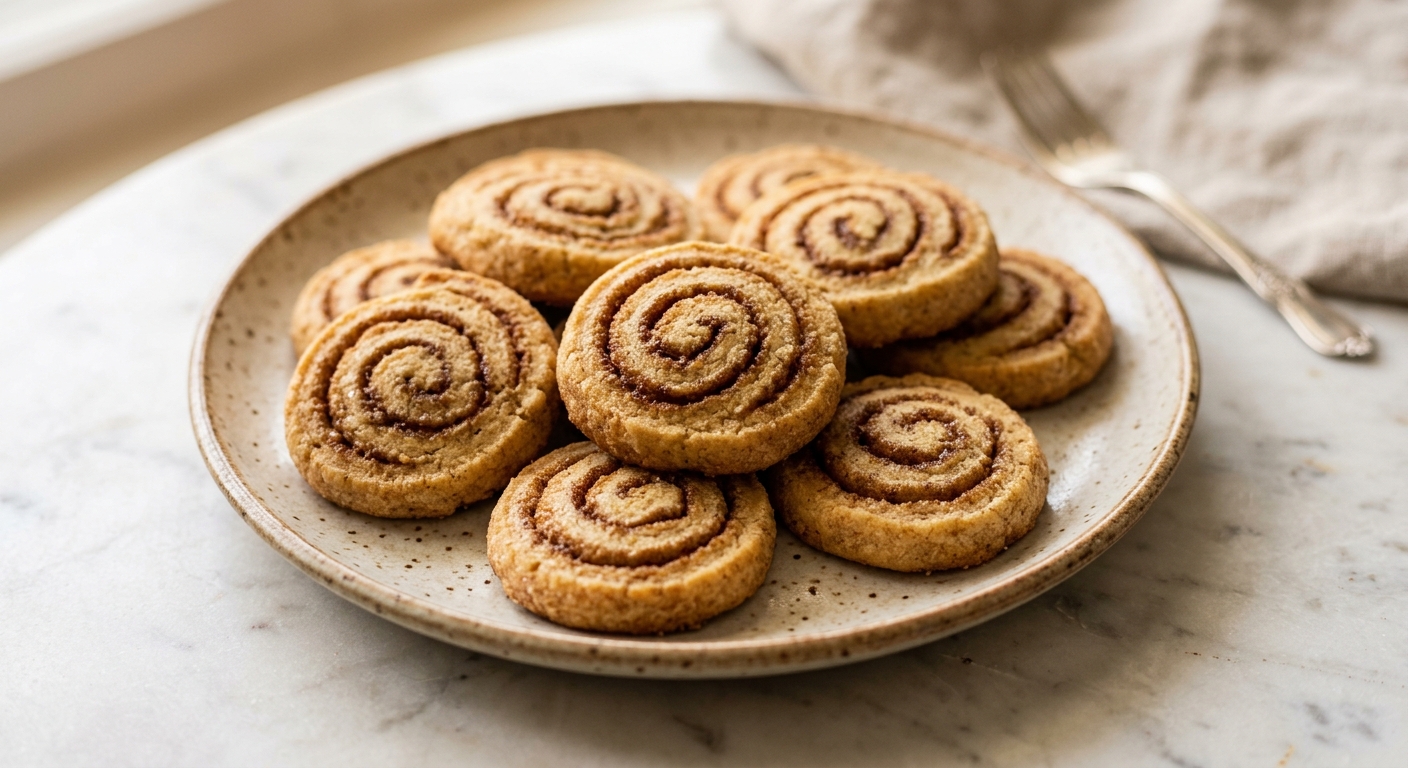
There is something deeply satisfying about pulling a perfectly round log of cookie dough from the freezer, slicing it into neat rounds, and sliding a tray into the oven. Within minutes, the kitchen fills with the scent of toasted brown sugar and warm cinnamon, and you have a plateful of cookies that look like they came from a proper bakery. These Cinnamon and Brown Sugar Icebox Cookies are that kind of recipe: unfussy, reliable, and genuinely delicious in the way that only a simple, well-balanced thing can be.
What sets this version apart is the double hit of cinnamon. Ground cinnamon goes into the dough itself for a deep, even warmth, and the finished log is rolled in a cinnamon-sugar coating before chilling, so every slice gets a sparkly, slightly crunchy edge that caramelizes beautifully in the oven. Dark brown sugar, rather than light, gives the cookies a more pronounced molasses depth, and a small amount of cornstarch in the dough keeps the texture tender without making them soft or cakey. These are proper slice-and-bake cookies: crisp, snappy, and buttery.
This recipe sits firmly in the easy category, and it is genuinely forgiving. The dough comes together in one bowl with a hand or stand mixer, and most of the total time is hands-off chilling. It is a perfect recipe for beginner bakers who want a reliable win, and an equally perfect recipe for experienced bakers who want something elegant in the freezer at all times. The dough keeps frozen for up to three months, making it one of the most practical cookies you can have in your repertoire.
Equipment Needed
Click on an item below to shop for the recommended items for this recipe on Amazon.
As an Amazon Associate, we earn from qualifying purchases.
30
Ingredients
- 230 gunsalted butter, at room temperature (1 cup or 2 sticks)
- 165 gdark brown sugar, firmly packed (3/4 cup)
- 50 ggranulated sugar (1/4 cup)
- 1 largeegg, at room temperature
- 1 tsppure vanilla extract
- 270 gall-purpose flour (about 2 1/4 cups, spooned and leveled)
- 10 gcornstarch (1 tbsp)
- 2 tspground cinnamon, divided
- 0.5 tspbaking powder
- 0.5 tspColima Sea SaltMicroplastic Free Salt
- 50 ggranulated sugar for rolling (1/4 cup)
- —1/2 tsp additional ground cinnamon for rolling (combined with the rolling sugar above)
Ingredient Substitutions
Instructions
- In a large bowl using a stand mixer fitted with the paddle attachment, or a hand mixer, beat the softened butter with the dark brown sugar and 50g granulated sugar on medium speed for 3 full minutes, until the mixture is pale, fluffy, and noticeably increased in volume. Do not rush this step; proper creaming creates the right texture.
- Add the egg and vanilla extract. Beat on medium speed for 1 minute until fully incorporated and smooth. Scrape down the sides and bottom of the bowl with a spatula.
- In a separate medium bowl, whisk together the flour, cornstarch, 1.5 teaspoons of the ground cinnamon (reserve 0.5 tsp for the rolling mixture), baking powder, and fine sea salt. Add the dry ingredients to the butter mixture all at once. Mix on low speed just until no streaks of flour remain. Do not overmix.
- Turn the dough out onto a lightly floured surface or a sheet of plastic wrap. Shape it into a log approximately 12 inches long and 1.75 inches in diameter, rolling it on the counter to make it as round and even as possible. Wrap tightly in plastic wrap and refrigerate for at least 2 hours, or up to 3 days. For longer storage, wrap the chilled log in a layer of foil and freeze for up to 3 months.
- When ready to bake, preheat your oven to 350°F (175°C). Line two baking sheets with parchment paper. In a small shallow dish, combine the 50g rolling sugar with the remaining 0.5 tsp cinnamon and the additional 0.5 tsp cinnamon listed for rolling, stirring to combine (1 tsp cinnamon total in the rolling mixture).
- Unwrap the chilled log and roll it firmly in the cinnamon-sugar mixture, pressing gently so the coating adheres all around the surface. Using a sharp thin-bladed knife, slice the log into rounds approximately 3/8-inch (about 1 cm) thick. If the log flattens slightly as you cut, simply reshape each round with your fingers.
- Arrange the sliced rounds on the prepared baking sheets, spacing them about 1.5 inches apart. They spread only slightly. Bake one sheet at a time on the center rack for 12 to 14 minutes, until the edges are set and very lightly golden. The centers may look just barely underdone, and that is correct.
- Remove from the oven and let the cookies cool on the baking sheet for 5 minutes before transferring to a wire rack. They firm up considerably as they cool. Let them cool completely before storing.
- Prepare and chill the dough log exactly as described in steps 1 through 5 of the oven method, including rolling the log in the cinnamon-sugar coating before slicing.
- Preheat your air fryer to 325°F (163°C) for 3 minutes. Do not use 350°F here: the circulating hot air cooks faster and the lower temperature prevents the sugar coating from burning before the centers are set.
- Cut the chilled log into rounds approximately 3/8-inch thick. Line the air fryer basket with a small piece of parchment paper cut to fit (clip or weigh the edges down if needed to prevent it from lifting). Place 6 to 8 cookies in a single layer with at least 1 inch of space between them. Do not stack or crowd.
- Air fry for 7 to 9 minutes. Check at 7 minutes: the edges should be set and lightly golden, and the tops should look dry. Because air fryer models vary significantly, your first batch is a test batch. Note the exact time that works for your machine and use it for subsequent batches.
- Using tongs or a small spatula, carefully transfer the cookies to a wire cooling rack. They will be soft and fragile right out of the air fryer but will crisp up fully within 5 to 10 minutes. Repeat with remaining dough, allowing the basket to return to temperature between batches if needed.
- Prepare the dough through step 3 of the oven method. Shape into a 12-inch log, wrap tightly in plastic wrap, then wrap again in aluminum foil. Label with the date and the instruction ‘Bake at 350°F for 14 to 16 minutes.’ Freeze for at least 4 hours before baking, or store for up to 3 months.
- To prepare the cinnamon-sugar coating for freezer logs: mix the rolling sugar and cinnamon in a zip-seal bag and store at room temperature alongside a note about the log. This way everything is ready when you want fresh cookies.
- When ready to bake from frozen, remove the log from the freezer and let it sit at room temperature for exactly 10 minutes. This brief rest makes slicing cleaner without softening the dough enough to lose its shape. Preheat your oven to 350°F (175°C) and line a baking sheet with parchment.
- Roll the still-firm log in the cinnamon-sugar mixture and slice into 3/8-inch rounds with a sharp knife. If the frozen dough crumbles slightly at the edges when you cut, press the rounds back together gently between your palms before placing them on the sheet.
- Bake frozen slices for 14 to 16 minutes, 2 minutes longer than the fresh-dough method, until the edges are golden and set. Cool on the pan for 5 minutes, then transfer to a rack. The cookies will be indistinguishable from those baked fresh.
Nutrition Per Serving
Per 1 serving (makes approximately 30 cookies from one 12-inch log)
Why This Recipe Works
The foundation of a great icebox cookie is a dough that is firm enough to slice cleanly when cold but bakes up tender rather than tough. Here, that balance comes from a few deliberate choices. The ratio of butter to flour is generous, which keeps the cookies rich and shortbread-like. Creaming the butter and sugars for a full 3 minutes incorporates air into the fat, giving the cookies a slightly open, tender crumb rather than a dense, hard texture. The cornstarch is a small but important addition: it interferes with gluten development and absorbs a little moisture, resulting in a more delicate, melt-in-the-mouth texture without making the cookies soft or cakey.
Dark brown sugar does double duty here. Its higher molasses content (compared to light brown sugar) adds both flavor and hygroscopicity, meaning it holds onto a tiny bit of moisture even after baking. This is why these cookies have that characteristic slight chew at the center while staying crisp at the edge, a combination that is far more satisfying than a uniformly crunchy cookie. The small amount of baking powder, just half a teaspoon, gives a very gentle lift that prevents the cookies from being completely flat and dense without making them puff or lose their defined edges.
The cinnamon-sugar coating applied before slicing is more than decorative. As the cookies bake, the sugar on the exterior caramelizes against the hot pan and the dry oven air, forming a thin, crackly crust that adds textural contrast. This is why it is important not to skip pressing the coating firmly onto the log: a light dusting will fall off; a pressed coating adheres and caramelizes properly. If your cookies come out pale with no crust, your oven may run cool; try increasing the temperature by 10 to 15 degrees for the next batch.
Baker’s Tips
- Butter temperature matters more than you might think. It should be soft enough that your finger leaves an easy indent when pressed, but not so warm that it looks greasy or shiny. If your kitchen is warm and the butter gets too soft, pop the mixed dough into the fridge for 15 minutes before shaping.
- For the roundest, most even log, roll the wrapped dough back and forth on your counter with even pressure from both hands moving from the center outward. A perfectly round log means perfectly round cookies.
- A thin, sharp chef’s knife or slicing knife gives much cleaner cuts than a serrated knife, which can drag and distort the rounds. Wipe the blade clean with a damp cloth every 5 or 6 slices.
- Rotate the log 90 degrees after every few cuts to prevent the bottom from flattening under the weight of the log as you slice.
- Chilling the log on both a flat and a curved surface alternately (rolling it in the fridge on a baking sheet) helps maintain the round cross-section during the full chill time.
- For the most uniform cookies, use a ruler or mark your knife blade at 3/8 inch before you start slicing.
- If you are baking for a crowd, you can fit two logs in the freezer and stagger baking them so you always have warm cookies ready without baking more than you need at once.
Variations
- Cardamom and orange: Replace half the cinnamon in the dough with ground cardamom and add 1 tsp finely grated orange zest to the butter-sugar mixture for a floral, citrusy spin.
- Espresso brown sugar: Add 1.5 tsp instant espresso powder to the dry ingredients for a mocha-cinnamon flavor that pairs beautifully with an afternoon coffee.
- Pecan crunch: Press finely chopped toasted pecans into the surface of the log after rolling in cinnamon-sugar so every slice gets a nutty, caramelized edge.
- Brown butter version: Brown the butter first, let it solidify in the fridge until firm but pliable (about 1 hour), then proceed with the recipe. The resulting cookies have an intensely nutty, toffee-like depth.
- Sandwich cookies: Sandwich two cookies around a small dollop of cream cheese frosting or dulce de leche for a simple but impressive dessert.
Troubleshooting & FAQ
My dough is too soft to shape into a log. What went wrong?
My cookies are spreading too much and coming out flat and greasy.
The cookies are crisp on the outside but still raw and doughy in the middle after the stated bake time.
The cinnamon-sugar coating is falling off instead of sticking to the baked cookies.
My slices are crumbling or breaking when I cut them from frozen.
Storage & Make-Ahead
- Storage: Store baked cookies in an airtight container at room temperature for up to 5 days. They actually improve on day 2 as the cinnamon flavor deepens. For longer storage, freeze baked cookies in a single layer, then transfer to a zip-seal bag and freeze for up to 2 months. Thaw at room temperature for 15 minutes. Unbaked dough logs keep refrigerated for up to 3 days and frozen for up to 3 months.
- Make-Ahead: The dough log is the ultimate make-ahead cookie. It can be made and refrigerated up to 3 days in advance or frozen for up to 3 months. For gifting, wrap a frozen log in parchment and twine with a baking tag: the recipient can bake fresh cookies whenever they like.