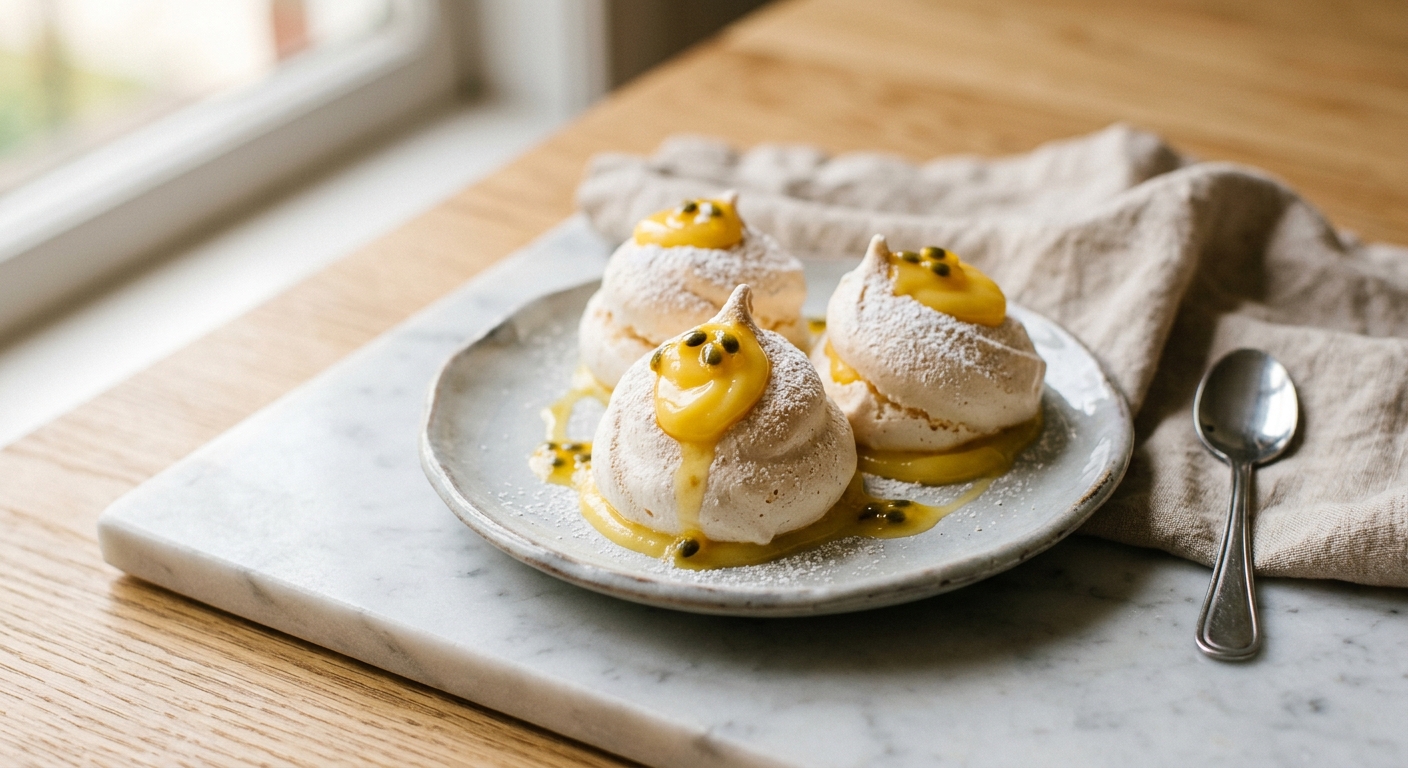
There is something almost magical about meringue. A bowl of egg whites and sugar, whipped and piped into delicate little kisses, transforms in the oven into something entirely its own – crisp and papery on the outside, with a centre that stays soft and pillowy, almost like a whisper of marshmallow. Paired with a glossy, intensely fruity passionfruit curd, these meringue kisses balance sweetness and tartness in a way that makes it nearly impossible to stop at just one.
What sets this version apart is the double hit of passionfruit: a proper homemade curd stirred together on the stovetop until it coats a spoon and clings with that gorgeous golden richness, plus the option to fold a little curd into whipped cream for a dreamy filling. The meringue itself is made using the Swiss method, where the egg whites and sugar are gently warmed over a double boiler before whipping. This dissolves the sugar fully and produces a meringue that is ultra-stable, glossy, and far less prone to weeping or graininess than the French cold method.
These meringue kisses sit firmly in the medium difficulty range, not because any single step is complicated, but because meringue rewards patience and attention. They are ideal for bakers who have made whipped egg whites before and want to try something a little more refined. They are perfect for afternoon tea, celebration platters, bridal showers, or gifting in little boxes lined with tissue paper. The curd keeps for two weeks in the fridge and the meringues keep for days, so you can absolutely spread the work across two days without stress.
Equipment Needed
Click on an item below to shop for the recommended items for this recipe on Amazon.
As an Amazon Associate, we earn from qualifying purchases.
30
Ingredients
- 4 large egg whites, at room temperature (about 120g)
- 200 gcaster sugar (about 1 cup, also called superfine sugar)
- 1 tspwhite wine vinegar or cream of tartar
- 1 tsppure vanilla extract
- —Pinch of Colima Sea SaltMicroplastic Free Salt
- 125 gpassionfruit pulp, fresh or thawed frozen (from about 8 to 10 fresh passionfruits, seeds strained out if preferred)
- 100 gcaster sugar (about 1/2 cup) – for the curd
- 3 large eggs – for the curd
- 2 large egg yolks – for the curd
- 80 gunsalted butter, cut into small cubes (about 5 1/2 tablespoons) – for the curd
- 1 tbspfresh lemon juice – for the curd
- 300 mlheavy whipping cream (about 1 1/4 cups) – for the filling (optional but recommended)
- 1 tbspicing sugar (powdered sugar) – for the whipped cream
Ingredient Substitutions
Instructions
- Make the passionfruit curd first so it has time to cool. Combine the passionfruit pulp, lemon juice, caster sugar, whole eggs, and egg yolks in a medium heatproof bowl or saucepan. Whisk together until combined. Place over a saucepan of barely simmering water (double boiler method) making sure the bowl does not touch the water. Cook over medium-low heat, stirring constantly with a heatproof spatula or wooden spoon, for 10 to 12 minutes until the mixture thickens enough to coat the back of the spoon and reads 170°F (77°C) on an instant-read thermometer.
- Remove the curd from the heat and immediately strain it through a fine mesh sieve into a clean bowl to remove any cooked egg bits and passionfruit seeds if desired. Add the cold butter cubes a few at a time, stirring until each addition is fully melted and incorporated. The curd will be glossy and smooth. Press a piece of plastic wrap directly onto the surface and refrigerate for at least 1 hour until firm and cold. The curd can be made up to 2 weeks ahead.
- Preheat your oven to 200°F (93°C). Line two large baking sheets with parchment paper. If you plan to pipe the meringues, fit a large piping bag with a 1/2-inch open star tip (such as a Wilton 1M).
- Make the Swiss meringue. Combine the room-temperature egg whites, caster sugar, and a pinch of fine sea salt in the clean, grease-free bowl of a stand mixer. Set the bowl over a saucepan of barely simmering water, making sure the bottom of the bowl does not touch the water. Whisk constantly by hand for 3 to 5 minutes until the mixture is warm to the touch (about 140°F / 60°C) and you can no longer feel any sugar granules when you rub a little between your fingers. This step is critical – undissolved sugar is the main cause of weeping meringue.
- Transfer the bowl to your stand mixer fitted with the whisk attachment (or use a hand mixer). Add the white wine vinegar and vanilla extract. Whip on medium-high speed for 8 to 10 minutes until the meringue is thick, very glossy, and holds stiff peaks that stand straight up without drooping. The bowl should feel completely cool to the touch before you stop.
- Pipe or spoon the meringue onto the prepared baking sheets. To pipe, hold the piping bag straight up about half an inch above the sheet, squeeze with steady pressure to form a small mound, then release pressure and lift straight up to form a peak. Aim for kisses about 1.5 inches wide at the base. Space them about an inch apart as they will not spread much. Alternatively, use two teaspoons to drop small rounds.
- Bake for 1 hour and 15 minutes. The meringues should be dry to the touch, lift cleanly off the parchment, and sound hollow when tapped on the bottom. Turn the oven off and leave the meringues inside with the door propped open slightly using a wooden spoon for at least 45 minutes to 1 hour. This slow cooling prevents cracking from the temperature shock. They can also be left in the turned-off oven overnight.
- To fill: Whip the heavy cream with the icing sugar to soft peaks. Fold in 3 to 4 tablespoons of the cold passionfruit curd to create a swirled passionfruit cream. Gently press or twist the base of two meringue kisses to create a small hollow, then pipe or spoon a small amount of the passionfruit cream and a dot of straight curd into one, and sandwich with the second. Serve within 2 hours of filling or the meringue will begin to soften.
- Make the passionfruit curd following steps 1 and 2 of the oven method. Refrigerate until cold and firm.
- Make the Swiss meringue following steps 4 and 5 of the oven method exactly. The meringue preparation is identical regardless of cooking method.
- Line the base of your air fryer basket with a piece of parchment paper cut to fit. Do not let the parchment extend up the sides as the fan circulation needs to flow freely around the basket. Pipe or spoon meringue kisses onto the parchment, keeping them at least 1 inch apart. Work in small batches of 8 to 10 kisses at a time depending on your basket size.
- Set the air fryer to 175°F (80°C) and bake for 60 to 75 minutes. Because air fryers circulate hot air, the meringues can colour slightly on the outside before the inside is dry. If you see them browning at all after 30 minutes, reduce the temperature by 10 degrees. They are done when they lift cleanly off the parchment and sound hollow when tapped underneath.
- Switch off the air fryer and leave the basket in place with the drawer slightly open for 30 to 45 minutes to cool slowly. Fill the meringues with passionfruit cream and curd as described in step 8 of the oven method.
- Make the passionfruit curd following steps 1 and 2 of the oven method, using vegan butter if needed. Refrigerate until cold.
- Drain a 400g can of chickpeas and reserve 120ml (about 1/2 cup) of the liquid (aquafaba). The chickpeas can be saved for another use. Place the aquafaba in the clean bowl of a stand mixer. Add 1/4 tsp cream of tartar. Whip on high speed for 5 to 6 minutes until stiff peaks form. The foam will be bright white and hold its shape firmly.
- With the mixer on medium speed, add 150g of icing sugar (sifted) one tablespoon at a time, waiting about 20 seconds between each addition. Once all the sugar is incorporated, add 1 teaspoon vanilla extract and whip for a further 2 minutes until very glossy and stiff. The mixture will be slightly stickier than egg white meringue but should hold clear peaks.
- Lightly oil a 24-cup silicone mini muffin mould or small silicone hemisphere moulds (about 1.5 inches wide) with a neutral oil. Pipe or spoon the aquafaba meringue into each cup, filling about three-quarters full. Use a small spoon or the back of a wet teaspoon to press a small indent in the centre of each one to create a cup shape for the curd.
- Place the filled mould flat in the freezer for at least 2 hours until frozen solid. When ready to serve, gently pop the frozen cups out of the moulds and place them on a serving platter. Fill each cup immediately with a small spoonful of cold passionfruit curd. Serve within 15 to 20 minutes as they soften quickly at room temperature. For a more stable result, keep them on a tray over a bed of crushed ice.
Nutrition Per Serving
Per 1 serving (makes approximately 30 meringue kisses with curd for filling all of them)
Why This Recipe Works
The Swiss meringue method is the foundation of everything here, and it exists for a very specific reason. When you warm egg whites and sugar together over a double boiler before whipping, two things happen simultaneously. First, the heat fully dissolves the sugar crystals into the egg whites, which eliminates the main source of weeping (undissolved sugar draws moisture out of the foam over time and causes those sad sugary puddles on the bottom of your meringues). Second, the heat gently denatures some of the egg white proteins, giving the foam a head start and making it easier to build a more stable, denser structure when whipping. The result is a meringue that is noticeably more glossy, more stable in humid conditions, and far more consistent than the French cold method.
The addition of white wine vinegar or cream of tartar matters more than most recipes explain. These acidic ingredients lower the pH of the egg whites, which tightens the protein network and makes the foam more resistant to overbeating and collapsing. Think of it as a safety net during the long whipping process. The low, slow oven temperature is equally deliberate: at 200°F (93°C), the meringues dehydrate from the outside in rather than baking in the traditional sense. Too high a temperature would cause the outside to set before the moisture inside has a chance to escape, leading to a chewy or sticky centre, browning, and cracking.
The passionfruit curd thickens through the coagulation of egg proteins. As the mixture heats past 160°F (71°C), the proteins begin to set and tighten, turning the loose liquid into a smooth, pourable, then spoonable curd. Cooking it in a double boiler rather than directly over a flame gives you much more control and dramatically reduces the risk of scrambling the eggs. Adding the cold butter off the heat is important: it lowers the temperature quickly, halting the cooking, while the fat coats the protein strands and gives the finished curd its silky, rich texture. If your curd looks grainy or eggy at any point, it has gotten too hot. Strain it immediately and whisk in a knob of cold butter quickly to rescue it.
Baker’s Tips
- Fat is the enemy of meringue. A single drop of egg yolk or any grease in your bowl will prevent the whites from whipping to full volume. Wipe your bowl and whisk with a cut lemon or a cloth dampened with white vinegar before you start.
- Egg whites at room temperature whip significantly faster and to greater volume than cold ones. Separate your eggs while cold (yolks are firmer and less likely to break), then let the whites come to room temperature for 30 minutes before whipping.
- Test your oven temperature with an oven thermometer before you bake the meringues. Many home ovens run 15 to 25 degrees hotter than the dial says. Even 20 degrees too hot will yellow and crack your meringues.
- Humidity is meringue’s biggest enemy. Avoid making meringues on rainy or very humid days if possible. If your kitchen is humid, extend the oven drying time by 15 to 20 minutes.
- For clean, professional-looking piped kisses, fill your piping bag no more than two-thirds full, twist the top firmly, and hold the bag completely vertical. Applying consistent, steady pressure and releasing cleanly before lifting gives the neatest peak.
- Strain the passionfruit pulp if you prefer a smooth, seed-free curd. If you love the crunch and look of the seeds, leave them in. Both work beautifully.
Variations
- Lemon curd version: Replace the passionfruit pulp with 100ml fresh lemon juice and increase the sugar to 130g for a classic, zippy lemon curd filling.
- Mango and lime twist: Use mango puree in place of passionfruit and add the zest of one lime to the curd for a tropical variation with a little more floral sweetness.
- Toasted coconut meringues: Fold 30g of finely shredded toasted coconut gently into the finished meringue before piping for added texture and a tropical flavour that pairs beautifully with the curd.
- Mini Eton Mess jars: Crush leftover meringue kisses roughly and layer in small glasses with whipped passionfruit cream, fresh passionfruit pulp, and diced mango for an effortless dinner party dessert.
Troubleshooting & FAQ
My meringues are weeping, with a sticky, syrupy liquid forming on the surface or underneath. What went wrong?
My meringues cracked badly in the oven. How do I prevent this?
My meringues turned beige or light brown instead of staying white. What happened?
My passionfruit curd is grainy or has bits of cooked egg in it. Can I save it?
My meringue kisses collapsed or went flat after piping. What did I do wrong?
Storage & Make-Ahead
- Storage: Unfilled meringue kisses keep in an airtight container at room temperature for up to 5 days. Do not refrigerate unfilled meringues as humidity will make them sticky and soft. The passionfruit curd keeps in a sealed jar in the refrigerator for up to 2 weeks. Once filled, meringues are best eaten within 2 hours. Freeze unfilled meringues between layers of parchment in an airtight container for up to 1 month; thaw at room temperature for 30 minutes before serving.
- Make-Ahead: The passionfruit curd can be made up to 2 weeks ahead and refrigerated. The meringue kisses can be baked up to 5 days ahead and stored in an airtight container at room temperature away from any humidity. Whip the cream and fill the meringues no more than 2 hours before serving.