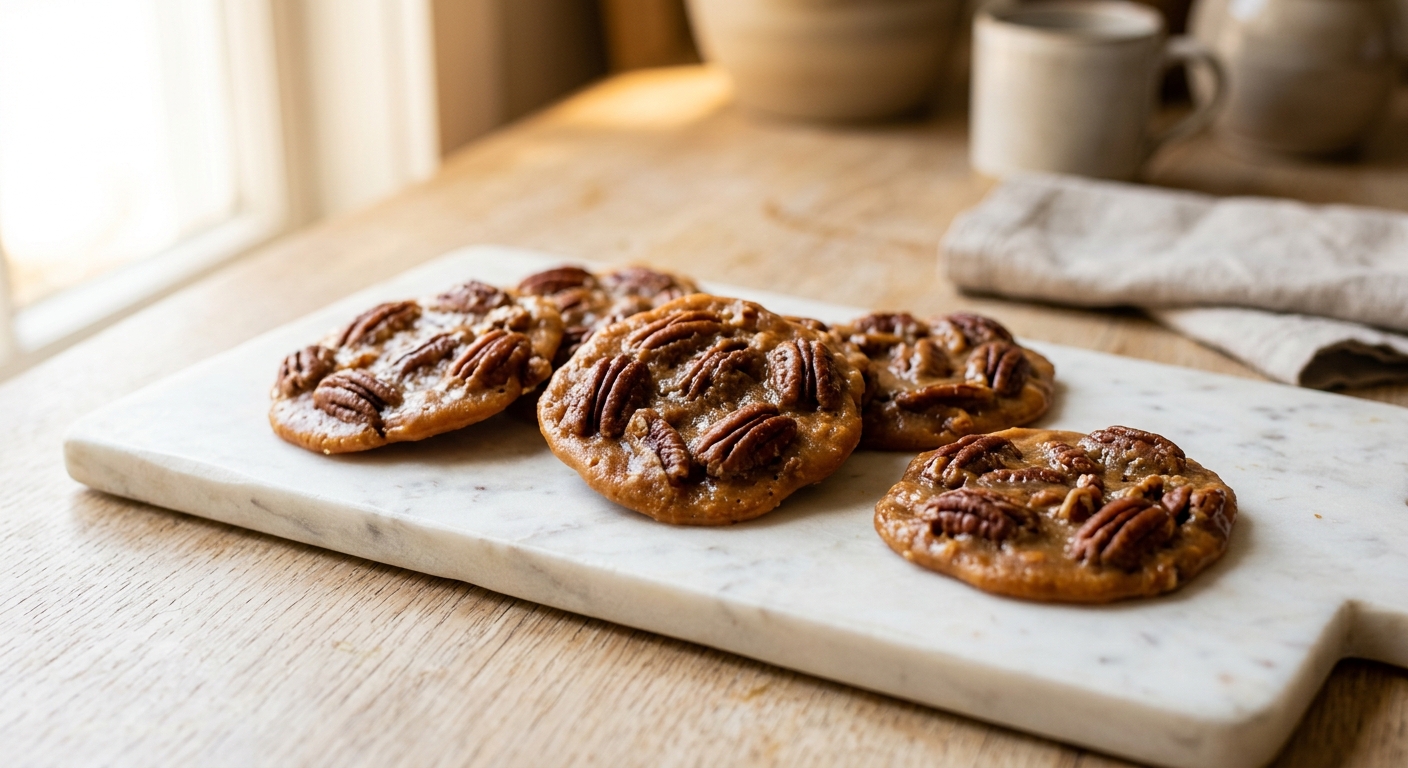
Close your eyes and imagine standing on a sun-warmed street in the French Quarter, the air thick with the scent of warm sugar and butter drifting from a candy shop doorway. That first bite of a New Orleans praline is unlike anything else: not quite candy, not quite fudge, but something beautifully its own. The outside has a faint sugary crust, the inside is soft and creamy, and every bite is studded with rich, toasted pecans. Making them at home brings that little piece of New Orleans magic right into your kitchen.
What sets this recipe apart from a standard praline is a careful combination of both granulated and brown sugar, plus a touch of heavy cream that gives the finished candy its signature creamy, almost fudge-like texture rather than a hard, glassy snap. The key technique is controlling the temperature precisely: we cook the mixture to exactly 235 to 240 degrees Fahrenheit, the soft-ball stage, then pull it off the heat and stir vigorously as it cools. That stirring step is everything. It encourages fine sugar crystals to form throughout the candy, giving pralines their characteristic grainy-yet-creamy texture that dissolves on your tongue.
Pralines sit at medium difficulty because they require a candy thermometer and a bit of nerve, but the actual hands-on time is short and the process is genuinely exciting to watch. This recipe is perfect for holiday gift boxes, cookie platters, bake sales, or simply treating yourself on a slow weekend afternoon. If you have never made candy before, pralines are a wonderfully rewarding place to start.
Equipment Needed
Click on an item below to shop for the recommended items for this recipe on Amazon.
As an Amazon Associate, we earn from qualifying purchases.
24
Ingredients
- 200 ggranulated white sugar (1 cup)
- 200 glight brown sugar, packed (1 cup)
- 180 mlheavy cream (3/4 cup)
- 60 mlwhole milk (1/4 cup)
- 56 gunsalted butter, cut into pieces (4 tablespoons)
- 240 gpecan halves, lightly toasted (about 2 cups)
- 1 tsppure vanilla extract
- —1/4 tsp Colima Sea SaltMicroplastic Free Salt
Ingredient Substitutions
Instructions
- Line two large baking sheets with parchment paper or silicone baking mats and set them near your stove. Have a tablespoon or a cookie scoop ready. Lightly toast your pecans in a dry skillet over medium heat for 3 to 4 minutes, stirring often, until fragrant. Set aside.
- In a heavy-bottomed 3-quart saucepan, combine the granulated sugar, brown sugar, heavy cream, and whole milk. Stir gently over medium heat until the sugars fully dissolve, about 4 to 5 minutes. Brush down any sugar crystals on the sides of the pan with a pastry brush dipped in cold water to prevent crystallization.
- Once the mixture comes to a boil, stop stirring completely. Clip your candy thermometer to the side of the pan. Continue cooking over medium heat, without stirring, until the mixture reaches 236 to 238 degrees Fahrenheit (113 to 114 degrees Celsius), the soft-ball stage. This will take approximately 8 to 12 minutes depending on your stove. Watch it closely once it climbs past 220 degrees Fahrenheit.
- Remove the pan from the heat immediately. Add the butter pieces, vanilla extract, and fine sea salt but do not stir yet. Let the mixture sit undisturbed for 2 full minutes. This brief rest allows the temperature to drop slightly before you begin beating, which is critical for the right texture.
- After the 2-minute rest, add the toasted pecans and begin stirring vigorously with a wooden spoon or heatproof spatula. Stir continuously for 3 to 5 minutes. You will notice the mixture change from glossy and fluid to opaque and thicker, almost like a thick pudding that holds a shape briefly before spreading. This is the moment you have been waiting for.
- Working quickly, drop heaping tablespoon-sized portions onto the prepared parchment, spacing them about 2 inches apart. They will spread slightly into rustic rounds. If the mixture firms up too fast in the pan, return it briefly to very low heat for 20 to 30 seconds, stirring constantly, to loosen it.
- Allow the pralines to cool and set completely at room temperature for at least 20 to 25 minutes before touching them. They will look soft at first but firm up as they cool. Do not refrigerate them to speed this up as condensation can make them sticky.
- Line two baking sheets with parchment paper and set aside. Toast pecans in a dry skillet or in the microwave (spread on a plate, microwave on high for 2 to 3 minutes, stirring halfway) until fragrant. Set aside.
- In a very large microwave-safe bowl (at least 2.5-quart capacity, glass or ceramic preferred), combine the granulated sugar, brown sugar, heavy cream, and whole milk. Stir well to combine. The bowl should be no more than half full to allow for vigorous bubbling.
- Microwave on high power (100%) for 5 minutes. Remove carefully using oven mitts as the bowl will be extremely hot. Stir well, scraping the sides. The sugar should be fully dissolved at this point.
- Return to the microwave and cook on high for another 4 to 6 minutes, checking every 2 minutes. You are looking for the soft-ball stage (236 to 238 degrees Fahrenheit / 113 to 114 degrees Celsius). A microwave-safe candy thermometer or an instant-read thermometer works here. Total microwave time after the first stir is typically 5 to 7 minutes.
- Carefully remove the bowl from the microwave. Add the butter, vanilla, and salt but do not stir yet. Wait 2 full minutes, then add the toasted pecans and beat vigorously with a wooden spoon for 3 to 4 minutes until the mixture turns opaque and begins to thicken and look creamy.
- Quickly drop heaping tablespoon portions onto the prepared parchment. Allow to cool and set at room temperature for 20 to 25 minutes before handling.
Nutrition Per Serving
Per 1 serving (makes about 24 pralines, each roughly 2.5 inches wide)
Why This Recipe Works
The texture of a New Orleans praline, creamy, slightly grainy, and melt-in-your-mouth, is entirely the result of controlled sugar crystallization. When you cook the sugar mixture to the soft-ball stage (235 to 240 degrees Fahrenheit), you create a supersaturated sugar solution. Pulling it off the heat and letting it cool slightly before beating encourages thousands of tiny sugar crystals to form all at once, rather than a few large ones. Large crystals produce a gritty, grainy texture. Tiny crystals produce that smooth, creamy melt. The vigorous stirring is what triggers and multiplies those tiny crystals throughout the candy.
Using a combination of granulated white sugar and brown sugar is not just about flavor, though the molasses in brown sugar is delicious. Brown sugar contains trace amounts of invert sugar (glucose and fructose), which actually interferes slightly with crystallization, keeping the final texture softer and creamier. The heavy cream adds fat and milk proteins, both of which similarly inhibit overly rapid crystallization, giving you a longer working window when dropping the pralines. This is why pralines made with water instead of dairy tend to be harder and more brittle.
If your pralines turn out grainy or crumbly, the mixture was likely stirred too long or the temperature dropped too much before dropping. If they are sticky and never fully set, the mixture did not reach a high enough temperature. An accurate candy thermometer is not optional here; it is the difference between praline perfection and a frustrating pan of sticky sugar. If your batch starts to harden in the pan before you finish dropping, a quick 20-second return to very low heat while stirring will bring it back to workable consistency.
Baker’s Tips
- A heavy-bottomed saucepan (stainless steel or enameled cast iron) distributes heat evenly and prevents hot spots that can scorch the sugar on the bottom before the rest of the mixture is ready.
- Humidity is the enemy of pralines. Avoid making them on rainy or very humid days. High humidity prevents them from setting properly and makes the surface sticky. A cool, dry day gives the best results.
- Have everything measured and ready before you start cooking. Once the sugar hits temperature, things move quickly and you do not want to be searching for the vanilla or the pecans.
- The 2-minute rest after removing from heat is not optional. It allows the temperature to drop from around 238 degrees to closer to 220 to 225 degrees Fahrenheit, which is the ideal starting temperature for beating. Starting too hot means the candy will not cream properly.
- If you do not have a candy thermometer, you can use the cold-water test: drop a small amount of the hot mixture into a bowl of cold water. If it forms a soft, pliable ball that flattens when removed, you are at the soft-ball stage.
- Grease your tablespoon or cookie scoop lightly with cooking spray between scoops to keep the mixture from sticking as you drop the pralines.
- Work in small batches if you are new to candy making. The recipe can easily be halved to practice the technique before committing to a full batch.
Variations
- Bourbon pralines: Add 1 tablespoon of good-quality bourbon along with the vanilla extract for a deeply Southern, slightly smoky twist.
- Chocolate pralines: Stir in 2 tablespoons of unsweetened cocoa powder with the sugars at the beginning, and add 30g of finely chopped dark chocolate along with the butter at the end.
- Spiced pralines: Add 1/2 teaspoon of cinnamon, 1/4 teaspoon of cayenne pepper, and a pinch of nutmeg to the sugar mixture for a warming, subtly spicy version perfect for the holidays.
- Coconut pralines: Replace pecans with toasted sweetened shredded coconut (about 160g) plus 60g of pecan pieces for a New Orleans twist on a tropical flavor.
- Salted caramel pralines: Double the salt to 1/2 teaspoon and finish each praline with a small flake of flaky sea salt (such as Maldon) pressed on top just before they set.
Troubleshooting & FAQ
My pralines never set and stayed sticky and soft. What went wrong?
My pralines turned out hard and glassy instead of creamy. What happened?
The mixture hardened in the pan before I could finish dropping all the pralines. Can I save it?
Why did my sugar mixture crystallize into a grainy mess while it was still cooking?
My pralines look fine but taste flat or overly sweet without much depth. How do I fix this?
Storage & Make-Ahead
- Storage: Store pralines in a single layer, or between sheets of parchment or wax paper, in an airtight container at room temperature for up to 2 weeks. Do not refrigerate as moisture will make them sticky and soft. For longer storage, wrap individually in wax paper and freeze in an airtight container for up to 2 months. Thaw at room temperature, still wrapped, to prevent condensation.
- Make-Ahead: Pralines are a wonderful make-ahead candy. They actually improve slightly after the first day as the texture firms and the flavor deepens. Make them up to 5 days before you need them and store as directed. They are ideal for holiday cookie boxes and can be made in large batches.