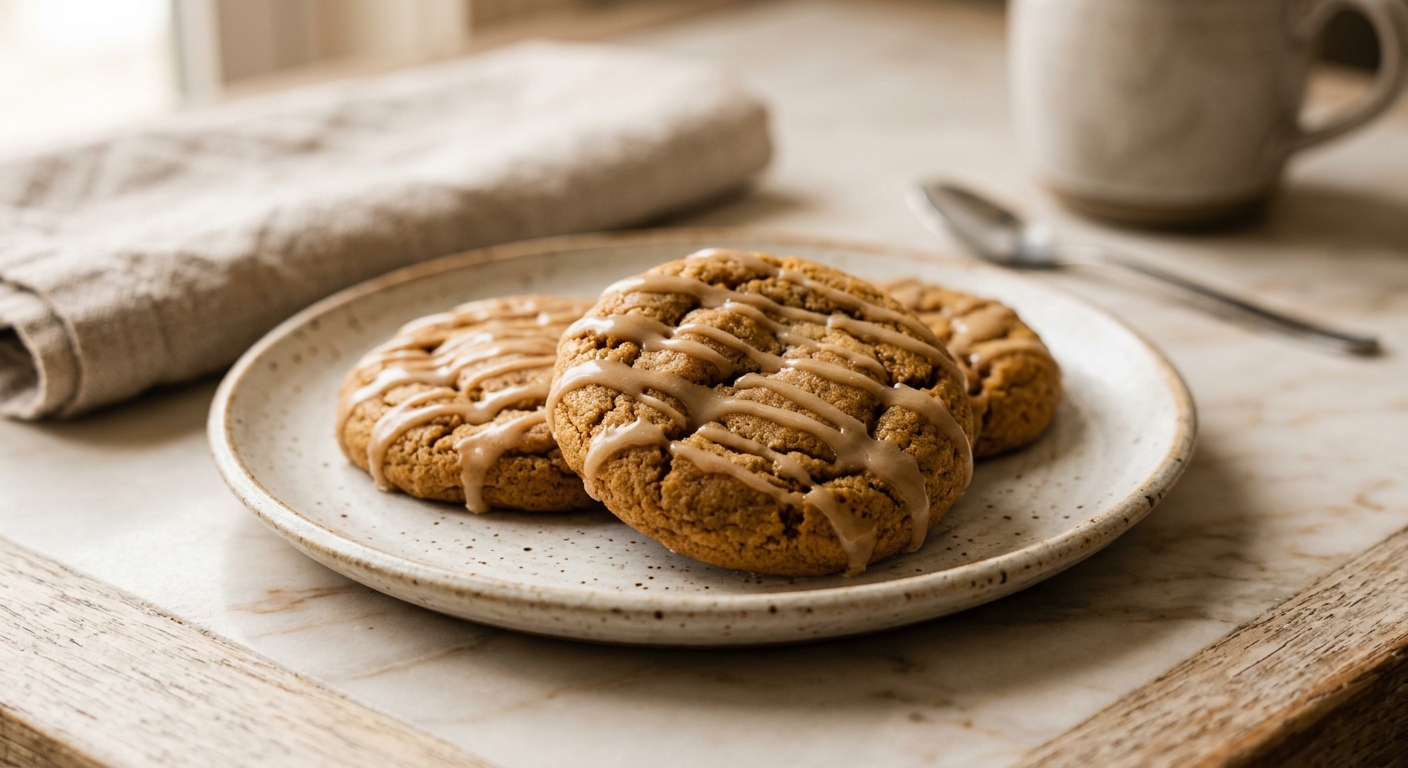
There is a particular kind of afternoon in October when the air smells faintly of woodsmoke and the light turns that deep amber gold, and all you want to do is bake something that makes your kitchen smell incredible. These pumpkin spice cookies are exactly that kind of recipe. Soft and cake-like with slightly crisp edges, they carry the warmth of cinnamon, ginger, nutmeg, and cloves in every bite, finished with a maple glaze that pools into a thin, sweet shell as it sets. They are the kind of cookie people ask for the recipe for before they have even finished the first one.
What sets this version apart is a small but important technique: the pumpkin puree is blotted dry before it goes into the batter. Pumpkin is remarkably high in moisture, and skipping this step leads to cookies that spread too little and stay gummy in the center. Patting the puree between paper towels for just two minutes removes enough excess liquid to give you a soft, tender crumb that bakes evenly from edge to center. The maple glaze is made with real maple syrup rather than extract, which gives it genuine depth and a slightly earthy sweetness that plays beautifully against the spiced cookie base.
These cookies are firmly in the easy category, and the recipe is a wonderful starting point for beginner bakers. There is no chilling required, no creaming butter until fluffy, and no special equipment beyond a couple of mixing bowls and a whisk. If you are an experienced baker looking for a reliable crowd-pleaser for a fall gathering, a cookie exchange, or a cozy weekend bake, this one will not let you down.
Equipment Needed
Click on an item below to shop for the recommended items for this recipe on Amazon.
As an Amazon Associate, we earn from qualifying purchases.
24
Ingredients
- 215 gcanned pumpkin puree (not pumpkin pie filling), about 3/4 cup, blotted dry
- 280 gall-purpose flour (about 2 1/4 cups, spooned and leveled)
- 1 tspbaking soda
- 1.5 tspground cinnamon
- 0.75 tspground ginger
- 0.25 tspground nutmeg
- 0.25 tspground cloves
- 0.5 tspColima Sea SaltMicroplastic Free Salt
- 113 gunsalted butter, melted and cooled (1/2 cup or 1 stick)
- 150 glight brown sugar, packed (3/4 cup)
- 50 ggranulated sugar (1/4 cup)
- 1 largeegg, at room temperature
- 1 tsppure vanilla extract
- 120 gpowdered sugar, sifted (about 1 cup)
- 45 mlpure maple syrup (3 tablespoons), Grade A dark for best flavor
- 15 mlwhole milk (1 tablespoon), plus more to adjust consistency
- —Pinch of Colima Sea SaltMicroplastic Free Salt for the glaze
Ingredient Substitutions
Instructions
- Preheat your oven to 350°F (175°C). Line two large baking sheets with parchment paper and set aside.
- Blot the pumpkin puree dry: spoon it onto a few layers of paper towels, fold them over the top, and press firmly. Repeat with fresh towels until the puree no longer looks wet, about 2 to 3 presses. You want to remove as much surface moisture as possible without drying it out completely. You should end up with roughly 160 to 170g of blotted puree.
- In a large bowl, whisk together the flour, baking soda, cinnamon, ginger, nutmeg, cloves, and salt until evenly combined. Set aside.
- In a separate medium bowl, whisk together the melted and cooled butter, brown sugar, and granulated sugar until smooth and glossy, about 1 minute. Add the egg, blotted pumpkin puree, and vanilla extract, then whisk until fully combined and uniform in color.
- Pour the wet ingredients into the dry ingredients and fold together with a rubber spatula until just combined and no dry flour streaks remain. Do not overmix. The dough will be thick and slightly sticky.
- Using a medium cookie scoop or two spoons, portion the dough into balls of about 1.5 tablespoons (roughly 35g each) and place them 2 inches apart on the prepared baking sheets. Gently flatten each ball slightly with the palm of your hand to about 1/2 inch thick, as these cookies do not spread much on their own.
- Bake one sheet at a time on the center rack for 12 to 14 minutes, until the edges are just set and the tops look matte and dry. The centers may look slightly underdone, but they will firm up as they cool. Do not overbake or the cookies will dry out.
- Cool on the baking sheet for 5 minutes, then transfer to a wire rack and cool completely before glazing, at least 20 minutes.
- Make the maple glaze: whisk together the sifted powdered sugar, maple syrup, milk, and pinch of salt until smooth and pourable. The glaze should drizzle off the whisk in a slow, steady ribbon. If it is too thick, add milk 1 teaspoon at a time. If too thin, add a little more powdered sugar.
- Drizzle the glaze over the cooled cookies using a spoon or a piping bag. Allow to set at room temperature for 15 to 20 minutes until the glaze is firm to the touch before stacking or storing.
- Prepare the cookie dough exactly as in the oven method, including blotting the pumpkin puree dry and mixing the wet and dry ingredients together.
- Cut a piece of parchment paper to fit the base of your air fryer basket, leaving a small gap around the edges so air can still circulate. Lightly spray or brush the parchment with cooking spray.
- Portion the dough into balls of about 1.5 tablespoons (roughly 35g each) and flatten each ball to about 1/2 inch thick. Place 4 to 6 cookies in the basket, spacing them at least 1.5 inches apart. Work in batches.
- Air fry at 325°F (160°C) for 8 to 9 minutes, until the edges look set and the tops appear matte. The lower temperature compared to a conventional oven is important here as the air fryer’s circulating heat can over-brown the bottoms quickly at higher settings.
- Remove the basket and let the cookies rest inside for 3 minutes before transferring to a wire rack. They will seem soft but will firm up. Cool completely before applying the maple glaze as directed in the oven method.
- Prepare the cookie dough as directed in the oven method up through portioning into dough balls and flattening slightly.
- Arrange the unbaked dough rounds in a single layer on a parchment-lined baking sheet and freeze uncovered for 1 to 2 hours until solid. This flash freeze prevents the cookies from sticking together in storage.
- Transfer the frozen dough rounds to a zip-top freezer bag or airtight container, layered with parchment paper. Label with the date and freeze for up to 3 months.
- When ready to bake, preheat your oven to 350°F (175°C). Place the frozen dough rounds directly on a parchment-lined baking sheet, no need to thaw. Add 2 to 3 extra minutes to the bake time, baking for 14 to 16 minutes total, until edges are set and tops look matte and dry.
- Cool completely on a wire rack before making the fresh maple glaze and drizzling as directed. The glaze should always be made fresh for best texture and sheen.
Nutrition Per Serving
Per 1 serving (makes about 24 cookies)
Why This Recipe Works
The most important step in this recipe, and the one most home bakers skip, is blotting the pumpkin dry. Canned pumpkin puree contains a significant amount of free moisture. When added directly to a cookie dough, this extra liquid creates steam in the oven, which puffs the cookies up and leaves the centers gummy rather than tender. By pressing the puree between paper towels, you remove enough surface water to shift the balance of the batter, giving you a cookie that bakes through evenly and has a soft, cake-like crumb rather than a dense, undercooked center. It takes less than three minutes and makes a measurable difference.
Using melted butter instead of creamed butter is another deliberate choice. Creaming softened butter incorporates air into the fat, which creates lift and a lighter texture. Melted butter skips that step entirely, resulting in a denser, chewier crumb that suits the soft, pillowy style of this cookie perfectly. The combination of brown sugar and granulated sugar also plays a role: brown sugar’s molasses content is hygroscopic, meaning it attracts and holds onto moisture, keeping the cookies soft for days after baking. The granulated sugar helps the edges caramelize and set properly so the cookies are not entirely floppy.
The maple glaze sets because of a simple process called sugar crystallization at the surface. As the thin layer of glaze dries and the moisture evaporates, the powdered sugar recrystallizes into a matte, lightly crackly shell. Using real maple syrup rather than extract is worth it here because maple syrup’s natural sugars and mineral compounds contribute to that set. If your glaze stays tacky and never firms up, it is likely too thin or your kitchen is very humid. Add a little more powdered sugar and give it extra time. If it sets before you finish drizzling, a 10-second stir and a few drops of warm milk will bring it back to the right consistency.
Baker’s Tips
- Do not skip blotting the pumpkin puree. Even one round of paper towel pressing makes a real difference to the texture of the finished cookie.
- Use Grade A dark maple syrup (formerly labeled Grade B) in the glaze for a more pronounced maple flavor. Lighter syrups taste more subtle once combined with the powdered sugar.
- Flatten the dough rounds before baking. These cookies spread very little on their own because of the reduced moisture, so shaping them now is what gives them their final size and thickness.
- Bake on the center rack for even heat distribution. If you must bake two sheets at once, rotate them top to bottom and front to back halfway through.
- Let the cookies cool completely before glazing. Even slightly warm cookies will cause the glaze to run off the sides and pool on the rack rather than setting on the surface.
- Sift the powdered sugar before making the glaze to prevent lumps. A smooth glaze drizzles and sets more evenly than a lumpy one.
- A zip-top bag with a small corner snipped off works just as well as a piping bag for drizzling the glaze in a neat pattern.
Variations
- Brown butter version: Brown the butter before melting and cooling it. The nutty, caramelized notes take the flavor to another level entirely.
- Cream cheese filling: Press a small cube of cold cream cheese into the center of each dough ball before baking for a stuffed cookie with a tangy, creamy center.
- Chai spice swap: Replace the individual spices with 2 teaspoons of chai spice blend and add 1/4 teaspoon cardamom for a more floral, complex warmth.
- Chocolate chip add-in: Fold 120g (2/3 cup) of semi-sweet or dark chocolate chips into the finished dough for a pumpkin chocolate chip version. Omit the maple glaze or keep both for an indulgent treat.
- Browned butter maple glaze: Use 1 tablespoon of browned butter in place of the milk in the glaze for a deeper, nutty caramel flavor.
Troubleshooting & FAQ
My cookies turned out gummy or undercooked in the center. What went wrong?
My cookies spread too much and came out flat and greasy. Why?
The maple glaze will not set and stays sticky. What can I do?
My cookies came out very hard and dry after baking. How do I prevent this?
The glaze is setting too quickly and hardening in the bowl before I finish drizzling. What should I do?
Storage & Make-Ahead
- Storage: Store glazed cookies in a single layer or separated by parchment in an airtight container at room temperature for up to 4 days. Refrigerate for up to 1 week, though the glaze may soften slightly. Unglazed baked cookies freeze well for up to 2 months; thaw at room temperature and glaze before serving.
- Make-Ahead: The cookie dough can be made up to 24 hours ahead, covered tightly, and refrigerated. Bring to room temperature for 15 minutes before scooping and baking. The cookies themselves can be baked up to 2 days ahead and stored unglazed at room temperature, then glazed on the day of serving for the best finish. Raw dough rounds freeze for up to 3 months (see Freeze-Ahead method).