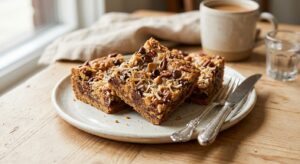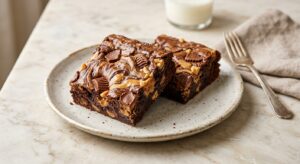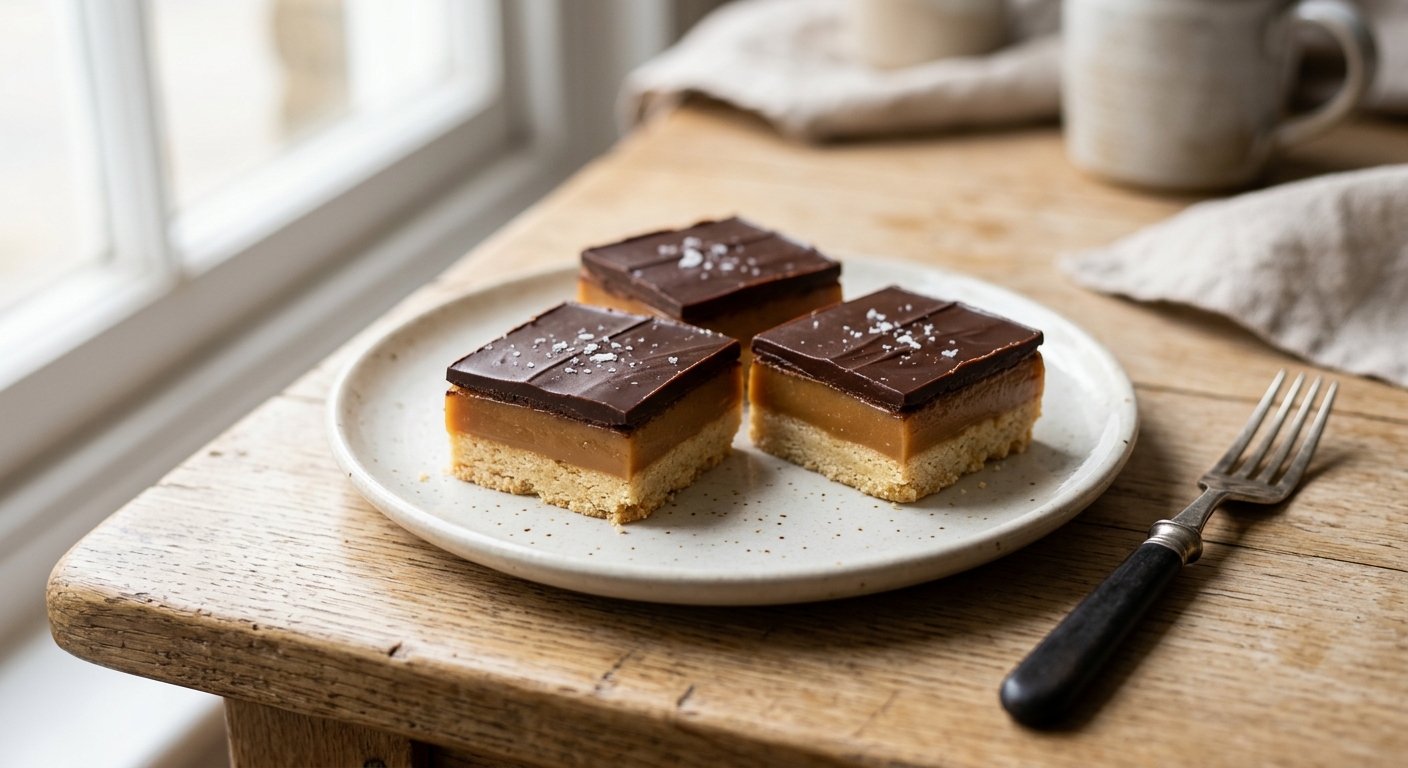
There is something almost absurdly satisfying about cutting into a pan of millionaire’s shortbread. The knife moves through the dark chocolate with a clean snap, then sinks into the yielding caramel, then meets the crumbly, golden shortbread beneath. Each layer is its own small pleasure, and together they are something close to perfect. These bars are the kind of thing you bring to a gathering and watch disappear in twenty minutes, the kind of thing people ask you for the recipe before they have even finished chewing.
What sets this version apart is the caramel. Rather than a simple condensed milk filling, this one is made with a combination of sweetened condensed milk, golden syrup, and real butter, cooked low and slow until it reaches a deep amber colour and a thick, fudgy consistency that holds its shape when cut without being hard or sticky. A generous pinch of flaky sea salt stirred in at the end pulls everything into balance, cutting through the richness and making the chocolate on top taste even more intense. The shortbread base uses a higher ratio of butter to flour than most recipes, giving it a melt-in-the-mouth tenderness rather than a hard, cracker-like crunch.
This is a medium-difficulty recipe, mostly because the caramel requires patience and attention, but nothing here is beyond a careful home baker. If you have made caramel before, this will feel very manageable. If you have not, consider this a gentle and delicious introduction. The recipe is ideal for bake sales, holiday gift boxes, afternoon tea, or simply keeping in the fridge for the moments when only something truly special will do.
Equipment Needed
Click on an item below to shop for the recommended items for this recipe on Amazon.
As an Amazon Associate, we earn from qualifying purchases.
16
Ingredients
- Extra Tenderness
- 225 gunsalted butter, cold and cubed (1 cup / 2 sticks)
- 280 gall-purpose flour (about 2 1/4 cups, spooned and leveled)
- 75 gpowdered (icing) sugar, sifted (about 2/3 cup)
- 30 gcornstarch (about 3 1/2 tbsp)
- Caramel (1 Cup / 2 Sticks)
- 0.5 tspColima Sea SaltMicroplastic Free Salt
- 225 gunsalted butter
- 200 glight brown sugar, packed (about 1 cup)
- 80 mlgolden syrup or light corn syrup (about 1/4 cup)
- 397 gone 14-oz can full-fat sweetened condensed milk
- 1 tsppure vanilla extract
- —1 to 1.5 tsp Colima Sea SaltMicroplastic Free Salt (such as Maldon), divided, plus extra for topping
- 300 ggood-quality dark chocolate (60 to 70% cacao), finely chopped (about 10.5 oz)
- 15 gunsalted butter (1 tbsp), for the chocolate layer, to add gloss
Ingredient Substitutions
Instructions
- Preheat your oven to 325°F (160°C). Grease a 9×13-inch baking pan and line it with parchment paper, leaving an overhang on the two long sides to use as handles later. This makes removing the slab much easier.
- Make the shortbread: In a large bowl or food processor, combine the flour, powdered sugar, cornstarch, and fine sea salt. Add the cold cubed butter and rub it in with your fingertips (or pulse in the food processor) until the mixture resembles fine breadcrumbs and just begins to clump together when pressed. Do not overwork it. Press the mixture evenly and firmly into the prepared pan in one compact layer. Prick all over with a fork to prevent puffing.
- Bake the shortbread for 20 to 25 minutes, until pale golden and set. The edges should have a slightly deeper colour than the centre. Remove from the oven and allow to cool completely in the pan, at least 30 minutes, before adding the caramel.
- Make the caramel: Combine the butter, brown sugar, golden syrup, and condensed milk in a medium to large heavy-bottomed saucepan over medium-low heat. Stir constantly with a silicone spatula or wooden spoon as the butter melts and everything comes together. Once the mixture is smooth and the sugar has dissolved (about 5 minutes), increase the heat to medium and bring to a gentle boil, stirring the entire time and scraping the bottom and sides of the pan. Cook for 8 to 12 minutes, stirring constantly, until the caramel has thickened noticeably, turned a deep amber-gold colour, and registers 225 to 230°F (107 to 110°C) on a candy thermometer. If you do not have a thermometer, test by dropping a small amount into cold water. It should form a soft ball.
- Remove the caramel from the heat and stir in the vanilla extract and 1 teaspoon of flaky sea salt. Pour immediately over the cooled shortbread and smooth with an offset spatula. Allow to cool at room temperature for 20 minutes, then refrigerate until the caramel is fully set and firm, about 45 to 60 minutes.
- Make the chocolate layer: Melt the chopped dark chocolate and 1 tablespoon of butter together. Use a double boiler (a heatproof bowl set over a pan of barely simmering water, not touching the water) or melt in 30-second microwave bursts, stirring between each, until smooth and glossy. Allow the chocolate to cool for 5 minutes so it is no longer steaming, then pour over the set caramel and tilt the pan gently to spread it evenly. Finish with a final scattering of flaky sea salt over the surface.
- Allow the chocolate to set at room temperature for 30 minutes, then refrigerate for a final 20 to 30 minutes until fully firm. Lift the slab from the pan using the parchment overhang and transfer to a cutting board. Using a sharp, heavy knife warmed briefly under hot water and dried, cut into 16 bars with one firm, downward stroke per cut to prevent cracking the chocolate. Wipe the blade clean between cuts.
- Line a 9×13-inch pan with parchment paper as described in the oven method. Crush 400g (about 14 oz) of digestive biscuits or graham crackers to fine crumbs using a food processor or by sealing them in a zip-lock bag and rolling with a rolling pin.
- Melt 120g (1/2 cup) unsalted butter and stir it into the biscuit crumbs until every crumb is coated and the mixture holds together when pressed. Tip into the prepared pan and press firmly and evenly into the base using the flat bottom of a measuring cup. Refrigerate for 20 minutes to firm up.
- Make the caramel exactly as described in the oven method steps 4 and 5: combine butter, brown sugar, golden syrup, and condensed milk in a heavy-bottomed saucepan over medium-low heat, stir constantly until dissolved, then cook over medium heat for 8 to 12 minutes to 225 to 230°F (107 to 110°C). Stir in vanilla and flaky sea salt, then pour over the chilled biscuit base. Refrigerate for 45 to 60 minutes until fully set.
- Prepare the chocolate layer exactly as in the oven method step 6: melt dark chocolate with butter, cool briefly, pour over the set caramel, scatter with flaky sea salt, and refrigerate until firm, about 30 minutes.
- Remove from the pan and cut as described in the oven method. Note that the biscuit base is more fragile than baked shortbread, so use a very sharp knife and a firm, clean stroke.
- Bake the shortbread base exactly as described in the oven method steps 1, 2, and 3. Allow to cool completely.
- Combine the butter, brown sugar, golden syrup, and condensed milk in a very large microwave-safe bowl (at least 2-quart capacity). The mixture will bubble up considerably, so err on the side of a larger bowl. Microwave on High (100%) for 2 minutes. Remove and stir thoroughly.
- Continue microwaving in 2-minute intervals on High, stirring well after each interval, for a total of 6 to 8 minutes. The caramel is ready when it has thickened, turned deep amber, and holds a ribbon on the surface for a few seconds when you lift and drop the spatula. If you have a thermometer, look for 225 to 230°F (107 to 110°C). The timing will vary by microwave wattage. If your microwave is 1200W or higher, start checking at the 6-minute mark.
- Stir in the vanilla and flaky sea salt. Pour over the cooled shortbread, smooth the top, cool for 20 minutes, then refrigerate until fully set, 45 to 60 minutes.
- Prepare and add the chocolate layer as described in the oven method step 6 (you can also melt the chocolate in the microwave in the same manner: 30-second bursts, stirring between each). Finish with flaky sea salt, set, and cut as directed.
Nutrition Per Serving
Per 1 serving (makes one 9×13-inch pan, cut into 16 bars)
Why This Recipe Works
The cornstarch in the shortbread is the quiet hero of this recipe. When mixed with flour, cornstarch dilutes the gluten-forming proteins, resulting in a more tender, delicate crumb that truly melts on the tongue rather than snapping like a hard biscuit. Using cold butter and working it in quickly (rather than creaming softened butter) also keeps gluten development minimal, while the fat coats the flour particles and creates that characteristic short, crumbly texture that gives shortbread its name. Baking at the relatively low temperature of 325°F (160°C) allows the base to cook through gently and turn a pale golden colour without becoming hard or overly browned.
The caramel layer works through the Maillard reaction and controlled sugar concentration. As the condensed milk, butter, sugar, and syrup cook together, the water content evaporates and the sugar concentration increases, raising the boiling point of the mixture. Cooking to 225 to 230°F (107 to 110°C) places the caramel in the soft-ball stage, meaning it will be pliable and fudgy when cooled rather than either runny or hard and brittle. The golden syrup is not just for flavour: its glucose content actively prevents the sucrose in the brown sugar from recrystallising, which would turn your caramel grainy and sandy. Stirring constantly throughout cooking ensures even heat distribution and prevents the milk solids from scorching on the bottom of the pan.
For the chocolate layer, adding a small amount of butter to the melted chocolate serves two purposes: it adds gloss (the fat coats the cocoa particles and reflects light) and it slightly softens the set chocolate, which makes the bars dramatically easier to cut without cracking. Allowing the chocolate to cool briefly before pouring it over the caramel prevents it from melting the caramel surface. If your chocolate layer does crack when cutting, the most likely cause is that it was too cold when you cut it. Let bars sit at room temperature for 10 minutes before slicing.
Baker’s Tips
- Use a heavy-bottomed saucepan for the caramel. Thin pans create hot spots that cause scorching, especially with the milk solids in condensed milk. A tri-ply stainless steel or enamelled cast iron pot is ideal.
- Do not rush the caramel. Cooking over medium-low to medium heat gives you control. If the caramel is bubbling violently or smells bitter, reduce the heat immediately.
- A candy thermometer takes the guesswork out of caramel. If you do not own one, they are inexpensive and worth having. The soft-ball test (a drop of caramel forms a pliable ball in cold water) is a reliable backup.
- Press the shortbread base very firmly and evenly into the pan. Use the flat bottom of a glass or dry measuring cup to compact it. A loosely pressed base will crumble when you cut the finished bars.
- Score the chocolate layer with a knife after about 15 minutes of setting, before it is fully firm. This pre-scoring reduces cracking when you make your final cuts later.
- Warm your knife under hot running water, wipe it dry, and cut with one firm downward motion rather than sawing back and forth. This gives you clean, professional-looking edges.
- For very neat, bakery-style bars, refrigerate the fully set slab for at least an hour, then trim a thin slice from all four edges before cutting into portions.
Variations
- White Chocolate and Raspberry: Replace the dark chocolate with 300g melted white chocolate and swirl 3 tablespoons of raspberry jam through the chocolate layer before it sets.
- Espresso Caramel: Stir 2 teaspoons of instant espresso powder into the caramel along with the vanilla. The coffee deepens the caramel flavour and makes the dark chocolate on top taste even richer.
- Orange and Dark Chocolate: Add 1 teaspoon of finely grated orange zest to the shortbread dough and another teaspoon to the melted chocolate for a classic flavour combination.
- Tahini Swirl: Replace the tablespoon of butter in the chocolate layer with 1 tablespoon of well-stirred tahini for a nutty, slightly bitter note that plays beautifully against the sweet caramel.
Troubleshooting & FAQ
My caramel is grainy and sandy, not smooth. What went wrong?
The caramel layer is too soft and runny, even after refrigerating. What happened?
The chocolate layer cracked into pieces when I tried to cut the bars. How do I prevent this?
My shortbread base is crumbling apart when I try to cut the bars. What went wrong?
The caramel looks oily and separated, with butter pooling on the surface. Can I fix it?
Storage & Make-Ahead
- Storage: Store cut bars in an airtight container. They keep at room temperature for up to 3 days (in a cool kitchen) or in the refrigerator for up to 10 days. Layer bars between sheets of parchment to prevent sticking. Freeze in a single layer until firm, then transfer to a freezer-safe container for up to 2 months. Thaw in the refrigerator overnight.
- Make-Ahead: The shortbread base can be baked up to 2 days ahead, cooled, and stored wrapped in the pan at room temperature. The caramel layer can be made and poured over the shortbread up to 2 days ahead, covered and refrigerated. Add the chocolate layer on the day you plan to serve or gift the bars for the freshest snap and appearance.