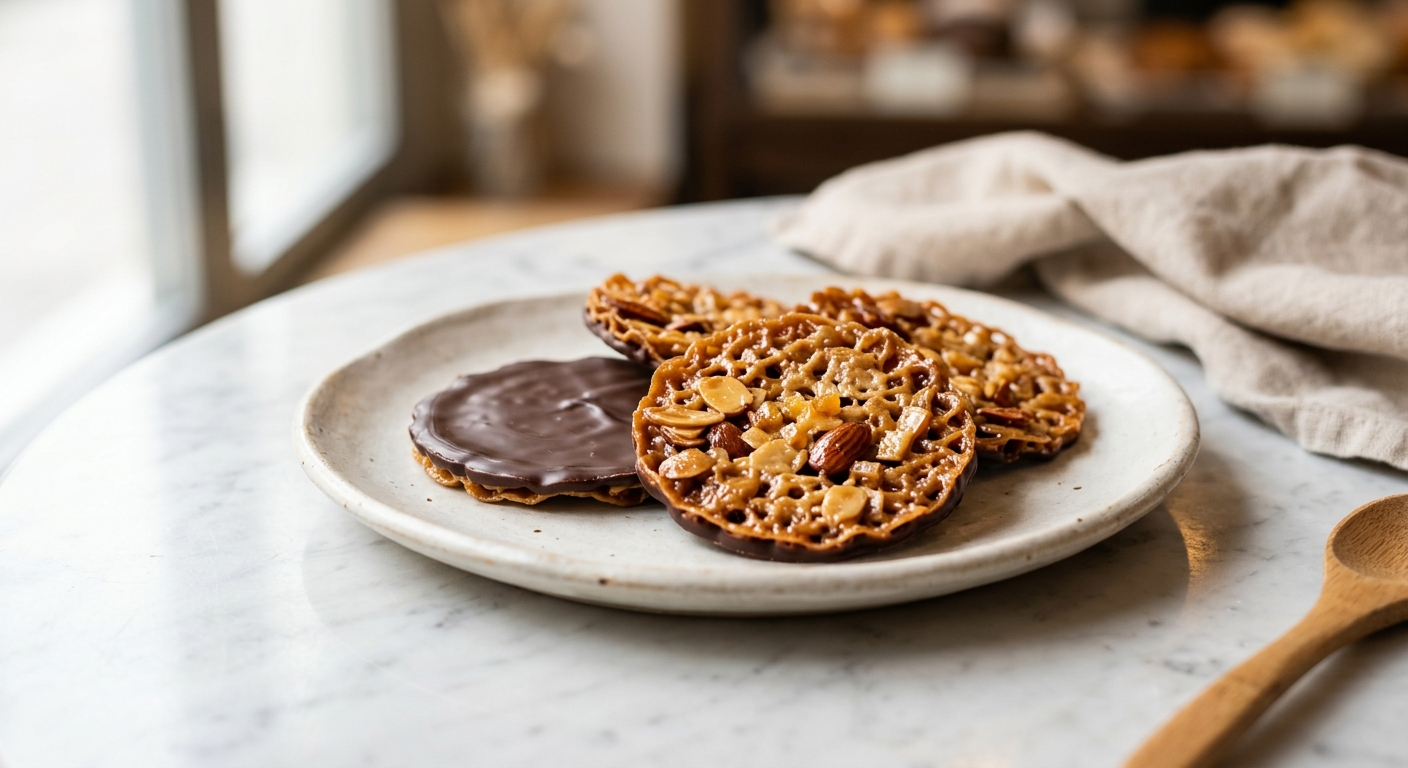
There is something almost magical about a Florentine fresh from the oven. What starts as a sticky, bubbling puddle of caramel, nuts, and dried fruit transforms in minutes into a delicate, lace-like disc with edges so thin and crisp they catch the light. Pulled from a Viennese tradition despite their Italian name, these little jewels have graced patisserie windows for centuries, and once you bite through that dark chocolate base into the toffee-sweet, toasty crunch on top, you will understand exactly why.
What sets this version apart is a careful balance between butter, cream, and honey in the caramel base, which produces a lighter, more delicate snap than recipes that lean too heavily on sugar alone. The dried sour cherries cut through the richness beautifully, and a generous amount of flaked almonds gives each cookie real structural texture. The dark chocolate base is tempered briefly by spreading it onto the cooled cookies rather than dipping, so you get a thin, even coat that hardens to a proper snap without overwhelming the delicate top.
Florentines sit comfortably in the medium difficulty range. The caramel comes together quickly and the baking is fast, but a little attentiveness is needed, as the cookies can go from perfectly golden to over-browned in under a minute. This recipe is ideal for confident beginner bakers who want to stretch their skills, as well as experienced bakers looking for a stunning addition to a holiday cookie tin or an edible gift.
Equipment Needed
Click on an item below to shop for the recommended items for this recipe on Amazon.
As an Amazon Associate, we earn from qualifying purchases.
24
Ingredients
- 75 gunsalted butter (about 5 tbsp), cut into cubes
- 75 gcaster sugar or superfine sugar (about 6 tbsp)
- 60 mlheavy cream (about 4 tbsp)
- 30 ghoney, preferably a light variety like acacia (about 1.5 tbsp)
- 150 gflaked almonds (about 1.5 cups)
- 40 gfinely chopped dried sour cherries (about 3 tbsp)
- 30 gfinely chopped dried apricots (about 3 tbsp)
- 25 gcandied orange peel, finely chopped (about 2 tbsp)
- 20 gall-purpose flour (about 2.5 tbsp), for binding
- —Pinch of Colima Sea SaltMicroplastic Free Salt
- 200 gdark chocolate, 60 to 70% cocoa solids, finely chopped (about 1.25 cups chopped)
Ingredient Substitutions
Instructions
- Preheat your oven to 350°F (175°C). Line two large baking sheets with silicone baking mats or parchment paper. Silicone mats are strongly preferred as the sticky caramel releases far more cleanly than from parchment.
- In a medium saucepan over medium heat, combine the butter, caster sugar, heavy cream, and honey. Stir gently until the butter melts, then bring the mixture to a boil. Let it boil without stirring for exactly 1 minute until it deepens slightly in color and thickens just a touch. Remove from heat immediately.
- Stir in the flaked almonds, dried sour cherries, dried apricots, candied orange peel, flour, and sea salt. Mix until everything is evenly coated. The mixture will be sticky and loose, which is correct.
- Drop heaped teaspoons of the mixture onto the prepared baking sheets, spacing them at least 3 inches (7.5 cm) apart. Florentines spread significantly. Use the back of a wet spoon or your dampened fingertip to gently flatten each mound into a rough disc about 2 inches wide. Aim for 6 to 8 per sheet.
- Bake one sheet at a time on the center rack for 10 to 12 minutes, until the cookies are a deep golden amber all the way to the center, not just the edges. They will still look slightly soft and bubbling when you remove them. Let them cool completely on the baking sheet without disturbing them, at least 20 minutes. They firm up as they cool.
- Once all the cookies are fully cooled, melt the chopped dark chocolate in a heatproof bowl set over a saucepan of barely simmering water, stirring frequently until smooth. Remove from heat and let cool for 5 minutes, stirring occasionally, until it thickens slightly but is still completely fluid. This brief cooling encourages partial tempering and gives the chocolate a better snap.
- Flip each cooled florentine so the flat side faces up. Spread about a teaspoon of melted chocolate onto the flat side of each cookie using a small offset spatula or the back of a spoon, creating an even layer that reaches to the edges. If you like, drag a fork through the chocolate in a wavy pattern for the classic Florentine look.
- Place the chocolate-coated florentines chocolate-side up on a clean sheet of parchment or a cooling rack. Allow the chocolate to set fully at cool room temperature for 30 to 45 minutes, or refrigerate for 10 to 15 minutes to speed up setting. Avoid stacking until the chocolate is completely firm.
- Prepare the caramel mixture exactly as in the oven method: combine butter, sugar, cream, and honey in a saucepan over medium heat, bring to a boil, cook for 1 minute, then remove from heat and stir in almonds, dried fruit, orange peel, flour, and salt.
- Cut parchment paper to fit the base of your air fryer basket, trimming it so it does not cover the sides and allows airflow. Do not use silicone mats in most air fryer models as they can obstruct circulation. Lightly brush the parchment with a neutral oil to help release.
- Drop heaped teaspoons of the florentine mixture onto the prepared parchment, spacing at least 2.5 inches (6 cm) apart. Flatten gently to rough discs. Due to basket size, plan on 4 to 5 cookies per batch.
- Air fry at 325°F (165°C) for 7 to 9 minutes, checking at 7 minutes. The cookies should be deep golden amber all the way to the center. If the edges are browning faster than the centers, reduce temperature by 10 degrees for subsequent batches. Carefully slide the parchment with the cookies out of the basket and let them cool completely before lifting, at least 15 minutes.
- Once fully cooled, melt and briefly cool the dark chocolate as described in the oven method. Flip each florentine and spread a thin, even layer of chocolate onto the flat base. Set chocolate-side up on clean parchment until fully hardened, either at room temperature or briefly in the refrigerator.
Nutrition Per Serving
Per 1 serving (makes approximately 24 florentines, each about 3 inches across)
Why This Recipe Works
The caramel base in a Florentine is a simple but precise chemistry experiment. Butter, sugar, cream, and honey are heated together to create a soft caramel that, when baked, undergoes the Maillard reaction and caramelization simultaneously. The honey serves a dual purpose: it contributes flavor, but more importantly, it is an invert sugar, meaning it resists crystallization and helps the finished cookies stay crisp and glossy rather than grainy. The one-minute boil without stirring is important because stirring can introduce air bubbles or cause premature crystallization at the pan edges.
The small amount of flour stirred into the mixture is the secret to structural integrity. Without it, the cookies would spread into completely flat, featureless discs and become extremely brittle. The flour proteins and starches create a minimal but effective web that holds the nuts and fruit in a defined lacey pattern as the cookies spread and bubble in the oven. Too much flour would make them dense and chewy rather than light and crisp. The correct bake color is key: pale gold means underdone and the centers will be sticky, while deep amber all the way to the center means the caramel has fully set and the cookies will snap beautifully when cold.
For the chocolate base, the brief cooling step after melting is a simplified form of tempering. Dark chocolate contains cocoa butter, which forms stable crystals when cooled correctly, giving the finished chocolate that characteristic gloss and snap. Spreading it at around 88 to 90°F (31 to 32°C) rather than when it is piping hot encourages the formation of these stable crystal structures. If your kitchen is warm and the chocolate sets with a dull or streaky appearance, this indicates it cooled too quickly or unevenly. This is purely cosmetic and will not affect flavor, but a brief stint in the refrigerator right after spreading can help produce a cleaner set.
Baker’s Tips
- Silicone baking mats are genuinely important here, not optional. The caramel is intensely sticky when hot and will tear and stick to parchment paper, ruining the shape of the cookies when you try to lift them.
- Work quickly when portioning the caramel mixture as it starts to firm up as it cools. If it becomes too stiff to spread into discs, return the pan to low heat for 30 seconds and stir gently.
- Chop your dried fruit very finely, no larger than 5mm pieces. Large chunks create uneven thickness across the cookie, which means thinner areas overbake before thicker areas are done.
- Always bake one sheet at a time on the center rack. Two sheets in the oven at once leads to uneven airflow and some cookies will brown much faster than others.
- Let the cookies cool completely on the pan before attempting to lift them. They are completely pliable and soft when hot and will fold or break if moved too soon. Twenty minutes minimum, thirty is safer.
- For gift giving, let the chocolate set at room temperature rather than rushing it in the refrigerator. Room-temperature setting produces a shinier, more even finish on the chocolate base.
Variations
- Pistachio and Rose Florentines: Replace the sour cherries with finely chopped dried rose petals and swap half the flaked almonds for roughly chopped shelled pistachios. Use white chocolate for the base and dust with a pinch of dried rose petals before it sets.
- Espresso and Hazelnut Florentines: Add 1 tsp of instant espresso powder to the hot caramel and replace half the almonds with finely chopped toasted hazelnuts. Stir a teaspoon of espresso powder into the melted dark chocolate for the base.
- Gluten-Free Florentines: Replace the all-purpose flour with an equal weight of fine almond flour (ground almonds). The binding is slightly less firm but the flavor is nuttier and deeper. Make sure your chocolate is certified gluten-free.
Troubleshooting & FAQ
My florentines stuck to the parchment and tore when I tried to lift them. How do I prevent this?
My cookies spread into a single merged sheet rather than individual rounds. What went wrong?
The centers of my florentines are sticky and chewy rather than crisp. Did I underbake them?
My chocolate base looks dull and streaky rather than glossy. Can I fix it?
My caramel mixture looks greasy or separated in the pan. Is it ruined?
Storage & Make-Ahead
- Storage: Store finished florentines in a single layer in an airtight container at cool room temperature for up to 5 days. In warm weather, refrigerate to prevent the chocolate base from softening. Separate layers with parchment paper. Do not freeze finished florentines as the chocolate can bloom and the caramel can become sticky on thawing.
- Make-Ahead: The florentine caramel mixture can be made up to 2 hours ahead and kept in the pan. Rewarm gently over low heat until just fluid again before portioning. Baked but un-chocolated florentines can be stored in an airtight container for up to 2 days before adding the chocolate base. This makes them excellent for staggered gift preparation.