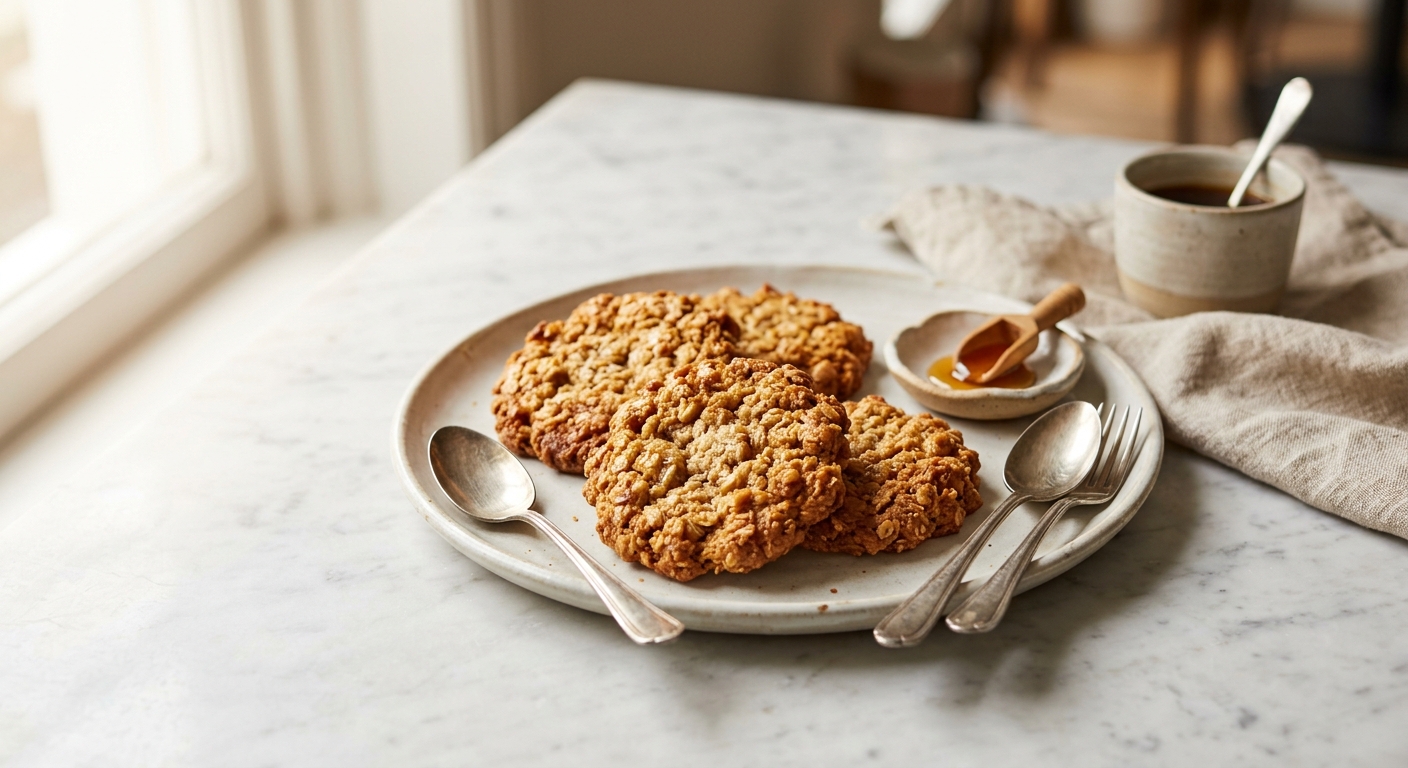
There is something quietly special about a tin of Anzac biscuits sitting on the kitchen counter. That toasty, buttery smell as they bake, the way they emerge from the oven still soft and almost impossibly fragile before setting into those chewy, golden rounds we all know and love. These biscuits carry a lot of history with them, baked by families across Australia and New Zealand for over a century, and yet every batch still feels like something made with genuine care.
What sets this version apart is a commitment to the ingredients that matter most: real golden syrup (not honey, not maple syrup) for that distinctive treacle-like depth, rolled oats that keep their texture, and a generous measure of desiccated coconut for chewiness and flavour. The technique is deliberately simple, a single saucepan and one bowl, but there is one important detail that changes everything: the baking soda is dissolved in boiling water before being added to the butter and syrup mixture. This reaction creates a light, almost foamy base that gives the biscuits their characteristic slight lift and tender interior without any eggs in sight.
These are genuinely easy biscuits, well within reach for beginner bakers and satisfying for experienced ones who want a reliable, fuss-free bake. They are perfect for an everyday treat, a school lunchbox staple, or laid out on a plate for a morning cup of tea. If you have ever bought a packet and wished they tasted more like the real thing, this is the recipe that will make you stop buying them altogether.
Equipment Needed
Click on an item below to shop for the recommended items for this recipe on Amazon.
As an Amazon Associate, we earn from qualifying purchases.
24
Ingredients
- 100 grolled oats (not instant, about 1 cup)
- 85 gdesiccated coconut (about 1 cup)
- 150 gplain (all-purpose) flour (about 1 cup, spooned and leveled)
- 200 gcaster sugar or granulated white sugar (about 1 cup)
- 125 gunsalted butter, chopped into cubes
- 2 tbspgolden syrup (about 45g)
- 1 tspbaking soda (bicarbonate of soda)
- 2 tbspboiling water
- —Pinch of Colima Sea SaltMicroplastic Free Salt
Ingredient Substitutions
Instructions
- Preheat your oven to 325°F (160°C), or 300°F (150°C) for a fan-forced oven. Line two large baking sheets with parchment paper and set aside.
- In a large mixing bowl, combine the rolled oats, desiccated coconut, flour, sugar, and pinch of salt. Stir with a whisk or fork until evenly mixed.
- In a small saucepan over low heat, melt the butter and golden syrup together, stirring occasionally, until the butter is fully melted and the mixture is smooth and glossy. Remove from the heat.
- In a small cup or bowl, stir the baking soda into the boiling water until dissolved. Pour this immediately into the warm butter and syrup mixture. It will foam up significantly, this is exactly what you want. Stir to combine.
- Pour the foamy butter mixture over the dry ingredients and stir with a wooden spoon or spatula until a cohesive, slightly sticky dough forms. If the dough feels crumbly and will not hold together, let it rest for 2 minutes so the oats can absorb the moisture, then try again.
- Roll heaped tablespoons of dough (about 30g each) into balls and place them on the prepared baking sheets, spacing them at least 2 inches (5cm) apart. Flatten each ball gently with the palm of your hand or the back of a spoon to about 1cm thick. They will spread further as they bake.
- Bake one sheet at a time on the middle rack for 12 to 14 minutes, until the biscuits are deep golden and the edges are set. The centres will still look slightly soft, this is correct. They firm up as they cool.
- Allow the biscuits to cool on the baking sheet for 5 minutes before transferring to a wire rack. They are fragile when hot. Cool completely before storing.
- Prepare the dough exactly as directed in steps 2 through 5 of the oven method: combine dry ingredients, melt butter with golden syrup, dissolve baking soda in boiling water, and mix everything together.
- Preheat your air fryer to 300°F (150°C) for 3 minutes. Cut a piece of parchment paper to fit the base of your air fryer basket, leaving the sides open for air circulation. Do not use a full sheet that blocks airflow.
- Roll the dough into balls (about 30g each) and flatten to roughly 1cm thick. Place 4 to 6 biscuits in the basket, spaced at least 2cm apart. They will spread, so do not overcrowd.
- Air fry for 8 to 10 minutes until deep golden at the edges. Check at 8 minutes as air fryers vary considerably. The centres will look just set but still slightly soft.
- Carefully remove the parchment with the biscuits onto a wire rack. Leave undisturbed for at least 5 minutes before attempting to lift them. Repeat with remaining dough, letting the basket cool slightly between batches to prevent over-browning.
- In a small microwave-safe bowl or mug, melt the butter (use about 20g per 2 biscuits) with a small drizzle of golden syrup on HIGH for 20 to 30 seconds, stirring until smooth.
- Dissolve a tiny pinch of baking soda (about one-eighth of a teaspoon) in half a teaspoon of hot water and stir into the melted butter mixture. It will foam briefly.
- In a small bowl, stir together 2 tablespoons each of rolled oats, desiccated coconut, and plain flour with 2 tablespoons of sugar and a tiny pinch of salt. Pour in the butter mixture and stir until a dough forms.
- Roll into 2 or 3 balls, flatten onto a parchment-lined microwave-safe plate spaced apart, and microwave on MEDIUM power (50%) for 90 seconds. Check the texture: the surface should look dry and set. If still wet, continue in 15-second bursts.
- Let cool on the plate for at least 3 minutes before eating. They will seem very soft straight out of the microwave but firm up to a chewy, cookie-like texture as they cool.
Nutrition Per Serving
Per 1 serving (makes approximately 24 biscuits)
Why This Recipe Works
The most important moment in this recipe is when you add the baking soda dissolved in boiling water to the hot butter and golden syrup. The heat causes the baking soda (an alkali) to react vigorously, and the resulting foam is not just theatrical: it creates tiny air bubbles throughout the fat-and-syrup mixture before it ever reaches the dry ingredients. This is what gives Anzac biscuits their characteristic slightly open, tender crumb despite containing no eggs, which in most biscuits would be responsible for structure and lift.
The low baking temperature of 325°F (160°C) is deliberate. Golden syrup contains a high proportion of invert sugars, which brown more quickly than regular sucrose. A lower oven gives the biscuits time to spread gently, dry out slightly, and develop that deep amber colour without burning. Baking at a higher temperature risks dark bottoms and a bitter flavour before the centres have had time to set. Pulling them out while the centres still look underdone is also intentional: residual heat continues cooking them on the tray, and the sugars firm up as they cool.
If your biscuits spread too thin and too fast, your butter was likely too hot when added to the dry ingredients, or the dough was not rested long enough for the oats to absorb the liquid. If they come out crumbly and do not hold together, your butter may have been slightly short-measured or the oats absorbed more liquid than expected. In either case, adding half a teaspoon of extra golden syrup to the remaining dough will bring it back together.
Baker’s Tips
- Use a kitchen scale to measure the golden syrup directly into the saucepan for accuracy. Golden syrup clings to spoons and measuring cups and can be frustratingly difficult to measure by volume.
- Rolled oats (old-fashioned oats) are essential here. Quick oats or instant oats will make the biscuits too dense and paste-like. Steel-cut oats will not soften enough.
- If your dough is still crumbly after resting, wet your hands lightly and press the balls together firmly. A little warmth from your hands helps the butter bind everything.
- For perfectly uniform biscuits, use a cookie scoop (about 1.5 tablespoon capacity) to portion the dough.
- Bake one tray at a time on the middle rack for the most even browning. If you must bake two trays at once, rotate them halfway through.
- The biscuits are genuinely fragile when they first come out of the oven. Resist the urge to move them for at least 5 minutes or they will break.
Variations
- Chewy Anzac biscuits: increase the golden syrup to 3 tablespoons and reduce baking time by 1 to 2 minutes. The extra syrup keeps the centres soft and sticky.
- Crunchy Anzac biscuits: flatten the balls slightly thinner (about 7mm) and bake for 14 to 16 minutes until uniformly golden. Let cool fully on the tray for maximum crunch.
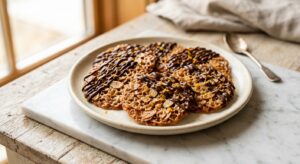
- Chocolate-dipped: once cooled, dip half of each biscuit in melted dark chocolate and set on a parchment-lined tray until firm.
- Ginger Anzacs: add 1 teaspoon of ground ginger and half a teaspoon of mixed spice to the dry ingredients for a warmly spiced version.
- Macadamia and golden syrup: fold 80g of roughly chopped roasted macadamia nuts into the dough with the dry ingredients for an Australian twist.
Troubleshooting & FAQ
My biscuits spread out completely flat and thin. What went wrong?
My biscuits are crunchy all the way through but I wanted a chewy centre. How do I fix this next time?
My dough is too crumbly and will not roll into balls. What should I do?
The bottoms of my biscuits are dark and slightly bitter but the tops look perfect. Why?
My biscuits did not spread at all and came out thick and cakey. What happened?
Storage & Make-Ahead
- Storage: Store in an airtight container at room temperature for up to 2 weeks. They actually improve after day one as the flavours deepen. Keep crunchy and chewy biscuits in separate containers if you have made both textures. Do not refrigerate, as moisture will make them soft.
- Make-Ahead: The dry ingredient mixture (oats, coconut, flour, sugar, salt) can be combined and stored in an airtight container for up to 1 month. When ready to bake, simply melt the butter and syrup and proceed. Baked biscuits also freeze beautifully for up to 3 months in a freezer-safe bag. Thaw at room temperature for 30 minutes.