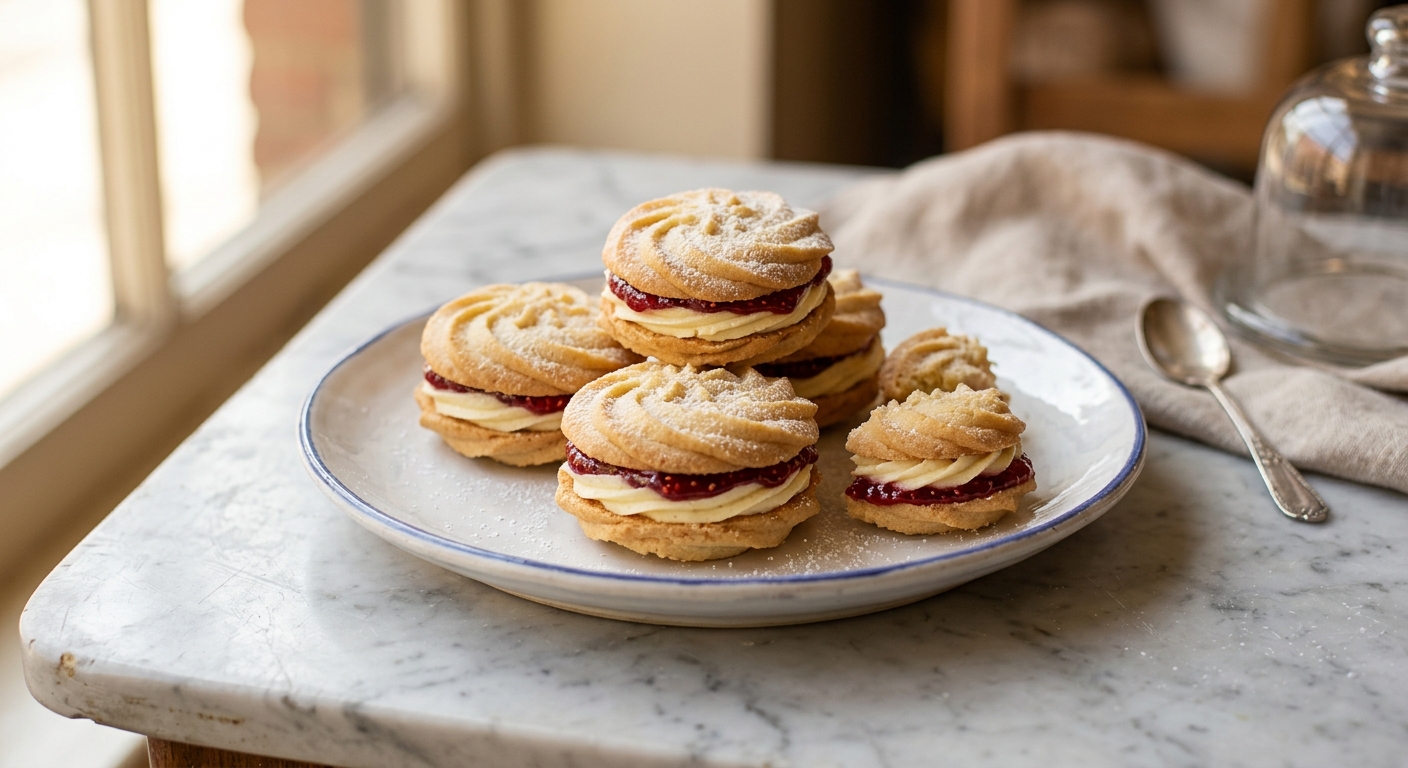
There is something undeniably elegant about a Viennese whirl. Sitting on a pretty plate, its ridged rosette of pale golden pastry dusted with the faintest snow of icing sugar, it looks like it belongs behind glass in a Viennese Konditorei. But the moment you bite through that crumbly, cloud-soft shell and hit the ribbon of sharp raspberry jam and sweet vanilla buttercream, you realize this is not a precious thing to admire from a distance. It is a biscuit to be eaten with both hands and absolutely no apology.
What sets this recipe apart is the ratio of cornflour to plain flour and, crucially, the temperature and treatment of the butter. A generous proportion of cornflour weakens the gluten network, giving you that signature dissolve-on-the-tongue delicacy rather than a sturdy snap. But the real secret is beating the butter for a full four to five minutes until it is genuinely pale, almost white, and whipped with air. That aeration is what makes the piped dough hold its ridges in the oven and produces a biscuit so light it barely seems to exist. No special equipment beyond a stand or hand mixer and a piping bag is required.
These are rated medium difficulty, primarily because piping a consistent rosette takes a little practice. Do not worry if your first tray looks imperfect as they will taste identical and the icing sugar hides a multitude of sins. They are perfect for afternoon tea, a weekend baking project with older children, or as a gift box treat that looks wildly impressive for the effort involved.
Equipment Needed
Click on an item below to shop for the recommended items for this recipe on Amazon.
As an Amazon Associate, we earn from qualifying purchases.
12
Ingredients
- Buttercream (about 9 Tbsp)
- 250 gunsalted butter, at room temperature (about 1 cup + 2 tbsp), must be genuinely soft
- 50 gicing sugar (powdered sugar), sifted (about 6 tbsp)
- 1 tsppure vanilla extract
- 200 gplain all-purpose flour, sifted (about 1 cup + 5 tbsp)
- 50 gcornflour (cornstarch), sifted (about 6 tbsp)
- —Pinch of Colima Sea SaltMicroplastic Free Salt
- 80 ggood-quality raspberry jam (about 5 tbsp), seedless preferred
- 125 gunsalted butter, at room temperature
- Buttercream (about 1.5 Cups)
- 200 gicing sugar (powdered sugar), sifted
- Buttercream
- 1 tsppure vanilla extract
- 1 tbspwhole milk or double cream
- 15 gicing sugar for dusting, to finish (about 2 tbsp)
Ingredient Substitutions
Instructions
- Preheat your oven to 375°F (190°C) / 355°F (180°C) fan. Line two large baking sheets with parchment paper. Fit a large piping bag with a large open star tip (Wilton 1M or a 6-point star tip with about a 1.5cm opening).
- Beat 250g of the room-temperature butter in a stand mixer fitted with the paddle attachment, or with a hand mixer in a large bowl, on medium-high speed for 4 to 5 minutes. Stop and scrape down the sides twice. The butter should become noticeably paler, almost ivory-white, and visibly fluffy. This step is non-negotiable for the right texture.
- Add the sifted 50g icing sugar, vanilla extract, and pinch of salt. Beat on low for 30 seconds to combine, then increase to medium-high and beat for another 2 minutes until very light and creamy. Scrape the bowl.
- Add the sifted flour and cornflour all at once. Mix on the lowest speed until just combined, about 30 seconds. Do not overmix. The dough will look like a very thick, slightly grainy paste. Spoon it into the prepared piping bag immediately.
- Pipe 24 rosettes onto the prepared baking sheets, spacing them about 4cm apart. To pipe a rosette, hold the bag vertically about 1cm above the parchment, apply even pressure, and swirl outward then back to the centre in one smooth motion, releasing pressure to finish. Aim for rounds about 4 to 5cm in diameter. Refrigerate the trays for 10 minutes before baking to help them hold their shape.
- Bake one tray at a time in the centre of the oven for 12 to 14 minutes. The biscuits are ready when the edges are just barely golden and the tops are set but still very pale. They will look underdone but will firm up completely as they cool. Do not overbake.
- Allow the biscuits to cool on the tray for 5 minutes before transferring carefully to a wire rack. They are very fragile when warm. Cool completely, at least 20 minutes, before assembling.
- Make the vanilla buttercream: beat 125g room-temperature butter for 3 minutes until pale. Add sifted 200g icing sugar in two additions, beating on low then medium. Add vanilla and 1 tbsp milk and beat for another 2 minutes until smooth and fluffy. Transfer to a piping bag fitted with a small star or round tip.
- To assemble: match biscuits into pairs of similar size. Spread or pipe a small amount of raspberry jam (about 1 tsp) onto the flat side of one biscuit. Pipe a ring or small swirl of buttercream onto the other. Press gently together. Dust generously with icing sugar just before serving.
- Prepare the dough exactly as described in steps 1 through 5 of the oven method, including the 10-minute refrigerator rest after piping. Cut parchment to fit your air fryer basket and clip or fold the edges so it does not lift in the circulating air.
- Preheat your air fryer to 320°F (160°C) for 3 minutes. This lower temperature is important as the direct circulating heat can brown the outside before the inside is set. Bake in batches of 6 to 8 rosettes at a time depending on your basket size.
- Place the parchment with piped rosettes carefully into the basket. Bake for 9 to 11 minutes. Check at 9 minutes: the biscuits should be set and just barely coloured at the edges, still very pale on top. They will look slightly underdone, which is correct.
- Remove the basket insert and allow the biscuits to cool in the basket for 3 minutes before lifting them on the parchment to a wire rack. They are extremely delicate when warm. Cool completely before assembling.
- Make the buttercream and assemble exactly as described in steps 8 and 9 of the oven method. Dust with icing sugar before serving.
Nutrition Per Serving
Per 1 serving (makes 12 sandwich biscuits (24 individual piped rounds))
Why This Recipe Works
The extraordinary lightness of a Viennese whirl comes down to two things working together: a weakened gluten structure and a high proportion of aerated fat. Cornflour (cornstarch) contains no gluten-forming proteins, so blending it with plain flour dilutes the overall protein content of the dough. Less gluten means less structure, which translates directly into that dissolving, almost powdery crumb rather than a chewy or snappy biscuit. Using icing sugar rather than caster or granulated sugar reinforces this effect: finer sugar particles integrate more smoothly into the fat, helping to keep the texture delicate and preventing any graininess.
The long butter-beating stage is where the magic truly happens. Creaming butter for four to five minutes until pale and fluffy is not just about mixing but about incorporating air. Those tiny air bubbles are trapped within the fat matrix and expand in the oven, contributing to the lift and lightness of the baked biscuit. This also means the butter temperature is genuinely critical. Butter that is too cold will not cream properly and you will struggle to pipe the dough. Butter that is too warm will be greasy and the dough will slump and lose its piped ridges. Aim for butter that yields easily to finger pressure but still holds its shape, around 65 to 68°F (18 to 20°C).
If your piped rosettes spread and lose definition in the oven, the butter was likely too warm or the dough was not chilled before baking. A 10-minute rest in the refrigerator firms up the fat so the ridges hold during the initial heat blast. If the biscuits crumble when you try to lift them, they are either still warm or were slightly overbaked. Always bake to a pale colour and give them time to firm on the tray. The oven is doing less work than you think here as the structure is built in the mixing bowl.
Baker’s Tips
- Butter temperature is the single most important variable. It should feel soft and pliable when pressed but should not be shiny or greasy. If your kitchen is warm, the dough may soften too quickly in the piping bag. Work in batches and keep the second tray refrigerated while the first bakes.
- Do not skip sifting the flour and cornflour. Small lumps in the dough can block the piping tip mid-rosette, which is frustrating. Sifting takes 60 seconds and saves real grief.
- Practice piping on a sheet of parchment first before committing to the baking tray. Consistent pressure is more important than perfect technique. The ridges are what catch the icing sugar and make them look beautiful.
- Use a kitchen scale to portion jam evenly between biscuits. About 5g per sandwich is plenty. Too much jam will cause the biscuits to slide or the filling to squirt out when bitten.
- If the buttercream is too stiff to pipe, add milk half a teaspoon at a time and beat again. If it is too soft (especially in warm weather), refrigerate it for 10 minutes then re-beat briefly.
- Match biscuit pairs before filling. Lay all 24 rounds out, identify natural pairs of similar size and shape, and assemble consistently. This makes a much neater finished tray and is a habit worth building.
Variations
- Chocolate Viennese Whirls: Replace 20g of the plain flour with 20g good-quality cocoa powder. Fill with chocolate ganache (100g dark chocolate melted with 50ml double cream, cooled until spreadable) instead of buttercream, and keep the raspberry jam.
- Lemon and Elderflower: Add the zest of one lemon to the biscuit dough and 1 tbsp elderflower cordial to the buttercream in place of the milk. Replace raspberry jam with lemon curd for a fragrant, floral variation.
- Pistachio Cream: Add 1 tbsp finely ground pistachios to the dough along with the flour, and fold 2 tbsp pistachio paste into the finished buttercream. Fill with apricot jam and finish with a crushed pistachio on top of each sandwich.
Troubleshooting & FAQ
My piped rosettes spread flat and lost their ridges in the oven. What went wrong?
The biscuits are crumbling and breaking when I try to sandwich them. How do I prevent this?
My dough is too stiff to pipe through the nozzle. What should I do?
My biscuits taste a bit bland or floury. How do I get more flavour?
The jam is squirting out the sides when the biscuits are bitten. How do I fix this?
Storage & Make-Ahead
- Storage: Store assembled Viennese whirls in an airtight container at room temperature for up to 3 days. They are best on day 1 and 2. Refrigerate in hot weather but allow to come to room temperature for 20 minutes before eating, as cold buttercream loses its soft texture. Unassembled baked biscuits can be frozen in a single layer for up to 2 months; thaw at room temperature and assemble fresh.
- Make-Ahead: The biscuit dough can be piped onto lined trays, covered loosely with cling film, and refrigerated for up to 24 hours before baking. The baked, unfilled biscuits keep well in an airtight tin for 3 days. The vanilla buttercream can be made up to 3 days ahead and stored in the fridge; bring to room temperature and re-beat briefly before using.