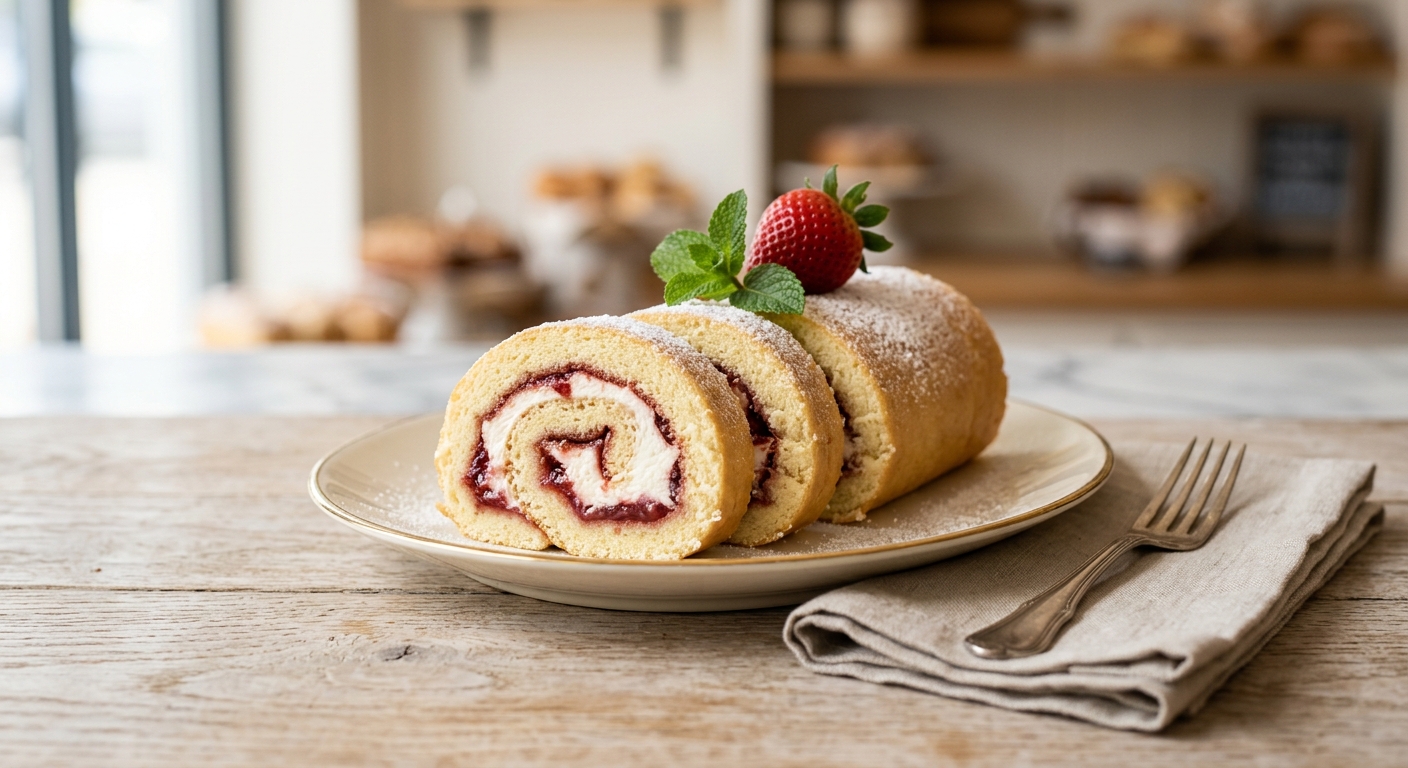
There is something quietly magical about a Swiss roll sitting on a cake stand, its tight spiral of cream and jam peeking out from each end like a promise. It feels like a bake from another era, the kind of thing your grandmother might have produced on a Sunday afternoon with very little fuss, and somehow that nostalgia makes it taste even better. The moment you slice through the pale golden sponge to reveal that perfect pinwheel, you will understand why this humble roll has been a tea-time staple for generations.
What sets this version apart is a warm-roll technique that is the single most important step in getting a crack-free finish. The sponge is turned out onto a sugar-dusted tea towel and rolled while it is still hot, training the gluten to hold that curve before the filling ever goes in. The sponge itself uses a simple separated-egg method: the yolks are beaten with sugar until thick and pale, and the whites are whipped to soft peaks before being folded in. No butter, no fat. The air beaten into those eggs is the only leavening, which is exactly why the texture stays so light and delicate, and why it can flex instead of crack.
This recipe sits comfortably in the medium difficulty range. The sponge bakes in under fifteen minutes and there are no complicated components, but the rolling step does require a little confidence. It is ideal for bakers who have made a few cakes before and want to try something new, and it is a genuinely stunning dessert to bring to a birthday gathering, a garden party, or any occasion where you want something beautiful with relatively little effort.
Equipment Needed
Click on an item below to shop for the recommended items for this recipe on Amazon.
As an Amazon Associate, we earn from qualifying purchases.
10
Ingredients
- Dusting The Tea Towel
- 4 largeeggs, separated, at room temperature
- 120 gcaster sugar or superfine sugar (about 1/2 cup plus 1 tbsp), divided
- 1 tsppure vanilla extract
- 90 gall-purpose flour (about 3/4 cup, spooned and leveled)
- 1 tspbaking powder
- —Pinch of Colima Sea SaltMicroplastic Free Salt
- 2 tbspcaster or granulated sugar
- Cream
- 180 ggood-quality strawberry jam (about 1/2 cup plus 2 tbsp), slightly warmed
- 300 mlheavy whipping cream (about 1 1/4 cups), cold
- 2 tbspicing sugar (powdered sugar), sifted, plus extra for dusting
- 1 tsppure vanilla extract
Ingredient Substitutions
Instructions
- Preheat your oven to 375°F (190°C). Grease a 10×15-inch (25×38 cm) rimmed baking sheet (jelly roll pan), line it with parchment paper, and grease the parchment too. Set aside. Lay a clean tea towel or thin kitchen towel flat on your counter and dust it evenly with 2 tablespoons of caster sugar.
- In a large bowl, beat the egg yolks with 80g (about 1/3 cup) of the caster sugar and the vanilla extract using a hand mixer or stand mixer on high speed for 4 to 5 minutes, until the mixture is very thick, pale, and falls from the beaters in a slow ribbon. This step builds the base structure of the sponge, so do not rush it.
- In a separate clean, dry bowl, whisk the egg whites with the pinch of salt on medium speed until foamy. Gradually add the remaining 40g (about 3 tbsp) of caster sugar and increase to high speed. Beat until the whites hold soft, glossy peaks. They should look like shaving foam, not stiff and dry.
- Sift the flour and baking powder together directly over the yolk mixture. Using a large balloon whisk or flexible spatula, fold gently until the flour just disappears, then add one-third of the egg whites and fold to loosen the batter. Add the remaining whites in two additions, folding with a light, sweeping motion that cuts down through the center and sweeps up the sides. Stop as soon as no white streaks remain. Overmixing deflates the air you just built in.
- Pour the batter onto the prepared pan and spread it gently and evenly to the corners using an offset spatula. Bake for 11 to 13 minutes, until the sponge is golden, springs back when lightly pressed in the center, and the edges are just beginning to pull away from the pan.
- As soon as the sponge comes out of the oven, run a knife around the edges and immediately turn it out onto the sugar-dusted tea towel, parchment side up. Carefully peel away the parchment. Starting from one of the short ends, roll the sponge up tightly inside the towel, including the towel as you go. Place the roll seam-side down on a wire rack and leave to cool completely, about 30 to 40 minutes. Do not skip this step. Rolling it hot and letting it cool in shape is what prevents cracking later.
- Once fully cooled, whip the cold cream with the icing sugar and vanilla to soft, billowy peaks. Gently unroll the sponge. Spread the warmed strawberry jam evenly over the surface, leaving a 1-inch (2.5 cm) border at the far short edge. Spread the whipped cream over the jam in an even layer. Re-roll the sponge firmly but gently, using the towel to help guide it, and transfer to a serving board seam-side down. Dust generously with icing sugar and refrigerate for at least 15 minutes before slicing with a sharp serrated knife.
- Check that your air fryer tray or basket fits a rimmed insert or small baking pan of at least 9×12 inches (23×30 cm). Line the pan with parchment and grease it well. Lay a sugar-dusted tea towel on your counter as instructed in the oven method.
- Prepare the sponge batter exactly as described in steps 2 through 4 of the oven method, taking care with the whipping and folding steps. The batter is the same regardless of cooking method.
- Pour the batter into the prepared pan and spread to an even thickness. Preheat your air fryer to 340°F (170°C) for 3 minutes if your model requires it. Place the pan in the basket and bake for 9 to 11 minutes. Check at 9 minutes by pressing the center gently. It should spring back and feel set, not wet. Air fryers vary significantly in power, so keep a close eye the first time you try this.
- Remove the pan carefully using oven gloves, as the basket will be very hot. Immediately turn the sponge out onto the sugar-dusted towel, peel away the parchment, and roll it up inside the towel from the short end, exactly as in the oven method. Cool completely seam-side down on a wire rack, about 25 to 30 minutes.
- Fill and finish the roll with jam and whipped cream following the same steps as the oven method. Because this sponge is slightly thicker, use a gentle, steady pressure when re-rolling. Dust with icing sugar and chill for 15 minutes before slicing.
Nutrition Per Serving
Per 1 serving (makes one 10-inch Swiss roll, approximately 10 slices)
Why This Recipe Works
The fat-free sponge in a Swiss roll is built entirely on the foam structure of whipped eggs. Beating the yolks with sugar until pale and ribbon-like dissolves the sugar and wraps air into a network of protein and fat from the yolk. The separately whipped whites add a large volume of stable air bubbles. When you fold the two together, you are creating a batter that is essentially a foam, and when heat hits it in the oven, that air expands and the proteins set around it, creating a sponge that is light enough to flex. Because there is no butter or oil to weigh it down, the sponge can stretch without cracking, provided it is handled correctly.
The warm-roll technique is the single most critical step in this recipe, and it is rooted in simple food science. Fresh from the oven, the gluten in the sponge is still warm, hydrated, and pliable. Rolling it immediately while it cools inside the towel trains those gluten strands to hold a curved shape as the proteins relax and set in that position. When you unroll it later to add the filling, the sponge already has a natural memory of the curve and happily re-rolls without resistance. If you allow the sponge to cool flat and then try to roll it cold, the gluten is rigid and the sponge cracks under the stress. The sugar on the towel serves a dual purpose: it stops the sponge from sticking and creates a very faint caramelized crust on the outside.
If your sponge does crack despite following the method, the most common cause is overbaking. Even one or two extra minutes at this temperature removes too much moisture from such a thin sheet, making it brittle. Always check at the minimum time and pull the sponge while it still feels slightly soft in the very center. It will finish setting as it rests. Small cracks can usually be hidden with a dusting of icing sugar and confident slicing.
Baker’s Tips
- Room-temperature eggs are non-negotiable here. Cold yolks do not beat to the same volume, and cold whites are harder to whip. Take your eggs out of the fridge at least 30 minutes before you begin.
- Make sure your bowl and beaters are completely clean and dry before whipping the egg whites. Any trace of fat, including from egg yolk, will prevent the whites from whipping properly.
- Warm the strawberry jam gently in the microwave or a small saucepan until it is just spreadable. A cold, stiff jam tears the delicate sponge as you spread it.
- Spread the batter to the very corners of the pan so the sponge has an even thickness throughout. Thin edges bake faster and become brittle, increasing the risk of cracking.
- Use a serrated bread knife in a gentle sawing motion to slice the roll. A straight blade pressed down will compress the cream and drag the sponge. Wipe the knife clean between slices for the most beautiful spirals.
- If you notice small cracks forming as you re-roll the filled sponge, do not panic. Apply gentle, even pressure and keep rolling. A dusting of icing sugar conceals most imperfections beautifully.
Variations
- Lemon and raspberry: Replace the vanilla in the sponge with 1 teaspoon of finely grated lemon zest, swap the strawberry jam for seedless raspberry jam, and add 2 teaspoons of lemon juice to the whipped cream.
- Chocolate Swiss roll: Replace 20g of the flour with 20g of good-quality unsweetened cocoa powder (sifted together with the remaining flour). Fill with plain whipped cream and a thin spread of chocolate ganache instead of jam.
- Tiramisu-inspired: Brush the unrolled sponge with 2 tablespoons of cooled espresso and 1 tablespoon of coffee liqueur. Fill with mascarpone cream (150g mascarpone folded into 150ml whipped cream with 2 tbsp icing sugar). Dust the finished roll with cocoa powder instead of icing sugar.
Troubleshooting & FAQ
My sponge cracked when I tried to roll it. What went wrong?
My whipped cream filling leaked out when I re-rolled the sponge. How do I prevent that?
My sponge stuck to the tea towel. How do I stop this happening?
The sponge batter seemed to deflate when I added the flour. Did I do something wrong?
Can I fill the Swiss roll the night before serving?
Storage & Make-Ahead
- Storage: Store the finished Swiss roll covered loosely in the refrigerator for up to 2 days. The cream filling means it must be kept chilled. For best texture, bring it to room temperature for 10 minutes before serving. The unfilled, rolled sponge (still in the towel) can be stored at room temperature for up to 1 day before filling.
- Make-Ahead: The sponge can be baked, rolled in the towel, and left to cool up to 8 hours ahead of filling. The whipped cream can be made up to 4 hours ahead and kept covered in the refrigerator. Assemble the filled roll up to 4 hours before serving and refrigerate until needed.