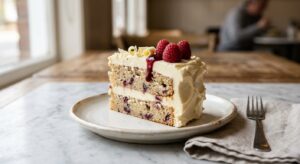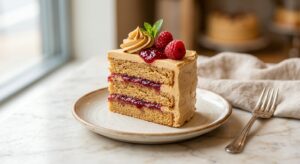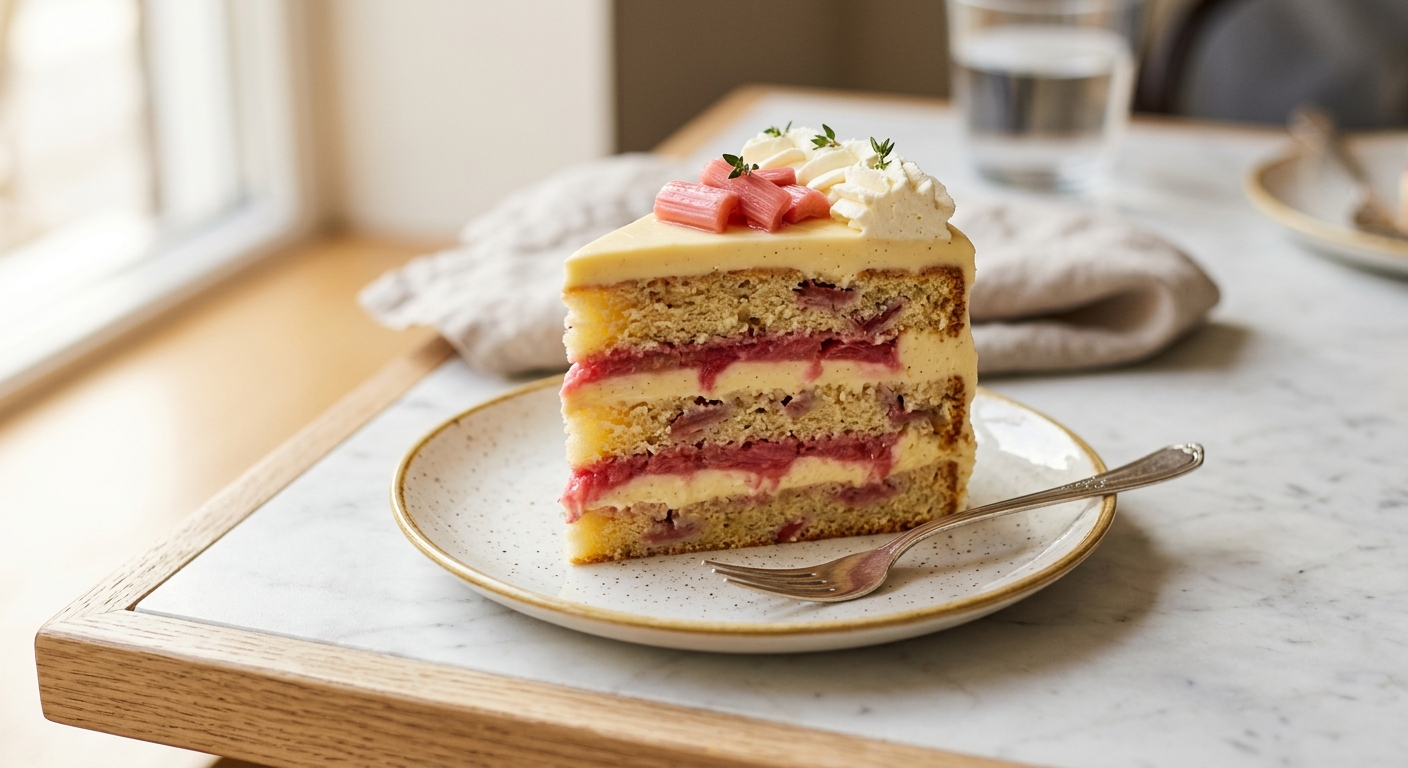
There is something almost magical about the combination of rhubarb and custard. The sharp, jammy fruit cutting through something rich and vanilla-sweet is one of those flavor pairings that feels both nostalgic and completely grown-up at once. This cake captures exactly that feeling: a soft, buttery vanilla sponge layered with a roasted rhubarb compote that turns a deep, jewel-like pink, and a custard buttercream so smooth and fragrant with vanilla that you will want to eat it by the spoonful. Stacked together and finished with swoops of frosting and a few curls of candied rhubarb on top, it is genuinely one of the prettiest cakes you can bring to a table.
What makes this version stand out is a two-part technique that takes the flavor much further than a simple rhubarb jam filling. The rhubarb is roasted in the oven rather than stewed on the stovetop, which concentrates its flavor, preserves its vivid color, and drives off excess water so your cake layers never go soggy. The custard buttercream is built on a real egg yolk and milk custard base, cooked on the stovetop and then beaten into butter, giving it a depth and richness that no powdered-sugar frosting can match. Together, these two elements make every single bite taste intentional and balanced.
This cake sits comfortably in the medium difficulty range. There are a few components to prepare, but none of them are technically demanding, and everything except the final assembly can be done ahead of time. It is perfect for a birthday, a spring celebration, or any occasion where you want to make something that feels genuinely special. If you have made a layer cake before and are comfortable with a bit of planning, you will find this wonderfully rewarding.
Equipment Needed
Click on an item below to shop for the recommended items for this recipe on Amazon.
As an Amazon Associate, we earn from qualifying purchases.
12
Ingredients
- Roasting Rhubarb
- 500 gfresh rhubarb, trimmed and cut into 3cm (1-inch) pieces (about 5 to 6 stalks)
- 100 gcaster sugar or granulated sugar (about 1/2 cup)
- Cake
- 1 tbspgrenadine or raspberry juice (optional, deepens the pink color)
- 300 gunsalted butter, softened to room temperature (about 1 1/3 cups)
- 300 gcaster sugar or granulated sugar (about 1 1/2 cups)
- 4 largeeggs, at room temperature
- 2 tsppure vanilla extract
- Custard Buttercream
- 300 gall-purpose flour (about 2 1/2 cups, spooned and leveled)
- 2 tspbaking powder
- 0.5 tspColima Sea SaltMicroplastic Free Salt
- 120 mlwhole milk, at room temperature (about 1/2 cup)
- 4 largeegg yolks
- 80 gcaster sugar or granulated sugar (about 6 tbsp)
- 30 gcornstarch (about 3 tbsp)
- 350 mlwhole milk (about 1 1/2 cups)
- 1.5 tsppure vanilla extract or vanilla bean paste
- 280 gunsalted butter, softened to room temperature (about 1 1/4 cups)
- —Pinch of Colima Sea SaltMicroplastic Free Salt
Ingredient Substitutions
Instructions
- Roast the rhubarb first: Preheat your oven to 375°F (190°C). Toss the rhubarb pieces with 100g sugar and the grenadine, if using, and spread in a single layer in a baking dish. Roast for 18 to 22 minutes until just tender and syrupy but the pieces still hold their shape. Do not stir during roasting. Set aside to cool completely. Once cool, drain off and reserve any excess syrup to brush on the cake layers.
- Make the custard base for the buttercream: Whisk the egg yolks, 80g sugar, and cornstarch together in a medium saucepan until pale and smooth. Gradually whisk in the 350ml milk. Place over medium heat and cook, whisking constantly, until the mixture thickens to a thick, pudding-like consistency, about 5 to 7 minutes. Remove from heat, stir in the vanilla and a pinch of salt, and press a sheet of plastic wrap directly onto the surface to prevent a skin forming. Refrigerate until completely cold, at least 1 hour.
- Bake the cake layers: Reduce the oven to 350°F (175°C). Grease three 8-inch round cake pans, line the bottoms with parchment paper, and flour the sides. Beat the 300g softened butter and 300g sugar together with a stand mixer or hand mixer on medium-high speed for 4 to 5 minutes until very pale and fluffy. Do not rush this step, as this creaming creates the air that lifts the cake.
- Add the eggs one at a time to the butter mixture, beating for 30 seconds after each addition. Scrape down the bowl between additions. Beat in the vanilla extract. If the mixture looks slightly curdled, add a tablespoon of the measured flour and beat briefly to bring it back together.
- Sift together the flour, baking powder, and salt. With the mixer on low, add the flour mixture in three additions, alternating with the milk in two additions, beginning and ending with flour. Mix only until just combined after each addition. Overmixing develops gluten and toughens the crumb.
- Divide the batter evenly among the three prepared pans (about 370g per pan if you have a kitchen scale, for perfectly even layers). Smooth the tops and bake for 28 to 32 minutes, until a toothpick inserted in the center comes out with just a few moist crumbs. Cool in pans for 10 minutes, then turn out onto a wire rack and cool completely before assembling.
- Finish the custard buttercream: Once the pastry cream is completely cold, beat the 280g softened butter in a stand mixer on high speed for 3 to 4 minutes until very pale and fluffy. Add the cold custard a large spoonful at a time, beating well between each addition. The mixture may look curdled partway through – keep beating, it will come together into a smooth, silky frosting. If it looks soupy, the butter was too warm. Refrigerate for 15 minutes and then beat again.
- Assemble the cake: If your cake layers have domed, use a serrated knife to level them. Place the first layer on a cake board or serving plate. Brush lightly with the reserved rhubarb syrup. Spread a generous layer of custard buttercream (about 3 to 4 tablespoons), then spoon over half of the cooled roasted rhubarb, spreading it gently to within 1cm (about 1/2 inch) of the edge. Repeat with the second layer. Place the third layer on top, brush with syrup, and use the remaining buttercream to frost the top and sides of the cake. Decorate with any remaining rhubarb pieces and a drizzle of the pink syrup.
- Roast the rhubarb: Preheat your oven to 375°F (190°C). Toss 350g rhubarb pieces with 70g sugar and spread in a single layer in a baking dish. Roast for 18 to 20 minutes until just tender. Set aside to cool completely and reserve any syrup.
- Prepare the custard base for the buttercream following the same stovetop method: whisk egg yolks, sugar, and cornstarch in a saucepan, whisk in milk, cook over medium heat until thickened, then cool completely under plastic wrap in the refrigerator.
- Make a two-thirds batch of the cake batter: Preheat oven to 350°F (175°C). Grease and line a 9×13-inch (23x33cm) baking pan with parchment paper. Cream 200g softened butter with 200g sugar for 4 minutes until light and fluffy. Beat in 3 eggs one at a time, then 1.5 tsp vanilla. Fold in 200g flour, 1.5 tsp baking powder, and 1/4 tsp salt in three additions, alternating with 80ml whole milk.
- Pour the batter into the prepared pan and smooth the top. Bake for 35 to 40 minutes, until a toothpick inserted in the center comes out with a few moist crumbs. Cool completely in the pan on a wire rack before frosting.
- Finish the custard buttercream using the full quantity: beat 280g softened butter until fluffy, then add the cold custard gradually, beating until smooth and silky. Spread the buttercream over the cooled cake in generous swoops, then arrange the roasted rhubarb pieces across the top and drizzle with any reserved pink syrup just before serving.
- Roast the rhubarb as directed in the oven method, but chop the pieces a little smaller (about 1cm) after roasting so they tuck neatly into cupcakes. Reserve the syrup for brushing.
- Make the custard base for the buttercream following the stovetop method and refrigerate until completely cold.
- Prepare the full cake batter as directed: cream butter and sugar, add eggs one at a time, then vanilla. Fold in sifted flour, baking powder, and salt in three additions alternating with milk.
- Line two standard 12-cup muffin tins with paper liners. Fill each cup about two-thirds full (roughly 55 to 60g of batter per cup). Do not overfill or the cupcakes will overflow and lose their flat-ish top needed for piping. Bake at 350°F (175°C) for 18 to 22 minutes until a toothpick comes out clean. Cool completely on a wire rack before frosting.
- Finish the custard buttercream by beating softened butter until fluffy, then adding the cold custard gradually. Transfer to a piping bag fitted with a large round or star tip. Pipe a swirl of buttercream on each cooled cupcake, then top with 3 to 4 pieces of roasted rhubarb and a drizzle of the reserved pink syrup for a beautiful finish.
Nutrition Per Serving
Per 1 serving (makes one 3-layer 8-inch round cake)
Why This Recipe Works
The decision to roast rather than stew the rhubarb is the most important technical choice in this recipe, and it has everything to do with water control. Raw rhubarb is about 94% water. When you stew it on the stovetop, that water releases quickly and you end up with a watery, loose compote that bleeds into your cake layers and makes them soggy within hours. Roasting at a higher heat allows the moisture to evaporate slowly while the natural sugars caramelize gently against the pan, which concentrates the flavor and produces that stunning deep pink syrup. The rhubarb holds its shape better too, giving you something with textural contrast rather than mush.
The custard buttercream, known in professional kitchens as a creme mousseline, works because of the interaction between egg yolk proteins, cornstarch, and fat. Cooking the egg yolks with cornstarch and milk denatures the proteins gently, creating a thick, stable gel. Crucially, the cornstarch also inhibits the egg proteins from overcooking and scrambling, which gives you a wide window of safety on the stovetop. When you beat this cold custard into whipped butter, the fat molecules from the butter physically surround and coat the water-based custard droplets, creating an emulsion that is remarkably silky and stable. This is why temperature matters so much: if the butter is too warm and greasy, the emulsion breaks and you get a soupy mess. If the custard is not cold enough, same problem. Both fridge-cold custard and properly room-temperature butter (around 68 to 70°F or 20 to 21°C) are non-negotiable for success.
The creaming method used for the sponge layers builds structure through air incorporation. Beating butter and sugar together for a full four to five minutes creates millions of tiny air bubbles trapped in the fat, which expand in the oven’s heat and give the cake its lift alongside the baking powder. This is why cold butter simply will not work here: it cannot trap air efficiently. The alternating flour and milk addition keeps the batter emulsified and prevents gluten from developing too aggressively, resulting in a crumb that is tender without being crumbly. If you see the batter curdle when you add eggs, it means the eggs were too cold and shocked the emulsified butter. A tablespoon of flour beats back in and rescues it every time.
Baker’s Tips
- Take the butter and eggs out of the refrigerator at least 1 hour before you start. Room temperature ingredients emulsify together properly, giving you a smoother batter and a more even crumb.
- Weigh your batter into the pans rather than eyeballing it. Three equal layers make for a much more stable and professional-looking assembled cake.
- Do not skip pressing the plastic wrap directly onto the surface of the custard. Even a few minutes of exposed air creates a thick, rubbery skin that leaves lumps in your buttercream no matter how hard you beat it.
- If your custard buttercream looks broken or curdled, do not panic. Place the bowl over a pan of warm water for 30 seconds while beating, or refrigerate for 15 minutes and beat again on high. It almost always comes back together.
- Use a bench scraper held at a 45-degree angle against a slowly rotating cake turntable for the smoothest possible frosting finish. A large offset spatula works well for the top.
- Taste your rhubarb before roasting. If it is very tart, increase the roasting sugar to 120g. If it is already on the sweeter side (early-season forced rhubarb), 80g is plenty.
- If you want cleaner, more defined layers when you cut the cake, refrigerate the assembled cake for at least 2 hours before slicing. This firms the buttercream and sets the layers in place.
Variations
- Strawberry and custard version: Replace the rhubarb with 500g fresh strawberries, halved, roasted the same way for 15 to 18 minutes. The flavor is sweeter and more floral, with the same beautiful pink syrup.
- Cardamom sponge: Add 1 tsp ground cardamom to the cake batter along with the flour for a warmly spiced sponge that pairs beautifully with the tart rhubarb.
- Rhubarb and ginger: Stir 2 tsp finely grated fresh ginger into the rhubarb before roasting and add 1/2 tsp ground ginger to the cake batter for a bolder, more warming flavor profile.
- Gluten-free version: Replace the all-purpose flour with a good-quality 1:1 gluten-free baking flour blend (one that contains xanthan gum). Add an extra egg yolk to the batter for structure. The result is slightly denser but still delicious.
- Lemon custard cream: Replace the vanilla in the buttercream with 2 tsp finely grated lemon zest and 1 tbsp lemon juice for a brighter, more citrus-forward frosting that cuts through the rhubarb beautifully.
Troubleshooting & FAQ
My custard buttercream looks curdled or soupy. What went wrong?
My cake layers came out dense and heavy instead of light and fluffy. What happened?
My rhubarb filling made the cake layers go soggy. How do I prevent this?
Why did my cake layers dome or crack on top during baking?
My custard base scrambled and has lumps in it. Can I save it?
Storage & Make-Ahead
- Storage: Store the assembled cake in an airtight container or under a cake dome in the refrigerator for up to 4 days. Because the custard buttercream contains egg yolks and milk, it must be kept chilled. Bring slices to room temperature for 20 to 30 minutes before serving for the best flavor and texture. Unassembled cake layers can be stored wrapped at room temperature for up to 2 days.
- Make-Ahead: The roasted rhubarb compote can be made up to 4 days ahead and stored in an airtight container in the refrigerator. The pastry cream base can be made up to 3 days ahead and kept refrigerated under plastic wrap. The cake layers can be baked up to 2 days ahead, wrapped tightly in plastic wrap, and kept at room temperature, or frozen for up to 2 months. The fully assembled frosted cake can be refrigerated a day ahead and brought out 30 minutes before serving.