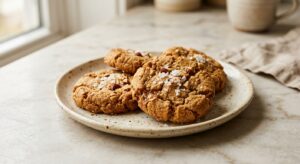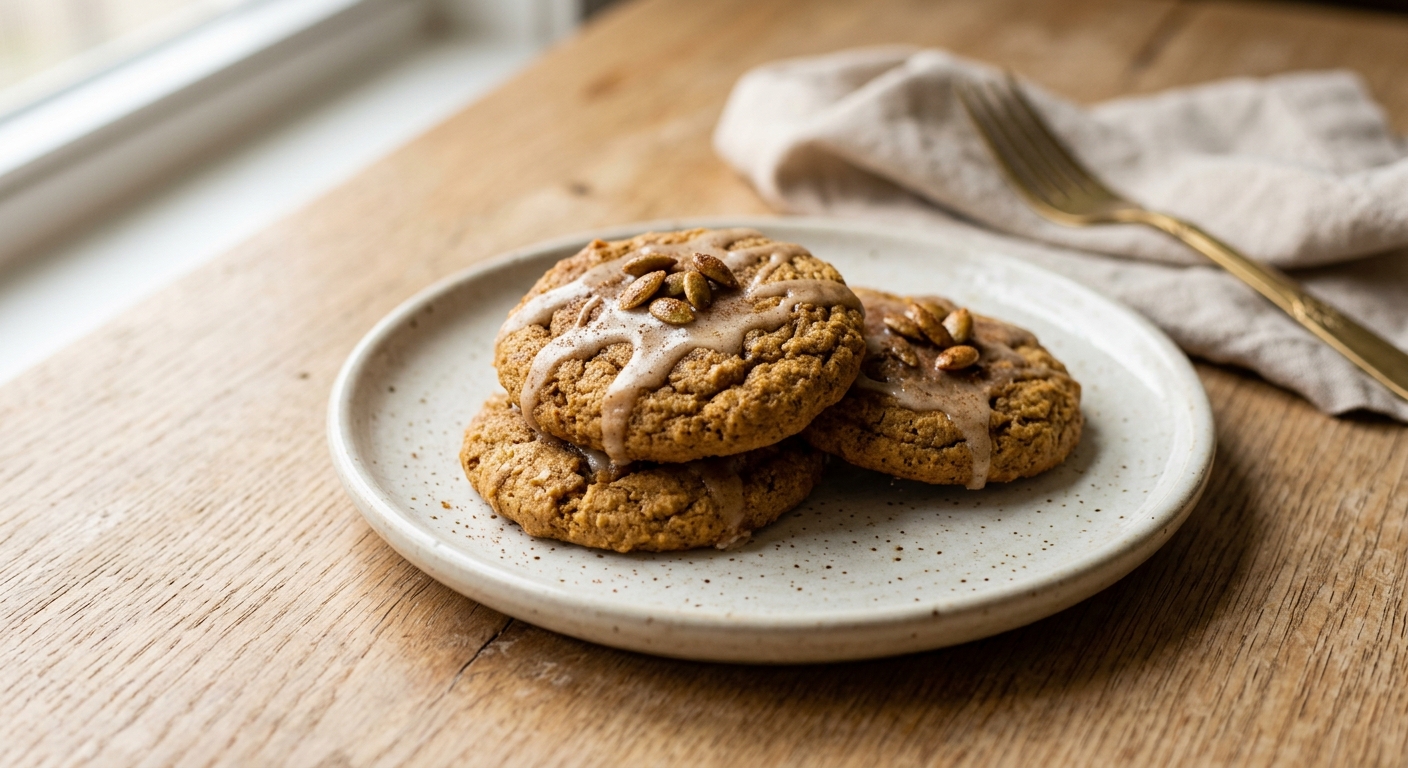
There is something almost magical about the moment pumpkin spice hits a hot pan. The kitchen fills with cinnamon, ginger, and clove, and suddenly it feels like the whole season has arrived at once. These cookies capture that feeling completely, with a tender, slightly chewy center and lightly crisped edges that make it nearly impossible to stop at one. They are the kind of cookie you bake on a Sunday afternoon when the leaves are turning and the oven is the best heater in the house.
What sets this recipe apart is the combination of browned butter and monk fruit sweetener. Browning the butter first drives off the water and toasts the milk solids to a nutty, almost caramel-like richness that rounds out the monk fruit’s clean sweetness beautifully. Monk fruit concentrate, blended here with allulose for bulk and texture, measures almost cup-for-cup like sugar and adds zero glycemic load to the final cookie. Real pumpkin puree keeps the crumb moist and tender without making the cookies cakey, and a full tablespoon of pumpkin spice blend means every bite is genuinely fragrant.
These cookies land firmly in the easy-to-medium category. Browning butter requires a little attention, but the rest of the dough comes together in one bowl with no mixer required. They are ideal for anyone managing blood sugar, following a low-carb or diabetic-friendly lifestyle, or simply wanting a treat they can feel good about. They are also genuinely delicious enough to serve to people who aren’t watching their sugar at all.
Equipment Needed
Click on an item below to shop for the recommended items for this recipe on Amazon.
As an Amazon Associate, we earn from qualifying purchases.
18
Ingredients
- 115 gunsalted butter (1/2 cup, cut into pieces)
- 160 gmonk fruit allulose blend sweetener, such as Lakanto Classic (3/4 cup, measured like sugar)
- 1 largeegg, at room temperature
- 1 tsppure vanilla extract
- 120 gcanned pumpkin puree, not pumpkin pie filling (1/2 cup)
- 210 gall-purpose flour (1 and 3/4 cups, spooned and leveled)
- 1 tbsppumpkin spice blend (or 1.5 tsp cinnamon, 3/4 tsp ginger, 1/4 tsp nutmeg, 1/4 tsp cloves, 1/4 tsp allspice)
- 1 tspbaking soda
- 0.5 tspbaking powder
- 0.5 tspColima Sea SaltMicroplastic Free Salt
- 1 tspground cinnamon, for rolling (optional)
- 2 tbspmonk fruit allulose blend, for rolling (optional)
- —Colima Sea SaltMicroplastic Free Salt for finishing, optional
Ingredient Substitutions
Instructions
- Brown the butter: Place the butter in a light-colored saucepan over medium heat. Swirl frequently as it melts, foams, and then begins to smell nutty. When the milk solids at the bottom turn golden amber, about 5 to 7 minutes, immediately pour into a large mixing bowl and let cool for 10 minutes. You should see small toasted bits at the bottom of the bowl. Do not skip this step or let it burn.
- Whisk the sweetener into the cooled brown butter until combined, about 1 minute. Add the egg and vanilla and whisk vigorously for 30 seconds until the mixture is smooth and slightly lightened. Fold in the pumpkin puree until fully incorporated.
- In a separate bowl, whisk together the flour, pumpkin spice blend, baking soda, baking powder, and fine sea salt. Add the dry ingredients to the wet and fold gently with a rubber spatula until just combined. The dough will be soft and slightly sticky. Do not overmix.
- Cover the bowl and refrigerate the dough for at least 30 minutes and up to 24 hours. Chilling firms the butter back up, prevents excessive spreading, and deepens the spice flavor.
- Preheat your oven to 350°F (175°C). Line two baking sheets with parchment paper. If using the cinnamon-sweetener rolling mixture, combine 1 tsp cinnamon and 2 tbsp monk fruit blend in a small bowl.
- Scoop the dough into balls about 1.5 tablespoons each (a #40 cookie scoop works perfectly). Roll each ball in the cinnamon-sweetener mixture if using, then place 2 inches apart on prepared baking sheets.
- Bake for 12 to 14 minutes, until the edges are set and the centers still look very slightly underdone. They will firm up considerably as they cool because allulose sets differently than sugar. Do not overbake. If desired, sprinkle with flaky sea salt immediately out of the oven.
- Let the cookies cool on the baking sheet for 8 minutes before transferring to a wire rack. They are fragile while warm. Cool completely before storing.
- Prepare the brown butter and dough exactly as directed in steps 1 through 4 of the oven method, including the 30-minute chill.
- Preheat your air fryer to 325°F (163°C) for 3 minutes. Cut a piece of parchment to fit your air fryer basket, trimming it so it does not block the sides and airflow. Lightly spray the parchment with nonstick cooking spray.
- Scoop dough into 1.5-tablespoon balls, roll in the optional cinnamon-sweetener mixture, and place 4 to 6 balls in the basket at least 1.5 inches apart. Do not overcrowd. They will spread slightly.
- Air fry at 325°F (163°C) for 8 to 10 minutes. Check at 8 minutes: the edges should look set and lightly golden, and the centers should still look soft. If the tops are browning too quickly, lay a small piece of foil loosely over the top for the last 2 minutes.
- Use a thin spatula to transfer cookies carefully to a cooling rack. Let rest for at least 8 minutes before eating. Repeat with remaining dough, allowing the air fryer basket to cool slightly between batches to prevent over-browning.
- Heat-treat the flour for food safety: Spread the 210g of flour on a baking sheet and bake at 350°F (175°C) for 5 minutes, or microwave in a microwave-safe bowl on high in 15-second bursts, stirring between each, until the flour reaches 165°F (74°C) on an instant-read thermometer. Let cool completely before using.
- In a small saucepan, melt the butter over medium heat until just beginning to brown and smell nutty, then pour into a large bowl. For a no-bake version you can also simply melt without browning, but browning adds significant flavor. Cool for 10 minutes.
- Whisk the monk fruit sweetener into the butter, then add the egg-free binder: 3 tablespoons of unsweetened applesauce in place of the egg (no raw egg in a no-bake application). Add vanilla and pumpkin puree and whisk until smooth.
- Fold in the cooled heat-treated flour, pumpkin spice, baking soda, baking powder, and salt. The dough will be very soft. Do not add raw leavening for eating purposes if preferred; the baking soda and powder can be omitted in this version as they serve no function without heat.
- Line a small baking sheet or plate with parchment. Scoop dough into 1.5-tablespoon balls and roll in the optional cinnamon-sweetener mixture. Place on the lined sheet and press each ball gently into a thick disc with the back of a spoon.
- Freeze for 45 to 60 minutes until firm. Transfer to an airtight freezer container, separating layers with parchment. Eat straight from the freezer or let sit at room temperature for 5 minutes for a softer, fudgier texture. Store frozen for up to 6 weeks.
Nutrition Per Serving
Per 1 serving (makes 18 cookies, about 2.5 inches each)
Sweetener: monk fruit allulose blend
Why This Recipe Works
Browning the butter before building this dough is not just a flavor trick, it is chemistry working in your favor. When butter is heated past its melting point, the water content evaporates and the milk proteins undergo the Maillard reaction, producing hundreds of new flavor compounds including diacetyl, furanones, and lactones that taste nutty, caramel-like, and complex. Because monk fruit sweetener does not caramelize the way sucrose does, that browned butter is doing the heavy lifting of adding warmth and depth. It compensates beautifully for the flavor that traditional sugar would normally provide through its own caramelization.
Allulose-based sweeteners behave differently from sugar in baked goods, and knowing this helps you bake successfully. Allulose does not absorb water the way sugar does (it is hygroscopic to a much lesser degree), which means cookies can dry out more quickly after baking and will feel firmer at room temperature. The pumpkin puree is essential here as a humectant, holding onto moisture and keeping the crumb tender. The chilling step matters too: it allows the butter to re-solidify and the flour to fully hydrate, which gives the cookies structure and prevents them from spreading into flat puddles in the oven. Allulose also has a higher melting point than sugar, so these cookies will look underdone at the center even when they are perfectly baked. Trust the time and let them cool on the pan.
If your cookies are spreading too much, the dough was not chilled long enough or your butter was too warm when you mixed it in. If they are crumbly or dry, the flour was over-measured (always use the spoon-and-level method, never scoop directly from the bag) or they baked a minute too long. If you notice a slight cooling or menthol sensation from the allulose, that is normal and typically fades as the cookies cool completely. Chilling also helps reduce this sensation by giving the allulose crystals time to fully dissolve into the dough.
Baker’s Tips
- Use a light-colored stainless saucepan to brown the butter so you can clearly see the milk solids changing color. Dark pans make it easy to accidentally burn the butter.
- Blot your pumpkin puree with a paper towel before measuring if it looks very wet. Excess moisture in the puree is a common reason these cookies come out cakey rather than chewy.
- The spoon-and-level method matters more with monk fruit cookies than with regular ones. Because allulose does not provide the same binding and moisture-retention as sugar, too much flour will make the cookies dry and crumbly.
- Do not skip the chill. 30 minutes is the minimum; 1 to 2 hours is even better. Cold dough bakes up with better texture, more defined edges, and deeper spice flavor.
- Pull the cookies out when the edges are set but the centers look slightly glossy and underdone. Allulose sets firm as it cools, and overbaked monk fruit cookies go from perfect to dry very quickly.
- For picture-perfect cookies, press each dough ball slightly flat before baking. Monk fruit blends do not spread as freely as sugar, so a gentle flatten helps create that classic round cookie shape.
- If you find the allulose cooling sensation noticeable in your brand of sweetener, try switching to a monk fruit allulose blend, which produces a more sugar-like texture and taste with no cooling effect.
Variations
- Cream cheese frosted version: Whip 115g softened cream cheese with 2 tbsp monk fruit powdered sweetener and 1/2 tsp vanilla until fluffy. Spread on fully cooled cookies for a pumpkin pie flavor.
- Chocolate chip addition: Stir in 60g sugar-free dark chocolate chips (such as Lily’s) with the dry ingredients for a chocolate-pumpkin combination.
- Spiced pecan version: Press one pecan half into the center of each dough ball before baking and add 1/4 tsp black pepper to the spice blend for a warming, sophisticated edge.
- Gluten-free version: Use a 1-to-1 gluten-free baking flour at the same weight (210g). Chill dough for the full 30 minutes and expect slightly thicker, softer cookies.
Troubleshooting & FAQ
My cookies came out cakey and puffy instead of soft and slightly chewy. What went wrong?
Why do my cookies feel dry and crumbly after cooling?
I can taste a strange cooling or menthol-like sensation. Is something wrong?
My cookies spread out way too thin and are greasy. What happened?
Can I use pure liquid monk fruit drops instead of the granular monk fruit blend?
Storage & Make-Ahead
- Storage: Store baked cookies in an airtight container at room temperature for up to 4 days. They actually improve on day 2 as the spices deepen. Refrigerate for up to 1 week. Freeze in a single layer, then transfer to a freezer bag for up to 2 months. Thaw at room temperature for 20 minutes.
- Make-Ahead: The cookie dough can be made up to 48 hours ahead and refrigerated, covered tightly. It can also be portioned into balls and frozen unbaked on a sheet pan, then transferred to a bag and frozen for up to 2 months. Bake from frozen at 350°F (175°C) for 14 to 16 minutes.