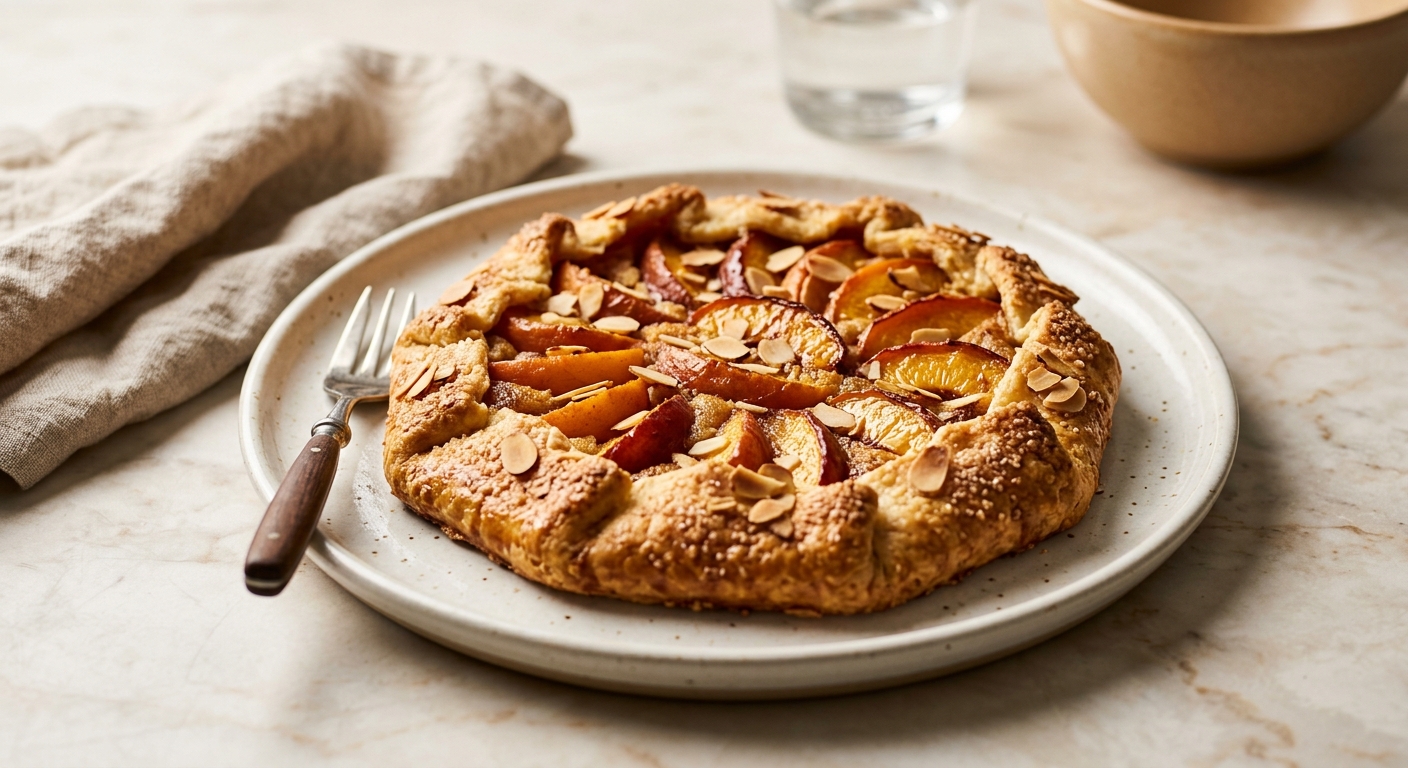
There is something deeply satisfying about a galette. Unlike a fussy tart with its straight sides and blind-baked shell, a galette is gloriously imperfect: rough-edged pastry folded over jewel-bright fruit, the edges turning golden and shatteringly crisp in the oven while the filling bubbles gently underneath. This peach and almond version is the kind of thing you make on a warm Saturday when the peaches at the market are at their absolute peak, fragrant and yielding, their skins blushing deep amber. Slide it onto a wooden board, dust it lightly with powdered allulose, and watch it disappear.
What sets this galette apart is the hidden layer of almond frangipane spread beneath the peaches. Made with fine almond flour, softened butter, an egg, and allulose, this thin layer does extraordinary work: it absorbs the peach juices as they release, preventing a soggy bottom while adding a rich, marzipan-like depth that plain fruit could never achieve on its own. The pastry itself is made with a touch of allulose and a small amount of almond flour blended into the all-purpose flour, giving it a subtle nuttiness and a tenderness that makes every bite feel intentional. Every component is sweetened with allulose, a naturally derived sugar alcohol with a glycemic index of zero, so the sweetness is real and satisfying without the blood sugar rollercoaster.
This recipe sits comfortably at a medium difficulty level. The pastry requires a light hand and a brief rest in the refrigerator, and the frangipane comes together in minutes. If you have made shortcrust pastry before, this will feel familiar and forgiving. If you are newer to pastry-making, the galette format is genuinely one of the most beginner-friendly ways to work with it, because imperfection is not just acceptable, it is the whole aesthetic. This is perfect for anyone eating low-glycemic or managing blood sugar without wanting to sacrifice a single ounce of pleasure at the table.
Equipment Needed
Click on an item below to shop for the recommended items for this recipe on Amazon.
As an Amazon Associate, we earn from qualifying purchases.
8
Ingredients
- Pastry
- 180 gall-purpose flour (about 1.5 cups, spooned and leveled)
- 30 gfine almond flour (about 4 tbsp)
- 20 ggranulated allulose (about 1.5 tbsp)
- 0.25 tspColima Sea SaltMicroplastic Free Salt
- 115 gunsalted butter, very cold, cut into 1 cm cubes (about 1/2 cup or 1 stick)
- 60 mlice water (about 4 tbsp), plus more as needed
- Frangipane
- 80 gfine almond flour (about 3/4 cup)
- 60 ggranulated allulose (about 4.5 tbsp)
- 55 gunsalted butter, softened to room temperature (about 4 tbsp)
- 1 largeegg, at room temperature
- 0.5 tsppure vanilla extract
- 0.25 tspalmond extract
- 550 gfresh ripe peaches (about 4 to 5 medium), pitted and sliced 5 to 6 mm thick
- Tossing The Peaches
- 1 tbspgranulated allulose
- Peaches
- 0.5 tspground cinnamon
- Peaches (helps Thicken Released Juices)
- 1 tbspcornstarch
- Egg Wash
- 1 largeegg, beaten with 1 tbsp water
- Topping
- 15 gsliced almonds (about 2 tbsp)
- Dusting After Baking (optional)
- —Powdered allulose
Ingredient Substitutions
Instructions
- Make the pastry: In a large bowl, whisk together the all-purpose flour, almond flour, granulated allulose, and salt. Add the cold butter cubes. Using your fingertips or a pastry cutter, rub or cut the butter into the flour until the mixture resembles coarse breadcrumbs with some pea-sized pieces of butter still visible. Those butter pieces are essential for flakiness. Do not overwork.
- Drizzle in the ice water one tablespoon at a time, tossing with a fork after each addition. Stop when the dough just begins to hold together when you press a small amount between your fingers. It should not be sticky or wet. Turn the dough out onto a lightly floured surface, press it into a flat disc, wrap tightly in plastic wrap, and refrigerate for at least 30 minutes and up to 24 hours.
- Make the frangipane: In a medium bowl, beat the softened butter and allulose together with a wooden spoon or hand mixer until pale and fluffy, about 2 minutes. Beat in the egg until fully combined, then add the vanilla extract and almond extract. Fold in the almond flour until smooth. Set aside at room temperature. The frangipane can be made up to 3 days ahead and refrigerated.
- Prepare the peaches: Toss the sliced peaches with 1 tablespoon of granulated allulose, cinnamon, and cornstarch in a bowl. Set aside while you roll the pastry. Note that allulose does not draw out moisture from fruit the way sugar does, so the peaches will release their juices primarily during baking rather than while resting. The cornstarch will thicken those juices beautifully.
- Preheat your oven to 400°F (200°C). Line a large rimmed baking sheet with parchment paper. Remove the chilled dough from the refrigerator and let it sit for 5 minutes to take the chill off slightly. On a lightly floured surface, roll the dough into a rough circle about 35 cm (14 inches) in diameter and 3 to 4 mm thick. It does not need to be perfectly round. Transfer carefully to the lined baking sheet.
- Spread the frangipane evenly over the pastry, leaving a 5 cm (2 inch) border all around the edge. Arrange the peach slices over the frangipane in overlapping concentric circles or a casual, rustic arrangement. Fold the pastry border up and over the outer edge of the peaches, pleating as you go to create a roughly 4 to 5 cm rim. Press gently to seal the pleats.
- Brush the folded pastry border generously with the egg wash. Scatter the sliced almonds over the pastry border and lightly over the peaches if desired. Bake for 40 to 45 minutes, until the pastry is deeply golden, the frangipane is set and lightly puffed, and the peach juices are bubbling and beginning to thicken at the edges.
- Remove from the oven and allow to cool on the baking sheet for at least 15 minutes before sliding onto a serving board or plate. Dust with powdered allulose if desired. Serve warm or at room temperature.
- Halve all ingredient quantities to make a smaller galette sized to fit your air fryer basket (roughly 17 to 18 cm or 7 inches in diameter). Make the pastry and frangipane as described in the oven method steps 1 through 3, using the halved quantities. Chill the pastry disc for at least 30 minutes.
- Prepare the halved quantity of peaches with allulose, cinnamon, and cornstarch. Preheat your air fryer to 350°F (175°C) for 3 minutes. Cut a circle of parchment paper to fit your air fryer basket, leaving a small border so air can still circulate around the edges.
- Roll the chilled dough into a rough circle approximately 22 cm (9 inches) across on a lightly floured surface. Carefully transfer it to the parchment circle. Spread the frangipane over the dough, leaving a 4 cm border. Arrange the peach slices over the frangipane, fold and pleat the border, then brush with egg wash and scatter sliced almonds over the pastry edge.
- Carefully lower the galette on its parchment into the preheated air fryer basket. Air fry at 350°F (175°C) for 22 to 26 minutes, checking at 18 minutes. The pastry should be deep golden and the frangipane visibly set. If the edges are browning too quickly, lay a small piece of foil loosely over the galette for the remaining time.
- Use the parchment to carefully lift the galette out of the basket. Rest for 10 minutes before serving. Dust with powdered allulose to finish.
- Make the no-bake almond crust: Combine 120g (1 cup plus 2 tbsp) fine almond flour, 60g (about 2/3 cup) rolled oats, 45g (3 tbsp) melted unsalted butter or coconut oil, 30g (2.5 tbsp) granulated allulose, a pinch of salt, and 1/2 tsp cinnamon in a bowl. Mix until the mixture holds together when pressed. Press firmly and evenly into the base and up the sides of a 23 cm (9-inch) tart pan with a removable base or a springform pan. Refrigerate for 20 minutes to set.
- Make the no-bake almond cream filling: Beat 225g (8 oz) full-fat cream cheese with 60g (4.5 tbsp) granulated allulose, 1/2 tsp vanilla extract, and 1/4 tsp almond extract until completely smooth and fluffy, about 3 minutes with a hand mixer. Fold in 60g (generous 1/2 cup) fine almond flour until evenly combined. Taste and adjust sweetness.
- Spread the almond cream filling evenly into the chilled crust, smoothing the top with an offset spatula. Return to the refrigerator for at least 90 minutes, or until the filling is fully set and firm to the touch.
- Just before serving, toss 450g (about 3 to 4 medium) fresh ripe peaches, sliced 5 to 6 mm thick, with 1 tablespoon granulated allulose and 1/2 teaspoon cinnamon. Arrange the peach slices decoratively over the set filling in overlapping circles or a casual pattern.
- Scatter a handful of toasted sliced almonds over the top, dust with powdered allulose, and serve immediately, or refrigerate for up to 2 hours before serving. Remove the tart from its pan just before slicing.
Nutrition Per Serving
Per 1 serving (makes one 10 to 11 inch free-form galette)
Sweetener: allulose
Why This Recipe Works
The flakiness of this pastry depends entirely on keeping the butter cold and in distinct pieces throughout the mixing process. When the cold butter hits the hot oven, it releases steam, and that steam pushes the pastry layers apart to create the signature shatter and flake. This is why ice water is essential and why overworking the dough is the enemy: warm hands, warm water, or too much mixing melts the butter into the flour, producing a crumbly, sandy crust rather than a tender, flaky one. The addition of almond flour to the pastry introduces extra fat in a finely distributed form, which shortens the gluten strands slightly and contributes to a more tender, delicate crumb without compromising structure.
The frangipane layer is the real engineering behind this galette. Stone fruits like peaches are extraordinarily juicy, and all that moisture released during baking has to go somewhere. Without a barrier, it would soak directly into the pastry and turn the base soggy. The almond frangipane acts as a sponge, absorbing those juices as it sets and cooking them into its own structure, concentrating flavor and protecting the crust underneath. The cornstarch in the peach mixture adds a secondary layer of protection: it gelatinizes in the presence of heat and moisture, thickening the remaining juices into a glossy, jammy sauce rather than a liquid puddle.
Allulose behaves differently from sucrose in baking, and it helps to understand why. It does not caramelize in the traditional sense (it begins to melt around 120°C and can recrystallize as it cools, which is perfectly normal and does not affect flavor), and it does not draw significant moisture out of fruit the way sugar does, so your peaches will stay slightly firmer before baking. If you notice a very light cooling sensation when eating a frangipane-heavy bite, that is allulose’s natural characteristic and is completely harmless. Using a finely milled granulated allulose (or blending coarser crystals briefly in a spice grinder) helps it dissolve more evenly into the frangipane for the smoothest texture.
Baker’s Tips
- Use peaches that are fragrant and just barely yielding to gentle pressure. Underripe peaches will not release enough juice or flavor; overripe ones will turn to mush in the oven.
- Keep everything cold when making the pastry. If your kitchen is warm, chill the bowl and your flour mixture for 15 minutes before adding the butter.
- Do not skip the cornstarch in the peach mixture. Even with allulose (which draws less moisture than sugar), peaches release significant juice at oven temperatures, and the cornstarch keeps the filling from becoming watery.
- Roll the dough between two sheets of lightly floured parchment paper if it sticks. This also makes transferring it to the baking sheet much easier.
- If the pastry cracks when you fold it over the fruit, simply press it back together with damp fingertips. The rustic look is part of the charm, and a little patching never shows after baking.
- For an extra-golden, professional-looking crust, brush the egg wash just over the folded rim and avoid getting it on the parchment, which can cause sticking.
- Let the galette cool for at least 15 minutes before slicing. The frangipane needs time to finish setting, and cutting into it too soon will cause the filling to run.
Variations
- Peach and Raspberry: Scatter 80g fresh raspberries over the frangipane before adding the peach slices for a tart berry contrast.
- Spiced Pear and Almond: Replace peaches with 3 to 4 firm ripe pears, thinly sliced, and add 1/4 tsp ground cardamom and a pinch of ground cloves to the fruit mixture. Ideal in autumn.
- Lemon Almond: Add 1 tsp finely grated lemon zest to the frangipane and 1 tsp lemon juice to the peach toss for a brighter, more citrus-forward flavor.
- Dairy-Free Version: Use vegan butter (very cold for the pastry, softened for the frangipane) and replace the egg wash with 2 tablespoons of plant-based milk brushed over the pastry edge.
Troubleshooting & FAQ
My pastry shrank when I baked it and the border unfolded. What went wrong?
The bottom of my galette was soggy even though I used the frangipane layer. How do I prevent this?
I notice a gritty or cooling sensation in the frangipane. Is something wrong?
My allulose seems to be recrystallizing on the surface of the cooled galette, leaving a whitish dusty coating. Is this a problem?
My peaches are not very sweet or flavorful. Can I do anything to improve the filling?
Storage & Make-Ahead
- Storage: Store leftover galette loosely covered at room temperature for up to 1 day, or refrigerate in an airtight container for up to 3 days. Reheat individual slices in a 325°F (160°C) oven or air fryer for 8 to 10 minutes to restore pastry crispness. The galette does not freeze well once assembled and baked, as the peaches become watery on thawing.
- Make-Ahead: The pastry disc can be made up to 2 days ahead and refrigerated, or frozen for up to 1 month (thaw overnight in the refrigerator). The frangipane can be made up to 3 days ahead and refrigerated; bring to room temperature for 15 minutes before spreading. Do not assemble the galette more than 1 hour before baking.