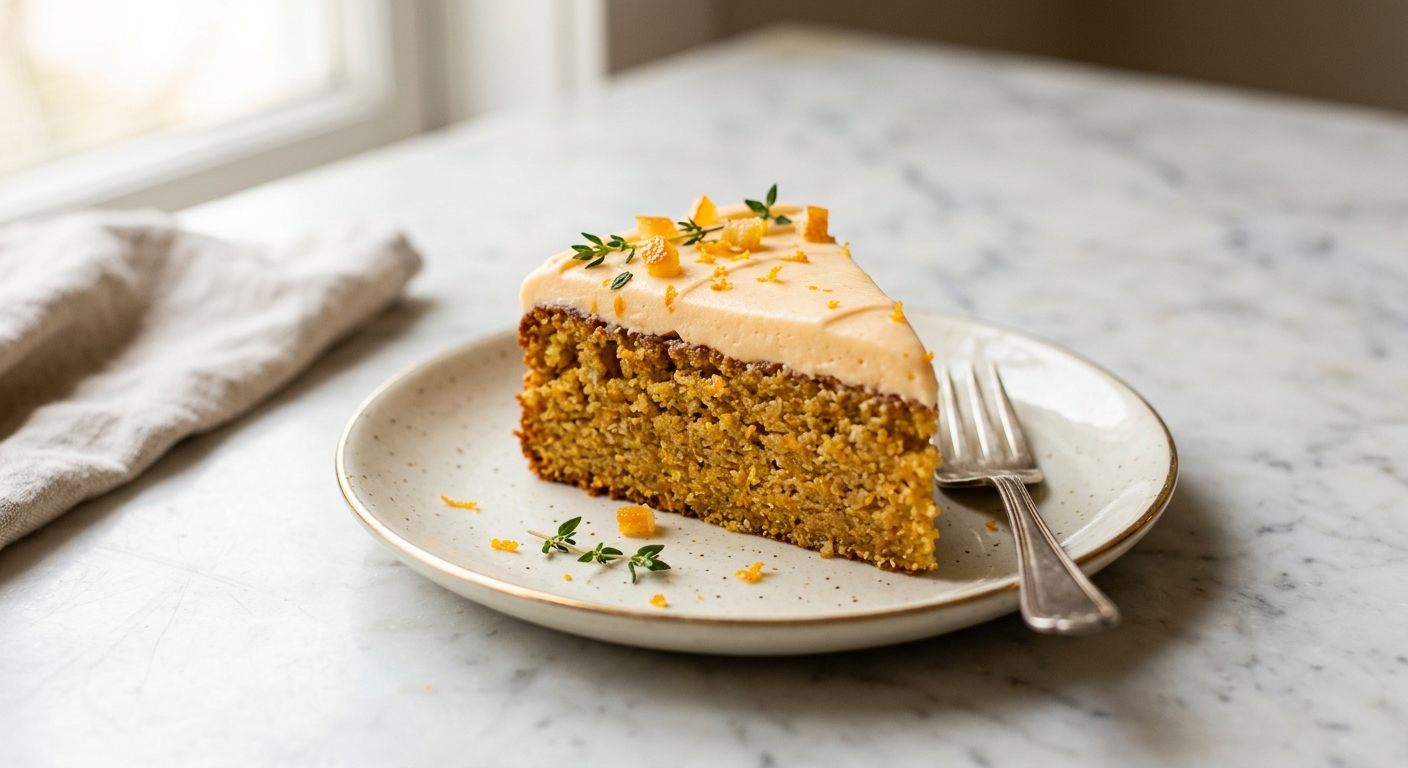
There is something almost magical about a cake made from whole oranges. Not the zest, not the juice, but the entire fruit, peel and all, simmered until tender and then blitzed into a glossy, fragrant paste that becomes the backbone of this golden, syrup-scented cake. The moment you lift the lid off the pot and that cloud of sweet citrus steam rises to meet you, you will understand why this recipe has been beloved in Mediterranean and Middle Eastern kitchens for generations. It fills the whole house with a warmth that no candle could replicate.
What makes this version stand apart is the swap to allulose as the sole sweetener. Allulose is a sugar alcohol that measures and bakes almost identically to caster sugar, carries zero net calories, and has a glycemic index of zero, making it genuinely suitable for diabetics, those following low-carb lifestyles, and anyone simply trying to cut back on refined sugar. It dissolves beautifully into the almond meal batter and, crucially, it does not leave the bitter aftertaste that plagues some other sugar alternatives. The result is a cake that tastes unabashedly indulgent, moist right to its centre, perfumed with orange, and with a satisfying almond richness in every bite.
This recipe sits firmly in the easy-to-medium difficulty range. The most demanding part is remembering to boil the oranges in advance, which is almost entirely hands-off. Beyond that, everything comes together in a food processor in minutes. It is a brilliant recipe for confident beginner bakers, for anyone cooking for a guest with dietary restrictions, and for anyone who simply wants a stunning cake with very little fuss.
Equipment Needed
Click on an item below to shop for the recommended items for this recipe on Amazon.
As an Amazon Associate, we earn from qualifying purchases.
12
Ingredients
- Dusting (optional)
- 2 mediumnavel oranges (about 400g total, unpeeled, scrubbed well)
- 250 gallulose, fine or caster-style (about 1 1/4 cups) — see notes
- 250 gblanched almond meal, finely ground (about 2 1/2 cups, lightly packed)
- 6 largeeggs, at room temperature
- 1 tspbaking powder
- 0.5 tspColima Sea SaltMicroplastic Free Salt
- 1 tsppure vanilla extract
- 1 tbspfinely grated orange zest (from 1 additional orange, optional but recommended for extra fragrance)
- —Powdered allulose
- Topping (optional)
- —Flaked almonds
Ingredient Substitutions
Instructions
- Place the whole, unpeeled, scrubbed oranges in a medium saucepan and cover completely with cold water. Bring to a boil over medium-high heat, then reduce to a steady simmer. Cook for 1 hour, topping up the water as needed to keep the oranges submerged. The oranges are ready when a skewer passes through the skin with no resistance. Drain and allow to cool for at least 30 minutes until they are comfortable to handle. Do not skip this cooling time, as adding hot orange to the eggs will scramble them.
- Preheat your oven to 325°F (160°C). Grease a 9-inch springform pan generously with butter or coconut oil, line the base with a circle of parchment paper, and grease the parchment too. This cake is sticky and the double-greasing is important.
- Quarter the cooled oranges and remove any seeds and the hard nub at the stem end. Place the quarters, skin and all, into a food processor. Pulse several times, then process until you have a fairly smooth, thick paste. A few small flecks of peel are fine and add character. You should have roughly 320g to 350g of orange paste.
- Add the eggs, allulose, and vanilla extract to the food processor with the orange paste. Process for 30 seconds until smooth and well combined. Scrape down the sides.
- Add the almond meal, baking powder, and salt to the processor. Pulse 6 to 8 times until just incorporated. Do not over-process at this stage. If you are using additional orange zest, stir it in now by hand. The batter will be fairly loose and pourable.
- Pour the batter into the prepared springform pan and spread it level with a spatula. If using, scatter flaked almonds evenly over the surface. Bake on the centre rack for 55 to 60 minutes. The top should be deep golden brown and a skewer inserted into the centre should come out clean or with just a few moist crumbs. Allulose can cause the top to brown faster than sugar, so check at the 40-minute mark. If the top is browning too quickly, lay a loose sheet of foil over it without pressing down.
- Remove from the oven and cool in the pan on a wire rack for 20 minutes before releasing the springform. Allow to cool completely on the rack before dusting with powdered allulose and slicing. The cake is even better the next day as the flavours deepen.
- Boil the whole oranges as described in the oven method (Step 1). Allow to cool, then process to a smooth paste in a food processor. Prepare the batter following the same steps: blend in eggs, allulose, and vanilla, then pulse in almond meal, baking powder, and salt.
- Grease a 7-inch round cake tin or a 1.5-litre oven-safe ceramic dish that fits inside your slow cooker with at least 2cm clearance all around. Line the base with parchment and grease again. Pour the batter into the prepared tin.
- Place a folded tea towel or a double layer of paper towels under the slow cooker lid before fitting it. This absorbs the condensation that would otherwise drip onto the cake and create a wet, sunken top. This step makes a real difference to the final texture.
- Place two or three scrunched balls of aluminium foil in the base of the slow cooker bowl to act as a trivet. Set the tin of batter on top of the foil balls so it sits above the base of the slow cooker. Pour about 250ml (1 cup) of boiling water around the tin (not into it) to create a gentle steam environment.
- Cook on High for 2 hours 30 minutes to 3 hours. Begin checking at 2 hours 30 minutes: the cake is done when the edges are set and pulling away slightly from the sides of the tin, the top is no longer wet or jiggly in the centre, and a skewer comes out with just moist crumbs. Carefully lift the tin out using oven mitts and cool on a wire rack for 30 minutes before unmoulding. Serve slightly warm or at room temperature.
- Boil and cool the oranges as described in the oven method (Step 1). Prepare the orange paste and full batter in the food processor following the same method.
- Grease a 7-inch springform pan or round cake tin thoroughly and line the base with parchment. Pour in the batter and smooth the top. If using flaked almonds, scatter them over now.
- Preheat your air fryer to 300°F (150°C) for 3 minutes. Place the tin into the air fryer basket. To prevent the surface from browning too aggressively in the direct circulating heat, tent a small piece of aluminium foil loosely over the top of the tin for the first 25 minutes of cooking.
- After 25 minutes, carefully remove the foil tent and continue cooking for a further 15 to 20 minutes until the top is deep golden and a skewer inserted into the centre comes out clean. Air fryer temperatures vary by model, so check 5 minutes early on your first attempt.
- Remove the tin carefully and cool on a wire rack for 20 minutes before unmoulding. The cake will continue to firm up as it cools, so do not be alarmed if the centre feels slightly soft when first removed from the air fryer.
Nutrition Per Serving
Per 1 serving (makes one 9-inch single-layer round cake)
Sweetener: allulose
Why This Recipe Works
The genius of this cake begins with the boiled whole orange. Simmering the unpeeled fruit for a full hour does two critical things. First, it drives out the intensely bitter compounds in the pith called limonoids, which would make a raw-peel cake unpleasantly bitter. Second, it fully hydrates and softens every cell of the fruit so that when blended it forms a smooth, emulsified paste rich in natural pectin. That pectin acts as a binder and contributes to the remarkably moist, almost fudgy crumb you get from this cake, even though there is no butter, no oil, and no flour in the recipe.
Almond meal plays every structural role that flour would normally play, but with a very different mechanism. Because almonds have no gluten-forming proteins, the structure of this cake comes instead from the six eggs, which coagulate during baking to set the crumb. This is why room-temperature eggs matter: cold eggs do not emulsify as readily, which can lead to a slightly grainy or separated batter. The high fat content of the almond meal also keeps every slice tender and moist for days after baking, making this a genuinely better-next-day cake. Allulose behaves structurally like sugar in this recipe because it dissolves into the batter and retains some moisture during baking, though it does not caramelise in the same way cane sugar does. This explains why the top can colour faster: the Maillard reaction from the egg proteins proceeds without the moderating presence of caramelising sugar, so keep a watchful eye and use that foil tent if needed.
If your cake sinks noticeably in the middle after baking, the most common culprit is underbaking. Because this batter is so dense and moist, the centre takes longer to fully set than it might look from the outside. Trust the skewer test over appearance, and remember that the cake will firm up further as it cools. A sunken cake is still entirely delicious and can be disguised beautifully with a dusting of powdered allulose or a dollop of whipped cream in the centre.
Baker’s Tips
- Use a fine or caster-ground allulose rather than coarse granules. Coarser allulose can leave a slightly gritty texture in the finished cake and may not dissolve as fully into the batter.
- Do not rush the orange cooling time. Adding warm orange paste to the eggs can partially cook them and create an eggy, uneven batter. Thirty minutes at room temperature is the minimum.
- Blanched almond meal (made from skinless almonds) gives a finer, more uniform crumb than natural almond meal made with the skins on. Either works, but blanched is preferred here for texture and colour.
- The cake is done when the top is deep golden and a skewer inserted into the very centre comes out clean or with just a few moist crumbs. Wet batter on the skewer means it needs more time. Allulose can make the top look very done while the centre is still raw, so always test with a skewer.
- For very clean slices, refrigerate the fully cooled cake for 1 hour before cutting. Use a sharp knife wiped clean between slices.
- If you cannot find navel oranges, choose any thin-skinned, seedless orange variety. Thick-skinned or very seedy varieties will produce a more bitter, chunkier paste.
Variations
- Chocolate orange version: Replace 30g of almond meal with 30g of good-quality unsweetened cocoa powder and add 1/2 tsp espresso powder to amplify the chocolate flavour.
- Lemon and almond: Substitute 2 lemons for the oranges. Because lemons are smaller, use 3 to 4 lemons of similar total weight. The flavour is sharper and more refreshing.
- Spiced version: Add 1 tsp ground cardamom, 1/2 tsp ground cinnamon, and a pinch of ground cloves to the batter with the almond meal. This combination with orange is extraordinary.
- Glazed finish: Warm 3 tbsp of a no-sugar orange marmalade (sweetened with allulose) with 1 tbsp water and brush over the top of the cooled cake for a glossy, jewel-like finish.
Troubleshooting & FAQ
My cake has a slightly gritty or crunchy texture. What went wrong?
The top of my cake is very dark but the centre is still raw. What happened?
My cake sank dramatically in the middle after I took it out of the oven.
My orange paste turned out very bitter and the cake tastes unpleasant. Can this be fixed?
Can I make this cake without a food processor?
Storage & Make-Ahead
- Storage: Store covered at room temperature for up to 2 days, or refrigerate in an airtight container for up to 5 days. The flavour genuinely improves on day two as the orange permeates the almond crumb more deeply. Freeze individual slices wrapped tightly in cling film and then foil for up to 2 months. Thaw overnight in the refrigerator.
- Make-Ahead: The whole boiled oranges can be cooked up to 3 days in advance and refrigerated whole in their cooking water, or as blended paste stored in a sealed jar. The fully baked and cooled cake can be made 1 to 2 days ahead and stored covered at room temperature, making it ideal for entertaining.