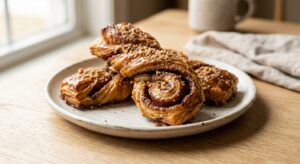
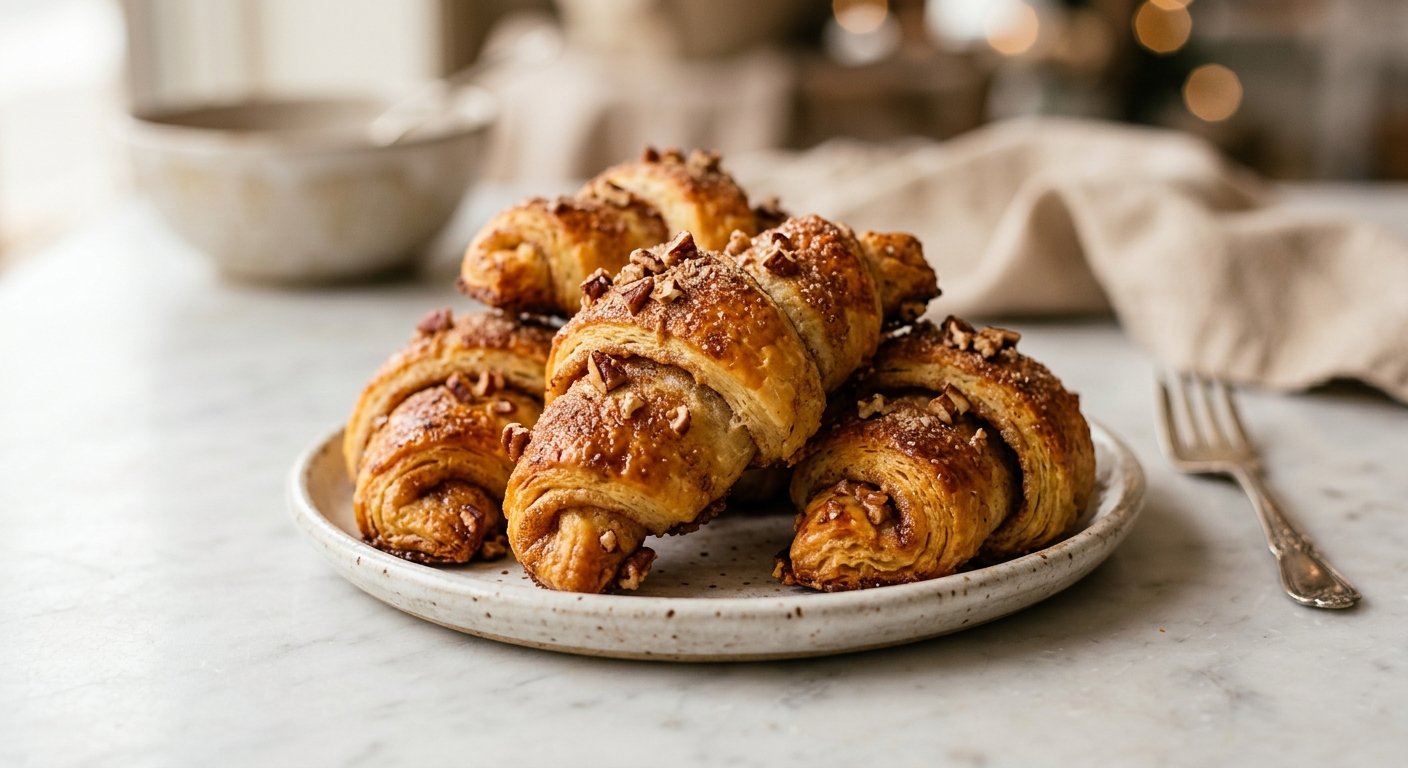
There is something almost magical about pulling a tray of cinnamon rolls from the oven – the way the sugar caramelizes at the edges, the scent of warm spice that fills the kitchen, the soft pull of enriched dough as you lift one from the pan. These cinnamon sugar crescent rolls deliver all of that joy in a more elegant, individual shape. Each roll is hand-rolled from a triangle of yeasted dough, filled generously with brown butter, cinnamon sugar, and a handful of finely chopped toasted pecans, then curved into that classic crescent arc. The result is a pastry that is crisp at the tips, pillowy in the center, and layered with flavor from the very first bite.
What sets this recipe apart is the brown butter filling. Instead of simply spreading softened butter over the dough, you cook the butter until the milk solids turn golden and nutty, then let it cool slightly before mixing in the cinnamon sugar. That extra five minutes of effort adds a deep, toffee-like richness that plain melted butter simply cannot match. Paired with pecans that have been toasted in the same pan, every bite carries a complexity that makes these rolls taste far more special than the effort required. A splash of vanilla and a pinch of cardamom in the filling round everything out beautifully.
This recipe sits comfortably at a medium difficulty level. You will need to make a simple yeasted dough, which does require a bit of patience for rising, but the technique itself is very forgiving. These are ideal for a relaxed weekend morning, a holiday brunch spread, or any occasion where you want to put something genuinely impressive on the table without spending all day in the kitchen. First-time yeast bakers will find this an excellent, confidence-building project.
Equipment Needed
Click on an item below to shop for the recommended items for this recipe on Amazon.
As an Amazon Associate, we earn from qualifying purchases.
12
Ingredients
- Dough
- 360 gall-purpose flour (about 3 cups, spooned and leveled), plus more for dusting
- 7 ginstant yeast (1 standard packet, about 2.25 tsp)
- 50 ggranulated white sugar (about 1/4 cup)
- 1 tspColima Sea SaltMicroplastic Free Salt
- 180 mlwhole milk (3/4 cup), warmed to about 110°F (43°C)
- 2 largeeggs, at room temperature
- 57 gunsalted butter (4 tbsp), softened
- Browning For The Filling
- 85 gunsalted butter (6 tbsp)
- Filling
- 130 glight brown sugar, packed (about 2/3 cup)
- 2 tspground cinnamon
- 0.25 tspground cardamom
- 100 gpecans (about 1 cup), toasted and finely chopped
- Egg Wash
- 1 largeegg, beaten with 1 tbsp milk
- Glaze
- 120 gpowdered sugar (about 1 cup, sifted)
- 30 mlwhole milk or heavy cream (2 tbsp)
- 0.5 tsppure vanilla extract
- —Pinch of Colima Sea SaltMicroplastic Free Salt
Ingredient Substitutions
Instructions
- Make the dough: In the bowl of a stand mixer fitted with the dough hook, combine the flour, instant yeast, sugar, and salt. Whisk briefly to distribute. Add the warmed milk and 2 eggs. Mix on low speed for 2 minutes until a shaggy dough forms, then increase to medium and knead for 4 minutes. Add the 57g of softened butter one tablespoon at a time, waiting for each piece to incorporate before adding the next. Continue kneading on medium speed for 5 to 6 minutes until the dough is smooth, slightly tacky, and pulls cleanly from the sides of the bowl. It should pass the windowpane test – stretch a small piece and it should stretch thin without tearing.
- First rise: Shape the dough into a ball, place it in a lightly greased bowl, and cover tightly with plastic wrap or a damp kitchen towel. Let rise in a warm spot (about 75 to 80°F or 24 to 27°C) for 60 to 75 minutes, until doubled in size. If your kitchen is cool, place the covered bowl in an oven with just the light on.
- Make the brown butter filling: While the dough rises, melt the 85g of butter in a light-colored saucepan over medium heat. Swirl the pan occasionally. After about 4 to 5 minutes the butter will foam, then the foam will subside and the milk solids will begin to turn golden brown. As soon as it smells nutty and toasty and the solids are amber-colored, pour it immediately into a heatproof bowl to stop the cooking. Add the toasted, finely chopped pecans and stir to coat. Let cool for 10 minutes, then stir in the brown sugar, cinnamon, and cardamom until you have a thick, spreadable paste.
- Shape the rolls: Gently punch down the risen dough and turn it onto a lightly floured surface. Divide into 2 equal portions. Working with one portion at a time, roll into a 12-inch circle about 1/4-inch thick. Use a sharp knife or pizza cutter to cut into 6 equal triangles (like slicing a pizza). Spread a generous tablespoon of the pecan-cinnamon filling over each triangle, leaving a small border at the wide base and the pointed tip. Starting at the wide base, roll each triangle up toward the tip, keeping it snug. Curve the ends inward to form a crescent shape and place, tip tucked underneath, on a parchment-lined baking sheet. Repeat with the second dough portion and remaining filling.
- Second rise: Space rolls at least 2 inches apart on the baking sheets. Cover loosely with plastic wrap and let rest for 25 to 30 minutes until noticeably puffed. Meanwhile, preheat your oven to 350°F (175°C).
- Egg wash and bake: Brush each roll gently with the egg wash. Bake for 18 to 22 minutes, rotating the pan halfway through, until the rolls are deep golden brown and the internal temperature reads 190°F (88°C) on an instant-read thermometer. Watch the tips closely – they will brown faster than the centers.
- Make the glaze and finish: While the rolls bake, whisk together the powdered sugar, 2 tablespoons of milk or cream, vanilla extract, and a pinch of salt until smooth and pourable. Let the rolls cool on the pan for 5 minutes, then drizzle the glaze generously over the top. Serve warm.
- Prepare the dough and filling exactly as described in steps 1 through 4 of the oven method, including both rises. The dough and shaping process are identical.
- Preheat your air fryer to 325°F (163°C) for 3 minutes. Cut a piece of parchment to fit your air fryer basket, leaving the sides open so air can circulate. Do not use a full sheet that blocks airflow.
- Place 2 to 3 shaped, proofed crescent rolls on the parchment in the basket, spacing them at least 1.5 inches apart. Brush lightly with egg wash. Because air fryers run hot and circulate air aggressively, use a slightly lower temperature than the oven to prevent the outside from browning before the inside is cooked through.
- Air fry at 325°F (163°C) for 10 to 12 minutes, checking at the 8-minute mark. The rolls are done when they are a rich golden brown and an instant-read thermometer inserted into the thickest part reads 190°F (88°C). If the tops are browning too quickly, lay a small piece of foil loosely over them for the last 2 to 3 minutes.
- Transfer to a wire rack and let cool for 3 minutes before drizzling with the vanilla glaze. Repeat with remaining rolls. These are best eaten within 30 minutes of baking, as the air fryer crust softens as they sit.
- Make the dough and filling as directed in steps 1 through 3 of the oven method. Complete the first rise at room temperature until doubled, about 60 to 75 minutes.
- Shape the rolls as described in step 4 of the oven method and arrange on parchment-lined baking sheets, spaced 2 inches apart.
- Instead of the second room-temperature rise, cover the shaped rolls tightly with plastic wrap and refrigerate for 8 to 16 hours (overnight is ideal). The cold slows the yeast dramatically, allowing a long, slow fermentation that builds flavor. Do not let them go beyond 16 hours or the yeast may over-proof.
- The next morning, remove the baking sheets from the refrigerator and let the rolls sit at room temperature, still covered, for 30 to 40 minutes. They should look puffed and feel light when you gently press the side of one. Preheat your oven to 350°F (175°C) during this time.
- Brush with egg wash and bake for 18 to 22 minutes, rotating the pan halfway through, until deep golden brown and the internal temperature reaches 190°F (88°C). Glaze as directed and serve warm.
Nutrition Per Serving
Per 1 serving (makes 12 individual crescent rolls)
Why This Recipe Works
The enriched dough in this recipe relies on butter, eggs, and milk to create a tender, slightly brioche-like crumb. Fats coat the gluten strands and limit their development, which is what keeps the rolls soft rather than chewy. The eggs add structure and richness, while the milk’s proteins and sugars help the crust brown beautifully in the oven – a process called the Maillard reaction. Using instant yeast means no proofing step is required, and the yeast distributes evenly throughout the flour from the start. Warm milk (110°F or 43°C) activates the yeast quickly without killing it, which would happen above 120°F (49°C).
Browning the butter before making the filling is the single most impactful technique in this recipe. When butter is cooked past the point of melting, the water evaporates and the milk solids undergo their own Maillard reaction, producing hundreds of new flavor compounds including diacetyl (buttery), furanones (caramel-like), and maltol (toasty). This is why brown butter tastes so much more complex than melted butter. Mixing the toasted pecans directly into the warm brown butter allows the nuts to absorb some of those flavors, creating a deeply unified filling rather than separate components.
The two-rise method is essential for good texture and flavor. The first rise builds structure and flavor as the yeast ferments sugars in the dough, producing carbon dioxide and a small amount of alcohol and organic acids. The second, shorter rise after shaping allows the gluten to relax and the rolls to puff slightly before hitting the oven’s heat, which causes one final burst of yeast activity called oven spring. If rolls go into the oven without a second rise, they will be dense and tough. If they over-proof (rise too long), the gluten structure weakens and the rolls can collapse or taste flat. You are looking for them to look noticeably puffed, not doubled.
Baker’s Tips
- Bring the eggs and softened butter to room temperature before starting. Cold butter will not incorporate smoothly into the dough and can seize up the mixer.
- Test your milk temperature with an instant-read thermometer rather than guessing. Milk that is too hot will kill the yeast before it has a chance to work.
- For the cleanest triangle cuts when shaping, use a pizza cutter or a sharp bench scraper rather than a knife, which can drag and compress the dough.
- Do not overfill the rolls. A generous tablespoon of filling per triangle is plenty. Too much filling will bubble out during baking and prevent the rolls from holding their shape.
- When rolling each triangle up from base to tip, keep the tension snug but not tight. Rolls that are rolled too loosely will unravel in the oven, while rolls rolled too tightly may not rise properly in the center.
- The internal temperature test (190°F or 88°C) is the most reliable way to know the rolls are fully baked. Rolls that look golden on the outside can still be doughy in the middle, especially at the thicker curved center.
- Let the rolls cool for at least 5 minutes before glazing. If they are too hot, the glaze will simply melt off and puddle on the pan rather than coating the rolls.
Variations
- Orange zest filling: Add 1 tablespoon of finely grated orange zest to the cinnamon-sugar filling and substitute fresh orange juice for the milk in the glaze for a bright, citrusy version.
- Chocolate pecan: Spread a thin layer of Nutella or dark chocolate ganache over the dough before adding the cinnamon-pecan filling for a richer, more indulgent roll.
- Maple glaze: Replace the vanilla glaze with 1 cup powdered sugar, 3 tablespoons pure maple syrup, and a pinch of cinnamon for a glaze that doubles down on the warm spice theme.
- Cream cheese frosting: Swap the simple glaze for a cream cheese frosting made from 115g softened cream cheese, 60g powdered sugar, 2 tablespoons milk, and 0.5 tsp vanilla, beaten until smooth.
- Nut-free version: Simply omit the pecans from the filling. The brown butter base still makes the filling exceptionally flavorful on its own.
Troubleshooting & FAQ
My dough is very sticky and won’t come together. What should I do?
My rolls did not rise during the first rise. What went wrong?
The filling is leaking out and burning on the pan during baking. How do I prevent this?
My crescent rolls unrolled or lost their shape in the oven. What happened?
The outside of my rolls is very brown but the center is still doughy. How do I fix this?
Storage & Make-Ahead
- Storage: Store cooled rolls in an airtight container at room temperature for up to 2 days. To refresh, warm individual rolls in a 300°F (150°C) oven for 5 to 7 minutes or microwave for 20 to 25 seconds. Refrigerate for up to 5 days. Freeze unglazed rolls in a single layer, then transfer to a zip-top bag, for up to 2 months. Thaw at room temperature and warm before glazing.
- Make-Ahead: The shaped, unproofed rolls can be refrigerated overnight on the baking sheet (see the Overnight Refrigerator Rise method above). The brown butter filling can be made up to 3 days ahead and stored in an airtight container in the refrigerator – gently warm it until just spreadable before using. The glaze can be mixed the night before and stored covered at room temperature.