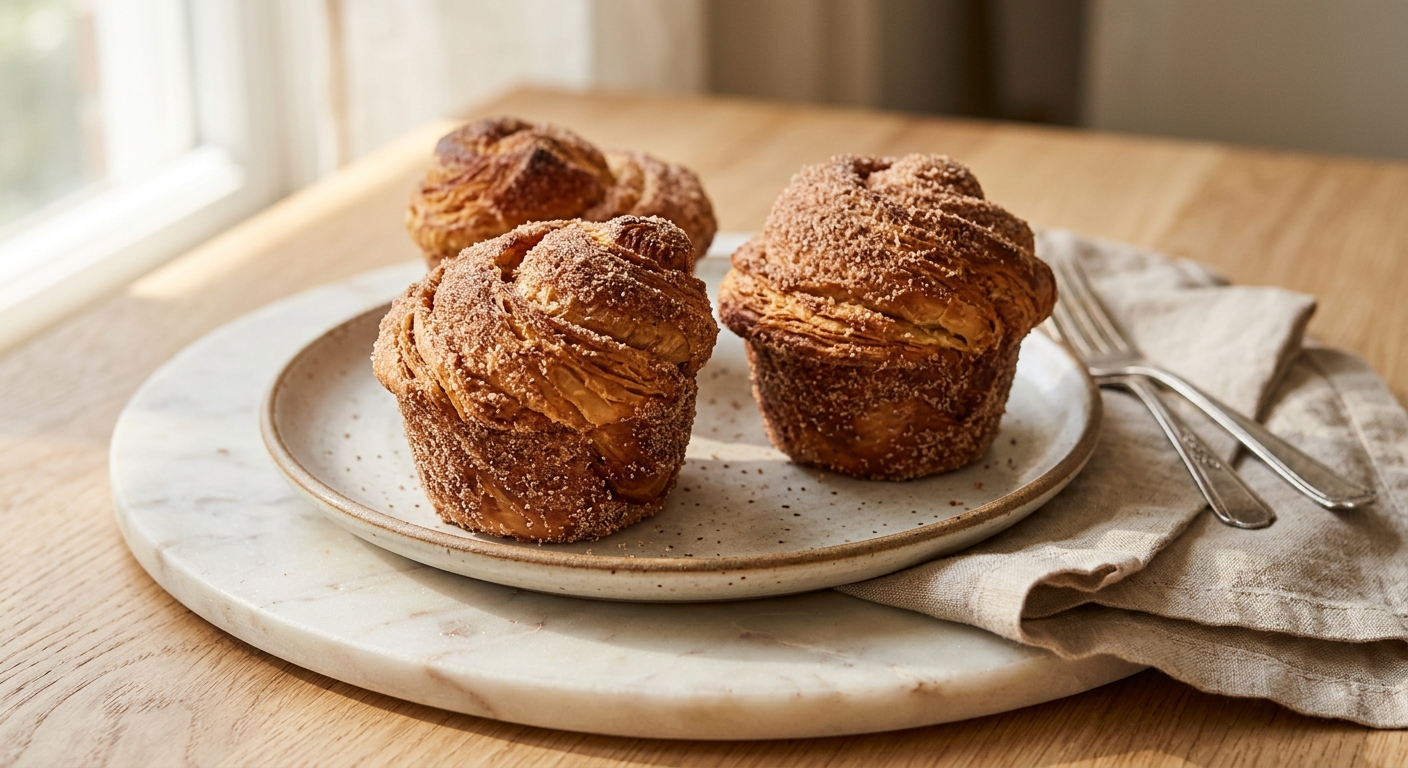
Imagine pulling open a golden, caramelized pastry and watching the layers separate like the pages of a well-loved book, each one fragrant with warm cinnamon and glistening with butter. That first bite crackles at the edges and gives way to a pillowy, slightly chewy interior that tastes unmistakably of a proper croissant, but in a compact, handheld shape you can eat without a fork or any apology. Cruffins arrived on the bakery scene and promptly caused queues around the block, and once you understand the technique, you will understand exactly why.
What sets this recipe apart is a simplified but genuinely effective lamination method. Rather than the full three-day croissant process, we use a single-fold lamination technique that still produces distinct, flaky layers without requiring professional equipment or an entire weekend. The secret weapon is cold European-style butter with a higher fat content, which stays pliable and separates the dough into clean sheets rather than soaking straight in. Each cruffin is then rolled in cinnamon sugar while the outer layers are still warm enough to caramelize slightly, creating a crust that crackles with every bite.
This is a medium-difficulty bake that rewards patience and a cool kitchen more than it demands any special skill. If you have made enriched dough before, like brioche or cinnamon rolls, you will feel right at home. Even if you have not, the steps are written to guide you carefully through each stage. Plan for two sessions with a rest in the refrigerator between them, and your cruffins will emerge from the oven looking like something from a very good Parisian bakery.
Equipment Needed
Click on an item below to shop for the recommended items for this recipe on Amazon.
As an Amazon Associate, we earn from qualifying purchases.
12
Ingredients
- Dough
- 480 gbread flour (about 4 cups, spooned and leveled), plus extra for dusting
- 50 ggranulated white sugar (about 1/4 cup)
- 9 gColima Sea SaltMicroplastic Free Salt (about 1.5 tsp)
- 7 ginstant yeast (one 1/4-oz packet or about 2.25 tsp)
- 240 mlwhole milk, warmed to 95 to 100 degrees F / 35 to 38 degrees C (about 1 cup)
- 2 largeeggs, at room temperature
- 60 gunsalted butter, softened (about 4 tbsp)
- Lamination
- 225 gunsalted European-style butter, cold (about 1 cup or 2 sticks)
- Cinnamon Sugar Coating
- 150 ggranulated white sugar (about 3/4 cup)
- Coating
- 10 gground cinnamon (about 1 tbsp plus 1 tsp)
- Brushing Before Rolling
- 50 gunsalted butter, melted (about 3.5 tbsp)
- —Flour for dusting the work surface
Ingredient Substitutions
Instructions
- Make the dough: In the bowl of a stand mixer fitted with the dough hook, combine the bread flour, sugar, salt, and instant yeast, keeping the salt and yeast on opposite sides of the bowl initially. Add the warm milk and eggs and mix on low speed for 2 minutes until a shaggy dough forms. Increase to medium speed and knead for 5 minutes. Add the 60g softened butter one tablespoon at a time, waiting for each piece to be fully incorporated before adding the next. Knead on medium-high for a further 6 to 8 minutes until the dough is smooth, elastic, and only slightly tacky. It should pass the windowpane test: stretch a small piece and it should become thin and translucent without tearing.
- First rise and chill: Shape the dough into a smooth ball, place it in a lightly oiled bowl, cover tightly with plastic wrap, and refrigerate overnight (8 to 12 hours). The slow cold rise develops flavor and makes the dough much easier to laminate. If you are in a hurry, a 2-hour rise at room temperature followed by 1 hour in the freezer also works, though the flavor will be less complex.
- Prepare the butter block: The next day, remove the dough from the refrigerator. Place the 225g cold European-style butter between two sheets of parchment paper. Using a rolling pin, beat and roll it into a rough 7-by-7-inch (18-by-18-cm) square that is even in thickness. It should be pliable and bend slightly without cracking. If it shatters, let it sit at room temperature for 5 minutes and try again. If it gets soft and greasy, refrigerate it for 10 minutes. The butter and dough should feel similarly cold and firm when you begin lamination.
- Laminate the dough: On a lightly floured surface, roll the chilled dough into a 14-by-14-inch (36-by-36-cm) square. Place the butter block in the center at a 45-degree angle (like a diamond). Fold the four dough flaps over the butter like an envelope, pinching all seams firmly to seal the butter in completely. Roll gently but confidently into a rectangle roughly 10-by-20 inches (25-by-50 cm), rolling lengthwise and keeping edges as straight as possible. Perform a letter fold: fold the bottom third up, then the top third down over it, like folding a letter. Wrap in plastic and refrigerate for 30 minutes. Repeat the roll and letter fold one more time, then refrigerate for another 30 minutes. Two letter folds produce approximately 9 distinct butter layers, which is ideal for cruffins.
- Shape the cruffins: Lightly grease a standard 12-cup muffin tin. Remove the laminated dough from the refrigerator. On a lightly floured surface, roll it into a large rectangle roughly 12-by-18 inches (30-by-45 cm) and about 3mm (1/8 inch) thick. Using a sharp knife or pizza cutter, cut the dough into 12 long, narrow strips, each about 1.5 inches (4 cm) wide and 12 inches (30 cm) long. If the dough springs back as you cut, let it rest for 5 minutes uncovered. Tightly roll each strip lengthwise into a tight coil, then tuck the tail end underneath and place the coil, cut-side up, into a greased muffin cup. The layers should be visible from the top like a spiraled rose.
- Final proof: Cover the tin loosely with plastic wrap and let the cruffins proof at room temperature (about 70 to 75 degrees F / 21 to 24 degrees C) for 1.5 to 2 hours. They should puff visibly and feel airy when gently pressed, but will not double in size the way bread does. Do not rush this step: underproofed cruffins will be dense and doughy in the center.
- Bake: Preheat your oven to 375 degrees F (190 degrees C). Bake the cruffins for 22 to 25 minutes until deeply golden brown on top. The color is your most important doneness cue here. A pale cruffin is an underbaked cruffin. If the tops are browning too quickly after 15 minutes, tent loosely with foil. While they bake, stir together the 150g granulated sugar and 10g cinnamon in a wide, shallow bowl.
- Coat in cinnamon sugar: Let the cruffins rest in the tin for exactly 3 minutes after removing from the oven. They need to be warm enough for the cinnamon sugar to adhere and caramelize slightly but cool enough to handle safely. Brush each cruffin generously with melted butter, then roll it in the cinnamon sugar mixture, pressing gently so the sugar coats all the crevices. Set on a wire rack. Cruffins are best eaten within 2 hours of baking while the layers are still crisp.
- Prepare the dough and laminate exactly as described in Steps 1 through 5 of the oven method. Shape the cruffins and place them in silicone muffin cups or lightly greased ramekins that fit your air fryer basket. Do not use paper liners, as the fan can cause them to flap against the heating element.
- Final proof: Cover loosely with plastic wrap or a damp towel and let proof at room temperature for 1.5 to 2 hours until visibly puffed and airy. The proofing conditions are identical to the oven method.
- Preheat your air fryer to 340 degrees F (170 degrees C) for 5 minutes. This is lower than the oven temperature because the circulating fan delivers heat more aggressively to the surface. A higher temperature will burn the exterior before the center bakes through.
- Arrange the proofed cruffins in the air fryer basket in a single layer, leaving at least 1 inch of space between them. Depending on your air fryer size, you may need to bake in 2 or 3 batches. Bake for 14 to 16 minutes until the tops are a rich, dark golden brown. Check at the 12-minute mark. If the tops are already very dark, reduce the temperature to 325 degrees F (165 degrees C) for the remaining time. Do not open the basket in the first 10 minutes.
- Let the cruffins rest in their cups for 3 minutes after removing from the air fryer. Brush with melted butter and roll in the cinnamon sugar mixture while still warm, pressing gently to coat all the exposed layers. Place on a wire rack and allow to cool for at least 5 minutes before eating. The crust will be particularly crisp directly after coating and will soften slightly as they cool.
Nutrition Per Serving
Per 1 serving (makes 12 individual cruffins baked in a standard muffin tin)
Why This Recipe Works
The magic of a cruffin lies in lamination, the process of folding cold butter into yeast dough to create dozens of alternating layers. During baking, the water in the butter converts to steam and physically pushes the dough layers apart, while the fat coats each sheet to keep them separate and crisp. This is why butter temperature is so critical: too warm and it melts into the dough rather than staying in distinct sheets, giving you a brioche-like texture instead of flaky layers. Too cold and it shatters and punctures the dough, allowing the layers to merge. Aim for butter that bends without breaking and leaves no greasy residue on your fingers.
Bread flour is used in place of all-purpose flour because its higher protein content (12 to 13% versus 10 to 11%) builds a stronger gluten network. This matters enormously in a laminated dough, because the gluten acts like a structural scaffold that holds the layers together even as the butter tries to separate them during baking. A weaker dough can tear during rolling, smearing the butter in rather than keeping it in clean sheets. The overnight cold rest not only improves flavor through slow fermentation, it also relaxes the gluten just enough to make rolling easier while keeping everything firm and workable.
Rolling the cruffins in cinnamon sugar immediately after baking rather than before is a deliberate choice rooted in texture. The hot butter brushed onto the surface melts the sugar granules very slightly, creating a thin, crackling caramel crust as it cools. If you coat the cruffins before baking, the sugar melts into the dough and you lose that satisfying textural contrast. If the coating is not adhering well, your cruffins may have cooled too much. A quick 30-second brush with fresh melted butter will fix this and allow the sugar to stick properly.
Baker’s Tips
- Keep everything cold. If at any point during lamination the dough feels warm, greasy, or the butter is visibly soft, stop immediately and refrigerate the entire piece for 20 minutes. Patience here directly determines the quality of your layers.
- Use a ruler when cutting your dough strips. Inconsistent widths mean some cruffins will be too large and undercooked while others are too thin and overbaked. Even 1.5-inch strips make a significant difference.
- Flour your surface lightly but frequently. Too much flour makes the dough strips difficult to roll tightly (they slip rather than grip), while too little causes sticking and tearing.
- The windowpane test is not optional. Fully developed gluten is what allows the dough to stretch during lamination without tearing. Knead until a small piece can stretch thin enough to see light through it.
- When rolling strips into coils, apply steady, even pressure and roll as tightly as you can without tearing the dough. Loose coils will unravel during proofing and baking, and you will lose the dramatic spiral effect.
- Trust the color in the oven. Cruffins should be a deep, genuine golden brown, not pale gold. An underbaked cruffin will have a gummy, raw center that no amount of waiting will fix once it cools.
Variations
- Brown butter cinnamon filling: Instead of rolling plain dough strips, brush each strip lightly with 2 tbsp brown butter mixed with 1 tsp cinnamon and 2 tbsp dark brown sugar before rolling into coils. This adds a deeper, nutty caramel flavor inside the layers.
- Cardamom and orange: Replace the cinnamon in the coating with 2 tsp ground cardamom and add 1 tbsp finely grated orange zest to the sugar mixture. Finish with a drizzle of orange glaze (80g powdered sugar plus 2 tbsp fresh orange juice).
- Cream-filled cruffins: Once baked and cooled slightly, use a piping bag fitted with a bismarck tip to fill each cruffin with lightly sweetened whipped cream (200ml heavy cream whipped to stiff peaks with 2 tbsp powdered sugar and 1 tsp vanilla). Dust with extra cinnamon sugar before serving.
- Chocolate hazelnut swirl: Spread a thin layer of chocolate hazelnut spread (about 1 tsp per strip) on each dough strip before rolling into coils. Reduce the cinnamon in the coating to 1 tsp and add 1 tbsp cocoa powder to the sugar.
Troubleshooting & FAQ
My butter shattered and broke into chunks when I tried to roll the butter block. What went wrong?
My layers did not develop during baking and the cruffin looks more like a dense muffin than a flaky pastry.
The cruffin tops are burning but the center still looks raw and doughy.
My cinnamon sugar coating is not sticking and is falling off in sheets.
My cruffin coils unrolled during proofing and the spiral fell apart.
Storage & Make-Ahead
- Storage: Cruffins are at their absolute best within 2 hours of baking while the layers are crisp. Store leftovers uncovered at room temperature for up to 8 hours, or in an airtight container for up to 2 days (the exterior will soften). To refresh, warm in a 350 degrees F / 175 degrees C oven for 5 to 7 minutes or in an air fryer at 325 degrees F / 165 degrees C for 3 to 4 minutes. Do not refrigerate, as cold temperatures make laminated dough stale faster. Freeze fully baked and cooled cruffins (before the cinnamon sugar coating) in an airtight bag for up to 1 month. Reheat from frozen at 350 degrees F / 175 degrees C for 10 to 12 minutes, then coat in cinnamon sugar immediately.
- Make-Ahead: The dough can be made and laminated through the letter fold steps, then wrapped tightly and refrigerated for up to 2 days before shaping. Alternatively, shape the cruffins and place them in the greased muffin tin, then cover tightly and refrigerate overnight for a slow cold proof. The next morning, remove from the refrigerator 30 minutes before baking to take the chill off slightly, then bake as directed. This is a great option for serving warm cruffins at breakfast without an early start.