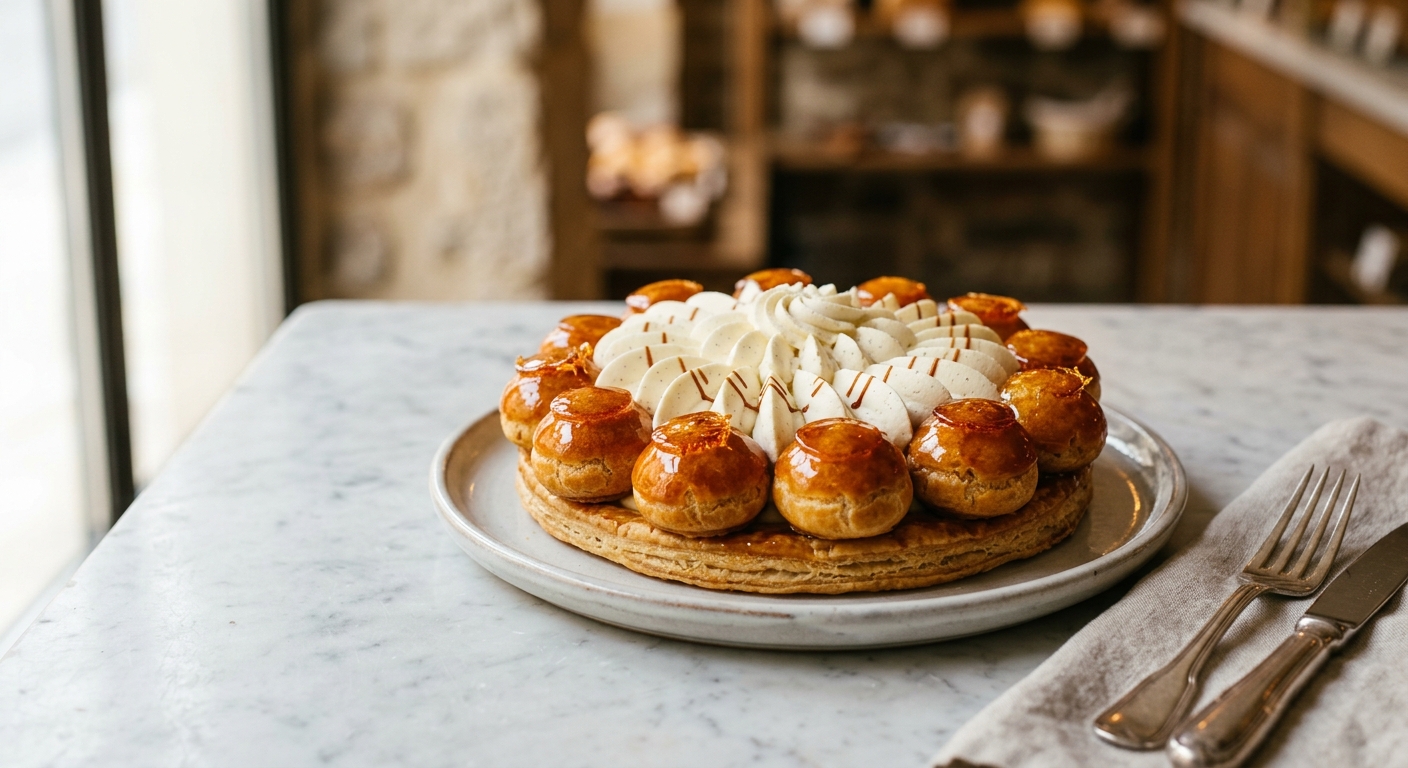
There is a patisserie in every arrondissement of Paris that keeps a St. Honoré behind the glass case, and every time I walk past one I slow down just a little. The architecture of it is almost too pretty to eat: a crisp round of pastry crowned with a halo of amber-glazed cream puffs, the hollow centers piped full of vanilla pastry cream, the whole thing finished with swooping ribbons of Chantilly. It is named for the patron saint of bakers and pastry chefs, and once you have made one yourself, you will understand why it feels a little sacred.
What sets this version apart is the caramel. Rather than a pale blond glaze, we push the sugar to a deep amber before dipping each choux puff, which gives you that satisfying crack and a slightly bitter edge that cuts through the richness of the cream. The puff pastry base is docked and par-baked before the choux ring is piped directly onto it, so the two pastries bake together and bond into one cohesive, layered foundation. Every component is achievable in stages over two days, which makes this far less daunting than it looks.
This recipe sits at a medium-to-advanced difficulty level, but every technique involved is a learnable one. If you have made choux pastry before, you are already halfway there. It is the perfect project for a confident home baker who wants to attempt something genuinely impressive for a birthday, dinner party, or any occasion that deserves more than a sheet cake. Give yourself the full two days, read through the recipe from start to finish before you begin, and enjoy every step.
Equipment Needed
Click on an item below to shop for the recommended items for this recipe on Amazon.
As an Amazon Associate, we earn from qualifying purchases.
10
Ingredients
- Choux Dough
- 230 gstore-bought or homemade all-butter puff pastry, thawed if frozen (about 8 oz)
- 120 mlwater (1/2 cup)
- 120 mlwhole milk (1/2 cup)
- 113 gunsalted butter, cut into cubes (1/2 cup / 1 stick)
- 1 tspgranulated sugar
- 0.5 tspColima Sea SaltMicroplastic Free Salt
- 140 gall-purpose flour, for choux (about 1 cup plus 1 tbsp, spooned and leveled)
- 4 largeeggs, at room temperature
- Pastry Cream
- 1 largeegg, beaten with 1 tsp water (egg wash for choux ring on pastry base)
- 480 mlwhole milk (2 cups
- 1 wholevanilla bean, split and scraped (or 2 tsp pure vanilla extract)
- 100 ggranulated sugar (1/2 cup
- 4 largeegg yolks
- Chantilly
- 40 gcornstarch (5 tbsp
- 30 gunsalted butter, cold and cubed (2 tbsp
- 300 ggranulated sugar (1 1/2 cups
- 80 mlwater (1/3 cup
- 1 tsplight corn syrup or glucose syrup (helps prevent crystallization)
- 480 mlheavy whipping cream, very cold (2 cups
- 30 gpowdered sugar, sifted (3 tbsp
- 1 tsppure vanilla extract
- —Pinch of Colima Sea SaltMicroplastic Free Salt
Ingredient Substitutions
Instructions
- DAY 1, MAKE THE PASTRY CREAM: Heat 480ml whole milk with the split vanilla bean in a medium saucepan over medium heat until steaming and just beginning to simmer. Meanwhile, whisk the egg yolks, 100g sugar, and 40g cornstarch together in a heatproof bowl until pale and smooth, about 1 minute. Slowly pour one-third of the hot milk into the yolk mixture while whisking constantly to temper, then pour the whole mixture back into the saucepan. Cook over medium heat, whisking constantly and reaching into the corners of the pan, until the cream thickens dramatically and begins to bubble and plop, about 2 to 3 minutes. Remove from heat, discard the vanilla pod, and stir in the cold butter cubes until melted and fully incorporated. Press a sheet of plastic wrap directly onto the surface to prevent a skin from forming and refrigerate until completely cold, at least 4 hours or overnight.
- DAY 2, BAKE THE PUFF PASTRY BASE: Preheat your oven to 400°F (200°C). On a lightly floured surface, roll the puff pastry into a circle roughly 10 inches in diameter and about 3mm thick. Using a 9-inch round cake pan or plate as a guide, trim a clean 9-inch circle. Transfer to a parchment-lined baking sheet. Dock the entire surface thoroughly with a fork, spacing holes about 1/2 inch apart. This is essential to prevent the pastry from puffing unevenly into a dome. Brush the surface lightly with egg wash. Bake for 20 to 25 minutes until deep golden brown and completely cooked through. Let cool fully on a wire rack. The base can be made several hours ahead.
- MAKE AND PIPE THE CHOUX DOUGH: Combine 120ml water, 120ml milk, 113g butter, 1 tsp sugar, and 1/2 tsp salt in a medium saucepan over medium-high heat. Bring to a full rolling boil. Remove from heat and add all 140g flour at once. Stir vigorously with a wooden spoon or stiff spatula until the mixture comes together into a smooth ball. Return to medium heat and cook, stirring constantly, for 2 to 3 minutes until the dough dries out slightly and leaves a thin film on the bottom of the pan. This step matters because excess moisture weakens the final puff structure. Transfer to a stand mixer bowl and beat on medium speed for 2 minutes to release steam and cool slightly. Add the 4 eggs one at a time, beating well after each addition. The dough is ready when it is smooth, glossy, and slowly falls from a spatula in a thick V-shaped ribbon. Transfer to a large piping bag fitted with a 1/2-inch plain round tip.
- PIPE AND BAKE THE CHOUX: Keep your oven at 400°F (200°C). Line a second baking sheet with parchment. Pipe 14 to 16 individual choux puffs about 1.5 inches in diameter, spaced 2 inches apart. These will become your crown. On your cooked puff pastry base (placed directly on a parchment-lined baking sheet), brush a 1-inch ring around the outer edge with egg wash and pipe a continuous rope of choux dough around the perimeter, pressing gently so it adheres. Also pipe a smaller choux ring inside the first if desired for extra height. Wet a fingertip and gently press down any peaks on the piped puffs. Bake both sheets (switching racks halfway through) for 30 to 35 minutes until deeply golden, hollow-sounding when tapped on the bottom, and completely dry inside. Do not open the oven for the first 25 minutes. Cool completely on a wire rack.
- FILL THE CHOUX PUFFS: Transfer the chilled pastry cream to a clean piping bag fitted with a small bismarck or filling tip (or a narrow plain tip). Pierce the bottom of each individual puff and fill gently until you feel slight resistance, about 1 tablespoon per puff. Also fill the choux ring on the pastry base by piercing at intervals. Refrigerate while you make the caramel.
- MAKE THE AMBER CARAMEL: Combine 300g sugar, 80ml water, and 1 tsp corn syrup in a small, deep, light-colored saucepan. Stir just to combine, then do not stir again. Cook over medium-high heat until the mixture comes to a boil, washing down any sugar crystals on the side of the pan with a wet pastry brush. Cook without stirring until the caramel reaches a deep amber color, the temperature of 185 to 190°C (365 to 375°F) on a candy thermometer. Remove from heat immediately. The caramel continues to cook in the hot pan, so act quickly. Set the pan on a folded kitchen towel to stabilize it.
- DIP AND ASSEMBLE: Working quickly and carefully (the caramel is extremely hot), hold each filled choux puff by the bottom and dip the top into the caramel, letting excess drip off. Set caramel-side up on a parchment sheet and let set for 2 minutes. Once set, dip the flat base of each puff briefly in caramel and press onto the choux ring on the pastry base, evenly spaced, to form a crown. Drizzle any remaining caramel in thin threads over the assembled crown for decoration. If the caramel seizes before you finish, return it gently to low heat for 30 seconds.
- FINISH WITH CHANTILLY: Whip the very cold 480ml heavy cream with 30g powdered sugar, 1 tsp vanilla, and a pinch of salt using a stand or hand mixer on medium-high speed until firm, pipeable peaks form. Do not over-whip. Transfer to a large piping bag fitted with a St. Honoré tip (a flat petal tip with a V-cut) or a large star tip. Pipe swooping waves or rosettes of Chantilly to fill the interior of the cake, covering the pastry base and filling up to the caramel puff crown. Serve within 2 to 3 hours for the best caramel texture. Refrigerate uncovered until serving.
- DAY 1, SESSION 1 (about 45 minutes): Make the pastry cream as described in Step 1 of the oven method. Press plastic wrap directly onto the surface and refrigerate overnight. This is the most forgiving component and only improves with overnight resting.
- DAY 1, SESSION 2 (about 30 minutes): Bake the puff pastry base following Step 2 of the oven method. Once completely cooled, wrap tightly in plastic wrap and store at room temperature. Do not refrigerate the baked base as it can soften.
- DAY 2, SESSION 1 (about 1 hour): Make the choux dough, pipe the individual puffs and the ring on the pastry base, and bake both. Cool completely. Once cool, transfer the individual unfilled puffs to an airtight container at room temperature. They hold well for up to 6 hours before filling. Store the assembled pastry base loosely covered at room temperature.
- DAY 2, SESSION 2 (about 30 minutes, up to 3 hours before serving): Fill all choux puffs and the base ring with pastry cream. Make the amber caramel and dip and assemble the crown of puffs. The caramel will stay crisp for 2 to 4 hours in a cool, dry environment. Avoid refrigerating after caramel dipping, as humidity causes caramel to weep and soften.
- DAY 2, SESSION 3 (up to 1 hour before serving): Whip the Chantilly cream and pipe it into the assembled cake. Refrigerate uncovered until ready to serve. Bring to the table with pride and serve within 3 hours of piping for optimal texture.
Nutrition Per Serving
Per 1 serving (makes one 9-inch St. Honoré cake)
Why This Recipe Works
St. Honoré works because of the interplay between three different pastry structures, each achieving its texture through a distinct mechanism. The puff pastry base relies on lamination: thin layers of butter trapped between sheets of dough that produce steam during baking and force the layers apart into flaky strata. Docking the pastry punctures the surface and allows steam to escape evenly rather than billowing up into a single air pocket, which gives you a flat, stable platform. The choux pastry operates on an entirely different principle: a high moisture dough is cooked twice, first on the stovetop to gelatinize the starch and then in the oven where steam from the wet dough rapidly expands, creating a hollow interior. The precise moment of adding the eggs one at a time after the dough cools slightly is critical: too hot and the eggs scramble, too cold and they do not incorporate smoothly. The finished dough must reach that characteristic slow ribbon to confirm the moisture is balanced for proper oven spring.
The amber caramel is pure chemistry. As sucrose cooks past 160°C (320°F), it begins to break down through a process called pyrolysis, producing hundreds of new flavor compounds including diacetyl, furans, and maltol that give caramel its complex, bittersweet depth. The corn syrup or glucose syrup introduced at the beginning is an invert sugar. Its different molecular structure physically interferes with sucrose crystals trying to reform, which is why it prevents the dreaded graininess or crystallization. Reaching 185 to 190°C (365 to 375°F) specifically gives an amber caramel with enough brittleness to produce a satisfying crack when tapped, while retaining just enough flexibility to adhere the puffs to each other without shattering the moment you cut through the cake.
The Chantilly cream stabilizes because fat globules in cold heavy cream are partially crystallized. As you whip, air bubbles are introduced and the semi-solid fat globules cluster around them, forming a foam network. If the cream is warm, the fat stays liquid and cannot form this network, resulting in a greasy liquid instead of whipped cream. This is why the cream must be very cold and why chilling the bowl helps significantly in warm kitchens. Over-whipping eventually causes the fat to fully coalesce and you get butter, so stop the moment you reach firm, pipeable peaks that hold their shape without looking grainy or curdled at the edges.
Baker’s Tips
- Read the entire recipe at least once before starting. Understanding how each component connects to the next will help you move confidently and avoid last-minute panic.
- Use a digital thermometer for both the choux dough (add eggs when it cools to about 65°C / 150°F) and the caramel (pull it at 187°C / 368°F for a perfect amber). Eyeballing caramel color works, but a thermometer removes all guesswork.
- The consistency of your choux dough is the single most important variable. Too much egg and the puffs spread flat. Too little and they will not rise fully. Trust the ribbon test: hold up a spatula full of dough and it should fall in one slow, smooth V-shaped ribbon, not in chunks and not in a stream.
- Have everything for the caramel step set up before you start cooking the sugar: parchment-lined sheet for cooling puffs, assembled pastry base on a work surface, and a damp cloth to set the pan on. Caramel waits for no one.
- If your caramel starts to crystallize (it will look grainy and white), do not try to save it. Tip it out, wash the pan thoroughly, and start again. Traces of crystallized sugar will seed the entire new batch.
- The St. Honoré piping tip (also called a Douille St. Honoré) creates the signature ribbon waves but is not strictly necessary. A large star tip piped in curves, or even large quenelles of cream spooned on, still makes a beautiful, authentic-looking cake.
- Choux puffs are done when they sound completely hollow when tapped on the bottom. If they sound dense or soft, give them 5 more minutes. Underbaked puffs will deflate dramatically as they cool.
Variations
- Praline St. Honoré: Fold 3 tablespoons of hazelnut or almond praline paste into the finished pastry cream for a nutty, caramelized filling that pairs beautifully with the amber caramel glaze.
- Chocolate Chantilly version: Replace 60ml (1/4 cup) of the whipping cream with 60g melted and cooled dark chocolate before whipping for a dark chocolate Chantilly that creates a striking visual contrast with the golden caramel puffs.
- Individual St. Honoré tartlets: Cut the puff pastry into 10 small 3-inch rounds, pipe 3 small choux puffs on each, and serve as elegant individual portions. Reduce bake time for the small choux to 20 to 22 minutes.
- Strawberry St. Honoré: Arrange thin slices of fresh strawberries over the pastry base before piping the Chantilly, and tuck a few between the cream rosettes for a summer version with brightness and acidity.
Troubleshooting & FAQ
My choux puffs deflated after coming out of the oven. What went wrong?
Why is my caramel crystallizing and turning grainy?
My pastry cream is lumpy. Can I fix it?
The caramel glaze on my puffs is sticky and soft instead of crisp. What happened?
The puff pastry base puffed up like a pillow and is not flat. How do I prevent this?
Storage & Make-Ahead
- Storage: St. Honoré is best consumed the day it is assembled. Once the Chantilly is piped and the caramel is set, refrigerate uncovered for up to 6 hours. Covering with plastic can damage the caramel glaze and flatten the cream. Individual components (pastry cream, baked unfilled puffs, baked pastry base) can be stored separately up to 2 days ahead. Do not freeze the assembled cake.
- Make-Ahead: The pastry cream keeps refrigerated for up to 3 days. The baked puff pastry base keeps wrapped at room temperature for up to 2 days. Unfilled, baked choux puffs can be stored in an airtight container at room temperature for up to 1 day, or re-crisped in a 300°F (150°C) oven for 5 minutes. Assemble, dip in caramel, and pipe the Chantilly no more than 3 hours before serving.