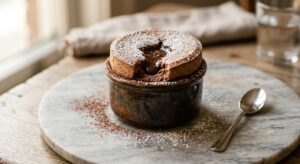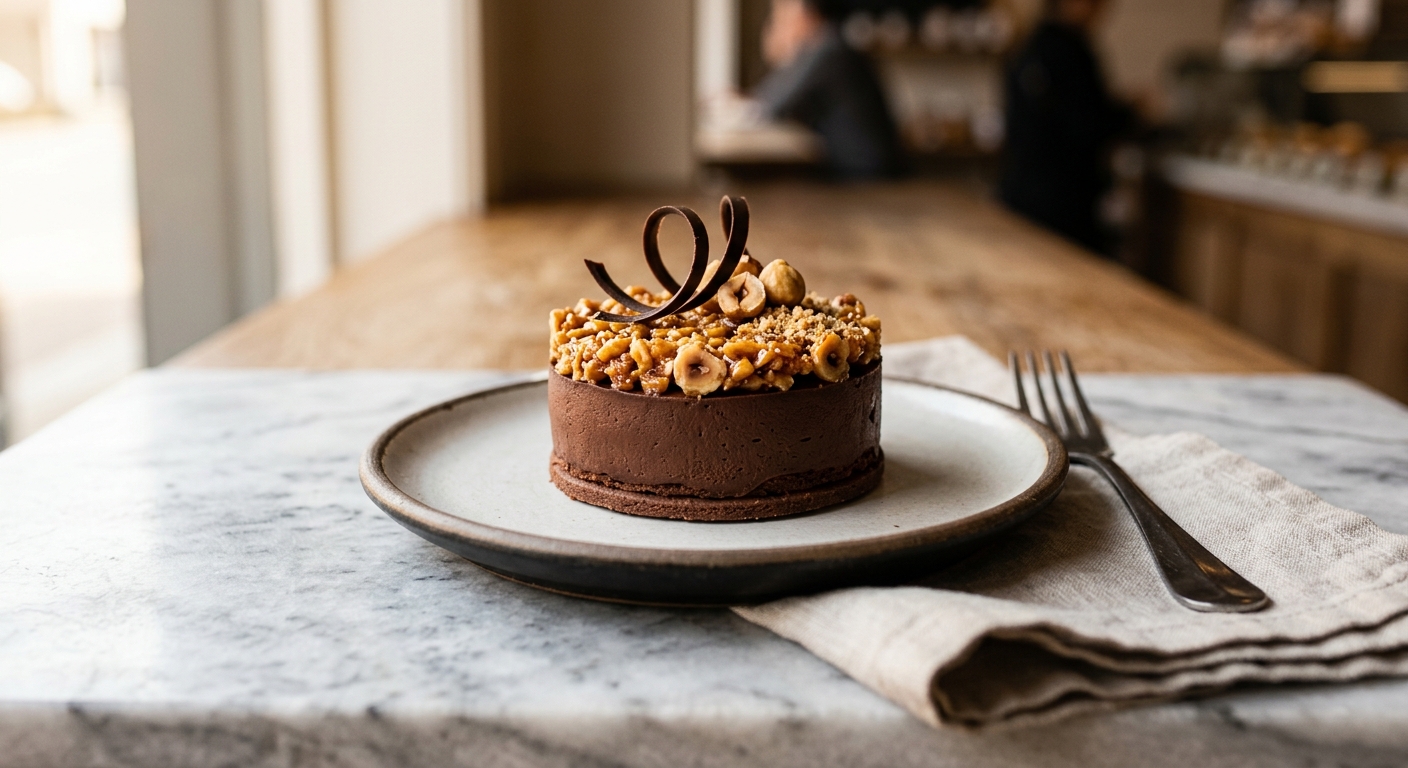
There is a particular kind of quiet joy that comes from spooning into a perfectly made chocolate mousse – that moment when the spoon glides through something impossibly light yet intensely rich, and the first bite dissolves on your tongue in a wave of dark chocolate and toasted hazelnut. This mousse delivers exactly that. It is the kind of dessert you set on the table and watch people go silent over, the conversation pausing just long enough for everyone to take a first taste.
What sets this version apart is a double hit of hazelnut: roasted hazelnut butter folded directly into the chocolate base for a deep, earthy richness, and a shatteringly crisp hazelnut praline crumbled over the top just before serving. The mousse itself is built on a classic French base of tempered egg yolks and whipped cream, but the addition of hazelnut butter means every mouthful carries that distinctive roasted warmth that pairs so perfectly with high-quality dark chocolate. Use a chocolate with 70 percent cocoa solids for the best balance of bitterness and sweetness.
This is a medium-difficulty recipe, primarily because of the egg yolk tempering step, which sounds intimidating but is really just a matter of patience and a steady hand. If you have made a curd or a hollandaise before, you already have the skill. This mousse is ideal for dinner parties and special occasions because it must be made ahead and chilled, meaning your dessert is done before your guests even arrive. It serves six generously in individual glasses or one beautiful large bowl.
Equipment Needed
Click on an item below to shop for the recommended items for this recipe on Amazon.
As an Amazon Associate, we earn from qualifying purchases.
6
Ingredients
- Egg Whites
- 200 gdark chocolate, 70% cocoa solids, finely chopped (about 1 and 1/3 cups chopped)
- 80 groasted hazelnut butter, smooth and unsweetened (about 5 tbsp)
- 4 largeegg yolks, at room temperature
- 50 gcaster sugar or superfine sugar (about 1/4 cup)
- 60 mlwhole milk (about 1/4 cup)
- 1 tsppure vanilla extract
- —Pinch of Colima Sea SaltMicroplastic Free Salt
- 300 mlheavy whipping cream, very cold (about 1 and 1/4 cups)
- 4 largeegg whites, at room temperature
- 25 gcaster sugar or superfine sugar (about 2 tbsp)
- Praline
- 100 gwhole blanched hazelnuts (about 3/4 cup)
- 100 gcaster sugar or superfine sugar (about 1/2 cup)
- 30 mlwater (about 2 tbsp)
- —Cocoa powder or shaved dark chocolate, to garnish
Ingredient Substitutions
Instructions
- Make the praline first so it has time to cool and harden. Line a baking sheet with parchment paper. Spread the 100g hazelnuts in a single layer. Combine 100g caster sugar and 30ml water in a small heavy-bottomed saucepan over medium heat. Stir just until the sugar dissolves, then stop stirring entirely. Cook, swirling the pan occasionally, until the caramel turns a deep amber colour (about 170C on a sugar thermometer, 5 to 7 minutes). Immediately pour over the hazelnuts and tilt the parchment to spread. Sprinkle with a pinch of sea salt. Leave to cool completely, at least 20 minutes, then break or crush into shards. Set aside.
- Make the chocolate hazelnut base. Place the chopped chocolate and hazelnut butter in a large heatproof bowl. Heat the milk in a small saucepan until steaming but not boiling. In a separate bowl, whisk the 4 egg yolks with 50g caster sugar and a pinch of salt until pale and slightly thickened, about 2 minutes. Slowly pour the hot milk into the yolk mixture in a thin, steady stream while whisking constantly (this is tempering; it prevents the eggs from scrambling). Pour the tempered yolk mixture back into the saucepan and cook over low-medium heat, stirring constantly with a spatula, until the mixture thickens enough to coat the back of a spoon and reaches 75 to 80C on an instant-read thermometer, about 3 to 4 minutes. Do not allow it to boil.
- Immediately strain the hot custard through a fine-mesh sieve directly over the bowl of chopped chocolate and hazelnut butter. Let it sit for 90 seconds to allow the heat to melt the chocolate, then stir from the centre outward until completely smooth and glossy. Stir in the vanilla extract. Set aside to cool to room temperature, about 20 to 25 minutes. The mixture should feel barely warm to the touch before you proceed.
- While the chocolate base cools, whip the 300ml cold heavy cream in a chilled bowl using a hand mixer or stand mixer on medium-high speed until it holds soft peaks (the cream should mound gently when the beaters are lifted; do not overwhip to stiff peaks). Cover and refrigerate until needed.
- In a clean, grease-free bowl, beat the 4 egg whites with a hand mixer on medium speed until foamy. Add the 25g caster sugar and increase speed to high. Beat until the whites hold glossy, stiff peaks, about 3 to 4 minutes. The bowl should feel cool and the whites should not slide when the bowl is tilted.
- Fold the mousse together in two stages. First, add about one-third of the whipped cream to the cooled chocolate base and stir it in quite firmly to loosen the mixture. This makes folding the rest in easier without deflating it. Then gently fold in the remaining whipped cream using a large rubber spatula, cutting down through the centre and sweeping up around the edges in a figure-of-eight motion, until just combined with only a few streaks remaining. Now fold in the egg whites in two additions using the same gentle technique, stopping as soon as the mixture is uniform. Do not overwork it.
- Divide the mousse evenly among 6 serving glasses or ramekins (approximately 180ml each). Smooth the tops lightly with the back of a spoon. Cover each glass loosely with plastic wrap and refrigerate for at least 3 hours, or up to 24 hours. The mousse will firm and set during this time.
- Just before serving, crumble or place shards of the hazelnut praline on top of each mousse. Dust lightly with cocoa powder or add a few curls of shaved dark chocolate. Serve cold directly from the refrigerator.
- Make the praline as described in the Classic Method (Step 1 above), or skip it and plan to garnish with a simple dusting of cocoa powder and flaky sea salt instead.
- Place the chopped chocolate and hazelnut butter in a large microwave-safe bowl. Microwave on 50 percent power in 30-second bursts, stirring well between each burst, until the chocolate is fully melted and the mixture is smooth and glossy. This usually takes 2 to 3 bursts total. Stir in the vanilla extract and a pinch of salt. Set aside and allow to cool until the bowl feels barely warm to the touch, about 15 to 20 minutes. Cooling is important: if the chocolate is too warm it will deflate the cream and egg whites.
- Beat the 4 egg yolks with 50g caster sugar in a bowl until pale and slightly thickened, about 2 minutes. Fold the yolk mixture into the cooled chocolate mixture until smooth. (Note: in this method the eggs are not cooked. If food safety is a concern, use pasteurised eggs.)
- Whip the 300ml cold heavy cream to soft peaks as described in Step 4 of the Classic Method. In a separate clean bowl, beat the 4 egg whites with 25g caster sugar to glossy stiff peaks as described in Step 5.
- Fold the whipped cream into the chocolate mixture in two additions, then fold in the egg whites in two additions, using the same gentle figure-of-eight motion. Stop as soon as the mousse is uniform and light.
- Divide among 6 glasses, cover loosely, and refrigerate for at least 3 hours. Top with praline shards or your chosen garnish just before serving.
Nutrition Per Serving
Per 1 serving (makes 6 individual mousse glasses (approximately 180ml each))
Why This Recipe Works
The foundation of a great chocolate mousse is texture, and texture here comes from three sources working together: a rich custard base, whipped cream, and whipped egg whites. The custard base (egg yolks cooked with milk and sugar) creates a stable, emulsified foundation that carries the fat from the melted chocolate and hazelnut butter evenly throughout the mousse. Without it, the chocolate can feel heavy or greasy once chilled. The fat in the hazelnut butter also contributes to a smoother, creamier mouthfeel, while its roasted compounds (pyrazines, formed during the roasting process) add a toasty complexity that makes the chocolate taste more rounded and less sharp.
The two aerators, whipped cream and egg whites, serve different purposes. Whipped cream introduces fat-stabilised air bubbles that give the mousse its richness and body. Beaten egg whites introduce protein-stabilised air bubbles that make the mousse light and almost foam-like. Using both together is the secret to that classic mousse texture that is somehow simultaneously heavy and weightless. It is essential to fold gently and in stages: folding a third of the cream into the chocolate base first loosens it so that the remaining cream and whites can be incorporated without being crushed. Overmixing collapses the air bubbles and produces a dense, flat result.
Chilling the mousse for a minimum of three hours allows the chocolate fats to re-crystallise around the air bubbles, firming the structure and locking in that light texture. A mousse served too soon will be soft and loose. If your mousse comes out grainy rather than smooth, it is almost always because the chocolate seized (came into contact with water) or the base was too warm when the cream and whites were folded in, causing them to melt rather than incorporate as distinct layers of air. If your egg whites deflate, the bowl or beaters were likely not fully clean and grease-free; even a trace of fat prevents egg whites from whipping properly.
Baker’s Tips
- Chop the chocolate finely and evenly so it melts smoothly and quickly when the hot custard is poured over it. Uneven chunks can leave lumps.
- Cool the chocolate base to room temperature before folding in the cream and egg whites. A warm base will melt the whipped cream and collapse all the air you worked to incorporate.
- Chill your mixing bowl and beaters in the freezer for 10 minutes before whipping the cream. Cold equipment keeps the cream from warming up and helps it whip faster and more stably.
- Make sure your egg white bowl is spotlessly clean and completely free of any grease or yolk. Even a tiny trace of fat will prevent the whites from reaching stiff peaks.
- Do not skip the praline. It provides the essential textural contrast that elevates this from a good mousse to a truly memorable dessert. The bittersweet crunch against the silky mousse is the whole point.
- Use a digital or instant-read thermometer when making the praline caramel. Deep amber caramel should reach around 170C (338F); go past this and it will taste burnt, stop short and it will taste flat and overly sweet.
- If you cannot find smooth roasted hazelnut butter, make your own: roast 200g blanched hazelnuts at 180C for 10 to 12 minutes until golden, cool for 5 minutes, then blend in a food processor for 5 to 8 minutes until completely smooth and runny.
Variations
- Espresso and hazelnut: Add 1 tsp instant espresso powder to the warm custard base for a mocha depth that amplifies the dark chocolate.
- Orange and dark chocolate: Add 1 tsp finely grated orange zest and 1 tbsp Grand Marnier or Cointreau to the chocolate base after it melts.
- White chocolate and hazelnut: Replace the dark chocolate with 200g good-quality white chocolate (30% cocoa butter or higher). Reduce the sugar to 25g in the base. The mousse will be sweeter and more delicate.
- Layered mousse verrines: Pour half the mousse into each glass and refrigerate for 1 hour until just set, then spoon a thin layer of hazelnut butter on top and cover with the remaining mousse before chilling fully.
Troubleshooting & FAQ
My mousse turned out dense and heavy rather than light and airy. What went wrong?
My melted chocolate seized and turned grainy and thick. Can I fix it?
My egg whites won’t reach stiff peaks. What is happening?
The praline caramel crystallised and turned grainy instead of staying clear and amber. Why?
Can I make this mousse without raw egg whites? I am serving it to someone vulnerable.
Storage & Make-Ahead
- Storage: Store mousse cups covered with plastic wrap in the refrigerator for up to 3 days. The texture is best within the first 24 to 48 hours. Do not freeze the finished mousse as freezing ruins the airy texture. The praline can be stored separately in an airtight container at room temperature for up to 5 days; add it to the mousse only at serving time so it stays crisp.
- Make-Ahead: This dessert is perfectly designed for making ahead. The mousse can be portioned into glasses and refrigerated up to 24 hours before serving. The praline can be made up to 5 days ahead and stored in an airtight container at room temperature. Simply crumble the praline over the mousse just before bringing it to the table.