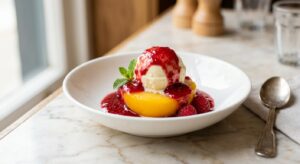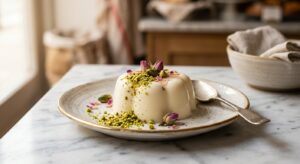
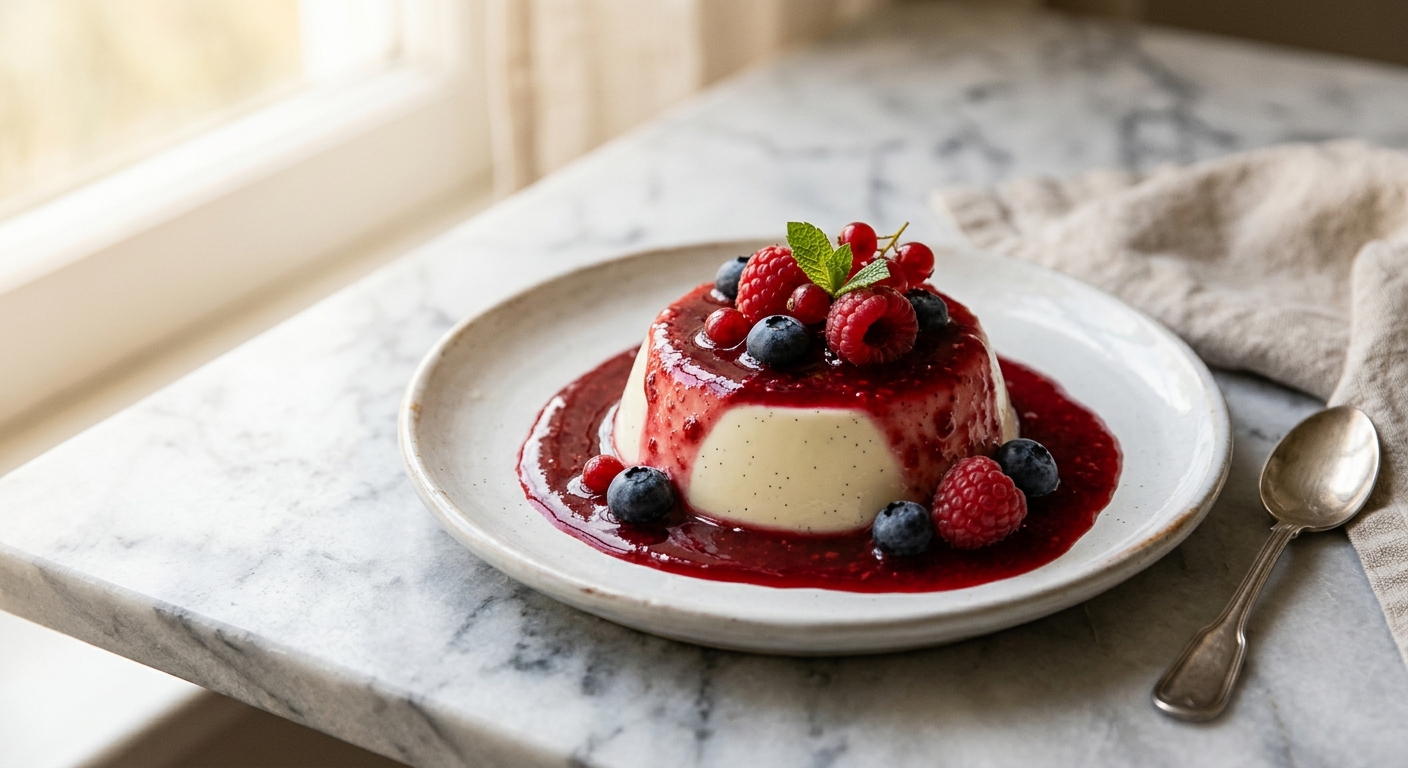
There is a moment, just before you unmold a panna cotta, when you wonder if it will hold. You run a thin knife around the edge, place a chilled plate on top, flip, and then lift the mold away to reveal a perfect ivory dome that quivers gently with every tiny vibration of the table. That moment never gets old. Panna cotta, which translates simply to ‘cooked cream’ in Italian, is one of those rare desserts that is simultaneously humble in its ingredients and breathtaking in its result. Draped in a deep crimson berry coulis with its jewel-like sheen, it is the kind of thing you serve at a dinner party and watch your guests go quietly speechless.
What sets this version apart is a careful attention to the gelatin ratio. Most panna cotta failures come down to one thing: too much gelatin, which produces a rubbery, dense texture more like jello than a dessert worth eating. This recipe uses just enough gelatin to give the cream structure while keeping it cloud-soft, almost spoonable. A full vanilla bean, scraped directly into the warm cream and left to steep, delivers a fragrance and depth that vanilla extract alone simply cannot match. The berry coulis is cooked briefly to concentrate its flavor, then strained for a sauce that is velvety smooth and intensely fruity.
Despite its elegant appearance, this is genuinely a beginner-friendly recipe. There is no tempering, no water bath, and no risk of curdling. If you can warm cream on a stove and stir, you can make this. It does require patience during the chilling phase, so plan ahead, but the actual work is minimal. This is the perfect make-ahead dessert for entertaining, a romantic dinner for two, or any time you want to serve something truly special with very little fuss.
Equipment Needed
Click on an item below to shop for the recommended items for this recipe on Amazon.
As an Amazon Associate, we earn from qualifying purchases.
6
Ingredients
- 600 mlheavy cream, also called double cream (about 2.5 cups)
- 200 mlwhole milk (about 3/4 cup plus 1 tbsp)
- 70 gcaster sugar or superfine sugar (about 1/3 cup)
- 1 wholevanilla bean, split lengthwise and seeds scraped
- 2.5 tsppowdered unflavored gelatin (about 7g or one standard sachet)
- 45 mlcold water (3 tablespoons), for blooming the gelatin
- —Pinch of Colima Sea SaltMicroplastic Free Salt
- 300 gmixed fresh or frozen berries (about 2.5 cups), such as raspberries, strawberries, or blackberries
- 50 gcaster sugar for the coulis (about 1/4 cup)
- 30 mlfreshly squeezed lemon juice (about 2 tablespoons)
- 15 mlwater for the coulis (1 tablespoon)
Ingredient Substitutions
Instructions
- Lightly grease six 150ml (5oz) ramekins or dariole molds with a neutral oil such as sunflower or almond oil. Wipe out any excess with a paper towel, leaving only the thinnest film. This will make unmolding much easier. Set the molds on a small baking tray and place in the refrigerator while you prepare the panna cotta.
- Bloom the gelatin: Pour the 45ml of cold water into a small bowl. Sprinkle the powdered gelatin evenly over the surface. Do not stir. Let it sit undisturbed for 5 to 10 minutes. The gelatin will absorb the water and swell into a soft, spongy mass. This step is essential for a smooth, lump-free result.
- Meanwhile, combine the heavy cream, whole milk, caster sugar, scraped vanilla seeds, the spent vanilla pod, and the pinch of sea salt in a medium saucepan. Place over medium-low heat, stirring occasionally, until the sugar is completely dissolved and the mixture is steaming hot, about 5 to 7 minutes. Do not let it boil. You should see a few wisps of steam rising but no bubbles breaking the surface.
- Remove the pan from the heat. Add the bloomed gelatin to the hot cream mixture and whisk immediately and thoroughly until it is completely dissolved with no lumps remaining, about 1 to 2 minutes. If you see any undissolved specks, return the pan to low heat for 1 minute, whisking constantly, but do not allow it to boil.
- Remove the vanilla pod from the cream. Pour the mixture through a fine-mesh sieve into a large measuring jug or bowl with a pour spout for easy filling. Allow the mixture to cool for 10 to 15 minutes at room temperature, then carefully divide it evenly among the prepared molds.
- Cover each mold loosely with plastic wrap and refrigerate for a minimum of 4 hours, or preferably overnight, until fully set. The panna cotta should feel firm at the edges but still have a slight jiggle in the very center, like a just-set gelatin dessert.
- While the panna cottas chill, make the berry coulis: Combine the berries, 50g sugar, lemon juice, and 1 tablespoon of water in a small saucepan. Cook over medium heat, stirring often, for 8 to 10 minutes until the berries have completely broken down and the sauce has thickened slightly. Press the mixture through a fine-mesh sieve using a spatula, discarding the seeds and skins. Taste and adjust with a little more sugar or lemon juice. Let cool completely, then refrigerate until needed.
- To unmold: Run a thin paring knife or offset spatula gently around the inside edge of each mold. Place a chilled serving plate upside down on top of the mold, then quickly flip both together. Give a gentle shake. The panna cotta should release cleanly. If it resists, hold the mold over warm (not hot) water for 10 seconds and try again. Spoon the cold berry coulis generously around and over each panna cotta and serve immediately.
- Choose six elegant glasses: small wine glasses, coupe glasses, or glass dessert cups all work beautifully. No greasing is needed. Arrange them on a tray that will fit in your refrigerator.
- Bloom the gelatin by sprinkling it evenly over 45ml of cold water in a small bowl. Do not stir. Let it sit for 5 to 10 minutes until swollen and spongy.
- Combine the heavy cream, whole milk, caster sugar, vanilla seeds, vanilla pod, and salt in a medium saucepan over medium-low heat. Stir occasionally until the sugar dissolves and the mixture is steaming but not boiling, about 5 to 7 minutes.
- Remove from heat and immediately whisk in the bloomed gelatin until fully dissolved. Remove the vanilla pod and pour the mixture through a fine-mesh sieve into a large measuring jug. Cool for 15 minutes at room temperature.
- Carefully pour the cream mixture evenly into the prepared glasses. If you want a tilted set for a dramatic presentation, prop each glass at an angle using a folded kitchen towel on the tray before pouring, then refrigerate at the angle until set. Once set, straighten the glasses before adding coulis.
- Refrigerate uncovered for 30 minutes, then drape loosely with plastic wrap and continue chilling for at least 3.5 more hours, or overnight. The panna cotta is ready when it is fully set around the edges with a slight wobble in the center.
- Make the berry coulis using the same stovetop method: cook the berries, sugar, lemon juice, and water for 8 to 10 minutes, then strain and cool. Spoon or pour a generous layer of cold coulis directly over each set panna cotta in the glass just before serving. Garnish with a fresh berry or small mint sprig if desired.
- Lightly oil six 150ml ramekins or dariole molds with a neutral oil and refrigerate on a tray as instructed in the stovetop method. Bloom the gelatin in 45ml of cold water in a small bowl for 5 to 10 minutes.
- Combine the heavy cream, whole milk, sugar, vanilla seeds, vanilla pod, and salt in a large microwave-safe measuring jug or bowl (at least 1 liter capacity to prevent overflow). Microwave on medium power (50%) in 90-second intervals, stirring between each, for a total of about 4 to 5 minutes until the mixture is steaming hot and the sugar is dissolved. Do not use full power, as the cream can boil over rapidly.
- Remove the vanilla pod. Add the bloomed gelatin to the hot cream and whisk vigorously for 1 to 2 minutes until completely dissolved with no traces of granules. If you feel any gritty texture, microwave the mixture on medium power for 30 seconds more and whisk again.
- Strain the mixture through a fine-mesh sieve, let it cool for 10 minutes, then pour evenly into the prepared molds. Refrigerate for a minimum of 4 hours or overnight.
- For the microwave berry coulis: Combine the berries, 50g sugar, lemon juice, and water in a microwave-safe bowl. Microwave on full power for 3 to 4 minutes, pausing halfway to stir, until the berries are completely broken down and the mixture is bubbling and slightly syrupy. Strain through a fine-mesh sieve, pressing firmly with a spatula. Cool completely and refrigerate.
- Unmold as described in the stovetop method, or serve in glasses. Spoon the cold coulis over each panna cotta just before serving.
Nutrition Per Serving
Per 1 serving (makes 6 individual panna cottas in 150ml (5oz) ramekins or dariole molds)
Why This Recipe Works
The magic of panna cotta lies in a precise balance between fat and gelatin. Heavy cream is rich in fat, which gives the dessert its characteristic silkiness and mouthfeel. However, fat alone does not set. Gelatin, a protein derived from collagen, forms a network of long chains that trap the liquid cream and hold it in a soft solid structure when chilled. The critical science here is the gelatin-to-liquid ratio: too little gelatin and the panna cotta will not unmold cleanly; too much and it becomes bouncy and unpleasantly dense. At 7g of gelatin to 800ml of liquid, this recipe sits at the lower end of the spectrum on purpose, giving you a dessert that barely holds its shape but dissolves instantly the moment it touches your tongue.
Blooming the gelatin in cold water before adding it to the hot liquid is a non-negotiable step. Dry gelatin granules are tightly coiled proteins. When they are sprinkled over cold water, they hydrate slowly and evenly, allowing each granule to swell before being dissolved. If you skip this step and add dry gelatin directly to hot cream, the outer surface of each granule overheats and seizes into a rubbery clump before the interior has a chance to hydrate, resulting in lumps no amount of whisking can fix. The hot cream (around 70 to 80 degrees Celsius, well below boiling) is the perfect temperature to dissolve the pre-bloomed gelatin completely. Boiling must be avoided because sustained high heat can break down gelatin’s protein chains, permanently weakening its setting ability.
The berry coulis works on a straightforward principle of pectin concentration. Berries contain natural pectin in their cell walls. As they cook down with sugar and lemon juice, the cell walls rupture, releasing both pectin and juice. The acid in the lemon juice helps the pectin chains bond together, and the evaporation of water concentrates everything into a glossy, lightly thickened sauce. Straining removes seeds and skins for a refined texture. If your coulis is too thin after cooling, return it to the heat and simmer for a few more minutes. If it is too thick, stir in a teaspoon of water at a time until it reaches a pourable consistency.
Baker’s Tips
- Do not skip greasing the molds, even lightly. A thin film of neutral oil is all that stands between a perfect unmolded panna cotta and a frustrating stuck one.
- Use full-fat dairy throughout. Low-fat cream or skim milk will produce a noticeably less silky, less stable result, and you may need to increase the gelatin.
- Steep the vanilla pod in the hot cream for at least 5 minutes before straining for the deepest flavor. The spent pod can be rinsed, dried, and buried in a jar of sugar to make vanilla sugar.
- Letting the cream mixture cool slightly (to around 40 to 50 degrees Celsius) before pouring into molds is important if your molds are already very cold from the refrigerator. Pouring hot liquid into cold molds can create condensation and an uneven surface on the finished panna cotta.
- For the clearest, most refined coulis, press the cooked berries through a fine-mesh sieve in batches rather than all at once. Take your time and work the spatula in circular motions to extract maximum liquid without pushing through any seeds.
- Check the set before unmolding: the panna cotta should feel firm with a distinct jiggle only in the very center, similar to a softly set jello. If the entire surface moves like liquid, refrigerate for another hour.
Variations
- Honey and lavender: Replace the caster sugar with 60ml (4 tbsp) of good-quality honey and add 1 tsp dried culinary lavender to the cream while heating. Strain before pouring into molds. Pair with a peach or apricot coulis.
- Espresso panna cotta: Add 2 tsp instant espresso powder to the hot cream mixture. Serve with a dark chocolate sauce instead of berry coulis for a sophisticated mocha pairing.
- Lemon panna cotta: Add the zest of 2 unwaxed lemons to the cream while heating and steep for 10 minutes before straining. Reduce vanilla to just 0.5 tsp paste. Pairs beautifully with the berry coulis or a simple crushed amaretti topping.
- Coconut mango (vegan-friendly): Use full-fat coconut cream in place of heavy cream, oat milk in place of whole milk, and agar-agar instead of gelatin. Top with a mango and passion fruit coulis for a tropical dessert that is also dairy-free.
Troubleshooting & FAQ
My panna cotta did not set and is still liquid after 4 hours of chilling. What went wrong?
My panna cotta is too firm and rubbery, not silky at all. How do I fix it?
The panna cotta stuck to the mold and broke apart when I tried to unmold it. Help!
My berry coulis has seeds in it even after straining. How do I get it perfectly smooth?
There are small white lumps or a grainy texture in my panna cotta. What are they?
Storage & Make-Ahead
- Storage: Store set panna cottas (in their molds or glasses, covered with plastic wrap) in the refrigerator for up to 3 days. The berry coulis keeps in a sealed jar or airtight container in the refrigerator for up to 5 days. Do not freeze panna cotta, as the gelatin structure breaks down and becomes grainy upon thawing.
- Make-Ahead: Panna cotta is an ideal make-ahead dessert. Make the panna cottas up to 2 days in advance and keep them covered in the refrigerator in their molds. Make the berry coulis up to 3 days ahead and refrigerate separately. Unmold and plate just before serving for the cleanest presentation.