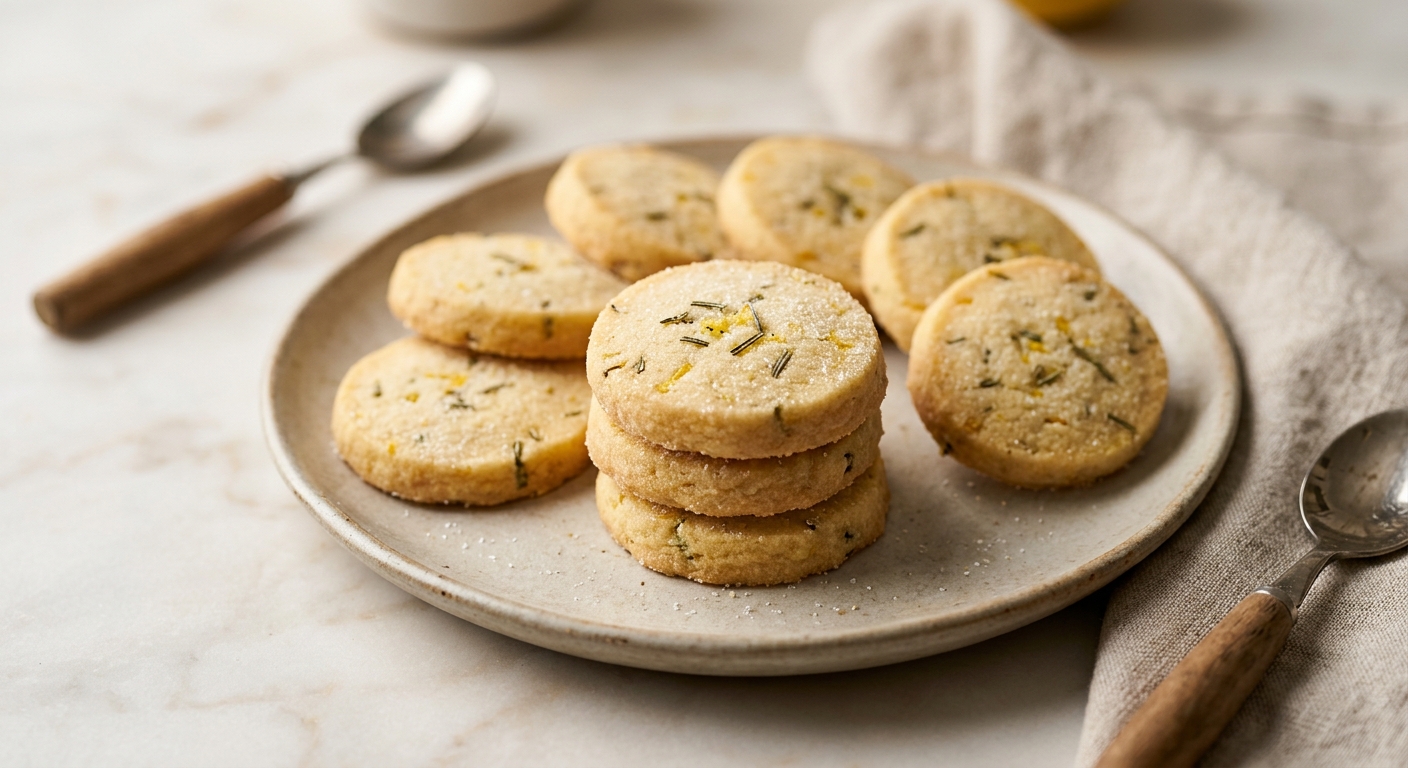
There’s a particular kind of magic that happens when you pair something deeply savory with something unmistakably sweet. These rosemary and lemon shortbread coins live right in that narrow, delightful gap. The moment you slice into the dough, the kitchen fills with the scent of fresh herbs and citrus zest, and you’ll find yourself wondering why you ever made plain shortbread at all. They’re thin, golden-edged, and satisfyingly crisp, the kind of cookie that begs to be eaten with a cup of Earl Grey or tucked into a gift tin for someone who deserves something genuinely thoughtful.
What sets this recipe apart is the technique of blooming the rosemary directly in the butter. Rather than simply stirring chopped herbs into the dough, you gently warm the butter with the rosemary first, letting the fat absorb those aromatic oils before it cools and gets creamed. This single extra step infuses every bite with a gentle, rounded herbal note that doesn’t taste sharp or overwhelming. The lemon zest goes in at the creaming stage so the sugar can work as a grater’s assistant, releasing even more citrus oil into the mixture. Together, they create a flavor that’s layered and intentional rather than an afterthought.
This recipe sits firmly in the easy category, requiring no special equipment beyond a hand mixer and a baking sheet. It is ideal for beginner bakers who want to make something that tastes impressive, or for experienced bakers looking for a reliable, scalable cookie they can dress up for any occasion. The slice-and-bake log format means you can keep the dough in your freezer and bake coins to order whenever the mood strikes.
Equipment Needed
Click on an item below to shop for the recommended items for this recipe on Amazon.
As an Amazon Associate, we earn from qualifying purchases.
30
Ingredients
- Extra Tenderness
- 230 gunsalted butter, cut into tablespoon pieces (1 cup / 2 sticks)
- 1.5 tbspfresh rosemary leaves, finely minced (from about 2 sprigs), plus 1 tsp extra for garnish if desired
- 100 gpowdered sugar, sifted (about 3/4 cup plus 1 tbsp)
- 2 tspfinely grated lemon zest (from 1 large lemon)
- 1 tsppure vanilla extract
- 240 gall-purpose flour, spooned and leveled (about 2 cups)
- 30 gcornstarch (about 3 tbsp)
- Rolling The Log (optional But Recommended)
- 0.5 tspColima Sea SaltMicroplastic Free Salt
- 2 tbspcoarse or turbinado sugar
Ingredient Substitutions
Instructions
- Bloom the rosemary butter: In a small saucepan over the lowest heat, melt 230g of butter with the minced rosemary. Stir gently and warm for 3 to 4 minutes, just until fragrant. Do not let it bubble or brown. Pour into a large mixing bowl and refrigerate until the butter is firm and fully solid again, about 45 minutes. It should feel like cool, creamy butter, not melted or greasy.
- Cream the butter and sugar: Once the rosemary butter is firm, beat it with a hand mixer on medium speed for 1 minute until just smooth. Add the sifted powdered sugar and lemon zest and beat on medium-high for 2 full minutes until pale and fluffy. The sugar will work with the zest to release the citrus oils. Add the vanilla extract and mix briefly to combine.
- Add the dry ingredients: Whisk together the flour, cornstarch, and salt in a separate bowl. Add the dry mixture to the butter in two additions, mixing on low speed until just combined after each addition. Stop as soon as no streaks of flour remain. The dough will look crumbly but will hold together when pressed between your fingers.
- Shape the log: Turn the dough out onto a lightly floured surface. Use your hands to press and roll it into a smooth log about 1.5 inches (4cm) in diameter and roughly 10 inches (25cm) long. Sprinkle the coarse sugar onto a piece of parchment and roll the log firmly so the sugar coats the outside evenly. Wrap tightly in parchment and refrigerate for at least 1 hour, or up to 3 days.
- Preheat and slice: When ready to bake, preheat your oven to 325°F (165°C). Line two baking sheets with parchment paper. Using a sharp chef’s knife, slice the chilled log into rounds about 1/3 inch (8mm) thick. If any rounds crack at the edges, simply press them back together gently. Arrange on the prepared baking sheets, spacing about 1 inch (2.5cm) apart.
- Bake and cool: Bake one sheet at a time on the center rack for 13 to 15 minutes, until the cookies are set and just barely golden at the edges. The centers will look pale and slightly underdone, but they firm up as they cool. Do not overbake. Let the cookies cool on the pan for 5 minutes before transferring to a wire rack to cool completely. They crisp up fully once cool.
- Prepare the dough following steps 1 through 4 of the oven method exactly. The same rosemary butter blooming, creaming, and log-forming process applies. Chill for at least 1 hour.
- Preheat your air fryer to 300°F (150°C) for 3 minutes. Cut a piece of parchment paper to fit your air fryer basket, leaving the edges slightly inside so air can still circulate around the sides.
- Slice the chilled log into rounds just under 1/3 inch (7 to 8mm) thick. Place 6 to 8 coins in the air fryer basket in a single layer, spacing them at least 1/2 inch (1cm) apart. Do not overlap. Because air fryers circulate hot air more aggressively, the cookies spread and brown faster, so use a lower temperature than the oven.
- Air fry for 8 to 10 minutes, checking at 8 minutes. The cookies should be very lightly golden at the edges with pale centers. They will feel soft when hot but crisp as they cool, so do not judge doneness by touch alone.
- Use a thin spatula to carefully transfer the cookies to a wire rack. They are fragile while warm. Let cool for at least 10 minutes before eating. Repeat with remaining dough in batches.
- Prepare the dough through step 4 of the oven method, forming and sugar-rolling the log as directed. Instead of refrigerating, wrap the parchment-wrapped log in a second layer of plastic wrap or place it inside a zip-top freezer bag. Label with the date and bake instructions. Freeze for at least 2 hours, or up to 3 months.
- When ready to bake, preheat your oven to 325°F (165°C) and line a baking sheet with parchment paper. Remove the log from the freezer and let it sit at room temperature for exactly 10 minutes. This prevents the log from cracking when sliced but keeps it firm enough to cut cleanly.
- Using a sharp, heavy chef’s knife, slice the log into rounds about 1/3 inch (8mm) thick using a single firm downward press rather than a sawing motion. A sawing motion on frozen dough can cause the coins to crumble. If any edges crack, press them back together with warm fingers.
- Arrange coins on the prepared baking sheet, spacing 1 inch apart. Bake straight from frozen on the center rack for 16 to 18 minutes, until the edges are just lightly golden. The extra 2 to 3 minutes compared to the refrigerator method accounts for the cold core of the frozen dough.
- Cool on the pan for 5 minutes, then transfer to a wire rack. Once fully cool, the texture will be identical to fresh-baked. Store any baked cookies in an airtight container at room temperature.
Nutrition Per Serving
Per 1 serving (makes about 30 coins from one slice-and-bake log)
Why This Recipe Works
Shortbread is one of the purest expressions of butter in baking, and that simplicity is exactly what makes technique so important here. The high fat-to-flour ratio (almost 1:1 by weight) means there is very little water in the dough and almost no gluten development, which is precisely why shortbread is so tender and crisp rather than chewy. The addition of cornstarch interrupts the flour’s gluten network even further, producing that signature sandy, melt-on-the-tongue crumb. Using powdered sugar instead of granulated sugar reinforces this effect: the fine particles dissolve instantly and don’t encourage the gluten structure that larger sugar crystals can create when they retain moisture during mixing.
Blooming the rosemary in warm butter is the heart of this recipe’s flavor. Rosemary’s aromatic compounds, primarily pinene and camphor, are fat-soluble, meaning they release far more effectively into butter than they would into water or a dry dough. By gently warming the butter with the herb, you essentially make an infused fat that carries flavor throughout every single crumb. The lemon zest works on a similar principle: rubbing zest into sugar (or in this case, adding it at the creaming stage where mechanical action and contact with sugar does the same job) ruptures the tiny oil glands in the zest, releasing limonene, the bright citrus compound, more fully than simply stirring in zest ever could.
Chilling the log before slicing is non-negotiable for clean, even coins. Warm shortbread dough is soft and will squash under the knife, giving you uneven thickness and ragged edges. Cold dough holds its shape perfectly. If your coins crack during slicing, the dough is either too cold (straight from freezer without resting) or the knife is not sharp enough. A 10-minute rest and a firm, decisive downward press with a sharp blade solves both problems. Baking at 325°F rather than a higher temperature is also deliberate: shortbread needs gentle, even heat to dry out and crisp without browning too quickly, which would make it taste toasted rather than buttery.
Baker’s Tips
- Use the best butter you can find. Because shortbread has so few ingredients, the quality of the butter is front and center in every bite. A European-style butter with higher fat content (83% or above) will give you an even richer, more tender result.
- Mince the rosemary very finely. Large pieces of rosemary in a delicate cookie can feel piney and harsh. Aim for pieces no larger than 1mm. A sharp knife and a little patience here pays off in every bite.
- Don’t overmix once the flour is added. Overworking shortbread dough develops gluten, which leads to a tough, hard cookie rather than a tender, crumbly one. Mix only until the flour just disappears.
- Roll the log on the parchment before wrapping it, not on a floured surface, to keep the coarse sugar coating intact and even.
- A sharp knife is more important than a strong one. Use your sharpest chef’s knife and slice with a single, firm downward press. Sawing back and forth drags the dough and distorts the shape.
- Let the cookies cool completely before storing them. Even slightly warm shortbread will steam and soften in an airtight container, losing that prized crispness.
Variations
- Lavender and Lemon: Substitute 1 tsp of finely crushed culinary dried lavender for the rosemary. Do not bloom dried lavender in warm butter as long, just 1 to 2 minutes, as its flavor intensifies quickly.
- Orange and Thyme: Replace lemon zest with orange zest and use fresh thyme in place of rosemary. Roll the log in poppy seeds instead of coarse sugar for a beautiful, bakery-style finish.
- Chocolate-Dipped: Once fully cooled, dip each coin halfway into melted dark or white chocolate. Place on a parchment-lined sheet and let set at room temperature. The bitterness of dark chocolate is especially good with the rosemary.
- Iced Shortbread Coins: Mix 80g powdered sugar with 1 to 2 tsp fresh lemon juice to make a thick glaze. Drizzle over cooled cookies and top with a tiny sprig of fresh rosemary or a small curl of lemon zest before it sets.
Troubleshooting & FAQ
My shortbread came out tough and hard, not tender and crumbly. What went wrong?
My cookies spread and went flat in the oven. What happened?
The rosemary flavor is too strong and almost medicinal. How do I fix this?
My log crumbles and falls apart when I try to slice it. What do I do?
The cookies look pale and underdone but the edges are already getting brown. Is that right?
Storage & Make-Ahead
- Storage: Store baked cookies in an airtight container at room temperature for up to 10 days. They actually improve slightly on day 2 as the flavors meld. For longer storage, freeze baked cookies in a single layer, then transfer to a freezer bag for up to 2 months. Thaw at room temperature for 20 minutes.
- Make-Ahead: The dough log can be refrigerated for up to 3 days or frozen for up to 3 months (see the Freezer-to-Oven method above). Baked cookies store well at room temperature for up to 10 days, making them ideal for gifting or preparing ahead for a party.