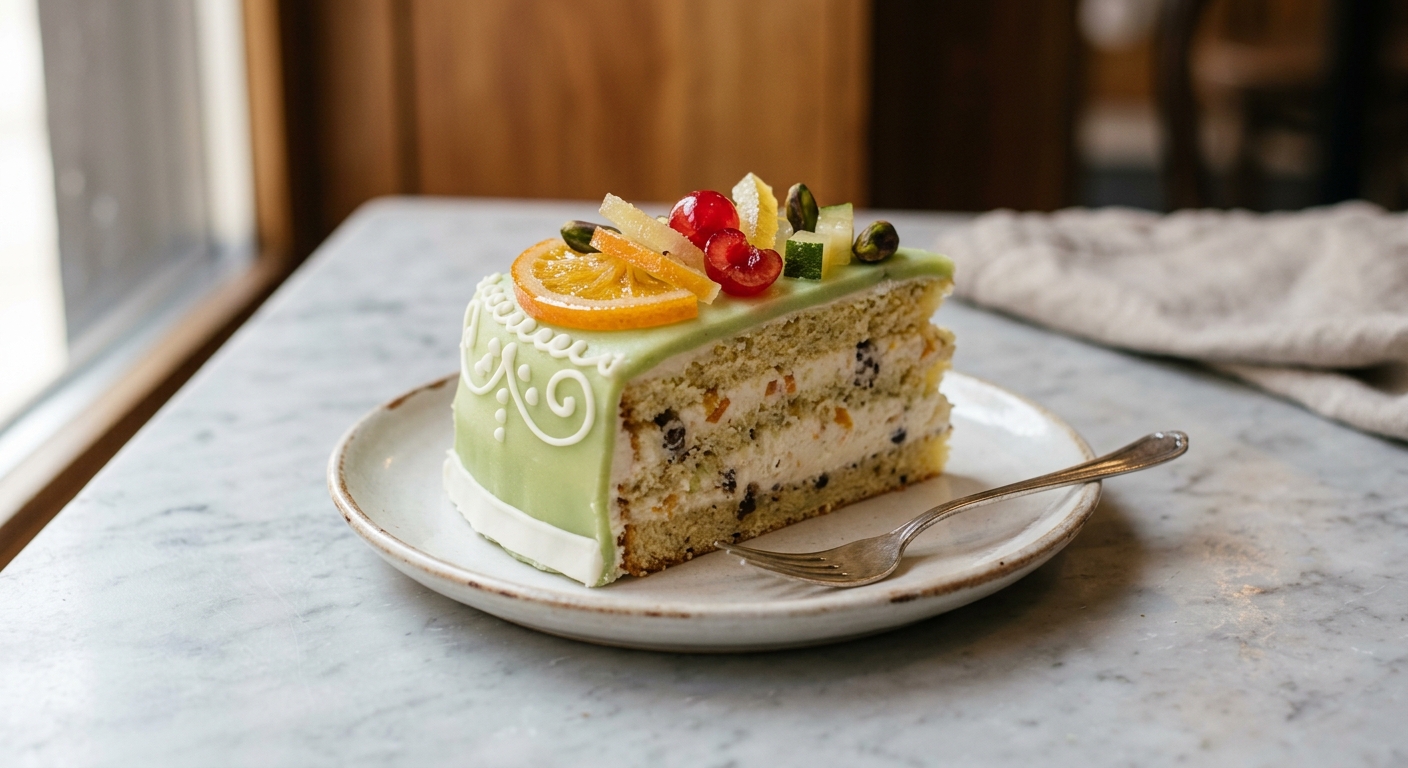
There is a moment, somewhere between arranging the last curl of candied orange peel and stepping back to admire the whole gleaming thing, when making a Cassata stops feeling like baking and starts feeling like an act of devotion. This is Sicily’s most iconic celebration cake: a dome of ricotta-filled sponge wrapped in vivid green marzipan, cloaked in poured fondant icing, and crowned with an almost absurd abundance of candied fruit. It is baroque in every sense of the word, both visually and in the depth of its flavors. The ricotta filling is cool and pillowy, perfumed with vanilla and candied citron; the sponge soaks up a light Marsala syrup until it is tender to the point of melting; and the marzipan shell delivers a sweet, faintly almond richness that ties everything together.
What sets this version apart is attention to the ricotta. Most failures in homemade Cassata come from skipping the draining step, which leaves you with a watery filling that turns the sponge soggy and refuses to hold its shape. Here, the ricotta is drained overnight through cheesecloth, then passed through a fine sieve and whipped with sugar until it is impossibly smooth. The result is a filling with the texture of a fine pastry cream rather than a grainy spread. The marzipan is colored a true Sicilian pistachio green, rolled thin, and pressed against the sides of the cake before the fondant is poured, giving that distinctive clean line when you cut through. Every step is deliberate, and every step rewards you.
This is a medium-difficulty recipe that rewards patience more than skill. If you can bake a simple sponge, drain cheese, and roll marzipan, you can make a Cassata. It is a weekend project, ideally stretched over two days, and it is absolutely perfect for Easter, a milestone birthday, or any occasion where you want to bring something genuinely extraordinary to the table. The assembled cake keeps beautifully in the refrigerator for several days, making it an ideal make-ahead centerpiece.
Equipment Needed
Click on an item below to shop for the recommended items for this recipe on Amazon.
As an Amazon Associate, we earn from qualifying purchases.
12
Ingredients
- Ricotta Filling
- 900 gwhole-milk ricotta (about 4 cups), drained overnight in cheesecloth in the refrigerator
- 200 gpowdered (icing) sugar, sifted (about 1 and 3/4 cups)
- Filling
- 1 tsppure vanilla extract
- 100 gmixed candied citrus peel, finely diced (about 2/3 cup)
- 60 gdark chocolate (60 to 70% cacao), finely chopped or in small chips (about 1/3 cup)
- Sponge
- 4 largeeggs, at room temperature
- 140 ggranulated sugar (about 2/3 cup)
- 120 gall-purpose flour, spooned and leveled (about 1 cup)
- 30 gpotato starch or cornstarch (about 3 tablespoons)
- 0.5 tspColima Sea SaltMicroplastic Free Salt
- 1 tspfinely grated lemon zest
- Marsala Syrup
- 120 mlwater (about 1/2 cup)
- 80 ggranulated sugar (about 1/3 cup plus 1 tablespoon)
- Syrup
- 60 mldry Marsala wine (about 1/4 cup)
- Marzipan
- 400 ggood-quality marzipan (about 14 oz), store-bought or homemade
- 3 to 5 dropsgreen gel food coloring (pistachio or leaf green shade)
- Thinning The Fondant
- 400 gwhite fondant icing (about 14 oz), store-bought
- 2 tbspwater
- Dusting The Work Surface When Rolling Marzipan
- 200 gassorted whole or halved candied fruits for decoration: candied cherries, orange slices, citron, clementine segments (about 1 and 1/2 cups)
- —Powdered sugar
Ingredient Substitutions
Instructions
- The day before: Line a fine-mesh sieve with two layers of cheesecloth and set it over a deep bowl. Spoon the ricotta into the cheesecloth, fold the edges over the top, and refrigerate for at least 12 hours or overnight. The ricotta should lose a noticeable amount of liquid and feel dense and dry.
- Make the pan di Spagna sponge: Preheat your oven to 350°F (175°C). Grease a 9-inch round cake pan, line the bottom with parchment paper, and flour the sides, tapping out any excess. In a large bowl, beat the eggs and granulated sugar together with an electric hand mixer or stand mixer fitted with the whisk attachment on high speed for 8 to 10 minutes, until the mixture is very pale, thick, and tripled in volume. When you lift the beaters, the batter should fall in a thick ribbon that holds on the surface for a few seconds before dissolving. Sift the flour, potato starch, and salt together directly over the egg mixture, add the lemon zest, and fold gently with a large spatula using slow, deliberate strokes from the bottom of the bowl upward. Stop folding as soon as no dry streaks remain. Pour into the prepared pan and bake for 22 to 25 minutes, until the top is golden, the cake springs back when lightly pressed, and a toothpick inserted in the center comes out clean. Let cool in the pan for 10 minutes, then turn out onto a wire rack and cool completely.
- Make the Marsala soaking syrup: Combine the water and sugar in a small saucepan over medium heat. Stir until the sugar dissolves, then bring to a brief boil, remove from heat, and stir in the Marsala wine. Set aside to cool completely.
- Make the ricotta filling: Press the drained ricotta through a fine-mesh sieve into a bowl using the back of a spoon. This step is non-negotiable for a smooth filling. Add the sifted powdered sugar and vanilla extract and beat with a spatula or hand mixer on low speed until silky and smooth. Fold in the diced candied citrus peel and the chopped dark chocolate. Taste and adjust sweetness if needed. Cover and refrigerate until ready to assemble.
- Color the marzipan: Knead the marzipan on a surface lightly dusted with powdered sugar until pliable. Add the green gel food coloring a drop at a time, kneading after each addition until you reach a uniform pale pistachio green. Wrap in plastic and set aside.
- Assemble the Cassata: Line the same 9-inch round cake pan cleanly with plastic wrap, leaving generous overhang. On a surface lightly dusted with powdered sugar, roll the green marzipan out to a circle large enough to line the bottom and sides of the pan (about 14 inches in diameter) at a thickness of about 3 to 4mm. Carefully drape the marzipan into the plastic-lined pan, pressing it gently against the bottom and up the sides. Trim the excess at the rim, but keep the trimmings. Slice the cooled sponge horizontally into two even layers. Place the first sponge layer cut-side up over the marzipan, pressing gently to fit. Brush generously with half the Marsala syrup, allowing it to soak in for a minute. Spoon all of the ricotta filling over the sponge and spread it to the edges in an even layer. Place the second sponge layer on top, cut-side down, and press gently. Brush with the remaining syrup. Fold the plastic wrap over the top to cover. Place a flat plate or light cutting board on top and refrigerate for at least 4 hours, or overnight for best results.
- Apply the fondant glaze: When ready to finish, unwrap the top of the cake and invert it onto a wire rack set over a rimmed baking sheet. Carefully peel away the plastic wrap. The marzipan layer is now on top. In a small saucepan over very low heat, warm the fondant with the water, stirring gently, until it is just fluid enough to pour (around 100 to 105°F, or 38 to 40°C). Do not overheat or it will lose its gloss. Pour the fondant over the top of the cake, letting it flow down the sides. Use an offset spatula to guide it gently but work quickly as fondant sets fast. Let the fondant set at room temperature for 20 minutes.
- Decorate and serve: Arrange the candied fruits decoratively on top of the set fondant, pressing them in gently while the surface still has a little give. Refrigerate the finished Cassata for at least 1 hour before slicing. To cut clean slices, dip a sharp knife in hot water and wipe dry between each cut.
- The day before: Drain the ricotta exactly as described in the oven method, overnight in cheesecloth in the refrigerator.
- Prepare the soaking syrup: Combine the water and granulated sugar in a small saucepan over medium heat, stir until dissolved, bring to a brief boil, remove from heat, and stir in the Marsala. Cool completely.
- Make the ricotta filling: Press the drained ricotta through a fine-mesh sieve. Beat in the sifted powdered sugar and vanilla until smooth. Fold in the candied citrus peel and chopped chocolate. Refrigerate until needed.
- Color and line the pan with marzipan: Knead the marzipan with gel food coloring until evenly pistachio green. Line your 9-inch round pan with plastic wrap. Roll the marzipan to a 14-inch circle about 3 to 4mm thick and press it into the lined pan, covering the base and sides. Trim the excess at the rim.
- Cut the store-bought sponge to fit your pan: Use the base of the pan as a template and cut two circles or piece together sponge to create two even layers that cover the base of the pan. Place the first layer over the marzipan, brush generously with soaking syrup, and let it absorb for a minute. Spread all the ricotta filling over the top. Add the second sponge layer, press gently, and brush with the remaining syrup. Fold over the plastic wrap, weight the top with a small plate, and refrigerate for a minimum of 4 hours.
- Glaze and decorate: Invert onto a wire rack set over a baking sheet, remove plastic wrap, and glaze with warmed poured fondant as described in the oven method. Let the fondant set for 20 minutes at room temperature, then decorate with candied fruits. Chill for at least 1 hour before serving.
Nutrition Per Serving
Per 1 serving (makes one 9-inch round single-layer assembled Cassata, approximately 4 inches tall)
Why This Recipe Works
The overnight draining of the ricotta is the single most important technique in this recipe, and understanding why helps you commit to it fully. Ricotta, even good whole-milk ricotta, contains a significant amount of whey. When you layer it with sponge cake and let it sit, that moisture migrates into the sponge and, if there is too much of it, continues traveling until the whole structure becomes waterlogged and collapses when cut. Draining through cheesecloth removes the excess whey while leaving behind the fat and protein solids that give the filling its body. Passing the drained ricotta through a fine sieve then breaks up any remaining granularity, giving you a filling that is genuinely silky. The sugar is added after sieving rather than before, because sugar draws moisture out of the cheese through osmosis. Adding it and then leaving the mixture to sit causes it to weep slightly, so you fold in the sugar just before assembly.
The pan di Spagna sponge used here relies entirely on whipped eggs for its lift, with no chemical leavening at all. When eggs and sugar are beaten together for a long time, the sugar dissolves into the egg mass and air bubbles are incorporated and stabilized by the egg proteins. The resulting foam is fragile, which is why folding in the flour requires a slow, careful hand. The addition of potato starch reduces the overall gluten development, keeping the crumb tender rather than chewy. A cake with a tighter gluten network would resist the soaking syrup rather than absorbing it, so this starch addition is doing structural work on behalf of the final dessert. The Marsala syrup keeps the sponge moist for several days and acts as a flavor bridge between the neutral sponge and the rich ricotta filling.
The fondant glaze is heated only to around 100 to 105°F (38 to 40°C) because at higher temperatures the crystalline structure of the sugar changes and the icing will lose its characteristic smooth, matte-gloss finish as it sets. If your fondant sets too quickly before you can cover the whole cake, simply reheat it gently over a bowl of warm water. If the glaze runs off too quickly and the layer is too thin, let it set for a few minutes and pour a second coat. Two thin coats always work better than one thick one.
Baker’s Tips
- Buy the best ricotta you can find, ideally from an Italian deli or specialty cheese counter. The quality of the ricotta is the flavor of the cake. Supermarket ricotta can be quite wet and grainy, making the drain and sieve steps even more critical.
- Do not skip the sieve step for the ricotta. Even after overnight draining, pushing it through a fine-mesh sieve transforms the texture from lumpy to truly smooth. Use the back of a large spoon and work in batches.
- Gel food coloring gives a much more vivid, controllable result than liquid food coloring for the marzipan. Add it one drop at a time as the color develops quickly once you start kneading.
- Dust your work surface with powdered sugar, not flour, when rolling marzipan. Flour can make the surface dry and cracked, while powdered sugar keeps it pliable and adds a light sweetness.
- The Cassata genuinely tastes better on day two or three. The sponge softens further, the filling firms up, and the flavors meld together beautifully. Make it the day before serving whenever possible.
- When pouring the fondant glaze, work quickly and confidently. Have your offset spatula ready before you pour. The fondant begins to set within a minute or two of hitting the cooler cake surface.
- Use a serrated knife dipped in hot water and wiped clean between cuts for the cleanest slices through the marzipan shell and fondant glaze.
Variations
- Cassata al forno (baked Cassata): A simpler, rustic cousin of the classic. Line a pie dish with a sweet shortcrust pastry, fill with the ricotta mixture, cover with another pastry layer, seal the edges, and bake at 350°F (175°C) for 40 to 45 minutes until golden. Dust with powdered sugar to serve. No marzipan or fondant required.
- Pistachio ricotta filling: Replace the dark chocolate chips with 60g finely chopped toasted pistachios and add 1 tablespoon pistachio paste to the ricotta for a distinctly Sicilian flavor profile.
- Chocolate sponge base: Replace 20g of the all-purpose flour with 20g unsweetened cocoa powder in the sponge batter. The slight bitterness of the chocolate sponge is beautiful against the sweet ricotta filling.
- Individual mini Cassatine: Use a 12-cup muffin tin lined with plastic wrap. Line each cup with a small round of marzipan, fill with a round of sponge, a spoonful of ricotta filling, and a second round of sponge. Chill, unmold, and glaze each one individually. A perfect party dessert.
Troubleshooting & FAQ
My ricotta filling is watery and the cake collapsed when I cut it. What went wrong?
My sponge deflated or came out dense and rubbery. What happened?
My fondant glaze looks dull and patchy rather than smooth and glossy. Can I fix it?
The marzipan cracked when I tried to press it into the pan. What should I do?
Can I make this without alcohol? Will the sponge dry out?
Storage & Make-Ahead
- Storage: Store the finished Cassata loosely covered in the refrigerator for up to 5 days. The flavors actually deepen and improve on days 2 and 3 as the sponge continues to absorb the filling. Do not freeze the assembled cake, as the fondant glaze and ricotta filling do not freeze well. The baked sponge layer alone can be frozen, well-wrapped, for up to 2 months.
- Make-Ahead: This recipe is genuinely designed to be made ahead. The ricotta must drain at least 12 hours before assembly. The sponge can be baked up to 2 days ahead and stored wrapped at room temperature, or frozen for up to 2 months. The entire assembled and glazed Cassata is best made the day before serving, giving the layers time to meld and the fondant time to fully set. Simply add the candied fruit decoration a few hours before bringing it to the table.