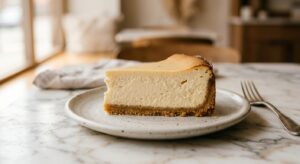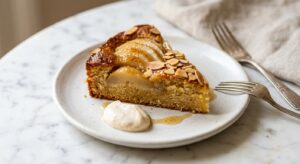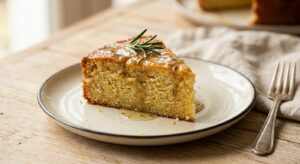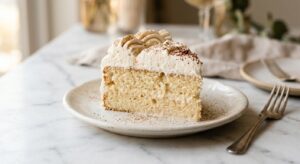
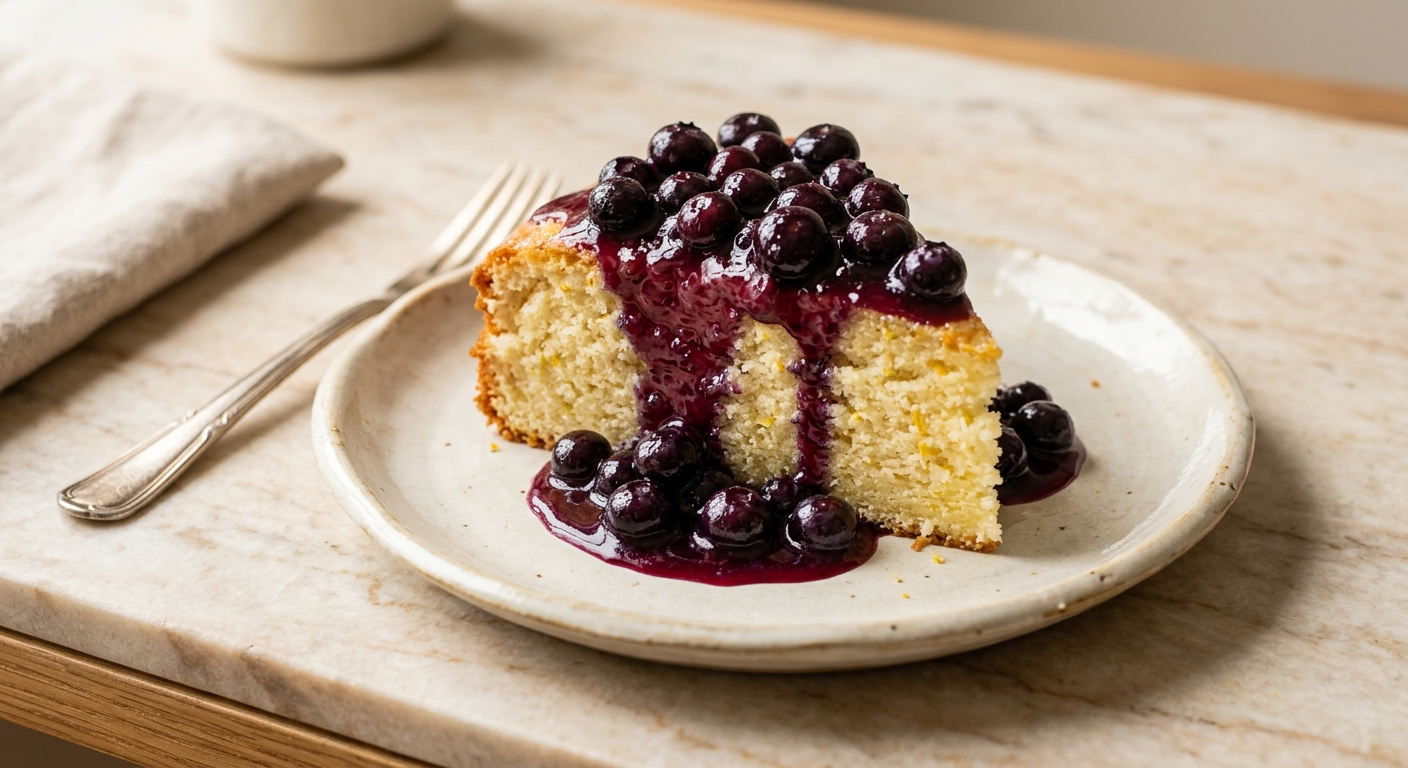
There is a particular kind of cake that does not announce itself loudly, but quietly wins over every single person who tastes it. This ricotta and lemon cake is exactly that. The moment you slice into it, you are greeted with a crumb so tender it almost sighs, pale and golden, with the faint perfume of lemon zest drifting up to meet you. Then comes the glaze: a deep violet cascade of blueberries cooked down with a little honey and lemon juice until they collapse into something thick, glossy, and genuinely beautiful. It is simple food made with care, and it tastes like it.
What sets this cake apart from a standard sponge is the full-fat ricotta folded into the batter. Ricotta acts as both a fat and a moisture source, its fine curds melting into the crumb during baking to create a texture that sits somewhere between a classic butter cake and a cheesecake. There is no dryness here, even on day two. The lemon does double duty as well: the zest is rubbed directly into the sugar before mixing, releasing the essential oils and infusing every bite with bright citrus flavor, while a splash of fresh juice in the glaze keeps the sweetness balanced and alive.
This recipe sits firmly in the easy-to-medium range of difficulty. If you can use a hand mixer and zest a lemon, you can make this cake. It is ideal for brunch gatherings, spring and summer celebrations, or any afternoon when you want something genuinely impressive without a complicated project. No special equipment is required beyond a standard loaf or springform pan, and the glaze takes less than ten minutes to prepare.
Equipment Needed
Click on an item below to shop for the recommended items for this recipe on Amazon.
As an Amazon Associate, we earn from qualifying purchases.
10
Ingredients
- 250 gfull-fat ricotta cheese, drained if very wet (about 1 cup plus 2 tbsp)
- 200 ggranulated white sugar (about 1 cup)
- 2 large lemons, zested (about 2 tightly packed tbsp zest), plus 3 tbsp fresh lemon juice reserved for the glaze
- 3 large eggs, at room temperature
- 120 mlAvocado Oil100% Pure Avocado Oil (about 1/2 cup)
- 1 tsppure vanilla extract
- 210 gall-purpose flour (about 1 3/4 cups, spooned and leveled)
- 2 tspbaking powder
- 0.5 tspColima Sea SaltMicroplastic Free Salt
- —— Blueberry Glaze —
- 250 gfresh or frozen blueberries (about 2 cups)
- 2 tbsphoney or pure maple syrup
- 3 tbspfresh lemon juice (from the reserved lemons above)
- 1 tspcornstarch mixed with 1 tsp cold water (slurry)
- —Pinch of Colima Sea SaltMicroplastic Free Salt
Ingredient Substitutions
Instructions
- Preheat your oven to 350°F (175°C). Grease a 9-inch round springform pan or a 9×5-inch loaf pan with butter or cooking spray, then line the bottom with parchment paper. If using a standard round cake pan, also line the sides.
- Place the granulated sugar and lemon zest in a large mixing bowl. Using your fingertips, rub the zest into the sugar for about 1 minute until the mixture is fragrant and slightly damp. This releases the lemon’s essential oils directly into the sugar, perfuming the entire batter.
- Add the ricotta, eggs, oil, and vanilla extract to the lemon sugar. Beat with a hand mixer on medium speed for about 90 seconds until the mixture is smooth, pale, and slightly increased in volume. A few small ricotta specks are perfectly fine.
- Sift the flour, baking powder, and salt directly over the wet ingredients. Using a rubber spatula, fold gently until just combined. Stop as soon as no dry streaks remain. Do not overmix; a few small lumps are better than a tough cake.
- Pour the batter into the prepared pan and smooth the top with an offset spatula or the back of a spoon. Bake in the center of the oven for 50 to 58 minutes for a round pan, or 55 to 65 minutes for a loaf pan. The cake is done when the top is deep golden, the edges have pulled slightly from the sides, and a skewer inserted in the center comes out clean or with just a few moist crumbs.
- Cool in the pan on a wire rack for 15 minutes, then release the springform or carefully invert and re-right the cake onto the rack. Allow to cool for at least 15 more minutes before glazing (the glaze sets better on a warm but not hot cake).
- While the cake cools, make the blueberry glaze. Combine the blueberries, honey, lemon juice, and pinch of salt in a small saucepan over medium heat. Cook, stirring occasionally, for 5 to 6 minutes until the berries burst and the mixture is bubbling and saucy. Stir in the cornstarch slurry and cook for 1 more minute until the glaze thickens and turns glossy. Remove from heat.
- Spoon the warm blueberry glaze over the top of the cake, allowing it to cascade naturally down the sides. The glaze will continue to set as it cools. Serve at room temperature, with extra glaze spooned alongside if desired.
- Line the insert of a 6-quart slow cooker with a large sheet of parchment paper, pressing it up the sides and leaving an overhang for lifting. Lightly grease the parchment with cooking spray.
- Prepare the batter exactly as described in Steps 2 through 4 of the oven method: rub zest into sugar, beat in ricotta, eggs, oil, and vanilla, then fold in the sifted dry ingredients until just combined.
- Pour the batter into the lined slow cooker and smooth the top. Place a double layer of paper towels under the lid before closing it tightly. The paper towels absorb condensation and prevent water from dripping back onto the cake, which would make the top wet and gummy.
- Cook on High for 2 hours to 2 hours 30 minutes. The cake is done when the edges are set and pulling away from the sides, the center feels firm (not wobbly) when gently pressed, and a skewer inserted in the thickest part comes out clean. Do not lift the lid during the first 90 minutes.
- Turn off the slow cooker and lift the cake out using the parchment overhang. Transfer to a wire rack and cool for 20 minutes. Make the blueberry glaze on the stovetop as described in Step 7 of the oven method, then spoon it generously over the top of the cooled cake.
- Grease a 7-inch round cake pan or springform pan and line the bottom with parchment paper. Prepare the batter exactly as described in Steps 2 through 4 of the oven method. Pour the batter into the prepared pan and smooth the top.
- Preheat your air fryer to 320°F (160°C) for 3 minutes. Place the pan in the basket and bake for 40 to 45 minutes. Check the cake at 35 minutes: if the top is browning too quickly, place a small square of foil loosely over the top for the remaining time.
- The cake is done when a skewer inserted in the center comes out clean or with a few moist crumbs. Because air fryers vary significantly in power, begin checking at 38 minutes. Do not open the drawer before this point.
- Remove the pan carefully using tongs or oven mitts and set on a wire rack. Cool in the pan for 15 minutes before releasing or unmolding. Make the blueberry glaze on the stovetop as described in Step 7 of the oven method and spoon over the warm cake.
Nutrition Per Serving
Per 1 serving (makes one 9-inch round cake or one 9×5-inch loaf)
Why This Recipe Works
The magic of this cake lies almost entirely in the ricotta. Full-fat ricotta is made from whey and has a high moisture content along with a fine, granular protein structure. When folded into the batter, those tiny curds distribute fat and water evenly throughout the crumb. During baking, the proteins set gently around the flour matrix while the fat keeps the gluten strands from bonding too tightly, resulting in a crumb that is tender and moist rather than chewy or dry. This is the same principle behind adding sour cream or cream cheese to cakes: more fat and more moisture, with dairy proteins that are gentler on gluten development than additional eggs or oil alone would be.
Rubbing the lemon zest into the sugar before mixing is a small step with a significant impact. Lemon zest contains limonene and other volatile aromatic compounds stored inside the cells of the peel. Mechanical abrasion against the sugar crystals ruptures those cells, releasing the oils and binding them to the sugar. Because sugar is hygroscopic and lipophilic, it holds onto these aromatics far better than simply stirring the zest into batter would, ensuring the lemon flavor is pronounced and evenly distributed rather than faint or spotty.
The cornstarch slurry in the blueberry glaze is a precise tool. Cornstarch granules absorb liquid and swell when heated above roughly 185°F (85°C), forming a gel network that thickens the sauce without cloudiness or a starchy taste (as long as it is cooked for at least one full minute after adding). If your glaze is too thin, simmer it an extra minute. If it thickens too much on cooling, whisk in a teaspoon of warm water to loosen it. The lemon juice keeps the berry color vibrant by maintaining an acidic environment, which stabilizes the anthocyanin pigments that give blueberries their deep blue-purple hue.
Baker’s Tips
- Drain your ricotta if it seems very wet. Spoon it into a fine mesh sieve set over a bowl and let it drain for 20 minutes before using. Excess moisture can make the batter too loose and the cake gummy in the center.
- Bring eggs to room temperature before mixing. Cold eggs can cause the batter to look slightly curdled or lumpy. If you forgot, place them in a bowl of warm water for 10 minutes.
- Measure flour by spooning it into the measuring cup and leveling off with a knife, or better yet, use a kitchen scale. Scooping directly from the bag can pack in up to 30% more flour, making the cake dry and dense.
- Do not skip the parchment paper on the bottom of the pan. Ricotta cakes are moist and tender and can stick. The parchment guarantees a clean release every time.
- The glaze is best applied when the cake is warm but not hot. A warm surface helps the glaze adhere and pool attractively without running off immediately. If the cake is fully cooled, the glaze will sit more on top rather than seeping in slightly at the edges, which is also beautiful.
- For the cleanest slices, use a sharp thin-bladed knife dipped in hot water and wiped clean between each cut.
Variations
- Orange and ricotta: Replace the lemon zest and juice with the same quantities of fresh orange zest and juice. Add 1/2 tsp of ground cardamom to the dry ingredients for a fragrant twist.
- Chocolate chip and lemon: Fold 80g (1/2 cup) of mini dark chocolate chips into the batter just before pouring into the pan. Omit the blueberry glaze and dust with powdered sugar instead.
- Raspberry glaze: Replace blueberries with fresh or frozen raspberries and use maple syrup instead of honey. Press the cooked mixture through a fine mesh sieve for a smooth, jewel-red sauce.
- Poppy seed version: Add 2 tablespoons of poppy seeds to the dry ingredients for a classic lemon-poppy flavor with added texture.
Troubleshooting & FAQ
My cake is still wet or gummy in the center even though it looked done on top. What happened?
My blueberry glaze turned out too thin and watery. How do I fix it?
The cake cracked deeply across the top. Is something wrong?
Why does my cake taste bland or only mildly lemony?
The cake stuck to the pan and broke when I tried to remove it. How do I prevent this?
Storage & Make-Ahead
- Storage: Store the glazed cake loosely covered in the refrigerator for up to 5 days. Bring to room temperature for 20 to 30 minutes before serving for the best texture. The unglazed cake can be stored at room temperature, well wrapped, for up to 2 days. Extra blueberry glaze keeps in a sealed jar in the refrigerator for up to 1 week.
- Make-Ahead: The unglazed cake can be baked up to 2 days ahead and stored wrapped at room temperature, or frozen (unglazed and well wrapped) for up to 2 months. Thaw overnight in the refrigerator. The blueberry glaze can be made up to 5 days ahead and refrigerated; gently rewarm it in a small saucepan over low heat, stirring until pourable, before using.