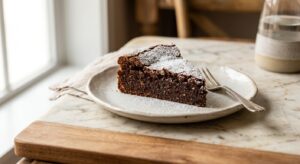
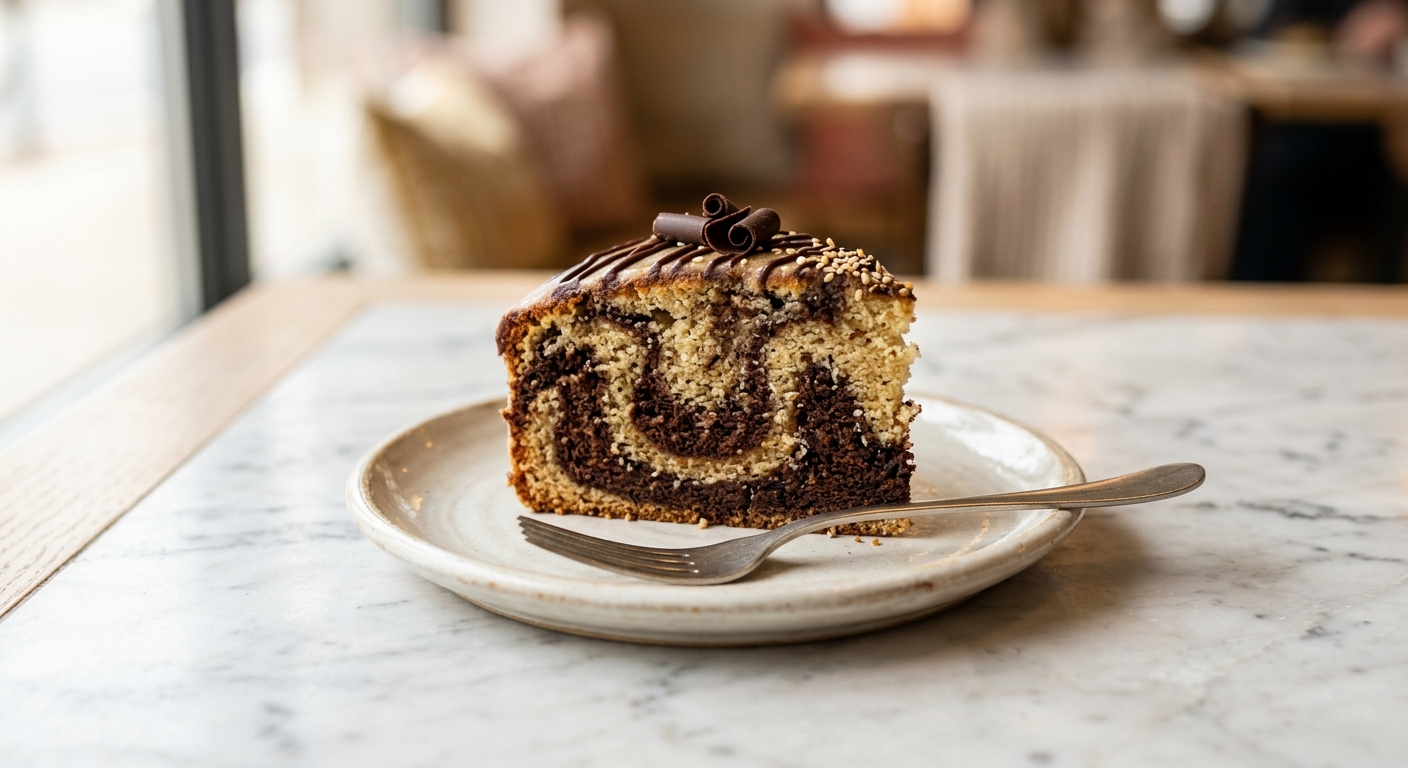
There is something almost meditative about swirling two batters together in a loaf pan, watching ribbons of chocolate curl through pale, creamy tahini batter before the oven transforms them into something extraordinary. This cake fills your kitchen with the warm, toasty scent of sesame and dark chocolate, a pairing that feels both unexpected and completely inevitable. When you pull it from the oven and slice through that dramatic marbled interior, the contrast of ivory and deep brown is genuinely breathtaking.
What sets this version apart is the tahini itself, used generously enough that you can actually taste it. Rather than a faint nuttiness, you get a real sesame backbone, slightly bitter and earthy, that balances the sweetness of the cake and makes the dark chocolate swirl sing. The chocolate portion is made with both cocoa powder and a small amount of melted dark chocolate, which gives it a richer, glossier color and a more complex flavor than cocoa alone. A touch of tahini is also folded into the chocolate batter so the two halves feel like they belong together rather than competing.
This is a medium-difficulty bake that any confident home baker can tackle on a weekend afternoon. It looks like it came from a bakery, but the technique is straightforward once you understand the swirling method. It is perfect for anyone who loves desserts that are a little more grown-up, a little less sweet, and a lot more interesting.
Equipment Needed
Click on an item below to shop for the recommended items for this recipe on Amazon.
As an Amazon Associate, we earn from qualifying purchases.
10
Ingredients
- Loosening The Chocolate Batter
- 240 gall-purpose flour (about 1 3/4 cups, spooned and leveled)
- 1.5 tspbaking powder
- 0.5 tspbaking soda
- 0.5 tspColima Sea SaltMicroplastic Free Salt
- 150 ggranulated sugar (about 3/4 cup)
- 80 glight brown sugar, packed (about 6 tbsp)
- 160 gwell-stirred tahini (about 2/3 cup), at room temperature
- 115 gunsalted butter (1/2 cup or 1 stick), melted and cooled slightly
- 3 largeeggs, at room temperature
- 240 mlwhole milk (1 cup), at room temperature
- 2 tsppure vanilla extract
- 30 gDutch-process cocoa powder (about 1/4 cup), sifted
- 60 gdark chocolate (70% cacao), finely chopped and melted
- 2 tbspwhole milk, warm
- Finishing (optional But Recommended)
- 1 tbsptahini (stirred into the chocolate batter)
- —Colima Sea SaltMicroplastic Free Salt
- Topping (optional)
- —1 tbsp sesame seeds
Ingredient Substitutions
Instructions
- Preheat your oven to 350°F (175°C). Grease a 9×5-inch loaf pan generously with butter or nonstick spray, then line it lengthwise with a strip of parchment paper, leaving an overhang on both long sides. This sling makes unmolding effortless.
- Whisk together the flour, baking powder, baking soda, and fine sea salt in a medium bowl. Set aside.
- In a large bowl, whisk the granulated sugar, brown sugar, tahini, and melted cooled butter together until smooth and well combined, about 1 minute. Add the eggs one at a time, whisking well after each addition. Whisk in the vanilla extract.
- Add the flour mixture in three additions, alternating with the milk in two additions (flour, milk, flour, milk, flour), folding gently with a rubber spatula after each addition just until no dry streaks remain. Do not overmix. The batter will be smooth and slightly thick.
- Transfer roughly two-thirds of the batter (about 520g) to a separate bowl and set aside as the tahini batter. To the remaining one-third of the batter still in the original bowl, add the sifted cocoa powder, melted dark chocolate, the extra tablespoon of tahini, and the 2 tablespoons of warm milk. Fold until fully combined and glossy. The chocolate batter should be slightly thicker but still pourable.
- Spoon alternating dollops of tahini batter and chocolate batter into the prepared pan, layering them loosely. Do not flatten or spread. Once all the batter is in the pan, use a skewer or butter knife to drag through the batter in long, lazy S-curves from one end of the pan to the other. Rotate the pan 90 degrees and repeat once more. Two to three passes are enough; over-swirling will muddy the two batters together.
- Scatter sesame seeds and a pinch of flaky sea salt over the top if using. Bake for 50 to 58 minutes, until a toothpick inserted into the center comes out with just a few moist crumbs and the top is deeply golden and springs back when lightly pressed. If the top browns too quickly, tent loosely with foil after 35 minutes.
- Cool in the pan on a wire rack for 20 minutes, then use the parchment sling to lift the cake out. Allow to cool completely on the rack before slicing, at least 45 minutes. The flavors deepen noticeably as it cools.
- Prepare the batter exactly as directed in Steps 1 through 5 of the oven method, substituting a 7-inch round cake pan or an 8×4-inch loaf pan that fits your air fryer. Grease and line with parchment as before.
- Preheat your air fryer to 310°F (155°C) for 5 minutes. Lower temperatures are important here because air fryers circulate heat intensely; too high and the outside will set and darken before the center cooks through.
- Layer and swirl the batters into the prepared pan as described in Steps 5 and 6 of the oven method. Scatter sesame seeds and flaky salt on top if using.
- Place the pan in the air fryer basket and bake at 310°F (155°C) for 45 to 50 minutes. Check at the 40-minute mark: if the top is already deep brown, lay a small square of foil loosely over the top for the remainder of the bake. The cake is done when a toothpick inserted in the center comes out with just a few moist crumbs.
- Carefully remove the pan from the basket (it will be very hot) and cool in the pan for 20 minutes before lifting out with the parchment sling. Cool completely on a wire rack before slicing.
- Cut a large piece of parchment paper to line the bottom and sides of your slow cooker insert, pressing it into the corners and leaving some overhang over the edges. This is essential since you cannot invert the cake. Grease the parchment lightly.
- Prepare the full batter as described in Steps 2 through 5 of the oven method. The batter quantities remain exactly the same.
- Layer and swirl the batters into the lined slow cooker insert as described in Step 6 of the oven method. Smooth the top gently. Scatter sesame seeds over the top if using. Do not add flaky salt yet as it will dissolve during the long cook.
- Place a double layer of paper towels flat across the top of the slow cooker insert before putting on the lid. The paper towels absorb condensation that would otherwise drip onto the cake and make the surface wet and soggy. This is the single most important slow cooker baking trick.
- Cook on High for 2 hours to 2 hours 30 minutes. Do not lift the lid before the 2-hour mark. The cake is done when the edges are fully set, the center no longer jiggles when the insert is gently shaken, and a toothpick inserted in the center comes out with just a few moist crumbs. The top will look pale and matte rather than golden, which is expected.
- Turn off the slow cooker and prop the lid open slightly for 15 minutes to let steam escape. Then lift the cake out using the parchment overhang, transfer to a wire rack, sprinkle with flaky salt if using, and cool for at least 1 hour before slicing. The texture firms up considerably as it cools.
Nutrition Per Serving
Per 1 serving (makes one 9×5-inch loaf cake)
Why This Recipe Works
The key structural decision in this recipe is using melted butter rather than creamed butter. Creaming aerates the batter and creates a lighter, more open crumb, but it also makes the batter stiffer, which can work against a clean marble swirl. Melted butter produces a more fluid batter that flows into soft ribbons when swirled, giving you those dramatic streaks. It also keeps the crumb tender and moist for days, which matters in a loaf cake meant to be eaten over time. The tahini contributes to this as well: its high fat and protein content adds moisture retention and a subtle density that makes each slice feel satisfying rather than fluffy and forgettable.
Dutch-process cocoa is specifically called for because it has been treated to neutralize its natural acidity. This means it does not interfere with the baking soda the way natural cocoa would, and it produces a darker, smoother, more intensely chocolate-colored swirl. The addition of melted dark chocolate to the chocolate portion is not just about flavor; the cocoa butter in the melted chocolate lubricates the batter, giving the chocolate swirl a slightly glossier, silkier texture that visually distinguishes it from the tahini portion in the finished slice.
The number-one failure point in marble cakes is over-swirling. Two to three passes with a skewer is genuinely all you need. Each drag of the skewer creates two swirl lines simultaneously as batter flows behind it, so you are creating more pattern than it appears. If you swirl more than four or five times, the two batters begin to incorporate into each other and you end up with a muddy brown cake rather than a true marble. If your swirl looks too sparse before baking, trust it: the batters spread slightly in the oven and the pattern becomes more visible as it bakes.
Baker’s Tips
- Stir your tahini thoroughly before measuring. Tahini separates in the jar with oil on top and dense paste at the bottom; using only the oil-heavy top portion will throw off the fat balance in the batter.
- Bring eggs and milk to room temperature before starting. Cold eggs added to melted butter can cause it to re-solidify into small clumps, which creates an uneven batter. A quick 10-minute rest in warm water fixes cold eggs in a hurry.
- Melt the dark chocolate gently over a double boiler or in 20-second microwave bursts, stirring between each. Overheated chocolate seizes and becomes grainy, and seized chocolate cannot be smoothly incorporated into the batter.
- Weigh your ingredients if possible, especially the flour. Scooping flour directly from the bag compacts it and can add 20 to 30 percent more flour than intended, leading to a dry, dense cake.
- Do not skip the parchment sling. A loaf cake baked for nearly an hour can stick stubbornly to the pan, and prying it out risks breaking the beautiful marbled cross-section you have worked to create.
- For the cleanest slices, use a thin sharp knife wiped clean between cuts. The cake slices most neatly when fully cooled.
Variations
- Orange tahini version: Add 1 tablespoon of finely grated orange zest to the tahini batter and 1 teaspoon of orange extract to the chocolate batter. The citrus cuts through the richness beautifully.
- Halva-studded: Crumble 60g of plain or vanilla halva into small pieces and fold half through the tahini batter and scatter the rest on top before baking for a chewy, sesame-candy surprise in every slice.
- White chocolate swirl: Replace the dark chocolate and cocoa with 80g melted white chocolate and a pinch of cardamom for a sweeter, more fragrant marble with a beautiful ivory-on-ivory contrast.
- Glaze finish: Whisk together 80g powdered sugar, 2 tablespoons tahini, and enough milk (1 to 3 teaspoons) to make a pourable glaze. Drizzle over the fully cooled cake and finish with sesame seeds and a pinch of flaky salt.
Troubleshooting & FAQ
My marble swirl disappeared and the cake looks brownish all the way through. What happened?
The top of my cake cracked dramatically. Is that a problem?
My cake tastes bitter. Did I use too much tahini?
The cake sank in the center after baking. What went wrong?
My chocolate batter seized up and turned grainy when I mixed in the cocoa and chocolate. How do I fix it?
Storage & Make-Ahead
- Storage: Store at room temperature, wrapped tightly in plastic wrap or in an airtight container, for up to 3 days. Refrigerate for up to 6 days; bring to room temperature before serving as the crumb firms when cold. The cake freezes beautifully: wrap individual slices in plastic wrap, then foil, and freeze for up to 3 months. Thaw at room temperature for 1 to 2 hours.
- Make-Ahead: The cake tastes even better on day two as the sesame and chocolate flavors mellow and deepen overnight. Bake it the day before serving and store wrapped at room temperature. The batter itself should not be made ahead as the leavening will lose its lift; bake as soon as the batter is assembled.