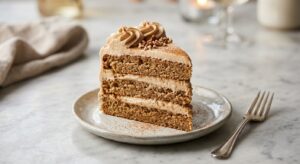
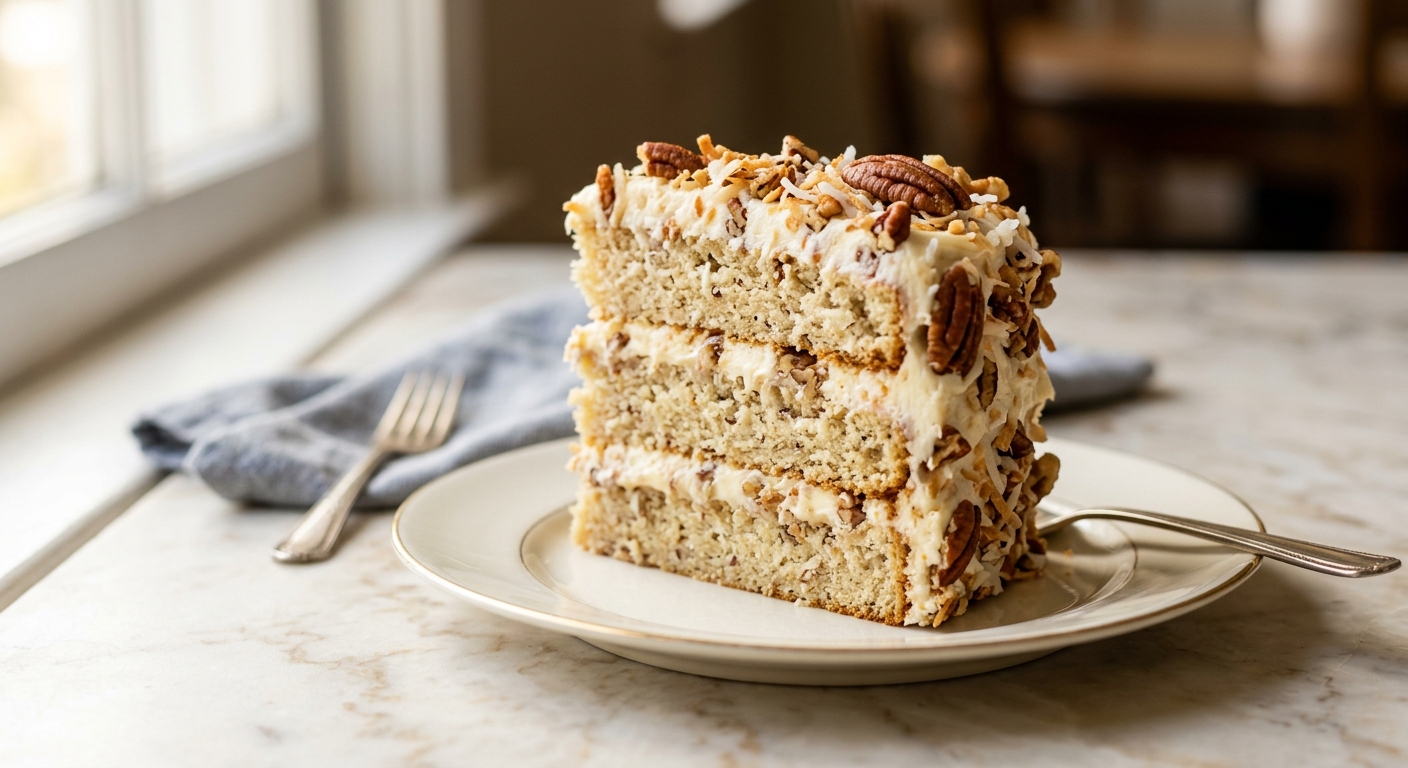
There is a cake that has anchored Southern potluck tables and birthday celebrations for generations, and once you have had a proper slice, the memory of it stays with you. Italian Cream Cake is a grand, unapologetically generous dessert: three tall layers of buttermilk cake shot through with shredded coconut and chopped pecans, each layer frosted with a cream cheese buttercream so silky and tangy it could stand on its own. The outside is pressed with even more toasted pecans, giving every bite a contrast of soft crumb, rich frosting, and satisfying crunch. It is the kind of cake that makes a room go quiet.
What sets this version apart is two deliberate choices. First, the pecans are toasted before they go into both the batter and the coating, coaxing out their natural butterscotch depth and preventing the soft, pale nuttiness you get from raw nuts in a baked dessert. Second, the egg whites are beaten separately to stiff peaks and folded into the batter at the very end, a step that lifts what could be a dense, heavy cake into something surprisingly light and tender. Buttermilk adds its characteristic gentle tang and reacts with the baking soda for an even, airy crumb. These are not fussy techniques, just thoughtful ones.
This cake sits firmly in the weekend bake or special occasion category. It is not difficult, but it does reward patience: three layers to bake and cool, a frosting to whip, and assembly that takes a few minutes of care. If you have made a layered cake before, you will feel at home here. If this is your first, the steps are written to guide you through each one clearly. The finished cake feeds a crowd and keeps beautifully for days, making all that effort genuinely worth it.
Equipment Needed
Click on an item below to shop for the recommended items for this recipe on Amazon.
As an Amazon Associate, we earn from qualifying purchases.
16
Ingredients
- Batter
- 150 gpecan halves (about 1.5 cups), divided
- 85 gsweetened shredded coconut (about 1 cup), divided
- 300 gall-purpose flour (about 2.5 cups, spooned and leveled)
- 1 tspbaking soda
- 0.5 tspColima Sea SaltMicroplastic Free Salt
- 226 gunsalted butter, softened to room temperature (1 cup or 2 sticks)
- 400 ggranulated sugar (2 cups)
- 5 largeeggs, separated, at room temperature
- 2 tsppure vanilla extract
- 240 mlfull-fat buttermilk, at room temperature (1 cup)
- 57 gunsweetened shredded coconut (about 0.75 cup)
- Egg Whites
- —Pinch of cream of tartar
- Frosting
- 450 gfull-fat block cream cheese, softened to room temperature (two 8-oz blocks)
- 226 gunsalted butter, softened to room temperature (1 cup or 2 sticks)
- 720 gpowdered sugar, sifted (about 6 cups)
- 2 tsppure vanilla extract
- —Pinch of Colima Sea SaltMicroplastic Free Salt
Ingredient Substitutions
Instructions
- Toast the pecans and coconut: Preheat your oven to 350°F (175°C). Spread the pecan halves in a single layer on a rimmed baking sheet and toast for 8 to 10 minutes, stirring once, until fragrant and one shade darker. Set aside to cool completely. Spread the sweetened shredded coconut on the same sheet and toast for 5 to 7 minutes, stirring every 2 minutes, until golden. Watch it carefully as it can burn quickly. Let cool. Roughly chop 100g (about 1 cup) of the toasted pecans for the batter and frosting coating, reserving the remaining whole halves for the top of the cake.
- Prepare the pans and mix the dry ingredients: Grease three 9-inch round cake pans, line the bottoms with parchment paper rounds, then grease the parchment and dust lightly with flour, tapping out the excess. In a medium bowl, whisk together the flour, baking soda, and fine sea salt. Set aside.
- Cream the butter and sugar: In the bowl of a stand mixer fitted with the paddle attachment, beat the softened butter on medium speed for 2 minutes until smooth and pale. Add the granulated sugar and beat on medium-high for a full 4 to 5 minutes, stopping to scrape down the sides, until the mixture is very light, fluffy, and almost white in color. This step builds the cake’s structure.
- Add the egg yolks and vanilla: Add the egg yolks one at a time, beating for 20 seconds after each addition and scraping the bowl as needed. Add the vanilla extract and beat until combined. The mixture will look silky and rich.
- Alternate the flour and buttermilk: With the mixer on low, add one third of the flour mixture and mix just until it disappears. Add half the buttermilk and mix until combined. Repeat with another third of flour, the remaining buttermilk, then the final third of flour, ending with flour. Do not overmix. Fold in the unsweetened shredded coconut and 75g (about 0.75 cup) of the chopped toasted pecans with a rubber spatula.
- Beat the egg whites and fold in: In a separate clean bowl using a hand mixer or the whisk attachment of your stand mixer, beat the egg whites with the pinch of cream of tartar on medium speed until foamy, then increase to high and beat until stiff, glossy peaks form, about 3 to 4 minutes. Do not overbeat to dry peaks. Scoop one large spoonful of egg whites into the batter and stir it in to loosen the mixture. Gently fold in the remaining egg whites in two additions using a wide rubber spatula, cutting down through the center and sweeping up along the sides, until just combined with no white streaks visible.
- Bake the layers: Divide the batter evenly among the three prepared pans (about 500g per pan if you have a scale). Smooth the tops. Bake for 25 to 28 minutes, rotating the pans halfway through, until the tops are golden, the edges pull away slightly from the sides, and a toothpick inserted in the center comes out with just a few moist crumbs. Do not open the oven before the 22-minute mark. Cool the layers in their pans on wire racks for 15 minutes, then turn them out, peel off the parchment, and cool completely, at least 1 hour, before frosting.
- Make the cream cheese frosting: Beat the softened cream cheese on medium speed until completely smooth with no lumps, about 2 minutes. Add the softened butter and beat until fully combined and fluffy, another 2 minutes. Add the sifted powdered sugar one cup at a time on low speed, mixing between additions to avoid a cloud of sugar. Add the vanilla and pinch of salt, then increase to medium and beat for 2 minutes until silky and spreadable. Do not overbeat, as cream cheese frosting can become too soft.
- Assemble and frost the cake: Place one cooled cake layer on a cake board or serving plate. Spread about 1 cup of frosting evenly to the edges using an offset spatula. Sprinkle a small handful of the remaining chopped pecans and toasted coconut over the frosting. Repeat with the second layer. Place the final layer on top, flat side up for a level surface. Apply a thin crumb coat of frosting all over the cake, then refrigerate for 20 minutes to set the crumbs. Apply the remaining frosting generously over the top and sides. Press the remaining toasted chopped pecans onto the sides of the cake, and arrange the reserved whole pecan halves decoratively on top. Refrigerate for at least 30 minutes before slicing for clean cuts.
- Prepare and toast: Preheat your oven to 350°F (175°C). Toast the pecans and coconut as described in the oven method above and let cool. Grease a 9×13-inch baking pan and line with parchment paper, leaving an overhang on the long sides for easy lifting.
- Mix the batter: Follow steps 2 through 6 of the oven method exactly, using the same ingredients and proportions. The batter does not change for a sheet cake format.
- Bake: Pour all the batter into the prepared 9×13 pan and spread it evenly into the corners. Bake at 350°F (175°C) for 35 to 40 minutes, rotating the pan at the 20-minute mark. The cake is done when a toothpick inserted in the thickest center part comes out with just a few moist crumbs and the top is golden. Sheet cakes can retain moisture in the center longer than thin layers, so check at 35 minutes but do not rush. Cool completely in the pan on a wire rack, at least 1 hour.
- Make the frosting: Prepare the cream cheese frosting using the same recipe as the oven method. For a sheet cake, the full frosting recipe will be generous. You can reduce to two-thirds of the frosting amounts if you prefer a lighter coating: 340g cream cheese, 170g butter, 480g powdered sugar.
- Frost and finish: Spread the frosting generously over the completely cooled cake directly in the pan, or lift the cake out using the parchment overhang and frost on a cutting board for cleaner edges. Scatter the toasted chopped pecans and toasted coconut over the top. Press gently so they adhere. Chill for 20 minutes before cutting into 16 squares to serve.
- Prepare and toast: Preheat your oven to 350°F (175°C). Toast the pecans and coconut as described in the primary oven method. Line two to three standard 12-cup muffin tins with paper cupcake liners.
- Mix the batter: Follow steps 2 through 6 of the oven method exactly. The batter is the same.
- Fill and bake: Use a large cookie scoop or a spoon to fill each liner about two-thirds full, roughly 60 to 65g of batter per cup. Overfilling will cause the cupcakes to dome and spill. Bake for 18 to 22 minutes, until the tops spring back lightly when touched and a toothpick comes out with just a few moist crumbs. Do not overbake: cupcakes dry out faster than layers. Cool in the pans for 5 minutes, then transfer to a wire rack and cool completely before frosting.
- Make the frosting: Prepare the full cream cheese frosting recipe. Transfer to a piping bag fitted with a large open star tip (such as a 1M or 2D). If the frosting feels too soft to pipe neatly, refrigerate it for 15 minutes to firm it up slightly before piping.
- Frost and finish: Pipe a generous swirl of cream cheese frosting on each cooled cupcake, starting at the outer edge and spiraling inward. Immediately press a small pinch of toasted chopped pecans and toasted coconut onto the frosting, and place a whole toasted pecan half on top of each one for a polished look. Serve at room temperature.
Nutrition Per Serving
Per 1 serving (makes one three-layer 9-inch round cake)
Why This Recipe Works
The most important technique in this cake is separating the eggs and folding in whipped whites at the end. Egg yolks, creamed into the butter-sugar mixture, contribute richness, fat, and emulsification, helping the batter hold together and stay moist. The whites, beaten separately to stiff peaks, are structural air pockets: when folded gently into the heavy batter, they introduce thousands of tiny bubbles that expand in the oven’s heat, lifting the crumb from dense to delicate. The cream of tartar is not optional decoration: it stabilizes the egg white foam by lowering its pH, making it more resistant to overbeating and collapse before it reaches the oven.
Buttermilk does double duty in this recipe. Its acidity activates the baking soda (an alkaline leavener), producing carbon dioxide bubbles that further lighten the crumb. But buttermilk also tenderizes the gluten strands in the flour through its lactic acid, resulting in a crumb that is soft and moist rather than chewy or tough. This is why regular milk is not a direct swap: it lacks the acid needed for both leavening and tenderizing. The fat in full-fat buttermilk also contributes to a richer mouthfeel.
Toasting the pecans and coconut before adding them to the batter is a step that matters more than it might seem. Raw pecans contain moisture and their natural oils have not yet been unlocked by heat, resulting in a softer, blander nut presence inside a finished cake. Toasting drives off that surface moisture and triggers the Maillard reaction in the nut’s proteins and sugars, developing roasted, almost caramel-like complexity. Similarly, toasted coconut takes on a golden color and nutty fragrance that raw or untoasted coconut simply cannot match. Both ingredients hold up better in the crumb and on the frosted exterior when they have been toasted first.
Baker’s Tips
- Bring all refrigerated ingredients, including butter, eggs, cream cheese, and buttermilk, to room temperature before you begin. Cold butter will not cream properly and cold cream cheese will leave lumps in your frosting.
- Weigh your batter into the three pans for perfectly even layers. Uneven layers mean uneven baking times and a lopsided finished cake.
- When folding in the egg whites, use a wide, flexible rubber spatula and work in gentle, sweeping motions. Speed is the enemy here. Aggressive stirring deflates the foam and loses the lightness you worked to create.
- If your cream cheese frosting seems too soft to spread or pipe cleanly, do not add more powdered sugar. Instead, refrigerate the frosting for 15 to 20 minutes. It will firm to a much more workable consistency.
- For clean, bakery-worthy slices, run a long knife under very hot water, wipe it dry, and slice the cake while it is still chilled. Wipe the blade clean between each cut.
- Do not skip the crumb coat. That thin first layer of frosting seals in crumbs so your final coat stays clean and beautiful. The 20-minute chill to set it is worth every minute.
- Toast more coconut and pecans than you think you need. It is easy to run short during the decorating step, and both toast quickly if you need a second batch.
Variations
- Chocolate Italian Cream Cake: Replace 40g of the flour with Dutch-process cocoa powder and add 1 teaspoon espresso powder to the dry ingredients for a mocha-coconut variation. Keep the cream cheese frosting as written.
- Lemon Italian Cream Cake: Add the zest of 2 lemons to the batter with the vanilla, and stir 2 tablespoons of fresh lemon juice and 1 teaspoon lemon zest into the finished frosting for a bright, citrusy lift.
- Nut-free version: Simply omit the pecans from the batter and the coating. Double the toasted coconut on the outside and top for decoration. The cake bakes and tastes wonderful without them.
- Rum-soaked layers: Brush each cooled cake layer with 2 tablespoons of dark rum or coconut rum before frosting. This adds a warmly boozy depth that pairs beautifully with the coconut and pecan flavors.
Troubleshooting & FAQ
My cake layers domed sharply in the center and cracked. What happened?
My cream cheese frosting is too runny to spread and keeps sliding off the cake. What went wrong?
The coconut and pecans sank to the bottom of my cake layers during baking. Can I prevent this?
My egg whites deflated when I folded them into the batter. The finished cake was dense and flat.
The outside of my cake layers is fully cooked but the center is wet and gummy. What did I do wrong?
Storage & Make-Ahead
- Storage: Store the frosted cake covered (a cake dome or loosely tented foil works well) in the refrigerator for up to 5 days. Because of the cream cheese frosting, it should not be left at room temperature for more than 2 hours. For the best texture, let slices sit at room temperature for 20 to 30 minutes before eating, as cold cream cheese frosting firms up considerably. Unfrosted cake layers can be wrapped tightly in plastic wrap and stored at room temperature for up to 2 days, or frozen for up to 3 months.
- Make-Ahead: This cake is an excellent make-ahead project. The three cake layers can be baked, cooled, wrapped individually in plastic wrap, and refrigerated up to 2 days ahead or frozen for up to 3 months (thaw overnight in the refrigerator still wrapped). The cream cheese frosting can be made up to 3 days ahead, covered, and refrigerated. Let it come to room temperature for 30 minutes and beat briefly with a hand mixer to restore its spreadable texture before using. The fully assembled cake can be made 1 day ahead and refrigerated.