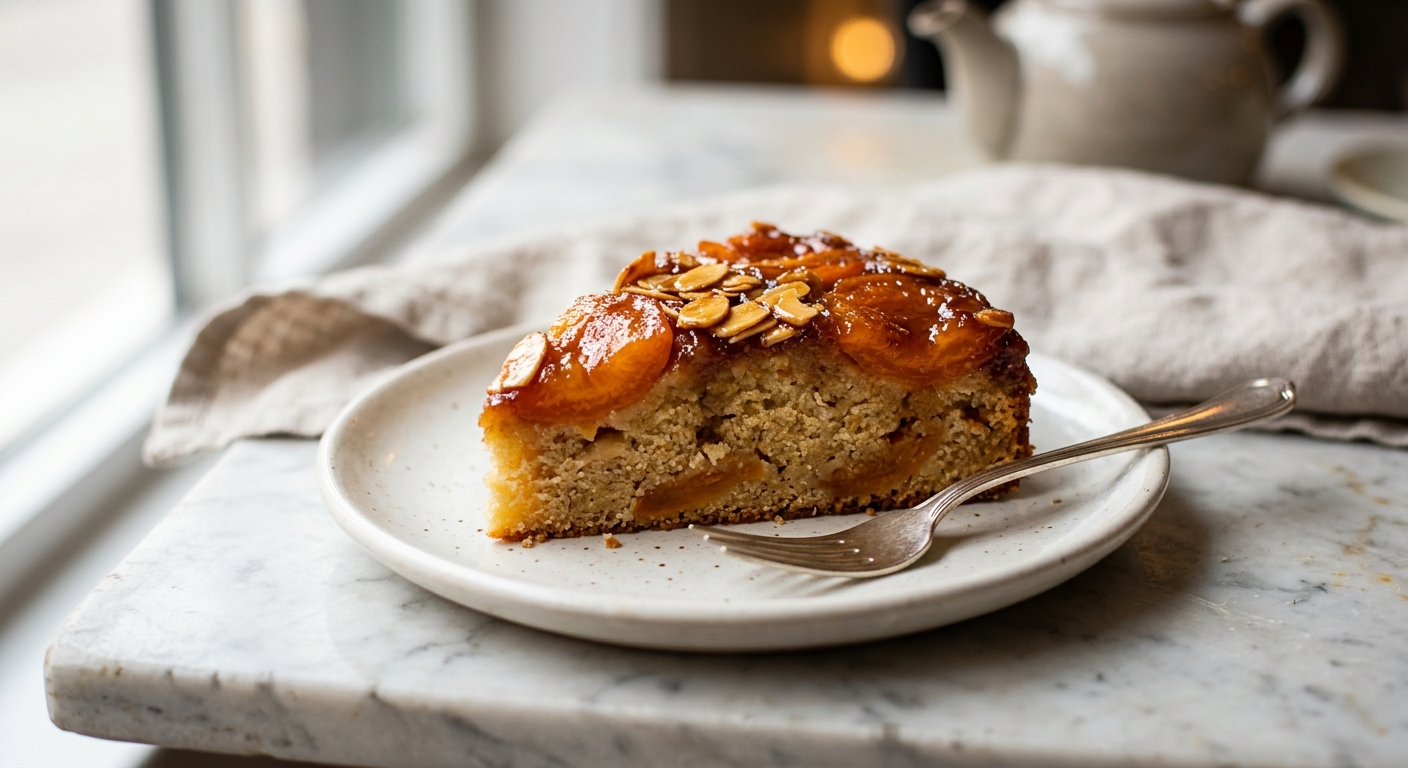
There is something quietly magical about an upside-down cake. You pour a humble batter over a pan of bubbling fruit and caramel, slide it into the oven, and forty minutes later you flip it out onto a plate to reveal something that looks almost too lovely to eat. The caramel has soaked into the top of the cake, the apricots have softened and deepened in colour to a jewel-like amber and rose, and the kitchen smells of toasted almonds and warm stone fruit. It is the kind of dessert that earns gasps at a dinner table without requiring a single piping bag or pastry thermometer.
What sets this version apart is a double hit of almond flavour and the use of brown butter in the caramel base. Instead of simply melting butter with sugar, we cook the butter until the milk solids turn golden and nutty before adding the brown sugar, creating a caramel with real depth. The cake batter itself is made with both almond flour and a touch of almond extract, which means every bite carries a warm, marzipan-like richness that plays beautifully against the tartness of fresh apricots. Ground almonds also keep the crumb wonderfully moist and tender for days after baking.
This recipe sits comfortably in the medium difficulty range, mostly because the brown butter caramel requires a watchful eye, but the actual technique is forgiving and approachable for any baker who has made a basic butter cake. It is perfect for a weekend afternoon bake when you want something genuinely impressive without spending hours in the kitchen. Serve it warm with a spoonful of creme fraiche or a scoop of vanilla ice cream, and do not be surprised when everyone asks for the recipe.
Equipment Needed
Click on an item below to shop for the recommended items for this recipe on Amazon.
As an Amazon Associate, we earn from qualifying purchases.
10
Ingredients
- Caramel (6 Tbsp)
- 85 gunsalted butter
- Cake (3/4 Cup Or 1.5 Sticks)
- 150 gsoft light brown sugar, for the caramel (3/4 cup, packed)
- 1 tbspfresh lemon juice
- 700 gfresh apricots, halved and pitted (about 8 to 10 medium apricots)
- 170 gunsalted butter, softened
- 180 gcaster sugar or granulated sugar (3/4 cup plus 2 tbsp)
- 3 largeeggs, at room temperature
- 1 tsppure almond extract
- 1 tsppure vanilla extract
- 130 gall-purpose flour (1 cup plus 1 tbsp, spooned and leveled)
- 100 galmond flour, also called ground almonds (1 cup)
- 1.5 tspbaking powder
- 0.5 tspColima Sea SaltMicroplastic Free Salt
- 60 mlwhole milk, at room temperature (1/4 cup)
- 25 gsliced almonds, for garnish (3 tbsp, optional)
Ingredient Substitutions
Instructions
- Preheat your oven to 350°F (175°C). Grease a 9-inch round cake pan (at least 2 inches deep) with butter and line the sides with a strip of parchment paper. Do not line the bottom as the caramel needs direct contact with the pan to set properly.
- Make the brown butter caramel: Place the 85g of butter in the cake pan and set it directly over medium heat on your stovetop (or melt it in a small saucepan and pour it in). Cook, swirling occasionally, until the butter turns golden brown and smells nutty, about 3 to 4 minutes. Remove from the heat, add the brown sugar and lemon juice, and stir until the sugar is moistened and forms an even layer across the bottom of the pan. Spread it to the edges with a spatula.
- Arrange the apricot halves cut-side down in a single snug layer over the caramel, starting from the outside edge and working inward. It is fine to pack them in fairly tightly as they will shrink slightly as they bake. Set the pan aside.
- Make the cake batter: Beat the softened butter and caster sugar together in a stand mixer or with a hand mixer on medium-high speed for 4 to 5 minutes until very pale and fluffy. This creaming step is important for building the cake’s lift. Scrape down the sides of the bowl.
- Add the eggs one at a time, beating well after each addition for about 30 seconds. If the mixture looks slightly curdled, do not worry. Beat in the almond extract and vanilla extract.
- In a separate bowl, whisk together the all-purpose flour, almond flour, baking powder, and salt. Add half the flour mixture to the butter mixture and fold gently with a spatula. Add the milk, fold again, then add the remaining flour mixture and fold just until no dry streaks remain. Do not overmix.
- Spoon the batter over the apricots in large dollops, then spread it gently and evenly with an offset spatula or the back of a spoon. Take care not to disturb the fruit arrangement underneath. Scatter the sliced almonds over the batter if using.
- Bake for 38 to 42 minutes, until the top is deep golden brown and a skewer inserted into the centre of the cake (avoiding the fruit layer) comes out with just a few moist crumbs. The edges will have pulled away slightly from the sides of the pan.
- Remove from the oven and let the cake rest in the pan for exactly 10 minutes. Run a thin knife around the edge of the pan, place a large serving plate or cake stand over the pan, then confidently flip the whole thing in one smooth motion. Leave the pan in place for 30 seconds to allow the caramel to drip down, then lift it off. Reposition any apricot halves that shifted. Serve warm or at room temperature.
- Cut a piece of parchment paper to fit the bottom of your slow cooker insert. Lightly grease the insert and the parchment. This step is essential for clean unmoulding.
- Make the caramel on the stovetop: Melt the 85g of butter in a small saucepan over medium heat. Cook until golden brown and nutty smelling, about 3 to 4 minutes. Add the brown sugar and lemon juice, stir to combine, and immediately pour the mixture evenly over the parchment in the slow cooker. Arrange the apricot halves cut-side down over the caramel in a single layer as described in the oven method.
- Prepare the cake batter exactly as described in steps 4 through 6 of the oven method, using a stand mixer or hand mixer. The batter itself does not change.
- Spoon and spread the batter gently over the apricots. Place a double layer of paper towels under the slow cooker lid before closing it. This absorbs condensation and prevents water from dripping onto the cake, which would create a soggy, pale top.
- Cook on High for 2 hours to 2 hours 30 minutes. The cake is done when the edges look set, the centre of the batter feels firm to a gentle press, and a skewer inserted into the centre comes out with moist crumbs but no wet batter. Slow cookers vary significantly in heat output, so start checking at the 2-hour mark.
- Turn off the slow cooker and remove the lid. Let the cake rest and steam-release for 15 minutes. Then run a spatula carefully around the edge, place a large plate or board over the insert, and flip confidently. Lift the insert, peel away the parchment, and rearrange any apricots. Allow to cool for at least 20 minutes before serving as the caramel will be very hot.
- Use a 7-inch round cake pan at least 2 inches deep. Grease it well and line the sides with parchment. Preheat your air fryer to 320°F (160°C) for 3 minutes.
- Make the brown butter caramel in a small saucepan on the stovetop: Cook the 85g butter over medium heat until golden and nutty, 3 to 4 minutes. Stir in the brown sugar and lemon juice, then pour into the prepared pan and spread evenly. Arrange the apricot halves cut-side down over the caramel. Because the pan is smaller, you will have slightly fewer apricots. Pack them in a snug single layer and reserve any extras.
- Prepare the full cake batter as in the oven method steps 4 through 6. Spoon and spread the batter carefully over the fruit, smoothing to the edges. Skip the sliced almond garnish as the confined heat of the air fryer can over-brown them.
- Place the pan in the air fryer basket. To prevent the top from over-browning before the centre is cooked through, loosely tent the pan with a piece of foil for the first 20 minutes of baking. Remove the foil for the final 10 to 15 minutes to allow the top to set and colour.
- Bake for 30 to 35 minutes total, until a skewer inserted in the centre comes out with just moist crumbs. Check at 28 minutes as air fryer temperatures vary. If the top colours too quickly, re-tent with foil.
- Rest the cake in the pan for 10 minutes, then run a knife around the edge, place a plate over the top, and flip in one confident motion. Wait 30 seconds before removing the pan. Serve warm or at room temperature.
Nutrition Per Serving
Per 1 serving (makes one 9-inch round cake)
Why This Recipe Works
The brown butter caramel is the engine of this recipe. Browning butter is a Maillard reaction, where the milk solids in the butter react with heat to create hundreds of new flavour compounds, including nutty, toasty notes that a simple melted butter caramel simply cannot match. Combining it with brown sugar (which already contains molasses) deepens the caramel flavour even further. The lemon juice serves two purposes: it adds a subtle brightness that keeps the sweetness from feeling flat, and the acidity helps inhibit sugar crystallisation, keeping the caramel smooth and glossy rather than grainy.
Almond flour is the secret to the exceptional texture of this cake. Unlike all-purpose flour, which is mostly starch and gluten-forming proteins, almond flour is primarily fat and protein with very little starch. This means it contributes richness and moisture without making the crumb tight or dry. Because almond flour cannot form gluten, it actually acts as a tenderiser, and the combination of all-purpose flour for structure and almond flour for tenderness gives you a crumb that is sturdy enough to hold up under the weight of the caramelised fruit but soft and yielding when you eat it. The almond extract amplifies the natural nuttiness and ties the topping and the cake together as a cohesive flavour profile.
The 10-minute resting period after baking is non-negotiable. When the cake comes out of the oven, the caramel is liquid and the fruit is extremely hot. If you flip it immediately, the caramel will run off the plate and the apricots may fall apart. Ten minutes allows the caramel to thicken slightly as it cools, acting almost like a glue that holds the fruit in place. If your cake does stick, return the inverted pan to the hot cake for 30 seconds and the residual heat will loosen any stubborn caramel.
Baker’s Tips
- Bring all refrigerated ingredients (butter, eggs, milk) to room temperature before starting. Cold butter will not cream properly, and cold eggs can cause the batter to curdle, resulting in a denser, uneven crumb.
- Choose apricots that are ripe but still slightly firm. Very ripe, soft apricots will collapse and lose their shape during baking, while firm apricots hold their structure and develop a beautiful tender texture as they cook.
- When making the brown butter, keep a close watch. The line between golden brown and burnt is narrow, and burnt butter will make the caramel bitter and unusable. As soon as you see the milk solids turn amber and smell a nutty aroma, remove the pan from the heat immediately.
- Pack the apricots snugly into the caramel. They will shrink as they bake and any large gaps will be filled with caramel rather than fruit. Starting from the outer edge and working inward gives the most even and visually appealing result.
- Use a pan that is at least 2 inches deep. The batter rises considerably and the caramel bubbles during baking, so a shallow pan risks overflow.
- When flipping the cake, use a plate significantly larger than the pan to catch any caramel drips, and make sure your hands and wrists are protected from the hot pan and any caramel that runs.
- If some apricot halves shift or fall out when you flip the cake, simply press them back into the caramel on the surface of the cake while it is still warm and the caramel is pliable. No one will ever know.
Variations
- Cardamom and orange version: Replace the almond extract with 1/2 tsp ground cardamom and add the zest of one orange to the batter for a fragrant, Middle Eastern-inspired twist.
- Raspberry and almond: Replace the apricots with 300g of fresh raspberries, arranged cut-side up (or just scattered) over the caramel. The berries release more juice, creating an extra-glossy, vibrant topping.
- Honey and thyme variation: Swap the brown sugar in the caramel for an equal weight of runny honey and add 4 fresh thyme sprigs on top of the caramel before arranging the apricots. Remove the thyme before flipping.
- Gluten-free version: Replace the all-purpose flour with an equal weight (130g) of a gluten-free plain flour blend that contains xanthan gum. Increase almond flour to 120g. The texture will be slightly more dense but still wonderfully moist.
Troubleshooting & FAQ
My caramel hardened and stuck to the pan instead of forming a glossy topping.
The batter seems to be curdling when I add the eggs. Is it ruined?
My cake sank in the middle after I took it out of the oven.
The apricots released a lot of juice and the caramel topping looks watery rather than glossy.
Can I use a springform pan instead of a regular cake pan?
Storage & Make-Ahead
- Storage: Store the cake loosely covered at room temperature for up to 2 days. Because of the fruit, it is best not stored in a completely airtight container at room temperature as condensation can make the caramel layer sticky. For longer storage, refrigerate in an airtight container for up to 5 days and bring to room temperature or warm individual slices briefly before serving.
- Make-Ahead: The brown butter caramel can be made up to 2 days ahead and stored in a sealed jar in the refrigerator. Reheat it gently until pourable before adding to the pan. The fully baked and cooled cake can be made 1 day ahead and stored as directed. The batter should not be made ahead as the leavening will lose its potency.