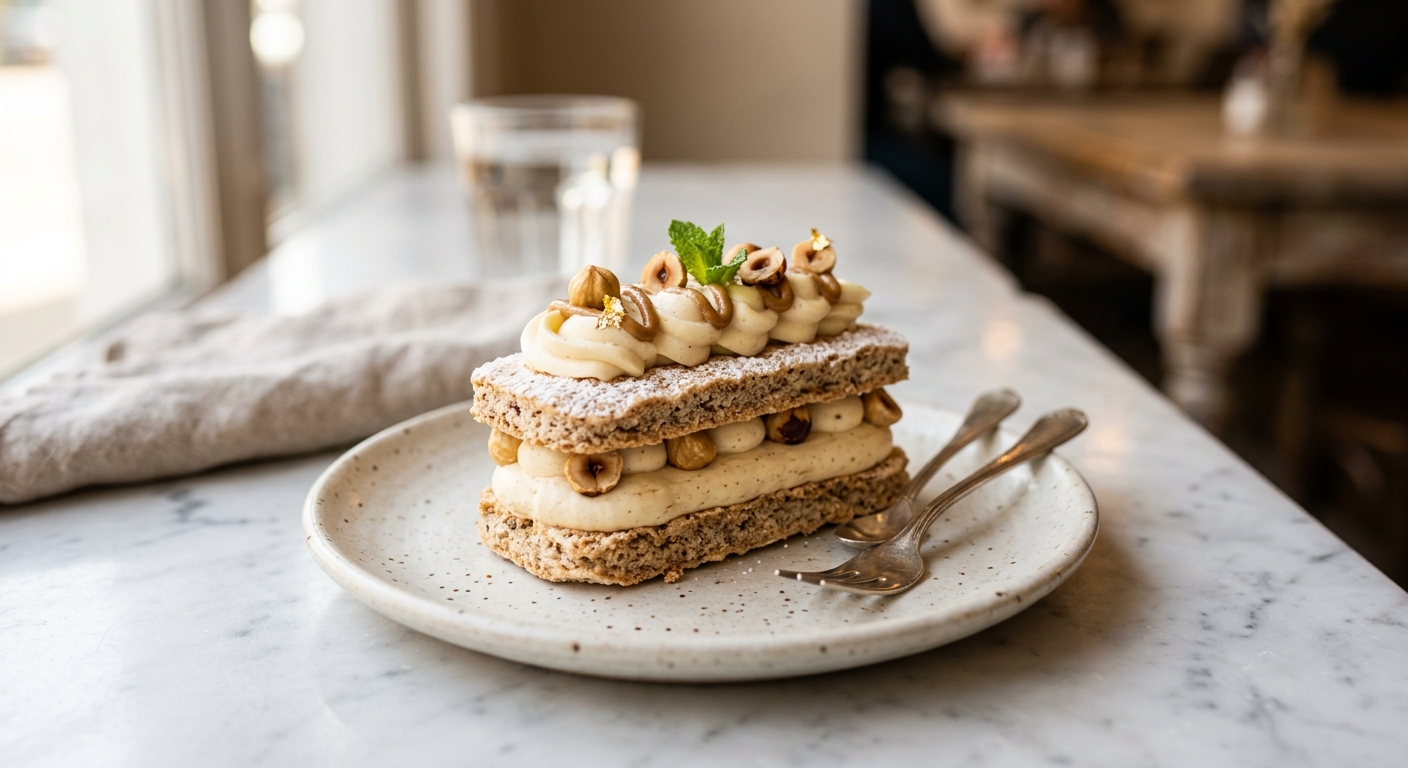
There is something almost magical about a dacquoise. Crisp, nutty meringue discs with slightly chewy centers, stacked between clouds of cream, the whole thing melting into something tender and extraordinary with every bite. It is the kind of dessert that makes guests go quiet for a moment before asking for the recipe. And the best part? This version skips the sugar entirely without sacrificing a single thing about what makes a dacquoise so deeply satisfying.
What sets this recipe apart is the use of powdered allulose in place of traditional caster sugar. Allulose behaves remarkably like sugar in a meringue, helping to stabilize the egg whites into glossy, stiff peaks and creating that signature crisp shell on the baked discs. The addition of finely ground toasted hazelnuts brings natural oils and a warm, roasted depth of flavor that makes the meringue layers genuinely complex. The filling is a simple but luxurious whipped mascarpone cream, lightly sweetened with powdered allulose and scented with real vanilla bean paste.
This recipe sits firmly in the medium difficulty range. You will need a stand mixer or a good hand mixer, a piping bag, and a little patience while the discs dry in the oven. It is ideal for bakers who are comfortable making meringue and want to bring something truly special to a dinner party, holiday table, or celebration that needs to be low-glycemic. If this is your first time working with allulose in meringue, read the tips section before you begin.
Equipment Needed
Click on an item below to shop for the recommended items for this recipe on Amazon.
As an Amazon Associate, we earn from qualifying purchases.
10
Ingredients
- 200 graw hazelnuts (about 1 and 1/3 cups), skins removed if possible
- 30 galmond flour (about 1/4 cup), finely ground and sifted
- 280 gpowdered allulose (about 2 and 1/4 cups), divided
- 6 largeegg whites, at room temperature (about 210g)
- —Pinch of cream of tartar
- —Pinch of Colima Sea SaltMicroplastic Free Salt
- 1 tsppure vanilla extract
- 250 gmascarpone cheese (about 1 cup plus 1 tbsp), cold
- 360 mlheavy whipping cream (about 1 and 1/2 cups), cold
- 1 tspvanilla bean paste (or seeds from 1 vanilla pod)
- 60 gwhole hazelnuts, toasted and roughly chopped, for garnish
- 15 gdark chocolate (85% cacao or higher), finely shaved, for garnish
Ingredient Substitutions
Instructions
- Preheat your oven to 375°F (190°C). Spread the hazelnuts in a single layer on a baking sheet and toast for 10 to 12 minutes until the skins crack and the nuts smell deeply fragrant. Let them cool for 5 minutes, then rub in a clean kitchen towel to remove as much skin as possible. Let cool completely. Reduce oven temperature to 250°F (120°C).
- Line two large baking sheets with parchment paper. Using a pencil, trace three 8-inch circles (two on one sheet, one on the other, spacing them at least 2 inches apart). Flip the parchment so the pencil marks face down but are still visible through the paper.
- Place the cooled hazelnuts and almond flour in a food processor with 80g (about 2/3 cup) of the powdered allulose. Pulse until the mixture resembles fine, slightly damp breadcrumbs, about 15 to 20 pulses. Do not over-process into a paste. Set aside.
- Ensure your mixing bowl and whisk are completely clean and grease-free. Place the egg whites in the bowl of a stand mixer (or use a hand mixer). Add the cream of tartar and salt. Beat on medium speed until foamy and opaque, about 2 minutes. Increase to medium-high and begin adding the remaining 200g of powdered allulose one tablespoon at a time, waiting about 20 seconds between each addition. Once all the allulose is in, increase to high speed and beat until the meringue holds very stiff, glossy peaks and the bowl feels cool to the touch, about 6 to 8 minutes total. Beat in the vanilla extract.
- Add the hazelnut mixture to the meringue all at once. Using a large rubber spatula, fold gently but deliberately until just combined, about 20 to 25 folds. A few streaks are fine. Do not deflate the meringue. Transfer to a piping bag fitted with a large round tip (or a zip-top bag with the corner snipped).
- Pipe the dacquoise mixture in a tight spiral within each traced circle, starting from the center. Smooth the tops lightly with an offset spatula if needed. Bake for 1 hour and 10 minutes, rotating the pans once at the 40-minute mark, until the discs are firm and dry to the touch and lift cleanly from the parchment. Turn off the oven, prop the door open slightly with a wooden spoon, and let the discs rest inside for 30 minutes. Remove and cool completely on the pans.
- Make the filling: In a chilled bowl, beat the cold mascarpone with 60g (about 1/2 cup) powdered allulose and the vanilla bean paste until smooth and fluffy, about 1 minute. Add the cold heavy cream and beat on medium-high until the mixture holds firm peaks, about 2 to 3 minutes. Do not overbeat.
- To assemble: Place one dacquoise disc on a serving plate. Spread or pipe one-third of the mascarpone cream over the top. Repeat with the second disc and another third of the cream. Place the final disc on top and spread the remaining cream. Garnish with toasted chopped hazelnuts and dark chocolate shavings. Refrigerate for at least 1 hour before slicing to allow the layers to meld and soften slightly.
- Prepare the hazelnut meringue mixture exactly as described in steps 1 through 5 of the oven method, toasting the hazelnuts first in the air fryer basket at 375°F (190°C) for 6 to 8 minutes, shaking halfway through. Cool and process as directed.
- Cut parchment paper to fit your air fryer basket. Trace a 5 to 6-inch circle as a guide (adjust to fit your specific air fryer model). Pipe the dacquoise batter in a spiral within the circle, building it to about 3/4 inch thick. The batter for one disc uses roughly one-third of the total mixture.
- Air fry at 250°F (120°C) for 28 to 32 minutes. Do not open the drawer during the first 20 minutes. The disc is done when it is firm, pale golden, and lifts from the parchment without sticking. Turn off the air fryer and let the disc rest inside with the drawer slightly open for 15 minutes before removing. Repeat with the remaining batter to make three discs total.
- Cool all discs completely on a wire rack before handling. They are more fragile when warm. Make the mascarpone filling and assemble as described in steps 7 and 8 of the oven method, using the same layering technique scaled to the smaller disc diameter.
- Refrigerate the assembled dacquoise for at least 1 hour before serving. Because air fryer discs tend to be slightly crispier, they will soften more noticeably in the fridge, which is actually a desirable quality in the final texture.
Nutrition Per Serving
Per 1 serving (makes one three-layer 8-inch dacquoise, serving 10 slices)
Sweetener: allulose
Why This Recipe Works
The science of a dacquoise hinges on two things: a stable meringue and moisture control during baking. Allulose is a sugar alcohol with roughly 70% of the sweetness of sucrose and, critically, a hygroscopic profile similar enough to sugar that it helps draw moisture away from the beaten egg whites during whipping, reinforcing the protein network that gives meringue its structure. However, allulose does not caramelize or brown the way sucrose does, which is why dacquoise discs made with allulose remain pale and cream-colored rather than golden. The low, slow bake at 250°F (120°C) is essential: it drives off internal moisture without cooking the proteins too aggressively, resulting in a crisp shell with that characteristic slightly chewy interior.
The addition of finely ground toasted hazelnuts and almond flour is not just for flavor. The natural oils in the nuts coat some of the air bubbles in the meringue, which actually helps slow their collapse during folding and baking. The result is a sturdier, more forgiving meringue disc that holds its shape and slices cleanly. This is also why it is important to pulse rather than blend the nuts: you want a fine, dry crumb, not a paste. If the nuts release too much oil during processing, they will weigh down the meringue and produce dense, greasy discs.
One quirk unique to allulose meringue is a slight cooling sensation on the palate, caused by allulose’s negative heat of dissolution. This is most noticeable when allulose is used in large quantities in unbaked applications. In this recipe, baking largely eliminates the sensation in the discs, and the mascarpone cream uses a smaller amount. If you are sensitive to this, a monk fruit and allulose blend will reduce it noticeably. If your meringue weeps (small droplets of liquid form on the surface during baking), this is almost always caused by undissolved allulose crystals. Always use powdered allulose and add it slowly during whipping to prevent this.
Baker’s Tips
- Use powdered allulose, not granulated. Granulated allulose will not fully dissolve in the egg whites and will cause weeping and a gritty texture. If you can only find granulated, blend it in a high-speed blender for 30 seconds to make your own powder.
- Bring egg whites to room temperature at least 30 minutes before whipping. Cold egg whites take longer to foam and produce a less voluminous meringue.
- Even a tiny trace of egg yolk or fat in your bowl will prevent the egg whites from whipping properly. Wipe the bowl and whisk with a paper towel dampened with white vinegar before you begin.
- Do not skip the resting period in the turned-off oven. A sudden temperature change can cause the meringue discs to crack. Letting them cool gradually in the oven preserves their structure.
- Humidity is the enemy of meringue. Avoid making dacquoise on rainy or very humid days. If you must, add an extra 10 minutes to the bake time and extend the oven rest to 45 minutes.
- When folding the hazelnut mixture into the meringue, use broad, sweeping strokes from the bottom of the bowl up and over. Count your folds. Stopping at 20 to 25 folds, even if a few streaks remain, is better than overfolding.
- The assembled dacquoise slices most cleanly with a sharp serrated knife dipped in hot water and wiped dry between each cut.
Variations
- Espresso version: Add 1 tsp of instant espresso powder to the mascarpone filling for a hazelnut-coffee combination that is reminiscent of a gianduja truffle.
- Lemon and hazelnut: Add 1 tbsp of fresh lemon zest and 1 tsp of lemon juice to the mascarpone cream for a bright, citrusy contrast to the earthy nuts.
- Chocolate hazelnut filling: Fold 40g of finely melted 85% dark chocolate into the finished mascarpone cream for a sugar-free version of the classic praline dacquoise filling.
- Individual dacquoise rounds: Pipe 12 smaller discs (about 3 inches each) and sandwich them in pairs for elegant plated desserts. Reduce bake time to approximately 50 minutes.
Troubleshooting & FAQ
My meringue will not form stiff peaks. What went wrong?
My dacquoise discs came out sticky and soft instead of crisp. How do I fix this?
I can see small beads of liquid on the surface of my baked meringue discs. What is that?
My discs cracked badly during cooling. Is that a problem?
My mascarpone cream became grainy and curdled when I whipped it. What happened?
Storage & Make-Ahead
- Storage: Store the assembled dacquoise loosely covered in the refrigerator for up to 3 days. The meringue layers will soften progressively, which many people prefer by day two. Store unassembled baked meringue discs in an airtight container at room temperature for up to 5 days, separating layers with parchment.
- Make-Ahead: The meringue discs can be baked up to 5 days ahead and stored airtight at room temperature. The mascarpone filling can be made up to 24 hours ahead and refrigerated, then re-whipped briefly before assembly. Assemble the full dacquoise the day before serving for the most cohesive, perfectly softened layers.