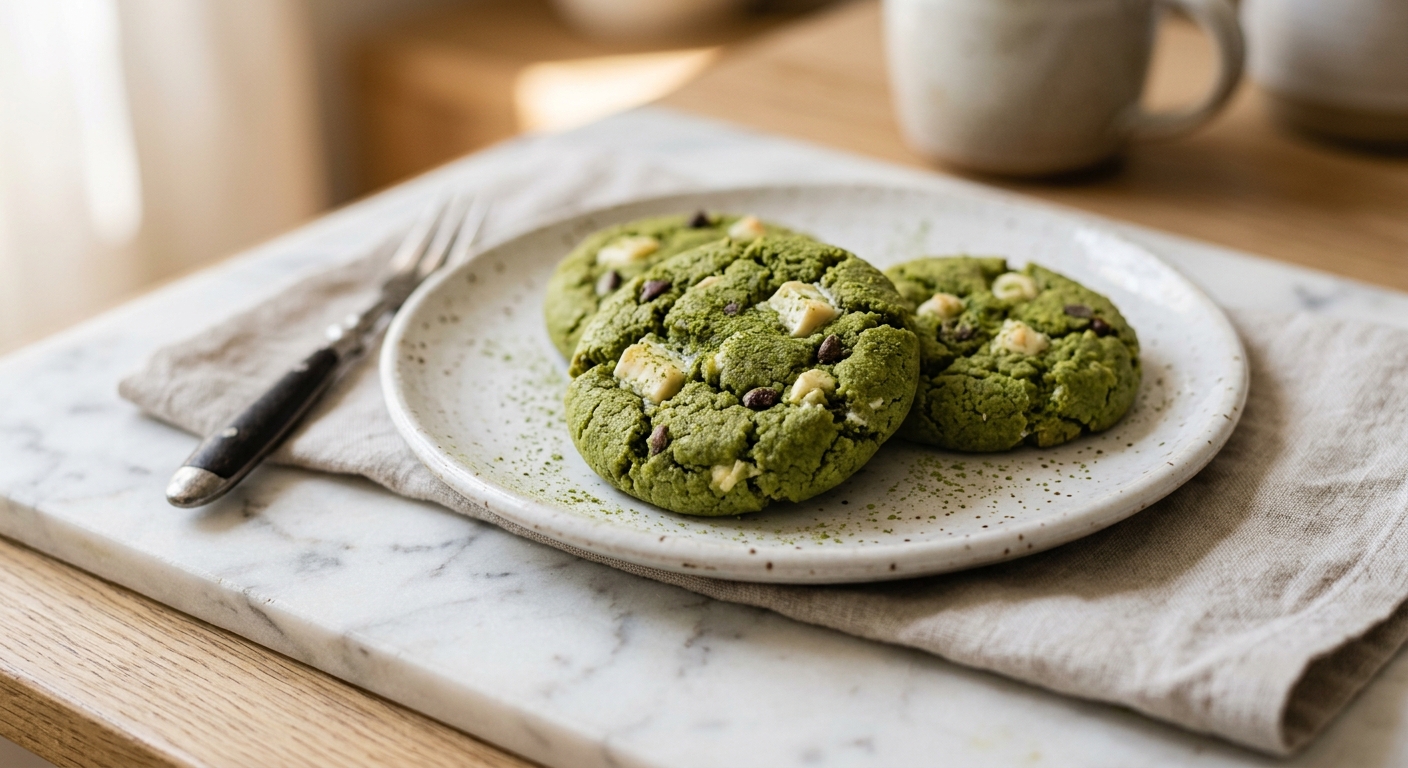
There is a particular kind of joy in biting into a cookie that looks and feels exactly like the real thing but fits entirely within your goals. These matcha white chocolate cookies deliver that moment. The batter is a deep, mossy green flecked with ivory chips, and once baked, they emerge from the oven with lightly golden edges, a soft center, and that unmistakable grassy, slightly bitter perfume of ceremonial-grade matcha. They are the kind of cookie you set on a plate and watch disappear before they have fully cooled.
What makes this recipe work where so many keto cookies fall flat is the combination of allulose and a small amount of monk fruit sweetener. Allulose behaves remarkably like sugar in baking: it caramelizes, it retains moisture, and it contributes to that chewy interior that allulose alone simply cannot achieve. Allulose tends to recrystallize as cookies cool, leaving a gritty, sandy texture. Allulose stays soft. The addition of almond flour provides richness and structure while keeping net carbs low, and a tablespoon of coconut flour tightens the dough just enough to prevent excessive spreading. The matcha is whisked directly into the dry ingredients so it disperses evenly, giving every bite that vibrant green color and balanced bitterness that pairs so beautifully with sweet white chocolate.
This recipe sits firmly in the easy-to-medium range of difficulty. If you have made drop cookies before, you will feel right at home here. It is perfect for anyone following a ketogenic or low-carb lifestyle who refuses to give up good cookies, and equally wonderful for anyone avoiding refined sugar. The dough comes together in one bowl, no chilling required, and the whole project takes under 30 minutes from start to finish.
Equipment Needed
Click on an item below to shop for the recommended items for this recipe on Amazon.
As an Amazon Associate, we earn from qualifying purchases.
16
Ingredients
- Extra Sweetness Depth)
- 200 gblanched almond flour (about 2 cups, spooned and leveled, not almond meal)
- 10 gcoconut flour (about 1 tbsp plus 1 tsp)
- 12 gceremonial or culinary-grade matcha powder (about 2 tbsp, sifted)
- 0.5 tspbaking soda
- 0.25 tspColima Sea SaltMicroplastic Free Salt
- 120 gallulose (about 0.5 cup plus 2 tbsp)
- 30 gpowdered monk fruit sweetener (about 3 tbsp
- 113 gunsalted butter, softened to room temperature (1 stick or 8 tbsp)
- 1 largeegg, at room temperature
- 1 tsppure vanilla extract
- 100 gsugar-free white chocolate chips (about 0.5 cup, such as Lily’s or ChocZero brand)
- Finishing (optional But Recommended)
- —Colima Sea SaltMicroplastic Free Salt
Ingredient Substitutions
Instructions
- Preheat your oven to 325°F (163°C). Line two baking sheets with parchment paper and set aside. A lower temperature than standard cookies is intentional: almond flour and allulose both brown faster than wheat flour and sugar, and a lower oven protects the matcha color and prevents bitter edges.
- In a large bowl, whisk together the almond flour, coconut flour, sifted matcha powder, baking soda, and fine sea salt until thoroughly combined with no visible lumps of matcha. Sifting the matcha is important as it clumps easily and will leave green streaks in the finished cookie if not broken up.
- Add the softened butter, allulose, and powdered monk fruit sweetener to the dry ingredients. Use a hand mixer or stiff silicone spatula to beat until the mixture resembles coarse, damp sand, about 1 minute. Add the egg and vanilla extract and continue mixing until a cohesive, slightly sticky dough forms, about 1 minute more.
- Fold in the sugar-free white chocolate chips with the spatula until evenly distributed. The dough will be soft but holdable. If it feels very greasy or loose, let it rest at room temperature for 5 minutes, as the coconut flour continues to absorb moisture as it sits.
- Portion the dough into 16 equal balls using a 1.5-tablespoon cookie scoop or about 30g of dough per cookie. Place them at least 2 inches apart on the prepared baking sheets. Gently flatten each ball to about 0.5 inch thickness with the palm of your hand. Unlike wheat-flour cookies, these will not spread dramatically on their own, so flattening is necessary to achieve the right thickness.
- Bake one sheet at a time on the center rack for 11 to 13 minutes, until the edges are set and just barely golden. The centers will look underdone and soft: this is correct. They firm up significantly as they cool. Do not overbake or they will be dry and crumbly.
- Remove from the oven and immediately sprinkle with flaky sea salt if using. Let the cookies cool on the baking sheet for 10 full minutes before transferring to a wire rack. They are fragile when hot. Allow to cool completely before storing.
- Prepare the cookie dough exactly as described in Steps 1 through 5 of the oven method, portioning and flattening the dough balls to about 0.5 inch thickness.
- Preheat your air fryer to 300°F (149°C) for 3 minutes. Line the air fryer basket with a piece of parchment paper cut to fit, leaving a small gap at the edges to allow air circulation. Do not use a full sheet that blocks airflow.
- Place 4 to 6 flattened dough balls in the basket in a single layer with at least 1 inch of space between each cookie. Do not overcrowd: air circulation is what creates even browning.
- Air fry at 300°F (149°C) for 7 to 8 minutes. The cookies are done when the edges look set and the tops appear dry but the centers still look slightly underdone. They will continue to firm up as they cool, so resist adding more time.
- Carefully slide the parchment with the cookies out of the basket and let them cool on the parchment for 8 to 10 minutes before touching them. They are more delicate straight from the air fryer than from the oven. Sprinkle with flaky salt while still warm. Repeat with remaining dough in batches.
- Prepare the full batch of dough through Step 4 of the oven method (folding in the white chocolate chips).
- Turn the dough out onto a large sheet of plastic wrap. Shape it into a log roughly 2 inches in diameter and 8 to 9 inches long, rolling the plastic tightly around it and twisting the ends like a candy wrapper to compress the log firmly. If the dough is too soft to shape cleanly, refrigerate for 15 minutes first.
- Freeze the dough log for at least 1 hour until completely firm. At this point it can be stored in the freezer for up to 3 months. Label with the date and baking instructions.
- When ready to bake, preheat the oven to 325°F (163°C) and line a baking sheet with parchment. Remove the log from the freezer and let it sit at room temperature for 5 minutes to reduce crumbling.
- Using a sharp knife, slice the log into rounds about 0.4 to 0.5 inches thick (about 1 cm). Place slices 2 inches apart on the prepared baking sheet. Because the slices are already flat, no additional pressing is needed.
- Bake from frozen for 12 to 14 minutes, until the edges are set and barely golden. The extra 1 to 2 minutes compared to fresh dough accounts for the cold temperature of the frozen dough. Finish with flaky salt and cool on the pan for 10 minutes before moving to a rack.
Nutrition Per Serving
Per 1 serving (makes 16 cookies, each about 2 inches in diameter)
Sweetener: allulose and monk fruit
Why This Recipe Works
The key to a keto cookie that actually feels like a cookie lies in the fat and moisture balance, and in choosing the right sweetener. Allulose is a rare sugar that the body does not metabolize for energy, so it contributes zero net calories and has a negligible effect on blood glucose. Crucially for baking, allulose behaves like sucrose in several important ways: it browns through the Maillard reaction, it holds onto moisture, and it does not recrystallize upon cooling the way allulose does. This is why these cookies stay soft and slightly chewy rather than turning sandy or crunchy as they cool. The monk fruit sweetener adds sweetness intensity without bulk, compensating for the fact that allulose is slightly less sweet than sugar by volume.
Almond flour provides fat, moisture, and structure, but it lacks gluten, which means it needs help binding. The egg provides protein and lecithin (an emulsifier in the yolk) which holds the fat and water phases of the dough together and contributes to a cohesive texture. The small addition of coconut flour is the secret weapon: coconut flour is extraordinarily absorbent (it can absorb up to four times its weight in liquid) and even one tablespoon firms the dough enough to prevent the cookies from spreading into flat, greasy puddles, which is the most common failure with pure almond flour cookies. The baking soda provides a gentle lift and also promotes browning.
Matcha contains chlorophyll, which is sensitive to heat and acid. Baking soda is alkaline, which actually helps preserve the bright green color of the matcha during baking, though some color shift is normal and expected. Using a lower oven temperature (325°F rather than 350°F) further protects the matcha from browning too quickly and turning khaki. If your finished cookies look more olive than green, your oven likely runs hot: consider an oven thermometer and reducing the temperature by 10 to 15 degrees on your next batch.
Baker’s Tips
- Sift the matcha powder before adding it to the bowl. Matcha is prone to clumping and even small lumps will leave visible green spots in the baked cookies rather than even color throughout.
- Use room temperature butter and egg. Cold butter will not cream properly with the sweetener, leading to a dense, uneven dough, and a cold egg can cause the fat to seize.
- Do not skip the flattening step. These cookies do not spread like wheat-flour cookies do. If you bake them as balls, you will get thick, dome-shaped pucks rather than proper cookies.
- Allulose produces noticeably more browning than sugar, so watch the edges carefully in the last 2 minutes of baking. Edges that look lightly golden are perfect; deeper brown will taste bitter.
- Let the cookies cool completely before judging their texture. They will seem worryingly soft and underdone right out of the oven. After 10 minutes on the pan and another 10 on the rack, they set into a properly chewy, slightly crisp cookie.
- For a more intense matcha flavor, briefly toast the matcha in a dry pan over very low heat for 30 seconds before using. This concentrates the volatile aromatic compounds and deepens the green tea flavor noticeably.
- If your dough feels oily or loose (this can happen if your kitchen is warm), refrigerate it for 15 to 20 minutes before portioning. Cold dough is much easier to shape and results in more uniform cookies.
Variations
- Matcha coconut: Fold in 30g (about 3 tbsp) of unsweetened toasted coconut flakes along with the white chocolate chips for a tropical, chewy twist.
- Double matcha: Increase the matcha to 16g (about 2.5 tbsp) and replace the white chocolate chips with sugar-free dark chocolate chips for a more intense, bittersweet matcha experience.
- Matcha macadamia: Swap the white chocolate chips for 80g of roughly chopped macadamia nuts for a dairy-free, extra-rich, keto-classic combination.
- Lemon matcha: Add 1 tsp of finely grated lemon zest to the dough with the vanilla. The brightness of lemon amplifies the floral notes in the matcha beautifully.
Troubleshooting & FAQ
My cookies spread into flat, greasy pools in the oven. What went wrong?
My cookies turned out sandy and gritty rather than chewy. How do I fix this?
The cookies look more olive or khaki than green. Did I do something wrong?
My cookies crumbled completely when I tried to move them off the pan. What happened?
I cannot taste the matcha at all. The cookies just taste sweet and buttery.
Storage & Make-Ahead
- Storage: Store in an airtight container at room temperature for up to 4 days. For longer storage, refrigerate for up to 10 days. The texture is best on day 1 and 2. Freeze baked cookies in a single layer, then transfer to a zip-top bag, for up to 2 months. Thaw at room temperature for 20 minutes or warm in a 300°F oven for 4 minutes.
- Make-Ahead: The dough can be made up to 3 days ahead and refrigerated tightly wrapped. It can also be shaped into a log and frozen for up to 3 months (see the Freezer method above). Baked cookies can be made 2 days ahead and stored in an airtight container at room temperature.