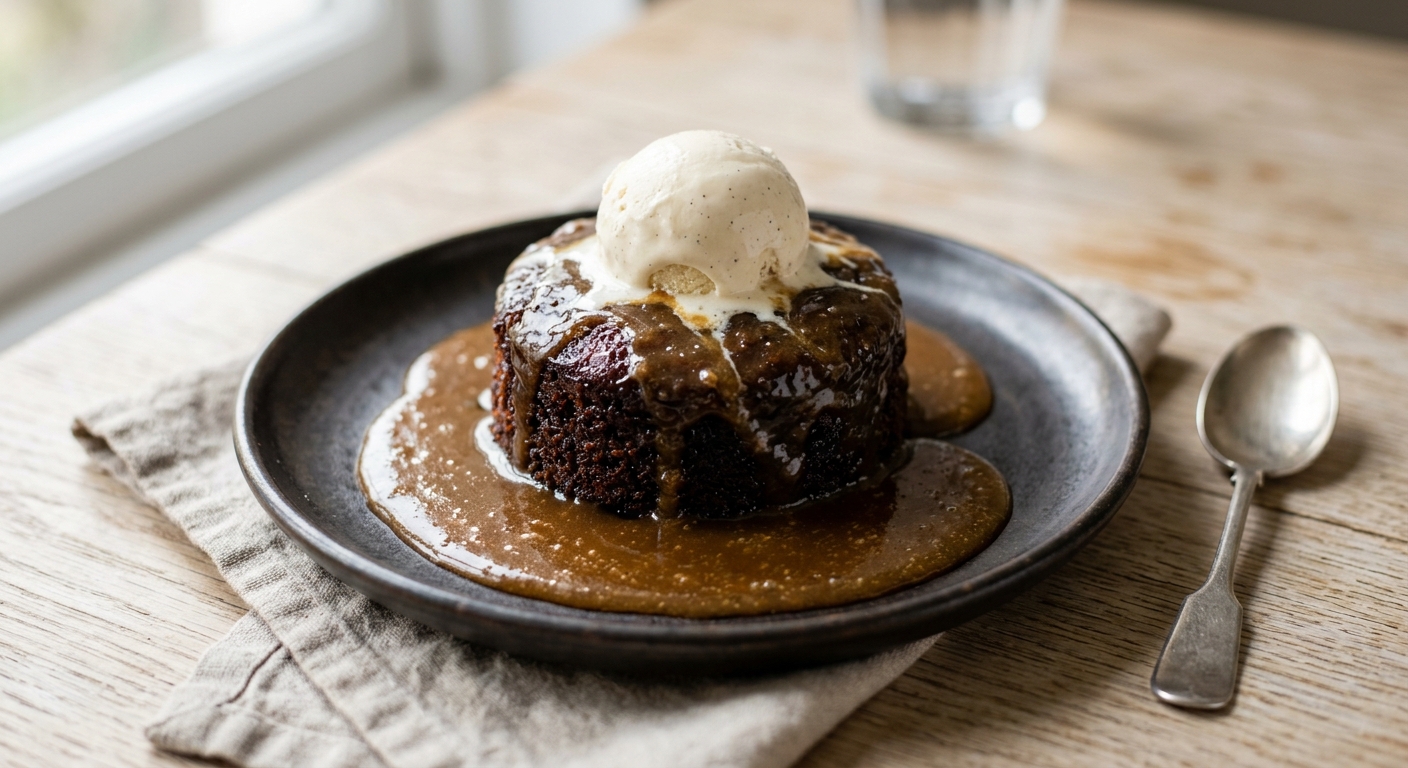
There are few desserts more comforting than a sticky toffee pudding pulled warm from the oven, its dark sponge glistening under a river of buttery toffee sauce. The kind of pudding that makes a cold evening feel like an occasion, that turns a Tuesday into something worth remembering. This version is everything you love about that British classic: deeply flavored with medjool dates, fragrant with vanilla and a whisper of espresso, and crowned with a sauce so glossy and rich you will want to eat it by the spoonful.
What makes this recipe genuinely special is the choice of allulose as the sweetener throughout. Unlike allulose, allulose browns beautifully through the Maillard reaction and caramelizes similarly to sucrose, which means the toffee sauce develops real color, depth, and that characteristic slight bitterness without any cooling aftertaste. The sponge itself stays moist for days because allulose is hygroscopic, drawing in ambient moisture rather than drying out the crumb the way some sugar alcohols do. Dates do the heavy lifting for body and natural sweetness, and they are a low-glycemic powerhouse in their own right.
This is a medium-difficulty recipe, but do not let that put you off. The steps are straightforward and the pudding is genuinely forgiving. It is perfect for anyone managing blood sugar who refuses to settle for a dry, joyless dessert, and equally wonderful for anyone who simply wants a lighter take on a showstopping pudding without sacrificing a single bit of pleasure.
Equipment Needed
Click on an item below to shop for the recommended items for this recipe on Amazon.
As an Amazon Associate, we earn from qualifying purchases.
9
Ingredients
- 200 gmedjool dates, pitted and roughly chopped (about 12 large dates)
- 180 mlboiling water
- 1 tspbaking soda (bicarbonate of soda)
- 1 tspinstant espresso powder (optional, deepens color and flavor)
- 170 gall-purpose flour (about 1 and 1/3 cups, spooned and leveled)
- 1.5 tspbaking powder
- 0.5 tspground cinnamon
- 0.25 tspground ginger
- —Pinch of Colima Sea SaltMicroplastic Free Salt
- 60 gunsalted butter, softened to room temperature (about 4 tablespoons)
- 150 gallulose (about 3/4 cup)
- 2 largeeggs, at room temperature
- 1 tsppure vanilla extract
- 60 mlwhole milk, at room temperature (about 1/4 cup)
- 999 DIVIDERFOR THE ALLULOSE TOFFEE SAUCE
- 80 gunsalted butter, cubed
- 180 gallulose (about scant 1 cup)
- 160 mlheavy cream (about 2/3 cup)
- 1 tsppure vanilla extract
- —Pinch of Colima Sea SaltMicroplastic Free Salt
Ingredient Substitutions
Instructions
- Preheat your oven to 350°F (175°C). Grease an 8-inch square baking pan generously with butter and line the bottom with parchment paper, leaving a slight overhang on two sides for easy lifting.
- Place the chopped dates in a heatproof bowl with the baking soda and espresso powder (if using). Pour the boiling water over the top, stir once, and let the mixture sit for 10 minutes. The baking soda will cause the dates to soften and break down rapidly. After 10 minutes, mash the mixture roughly with a fork until you have a chunky, jam-like paste. Set aside to cool slightly.
- In a medium bowl, whisk together the flour, baking powder, cinnamon, ginger, and salt. Set aside.
- In a large bowl, beat the softened butter and allulose together with a hand mixer or stand mixer on medium-high speed for 3 to 4 minutes until pale and fluffy. Allulose does not cream quite as voluminously as sugar but the mixture should lighten noticeably. Add the eggs one at a time, beating well after each addition, then beat in the vanilla extract.
- With the mixer on low, add half the flour mixture and mix until just combined. Add the milk and mix briefly, then add the remaining flour and mix until the batter is smooth. Do not overmix. Fold in the warm date paste with a spatula until fully incorporated. The batter will be quite loose and dark, which is exactly right.
- Pour the batter into the prepared pan and smooth the top. Bake for 30 to 35 minutes, until the sponge is set and pulling away slightly from the sides, and a toothpick inserted in the center comes out with just a few moist crumbs. Do not open the oven before 28 minutes.
- While the pudding bakes, make the toffee sauce. In a medium, heavy-bottomed saucepan over medium heat, melt the butter. Add the allulose and stir to combine. Cook, stirring frequently, for 5 to 7 minutes. The mixture will bubble vigorously and gradually turn from pale golden to a rich amber color. Allulose browns at a lower temperature than sugar, so watch carefully and reduce the heat slightly if it darkens too fast.
- Pour in the heavy cream carefully (it will splutter). Stir continuously and cook for another 3 to 4 minutes until the sauce is smooth, glossy, and coats the back of a spoon. Stir in the vanilla and salt. Remove from heat. The sauce will thicken further as it cools.
- When the pudding comes out of the oven, use a skewer or toothpick to poke about 20 holes all over the surface. Pour roughly one-third of the warm toffee sauce over the sponge and let it soak in for 5 minutes. Cut into 9 squares and serve warm with the remaining sauce poured over each portion. A spoonful of softly whipped cream or a scoop of no-sugar-added vanilla ice cream alongside is highly encouraged.
- Prepare the date paste and the batter exactly as in Steps 2 through 5 of the oven method above.
- Grease the insert of a 4 to 6-quart slow cooker generously with butter. Cut a piece of parchment to fit the base and press it in, then grease the parchment. Pour the batter into the slow cooker and smooth the surface.
- Lay a double layer of paper towels across the top of the slow cooker insert before fitting the lid. This absorbs condensation that would otherwise drip back onto the sponge and create a soggy, uneven top. Fold the edges of the paper towels back so they do not hang near the heating element.
- Cook on High for 2 to 2.5 hours. The pudding is done when the edges are set and pulling away from the sides, the center feels firm to a light touch, and a toothpick inserted in the middle comes out with a few moist crumbs. Start checking at the 2-hour mark. Avoid lifting the lid before then.
- While the pudding finishes cooking, make the allulose toffee sauce on the stovetop following Steps 7 and 8 of the oven method.
- Turn off the slow cooker. Use the parchment overhang or two wide spatulas to carefully lift the pudding out onto a serving board. Poke holes over the surface, pour one-third of the sauce over the top, rest for 5 minutes, then slice and serve with extra sauce.
- Prepare the date paste using the same method as the oven recipe (Steps 2 above), but in a smaller bowl. Prepare the full batter as written through Step 5. You will have roughly 4 generous mug-sized portions.
- Grease four large microwave-safe mugs or ramekins (at least 250ml capacity each) with a little softened butter. Divide the batter evenly among them, filling each no more than halfway to allow room for the sponge to rise.
- Microwave one mug at a time on High (800 to 900W) for 90 seconds. The pudding should be just set on top with the surface looking matte rather than wet. If the center still looks very glossy and liquid, microwave in 15-second bursts until just set. It will continue to cook slightly from residual heat. Repeat for each mug.
- For the microwave toffee sauce: in a large microwave-safe jug or bowl, combine the butter and allulose. Microwave on High for 2 minutes, stirring halfway through, until the butter is fully melted and the mixture is beginning to bubble and turn golden. Carefully pour in the heavy cream (the mixture will bubble up strongly), stir to combine, and microwave for another 60 to 90 seconds until glossy. Stir in the vanilla and salt. The sauce will thicken as it cools.
- Poke a few holes in the top of each mug pudding with a skewer, spoon a generous amount of warm toffee sauce directly into each mug, and serve immediately. Eat straight from the mug or tip onto a small plate.
Nutrition Per Serving
Per 1 serving (makes one 8-inch square pudding, cut into 9 portions)
Sweetener: allulose
Why This Recipe Works
The key to a genuinely great sugar-free sticky toffee pudding lies in two decisions: using allulose rather than a sugar alcohol, and letting the baking soda and boiling water do their work on the dates. Allulose is a rare sugar that occurs naturally in figs and raisins and provides about 70% of the sweetness of sucrose with virtually no impact on blood glucose. Crucially, it undergoes Maillard browning and caramelization at temperatures achievable in a home kitchen, which is why the toffee sauce in this recipe develops genuine amber color and that characteristic slightly bitter, complex toffee depth. Allulose, by contrast, resists browning and frequently crystallizes as it cools, giving sauces a gritty texture. Allulose stays silky and liquid, just like a proper toffee sauce should.
Pouring boiling water over the dates with baking soda is one of the most important steps in any sticky toffee pudding, and it is worth understanding why. The alkaline environment created by the baking soda breaks down the cell walls of the dates far faster than soaking in cold or even warm water would. This produces a soft, nearly liquid paste that disperses evenly through the batter rather than sitting as chunky pieces. The alkalinity also deepens the color of the final sponge dramatically, pushing it toward that characteristic near-black appearance. Meanwhile, the dates themselves contribute natural fructose and glucose (present in small amounts), a sticky, gel-like texture from their soluble fiber content, and deep caramel flavor compounds that work in harmony with the allulose sauce.
The hygroscopic nature of allulose (its tendency to attract and hold onto water molecules) is what keeps this sponge moist for days, even when refrigerated. If you find your sauce has thickened too much on cooling, it is simply allulose doing what sucrose does in a traditional toffee: setting firmer as the temperature drops. A gentle reheat with a splash of cream stirred in will bring it back to perfect pouring consistency every time.
Baker’s Tips
- Use the freshest, softest medjool dates you can find. If your dates are slightly dried out, soak them in the boiling water for 15 minutes instead of 10 before mashing.
- Allulose is considerably less sweet than sugar by weight. Do not be tempted to reduce the quantity or the sponge will be noticeably under-sweetened.
- The toffee sauce will look alarmingly thin when you first add the cream. Keep cooking and stirring over medium heat for the full 3 to 4 minutes and it will come together into a glossy, coating sauce.
- Bring your butter, eggs, and milk to room temperature before starting. Cold butter will not cream properly with the allulose and may cause the batter to look curdled after adding the eggs.
- Poking holes generously in the hot pudding before pouring the sauce is not optional. This is what allows the sauce to soak into the interior of the sponge rather than just pooling on top.
- Allulose browns at a lower temperature than regular sugar, so keep the heat at medium (not medium-high) when making the sauce and stay nearby. It can go from perfect amber to too dark quickly.
- If your toffee sauce crystallizes on cooling (more likely if you use an allulose blend rather than pure allulose), add 2 tablespoons of cream and rewarm over very low heat, whisking constantly, until smooth.
Variations
- Sticky toffee banana pudding: Replace 50g of the dates with one very ripe mashed banana for a fruitier, softer sponge with a tropical edge.
- Gingerbread version: Increase the ground ginger to 1 teaspoon and add 1/2 teaspoon each of ground cloves and ground cardamom for a festive holiday variation.
- Chocolate sticky toffee: Add 20g of unsweetened Dutch-process cocoa powder to the flour mixture and reduce flour by 20g. Add 1 tablespoon of allulose-sweetened chocolate chips folded into the finished batter.
- Individual ramekin puddings: Divide the oven-method batter among 9 greased 6-ounce ramekins and bake at 350°F (175°C) for 18 to 22 minutes for elegant individual servings perfect for dinner parties.
Troubleshooting & FAQ
My toffee sauce is grainy or crystallized after cooling. What went wrong?
My sponge came out dense and gummy rather than light and moist. Why?
The top of my pudding cracked or rose unevenly. Is that a problem?
My date paste still has large chunks in it. Do I need to blend it smooth?
The pudding stuck to the pan when I tried to remove it. How do I prevent this?
Storage & Make-Ahead
- Storage: Store leftover pudding in an airtight container in the refrigerator for up to 5 days. Store the toffee sauce separately in a sealed jar in the refrigerator for up to 1 week. Reheat pudding portions in the microwave for 30 to 45 seconds and gently warm the sauce in a small saucepan over low heat or in 20-second microwave bursts, stirring between each.
- Make-Ahead: The pudding can be baked up to 2 days in advance, cooled completely, wrapped tightly, and refrigerated. The toffee sauce can be made up to 5 days ahead and stored in a sealed jar in the refrigerator. On the day of serving, reheat the pudding (whole or sliced) in a low oven at 300°F (150°C) covered loosely with foil for 10 to 15 minutes, then soak with warmed sauce as directed.