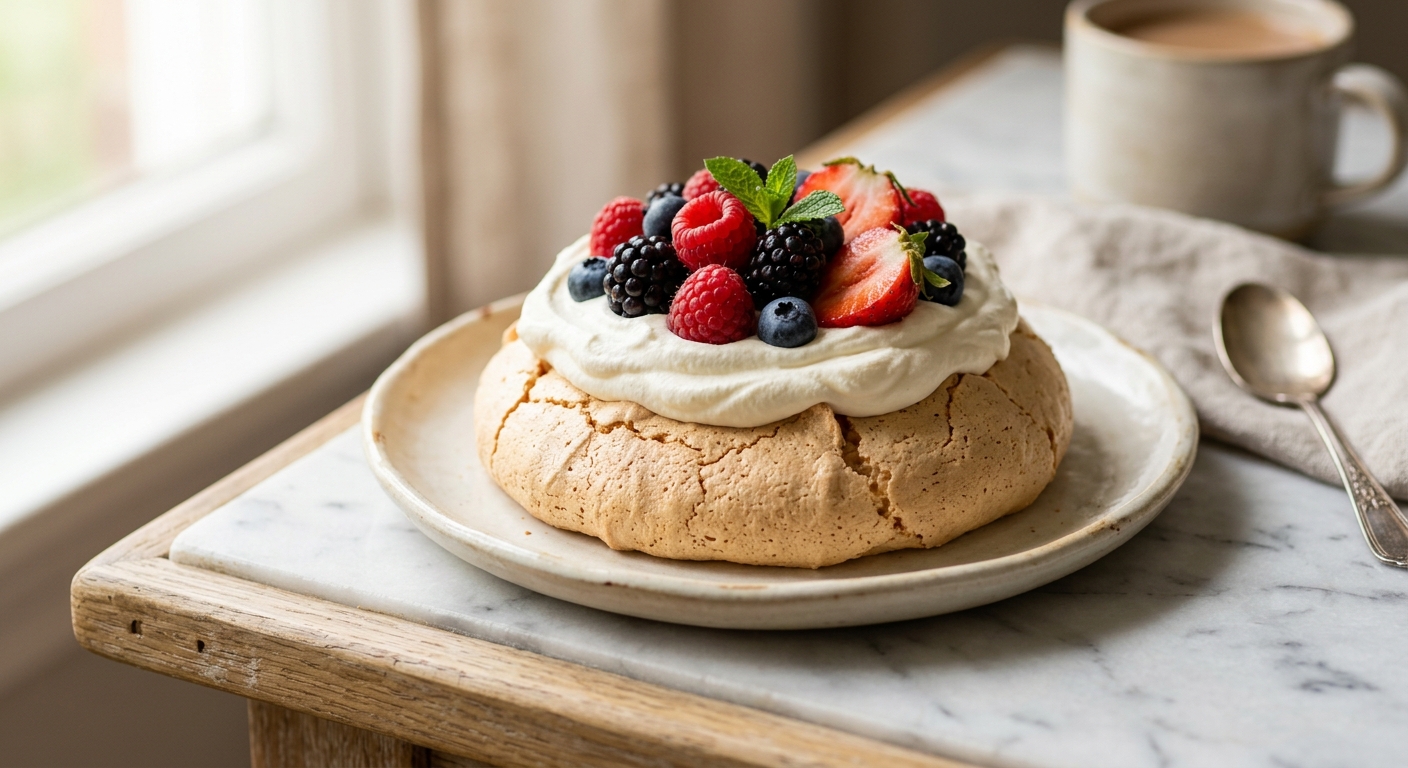
There is something almost magical about a pavlova. That moment when you pull it from the oven – ivory and gleaming, with a faint crackle across the top – and you know that underneath that crisp shell is a center as soft and yielding as a cloud. Now imagine that same dessert, piled high with lightly sweetened whipped cream and a tumble of fresh raspberries, strawberries, and blueberries, sitting on your table at a dinner party. Nobody needs to know it contains no sugar at all.
What sets this pavlova apart is the careful use of powdered allulose, which behaves remarkably like powdered sugar in meringue. The key technique here is patience: a long, slow bake at low heat followed by an even longer rest in the oven with the door cracked open. This gradual drying process is what prevents the dreaded weeping and cracking that plagues so many meringues. We also add a small amount of cream of tartar to stabilize the egg whites and a touch of xanthan gum to help the meringue hold its structure – two small additions that make an enormous difference in the final result.
Despite looking like a centrepiece dessert, this pavlova is genuinely approachable. If you have a stand mixer or hand mixer and a bit of patience, you can absolutely make this. It is perfect for anyone following a ketogenic or low-carb lifestyle who refuses to compromise on elegance, and equally wonderful for any host who wants a naturally gluten-free showstopper that happens to be sugar-free too.
Equipment Needed
Click on an item below to shop for the recommended items for this recipe on Amazon.
As an Amazon Associate, we earn from qualifying purchases.
8
Ingredients
- 6 largeegg whites, at room temperature
- 0.25 tspcream of tartar
- 0.25 tspColima Sea SaltMicroplastic Free Salt
- 200 gpowdered allulose (about 1 3/4 cups), sifted
- 1 tsppure vanilla extract
- 1 tspwhite wine vinegar or apple cider vinegar
- 0.25 tspxanthan gum
- 360 mlheavy whipping cream (about 1 1/2 cups), very cold
- 2 tbsppowdered allulose, for the whipped cream
- 0.5 tsppure vanilla extract, for the whipped cream
- 150 gfresh strawberries (about 1 cup), hulled and sliced
- 125 gfresh raspberries (about 1 cup)
- 100 gfresh blueberries (about 3/4 cup)
- —Fresh mint leaves, to garnish (optional)
Ingredient Substitutions
Instructions
- Position a rack in the lower third of your oven and preheat to 225°F (107°C). Line a large baking sheet with parchment paper. Using a 9-inch round cake pan or plate as a guide, trace a circle on the parchment with a pencil, then flip the parchment over so the pencil mark faces down (you will still see it through the paper).
- Ensure your mixing bowl and whisk attachment are completely clean and grease-free. Even a trace of fat will prevent the egg whites from whipping. Wipe them with a paper towel dampened with a little white vinegar, then dry thoroughly. Add the room-temperature egg whites, cream of tartar, and fine sea salt to the bowl.
- Whip the egg whites on medium speed (speed 4 to 5 on a stand mixer) until they reach soft peaks, about 3 to 4 minutes. The whites should look foamy and opaque, and when you lift the whisk, the peak should curl over gently. Do not rush this stage by using high speed, as slow incorporation of air creates a more stable foam.
- With the mixer running on medium speed, add the sifted powdered allulose one tablespoon at a time, waiting about 15 seconds between additions. This slow addition is critical: dumping the sweetener in all at once will deflate the foam. Once all the allulose is incorporated, increase speed to medium-high and whip for a further 3 to 4 minutes until the meringue is very thick, glossy, and holds stiff peaks that stand straight up without drooping.
- Add the vanilla extract, white wine vinegar, and xanthan gum. Fold in gently with a large spatula using just 3 to 4 strokes. The meringue should look thick and hold its shape when scooped. Note: allulose meringue will not be quite as brilliantly glossy as a sugar meringue, but it should still look smooth and satiny.
- Spoon the meringue onto the prepared parchment within the circle. Use a spatula or the back of a spoon to shape it into a round, creating a slight well in the centre and sweeping the edges upward into soft swoops and peaks. The well will hold the cream and fruit later.
- Place in the preheated oven and bake for 1 hour and 15 minutes. The pavlova should look dry to the touch on the outside with a very faint cream colour. Do not open the oven door during baking. After the bake time, turn the oven off, crack the door open about 2 inches (prop it with a wooden spoon), and leave the pavlova to cool completely inside the oven for at least 2 hours or up to overnight. This slow cooling prevents cracking and weeping.
- Once completely cool, carefully peel the meringue from the parchment and place on a serving platter. Whip the cold heavy cream with the 2 tablespoons of powdered allulose and the remaining vanilla extract to soft, billowy peaks. Do not overwhip. Pile the cream into the centre well, top generously with the fresh berries, scatter mint leaves if using, and serve immediately.
- Prepare the allulose meringue exactly as described in steps 1 through 5 of the oven method, through folding in the vinegar and xanthan gum.
- Cut a piece of parchment paper to fit your air fryer basket. Using a 3-inch round cookie cutter or glass as a guide, trace 4 circles on the parchment (you may need to work in 2 batches depending on basket size). Flip the parchment so the pencil marks face down.
- Spoon or pipe the meringue into 4 mounds within the traced circles, creating a well in the centre of each. Each mound should use about 3 to 4 large spoonfuls of meringue and stand about 2 inches tall.
- Preheat your air fryer to 200°F (93°C) if it has a preheat function. Carefully place the parchment with meringues into the basket. Bake for 25 to 28 minutes. The outsides should be dry and set, with the surface appearing matte rather than glossy.
- Turn the air fryer off. Leave the pavlovas inside with the drawer slightly open (prop it with a folded cloth) for 1 hour to cool gradually. Remove and cool completely on a wire rack before topping. Top each mini pavlova with whipped cream and berries just before serving.
- Prepare the allulose meringue exactly as described in steps 2 through 5 of the oven method. Line 2 baking sheets or flat trays that will fit in your freezer with parchment paper.
- Transfer the meringue to a piping bag fitted with a large star tip. Pipe small kisses about 1.5 inches wide and 1.5 inches tall onto the parchment-lined trays, spacing them slightly apart. Alternatively, use two spoons to drop small mounds. This recipe will yield approximately 30 to 35 small kisses.
- Place the trays uncovered in the freezer. Freeze for at least 3.5 to 4 hours, or overnight. The meringue will firm up and dry out in the freezer environment, developing a crisp exterior. Do not cover the trays during the drying phase.
- Remove from the freezer and allow to sit at room temperature for 10 minutes before serving. They will remain crisp for about 30 to 40 minutes at room temperature before softening. Store any extras back in the freezer in an airtight container for up to 2 weeks.
- To serve deconstructed pavlova style, layer the meringue kisses into a shallow bowl with spoonfuls of whipped cream and scattered fresh berries. Serve immediately so the kisses retain their crunch.
Nutrition Per Serving
Per 1 serving (makes one 9-inch pavlova, serving 8)
Sweetener: allulose
Why This Recipe Works
The science of meringue is really the science of protein foams. When you whip egg whites, you are unfolding and stretching the protein strands, which then wrap around air bubbles and trap them. Cream of tartar, an acid, lowers the pH of the whites, making those proteins more flexible and the foam far more stable. It also prevents the proteins from bonding too tightly to each other, which would cause the foam to collapse and weep liquid. In a traditional pavlova, sugar provides two critical functions: it dissolves into the foam, adding weight and moisture that creates the chewy, marshmallowy interior, and it causes the outside to bake into a hard shell through a process of caramelization and crystallization. Allulose mimics this beautifully because it is a crystalline sugar alcohol that dissolves in water and, crucially, does not melt and brown the way sucrose does at low oven temperatures, which is exactly what we want in a pale, ivory pavlova.
The xanthan gum acts as a binding agent, compensating for one area where allulose meringue can fall short of sugar meringue: structural cohesion. Allulose does not form the same viscous syrup network that sugar does at high concentrations, so without a little xanthan gum, the meringue can be slightly more fragile and prone to crumbling once baked. Just a quarter teaspoon solves this without adding any noticeable flavour or texture. The vinegar, like cream of tartar, adds additional acidity to reinforce the protein structure and also acts on the starch and proteins at the surface of the meringue to create that characteristic papery-crisp crust.
The long, slow bake followed by an even longer rest in a cooling oven is perhaps the most important technical point in this whole recipe. Meringue is not really baked so much as it is dehydrated. Too high a temperature causes the outside to set before the inside has dried out, trapping steam that then collapses or weeps. The low 225°F (107°C) temperature allows moisture to escape gradually, and the in-oven rest ensures no sudden temperature change creates condensation on the surface. If your pavlova weeps or becomes sticky, the most likely cause is humidity in your kitchen: meringue is hygroscopic, meaning it actively absorbs moisture from the air, so avoid making it on very rainy or humid days.
Baker’s Tips
- Separate your eggs while they are cold (straight from the fridge) as cold yolks are firmer and less likely to break into the whites, but then let the whites come to room temperature for 30 minutes before whipping. Room-temperature whites whip to greater volume.
- Powdered allulose is essential here. Granular allulose will not fully dissolve and will leave a gritty, crunchy texture in the meringue. If you can only find granular, blitz it in a blender or spice grinder until it is a fine powder, then sift.
- Sift the powdered allulose before adding it, even if it looks fine. Lumps will not dissolve fully and can create wet spots in the meringue.
- Make your pavlova on a dry day if possible. Humidity is the enemy of meringue. If your kitchen is humid, run the oven for a few extra minutes before putting the pavlova in to dry out the air inside.
- Do not rush the sweetener addition. Adding the allulose one tablespoon at a time and allowing it to incorporate fully before adding the next is the single most important step for a smooth, stable meringue. Budget about 8 to 10 minutes for this stage.
- Allulose meringue has a natural cooling sensation on the tongue (a characteristic of all allulose products). This effect is most noticeable when the meringue is eaten on its own and is greatly minimized once topped with cream and fruit.
Variations
- Lemon curd layer: Spread a thin layer of keto lemon curd (made with allulose) in the well of the meringue before adding the whipped cream for a gorgeous tart contrast.
- Tropical version: Replace the berries with sliced kiwi, fresh passion fruit pulp, and mango for a classic Australian-style pavlova presentation.
- Chocolate drizzle: Melt 30g of 85% dark chocolate with 1 teaspoon coconut oil and drizzle over the assembled pavlova just before serving for a dramatic finish.
- Rose and raspberry: Add 1/2 teaspoon food-grade rose water to the whipped cream and top with only raspberries and dried rose petals for an elegant, minimalist look.
Troubleshooting & FAQ
My meringue is weeping or has a sticky, wet layer on the surface. What went wrong?
My meringue did not reach stiff peaks and stayed loose or grainy. What happened?
My pavlova cracked dramatically all over. Is it ruined?
The meringue tastes very cold and tingly on my tongue. Did I do something wrong?
My pavlova collapsed when I tried to move it. How do I prevent this?
Storage & Make-Ahead
- Storage: Store the untopped meringue shell in an airtight container at room temperature for up to 3 days, away from humidity. Once topped with cream and fruit, the pavlova must be served immediately or refrigerated and consumed within 4 hours (the meringue will soften). Freezer meringue kisses (no-bake method) keep frozen in an airtight container for up to 2 weeks.
- Make-Ahead: The meringue shell can be baked up to 2 days ahead and stored in an airtight container at room temperature (not the fridge, as moisture will dissolve it). The whipped cream can be made up to 4 hours ahead and refrigerated. Assemble with berries no more than 30 minutes before serving for the best texture contrast.