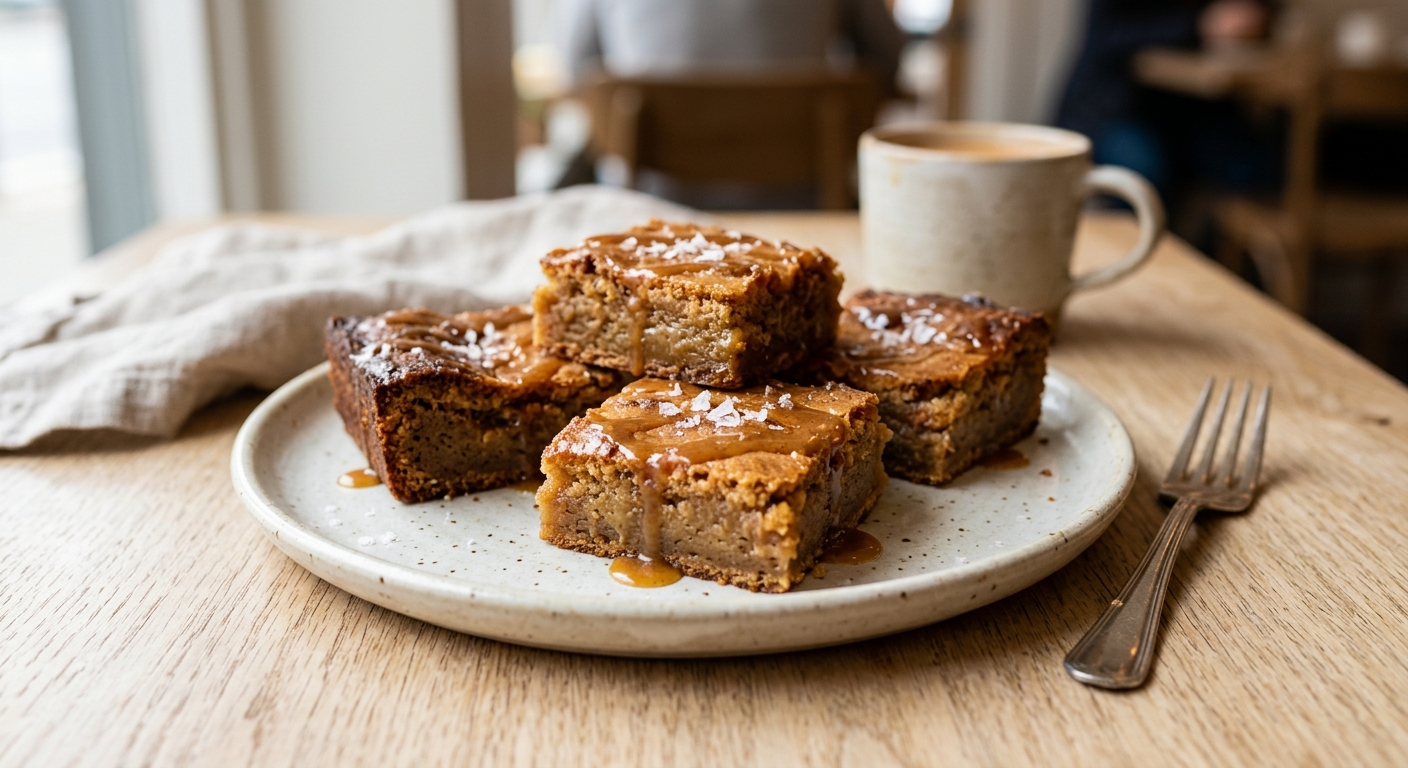
There is a particular kind of magic in a well-made blondie: that shatteringly thin top crust giving way to a dense, almost fudgy middle that smells like butterscotch and toasted vanilla. Most sugar-free versions of this classic fall flat, producing something cakey, dry, or faintly chemical-tasting. These blondies are different. They smell extraordinary while they bake, they pull cleanly from the pan, and when you bite in, the texture is so close to the real thing that you will find yourself checking the recipe again just to confirm.
The secret is the combination of two deliberate choices: browning the butter and using allulose as the primary sweetener. Browning the butter is non-negotiable here. It drives off the water content of the butter while creating hundreds of new flavor compounds through the Maillard reaction, concentrating a nutty, caramel-forward richness that does a lot of the heavy lifting in a recipe without refined sugar. Allulose, meanwhile, is a rare naturally occurring sugar found in figs and raisins that behaves almost identically to regular sugar in baking. It browns beautifully, it dissolves smoothly, and it creates that signature crackly blondie top that allulose simply cannot replicate. The result is a sugar-free bake that actually looks and tastes like it was made with sugar.
These blondies sit firmly in the easy-to-medium range of difficulty. Browning butter requires a few minutes of attentive stirring, but beyond that the batter comes together in one bowl with no mixer required. They are perfect for anyone managing blood sugar, following a low-glycemic lifestyle, or simply curious about whether sugar-free baking can be genuinely satisfying. Spoiler: it can.
Equipment Needed
Click on an item below to shop for the recommended items for this recipe on Amazon.
As an Amazon Associate, we earn from qualifying purchases.
16
Ingredients
- 115 gunsalted butter (about 1/2 cup or 1 stick), cut into pieces
- 200 gallulose, granulated (about 1 cup) – do not substitute allulose here without reading the notes
- 2 largeeggs, at room temperature
- 2 tsppure vanilla extract
- 150 gall-purpose flour (about 1 1/4 cups, spooned and leveled)
- 0.5 tspbaking powder
- 0.75 tspColima Sea SaltMicroplastic Free Salt, divided (1/2 tsp in batter, 1/4 tsp for topping)
- 80 gsugar-free chocolate chips or chopped dark chocolate (70% or higher), optional (about 1/2 cup)
- —Colima Sea SaltMicroplastic Free Salt, for finishing (such as Maldon)
Ingredient Substitutions
Instructions
- Preheat your oven to 325°F (163°C). Grease an 8×8-inch baking pan and line it with parchment paper, leaving an overhang on two sides for easy lifting. Set aside.
- Brown the butter: place the butter pieces in a light-colored saucepan over medium heat. Stir and swirl frequently. The butter will foam, then subside, then foam again. Keep cooking and stirring until the milk solids at the bottom turn deep golden-amber and the butter smells nutty and caramel-like, about 5 to 7 minutes. Immediately pour it into a large mixing bowl and scrape in every last bit of those toasted brown bits – they are pure flavor.
- While the brown butter is still warm (not hot – it should be comfortable to touch the bottom of the bowl), whisk in the allulose. Whisk vigorously for about 1 minute until the mixture is smooth and slightly thickened. Allulose dissolves readily in warm fat, which helps create a uniform, fudgy structure.
- Add the eggs one at a time, whisking well after each addition. Add the vanilla extract and whisk for another 30 seconds. The batter should look glossy and slightly lightened in color.
- Add the flour, baking powder, and 1/2 tsp fine sea salt to the bowl. Switch to a flexible spatula and fold until just combined and no dry streaks remain. Do not overmix. Fold in the chocolate chips or mix-ins if using.
- Pour the batter into the prepared pan and spread it into an even layer – it will be thick. Sprinkle the remaining 1/4 tsp fine sea salt and a generous pinch of flaky sea salt evenly over the top.
- Bake for 22 to 25 minutes, until the top is set and matte, the edges are pulling away from the sides, and a toothpick inserted 1 inch from the center comes out with just a few moist crumbs. The center will look very slightly underdone – this is correct. Allulose-based bakes firm up significantly as they cool.
- Let the blondies cool completely in the pan on a wire rack, at least 30 minutes, before lifting and slicing. Cutting them warm will result in a gummy, messy cut. Patience is rewarded.
- Brown the butter using the same method as the oven recipe: melt in a light-colored saucepan over medium heat, stirring until deep golden and nutty, 5 to 7 minutes. Pour into a large bowl, scraping every bit of browned solids in.
- Whisk the allulose into the warm brown butter for 1 minute until smooth. Add the eggs one at a time, then the vanilla, whisking well after each addition. Fold in the flour, baking powder, and 1/2 tsp fine sea salt with a spatula until just combined. Fold in chocolate chips if using.
- Grease a 7-inch square or 6-inch round air fryer-safe pan and line with parchment. Pour in the batter and spread evenly. Sprinkle with the remaining fine salt and a pinch of flaky sea salt.
- Air fry at 300°F (150°C) for 18 to 20 minutes. Start checking at 16 minutes – air fryers vary considerably. The top should be set and matte with no wet-looking center. A toothpick 1 inch from the center should yield moist crumbs, not wet batter. If the top is browning too fast, place a small square of foil loosely over the pan for the last 5 minutes.
- Cool in the pan for at least 25 minutes before lifting out and slicing. Because this is a smaller, thicker pan, the center will be especially soft and needs the full cooling time to set properly.
- Brown the butter for one serving: place 15g (1 tbsp) of butter in a small microwave-safe mug or ramekin. Microwave in 20-second intervals, watching closely after the first minute, until the butter is golden-amber and smells nutty, about 1 minute 20 seconds to 1 minute 40 seconds total. Watch it carefully – it can go from golden to burnt quickly in a microwave.
- Whisk 25g (2 tbsp) allulose directly into the browned butter in the mug until combined. Add 1 egg yolk (not a whole egg – a whole egg makes it rubbery), 1/4 tsp vanilla extract, and a tiny pinch of salt. Stir well.
- Add 20g (about 2 1/2 tbsp) all-purpose flour and a tiny pinch of baking powder. Stir until just smooth. Fold in a small handful of sugar-free chocolate chips if desired. The batter will be thick.
- Microwave on full power for 60 seconds. Check the center – it should be just barely set on top with a slightly glossy center. If it still looks very wet, microwave in 10-second bursts until just set. Do not overcook or it will become dry and spongy.
- Let the mug blondie rest for 2 minutes before eating – it will be very hot and will finish setting as it cools slightly. Finish with a pinch of flaky salt directly in the mug. Eat straight from the mug for the best experience.
Nutrition Per Serving
Per 1 serving (makes one 8×8-inch pan, cut into 16 squares)
Sweetener: allulose
Why This Recipe Works
Allulose is the MVP of this recipe, and understanding why it works so well explains why this blondie tastes genuinely different from most sugar-free bakes. Allulose is a monosaccharide that behaves almost identically to sucrose in heat-driven reactions. It participates in Maillard browning and caramelization, which is what gives these blondies their thin, glossy-crackly top and deep golden color. Allulose and most other sugar alcohols cannot do this – they simply do not brown the same way, leaving sugar-free bakes looking pale and tasting flat. Allulose also has a very similar hygroscopic behavior to sugar, meaning it holds onto moisture within the crumb, which is why the center of these blondies stays soft and fudgy rather than drying out.
Browning the butter before mixing is not just a flavor trick – it also changes the fat’s physical behavior in the batter. By cooking off the water content of the butter (which is about 16 to 18% of its weight), you are effectively concentrating the fat and eliminating steam that would otherwise puff the batter and create a cakier texture. The result is a denser, more fudgy crumb. The milk solids that turn golden during browning (the little flecks you scrape into the bowl) are rich in proteins and lactose that have undergone the Maillard reaction, contributing layered, nutty complexity that you simply cannot get from melted un-browned butter.
Baking at 325°F (163°C) rather than the more common 350°F is deliberate. Allulose browns more aggressively than regular sugar at high heat, and a lower temperature gives the batter time to bake through evenly before the edges over-darken. If your blondies are browning very quickly on the edges before the center is set, your oven runs hot – drop to 315°F and add 3 to 4 minutes. If they come out pale and cakey, your oven runs cool – increase to 335°F and check the same time window.
Baker’s Tips
- Do not skip scraping the pan when browning the butter. Those dark brown flecks stuck to the bottom of the pan are toasted milk solids with incredible flavor – they are not burned material to discard.
- Use a light-colored saucepan (stainless steel or enameled) to brown the butter so you can see the color change clearly. Dark nonstick pans make it very hard to judge doneness and you will almost certainly overshoot.
- Allulose is slightly less sweet than regular sugar. If you are accustomed to very sweet desserts, you can add 1 to 2 tablespoons of monk fruit sweetener to boost perceived sweetness without changing the texture.
- Bring your eggs to room temperature before adding them to the warm brown butter mixture. Cold eggs added to warm fat can cause the fat to seize slightly and may affect the final texture.
- Resist the urge to cut the blondies while warm. Allulose-based bakes are noticeably softer when hot than their sugar counterparts and need the full cooling time to set to a sliceable, fudgy consistency. A 30-minute wait gives dramatically better results than a 10-minute one.
- For perfectly clean cuts, use a sharp knife and wipe it clean between each slice. If the blondies have been refrigerated, let them sit at room temperature for 15 minutes before slicing.
Variations
- Espresso Brown Butter Blondies: whisk 1 tsp of instant espresso powder into the allulose-butter mixture. It deepens the toffee notes and gives the blondies an almost mocha quality without being overtly coffee-flavored.
- Tahini Swirl Blondies: drop 3 tablespoons of well-stirred tahini in small dollops over the surface of the batter before baking. Use a skewer to swirl. The sesame adds a nutty bitterness that plays beautifully against the sweet, caramel base.
- Pecan and Coconut Blondies: fold in 60g toasted chopped pecans and 30g unsweetened toasted coconut flakes in place of the chocolate chips. This version leans into a tropical-meets-Southern flavor profile.
- Extra Fudgy Version: reduce the flour to 120g and add 1 tbsp almond flour in its place. The lower starch content makes the center even more dense and yielding.
Troubleshooting & FAQ
My blondies came out cakey and dry instead of fudgy. What went wrong?
The top of my blondies is very dark or almost burned on the edges but the center is still underdone. What happened?
Why did my butter burn instead of browning when I was making the brown butter?
My blondies did not develop the shiny, crackly top. How do I get that?
Can I double the recipe for a 9×13-inch pan?
Storage & Make-Ahead
- Storage: Store blondies in an airtight container at room temperature for up to 4 days. For best texture, place a sheet of parchment between layers if stacking. Refrigerate for up to 7 days – allow to come to room temperature before eating, as cold temperatures can make allulose-based bakes slightly firmer. Freeze individually wrapped squares for up to 2 months; thaw at room temperature for 30 minutes.
- Make-Ahead: The brown butter can be made up to 5 days ahead and stored in an airtight container in the refrigerator. Bring it to room temperature before using. The full baked and cooled blondies can be made 2 days ahead and stored at room temperature, making them excellent for meal prep or packing into lunchboxes throughout the week.