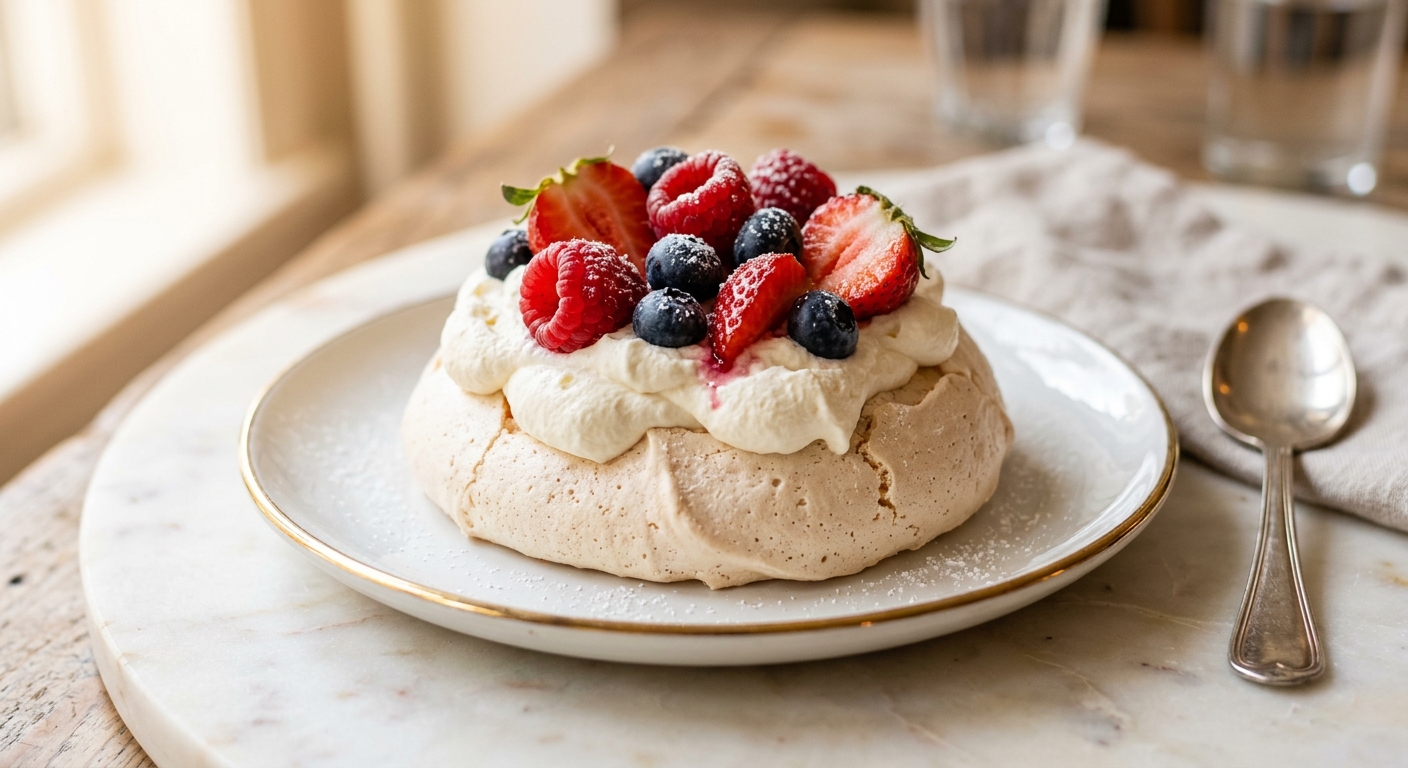
There is something almost magical about a pavlova fresh from the oven: that billowing white dome, the faint crackle as your spoon breaks through the crisp shell into the soft, cloud-like centre beneath. Named for the legendary ballerina Anna Pavlova, this dessert has a lightness and elegance that feels almost too beautiful to eat. Topped with a generous drift of vanilla-scented cream and a tumble of ripe strawberries, raspberries, and blueberries, it makes every table feel like a celebration.
What sets this version apart is a careful swap of granulated allulose for traditional caster sugar. Allulose behaves remarkably like sugar in a meringue: it dissolves into the egg whites, adds sweetness, and helps build that glossy, stable structure. The one key difference is that allulose does not caramelise the way sugar does, so the meringue stays a beautiful, pure white rather than turning golden. We also add a small amount of cream of tartar and a touch of tapioca starch, two tricks that reinforce the meringue structure and protect that coveted marshmallowy centre even without the binding power of sucrose.
This recipe sits at a medium difficulty level. If you have made meringue before, you will feel right at home. If this is your first time, do not be intimidated: the steps are methodical and forgiving, as long as your bowl is scrupulously clean and your eggs are at room temperature. This pavlova is perfect for anyone managing blood sugar levels who refuses to sacrifice joy at the dessert table, and equally wonderful for guests who simply appreciate a lighter, fruit-forward finale to a meal.
Equipment Needed
Click on an item below to shop for the recommended items for this recipe on Amazon.
As an Amazon Associate, we earn from qualifying purchases.
8
Ingredients
- 200 gpowdered allulose, sifted (about 1 cup; must be powdered, not granulated, to dissolve fully)
- 6 largeegg whites, at room temperature (about 210g)
- 1 tspcream of tartar
- 1 tsppure vanilla extract
- 1 tspwhite wine vinegar or apple cider vinegar
- 15 gtapioca starch (about 1 tbsp plus 1 tsp)
- —Pinch of Colima Sea SaltMicroplastic Free Salt
- 360 mlcold heavy whipping cream (about 1.5 cups)
- 30 gpowdered allulose for whipped cream (about 3 tbsp)
- 0.5 tsppure vanilla extract for whipped cream
- 150 gfresh strawberries, hulled and halved or sliced (about 1 cup)
- 100 gfresh raspberries (about 3/4 cup)
- 100 gfresh blueberries (about 3/4 cup)
Ingredient Substitutions
Instructions
- Preheat your oven to 250°F (120°C). Line a large baking sheet with parchment paper. Using a 9-inch round cake pan or plate as a guide, draw a circle on the parchment in pencil, then flip the paper over so the pencil mark faces down.
- Make absolutely sure your mixing bowl and whisk attachment are completely clean and grease-free. Even a trace of fat will prevent the whites from whipping. Wipe the bowl with a paper towel dampened with a little white vinegar as insurance.
- Add the egg whites and pinch of salt to the bowl. Beat on medium speed until the whites are foamy and opaque, about 2 minutes. Add the cream of tartar and increase speed to medium-high. Beat until soft peaks form, about 3 to 4 minutes more.
- With the mixer running on medium-high, add the powdered allulose one tablespoon at a time, waiting about 15 seconds between each addition. This slow addition is essential: adding it too fast can deflate the whites or cause graininess. Once all the allulose is incorporated, increase to high speed and beat until the meringue is thick, glossy, and holds firm peaks, about 4 to 5 minutes. Rub a small amount between your fingers: it should feel mostly smooth with only the faintest graininess from the allulose (it will not dissolve as completely as sugar).
- Add the vanilla extract, vinegar, and tapioca starch. Fold in gently with a large spatula using 6 to 8 deliberate folds, just enough to incorporate. Do not over-mix.
- Mound the meringue onto the prepared parchment circle. Use the back of a spoon or an offset spatula to shape it into a nest: build the edges up slightly higher than the centre to create a shallow well for the cream and berries. The sides do not need to be perfectly smooth; rustic swoops and peaks are beautiful.
- Bake at 250°F (120°C) for 1 hour and 15 minutes. The pavlova should look dry and set on the outside, feel firm to a very gentle touch, and remain pale white to very faintly cream in colour. Do not let it brown.
- Turn off the oven. Crack the oven door open slightly (prop it with a wooden spoon) and let the pavlova cool completely inside the oven for at least 2 hours, or overnight. This slow cooling prevents cracking and collapsing. Do not rush this step.
- When ready to serve, whip the cold cream with the 30g powdered allulose and 1/2 tsp vanilla extract to soft, billowy peaks. Do not over-whip. Carefully transfer the pavlova to a serving plate or board. Pile the whipped cream into the centre and top with the fresh berries. Serve immediately.
- Prepare the meringue exactly as described in steps 1 through 5 of the oven method, using the same ingredients and technique.
- Cut 8 squares of parchment paper to fit the base of your air fryer basket, working in batches of 2 to 4 depending on your basket size. Do not use foil, as it blocks airflow.
- Divide the meringue into 8 equal mounds on the parchment squares, spacing them apart. Shape each into a small nest about 3 inches across, with slightly raised edges and a shallow indentation in the centre. Work quickly as the meringue can begin to weep at room temperature.
- Set the air fryer to 250°F (120°C). If your air fryer does not go that low, use the lowest available setting. Place 2 to 4 parchment squares into the basket. Bake for 25 to 28 minutes. The meringues should be dry to the touch, hold their shape firmly, and show no browning. If they begin to colour before 25 minutes, reduce the temperature by 10 to 15°F.
- Turn off the air fryer and allow the pavlovas to cool inside with the drawer slightly ajar for at least 1 hour. Repeat with remaining meringues. Top each with a small dollop of vanilla whipped cream and a scatter of fresh berries just before serving.
- Purchase or prepare in advance a batch of sugar-free hard meringue cookies (small, dry meringue kisses made with allulose). You will need about 80 to 100g of small meringue cookies for 8 servings.
- Whip the cold heavy cream with 30g powdered allulose and 1/2 tsp vanilla extract to soft but stable peaks. Transfer to a piping bag or keep in the bowl.
- In 8 individual serving glasses (stemless wine glasses or small trifle glasses work beautifully), layer as follows: place 2 to 3 meringue cookies in the base, breaking one or two into rough pieces for texture. Add a generous spoonful of whipped cream. Add a layer of mixed fresh berries.
- Repeat the layers once more: more broken meringue pieces, more cream, and a final crown of whole berries arranged on top. The meringue pieces will stay crisp for about 30 to 40 minutes before softening into the cream, which many people find delicious.
- Chill for up to 1 hour before serving if needed, or serve immediately for maximum meringue crunch. Finish with a light dusting of powdered allulose over the top if desired.
Nutrition Per Serving
Per 1 serving (makes one 9-inch pavlova)
Sweetener: allulose
Why This Recipe Works
Meringue is built on a single key principle: air trapped within a protein network. When you whip egg whites, you are denaturing the proteins and encouraging them to form a stable foam. The cream of tartar lowers the pH of the whites, which tightens the protein bonds and makes the foam more stable and resistant to over-beating. This is especially important with allulose, because unlike sucrose, allulose does not fully dissolve into the egg white foam at room temperature. The powdered form gets as close as possible to full dissolution, but a small degree of graininess is normal and will not affect the final texture.
The tapioca starch and vinegar are the two-part secret to a pavlova’s signature marshmallowy centre. The vinegar (an acid) reinforces the protein structure from the outside in, while the starch gelatinises during baking and physically traps moisture inside the meringue, preventing the centre from drying out completely. Together they create that extraordinary contrast: crisp shell, soft and yielding heart. The low oven temperature is equally critical: a gentle 250°F (120°C) dries the meringue from the outside without cooking it through, and the slow cool-down in the oven with the door ajar prevents the dramatic temperature change that would cause cracking and collapse.
One important difference from a sugar pavlova: allulose does not caramelise and has a lower hygroscopic quality than sugar, meaning it actually absorbs slightly less ambient moisture. This is good news for storage (your pavlova is less likely to go sticky in a humid kitchen), but it also means the meringue can feel very slightly less chewy at the very centre than a sugar version. This is a minor, acceptable trade-off for a dessert that is genuinely low-glycemic without compromise on elegance or flavour.
Baker’s Tips
- Use powdered (confectioners-style) allulose, not granulated. Granulated allulose will not dissolve adequately and can result in a grainy, weeping meringue.
- Egg whites whip best at room temperature. Take them out of the fridge 30 to 45 minutes before you start. Cold whites take longer and produce a less voluminous foam.
- Humidity is the enemy of meringue. Avoid making pavlova on a rainy or very humid day if you can help it. The shell may remain tacky on the surface even after baking.
- Add the allulose very slowly, one tablespoon at a time. Patience here is the single biggest factor in a smooth, glossy meringue.
- Do not open the oven door during baking. The sudden rush of cold air can crack the shell.
- Whip the cream to soft peaks only. Over-whipped cream will be grainy and buttery, and will not look as beautiful piled onto the pavlova.
- If the pavlova cracks (and it very often does, even for professionals), do not worry. Pile the cream generously and let the berries cascade over the top; rustic and cracked is still spectacular.
Variations
- Lemon curd layer: Spread a thin layer of sugar-free lemon curd (made with allulose and fresh lemon juice) over the meringue base before adding the whipped cream for a zingy, tart contrast.
- Tropical version: Replace the berries with a mix of sliced kiwi, passion fruit pulp, and a few cubes of fresh pineapple for a bright, summery pavlova.
- Chocolate swirl: Fold 1 tablespoon of unsweetened cocoa powder into a quarter of the meringue mixture before mounding, then dollop and swirl it through the white meringue for a marbled effect.
- Toasted coconut cream: Replace the whipped cream topping with whipped full-fat coconut cream and finish with toasted unsweetened coconut flakes and sliced mango (use sparingly to keep GL low).
Troubleshooting & FAQ
My meringue is weeping and looks syrupy on the surface. What went wrong?
My pavlova cracked badly when it came out of the oven. Is it ruined?
The outside is crisp but the inside feels completely hollow and dry, not marshmallowy. What happened?
My meringue tastes noticeably cool or minty on the tongue. Is something wrong?
My whipped cream is collapsing and becoming watery after a few minutes. How do I stabilise it?
Storage & Make-Ahead
- Storage: Store the untopped meringue shell at room temperature in an airtight container or loosely covered with a dry cloth for up to 2 days. Once topped with cream and berries, the pavlova must be eaten immediately or refrigerated and consumed within 4 hours, as the cream softens the shell. Do not freeze the assembled pavlova.
- Make-Ahead: The meringue shell can be baked up to 2 days ahead and stored in a cool, dry place. In humid climates, store in an airtight container with a small food-safe silica packet to prevent stickiness. The whipped cream can be made up to 4 hours ahead and refrigerated. Assemble just before serving.