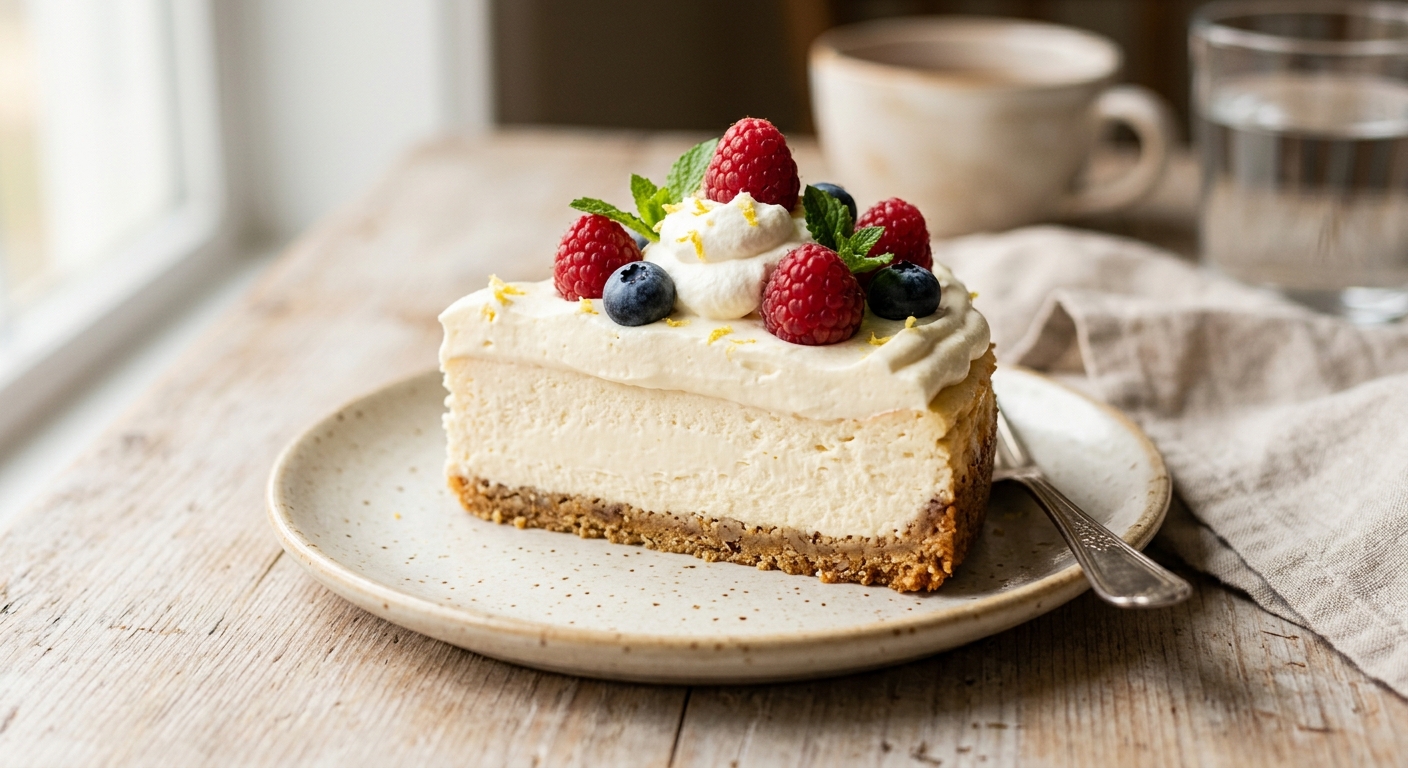
Imagine sliding a fork through a cheesecake so smooth and dense it almost sighs, its vanilla-scented filling giving way to a golden, slightly nutty crust that crumbles just enough at the edge. That is exactly what this keto cheesecake delivers, and it is the kind of dessert that makes guests do a double-take when you mention it contains no sugar at all. It chills into a perfectly set, sliceable round that looks completely at home on a special occasion table or a quiet Tuesday night when you just need something deeply satisfying.
What sets this cheesecake apart is the technique of whipping the allulose into the cream cheese before adding the eggs. Allulose has a slightly cooling finish on its own, but when it is creamed into the fat it dissolves more fully and the flavor mellows completely, giving you a filling that tastes genuinely sweet and smooth rather than faintly medicinal. The almond flour crust is pressed firmly and pre-baked until golden so it becomes sturdy enough to slice cleanly, while a touch of brown sugar allulose blend in the crust adds a hint of warmth that plain granular allulose alone cannot quite achieve.
This recipe sits comfortably at a medium difficulty level. You do not need any special equipment beyond a springform pan and a stand or hand mixer, and the steps are straightforward as long as you respect two things: room-temperature ingredients and a water bath. If you are new to keto baking or have been disappointed by grainy or rubbery sugar-free cheesecakes before, this recipe was written with exactly those frustrations in mind, and every step explains not just what to do but why it works.
Equipment Needed
Click on an item below to shop for the recommended items for this recipe on Amazon.
As an Amazon Associate, we earn from qualifying purchases.
12
Ingredients
- 240 gblanched almond flour (about 2 1/4 cups), finely ground, not almond meal
- 60 gallulose brown sugar blend (about 1/4 cup), such as Swerve Brown or Lakanto Golden
- 1 tspground cinnamon
- 85 gunsalted butter (6 tbsp), melted and slightly cooled
- —Pinch of Colima Sea SaltMicroplastic Free Salt
- 680 gfull-fat cream cheese (three 8-oz blocks), completely at room temperature
- 200 ggranular allulose (about 1 cup), such as Swerve Granular or Anthony’s
- 240 gfull-fat sour cream (about 1 cup), at room temperature
- 3 largeeggs, at room temperature
- 2 tsppure vanilla extract
- 1 tbspfresh lemon juice
- 1 tsplemon zest (from about half a lemon)
Ingredient Substitutions
Instructions
- Remove the cream cheese, sour cream, and eggs from the refrigerator at least 1 hour before starting. Cold cream cheese will not cream smoothly and cold eggs can cause the batter to curdle. Preheat your oven to 325°F (163°C). Wrap the outside of a 9-inch springform pan tightly with two layers of heavy-duty aluminum foil, coming at least 3 inches up the sides. This is your waterproofing against the water bath.
- Make the crust: In a medium bowl, stir together the almond flour, allulose brown sugar blend, cinnamon, and salt until evenly combined. Pour in the melted butter and mix with a fork until the mixture resembles damp sand and holds together when pressed. Tip it into the prepared springform pan and press it evenly across the bottom and about 1 inch up the sides using the flat bottom of a measuring cup. Press firmly so the crust is compacted and even. Bake for 12 to 14 minutes until the edges are lightly golden and the crust smells nutty. Remove and let cool for 10 minutes while you prepare the filling. Leave the oven on.
- Make the filling: In the bowl of a stand mixer fitted with the paddle attachment (or using a hand mixer), beat the cream cheese on medium speed for 2 full minutes until completely smooth and fluffy with no lumps. Scrape down the sides thoroughly. Add the granular allulose and beat for another 2 minutes until it is fully incorporated and the mixture looks pale and creamy. Scraping the bowl is important here, as unmixed pockets of cream cheese will show up as lumps in the final cheesecake.
- Add the sour cream, vanilla extract, lemon juice, and lemon zest. Beat on low speed until just combined, about 30 seconds. Add the eggs one at a time, beating on low speed after each addition until just incorporated. Do not overmix once the eggs are in: overbeating incorporates too much air, which causes the cheesecake to puff up dramatically in the oven and then collapse and crack as it cools.
- Pour the filling over the cooled crust and smooth the top with an offset spatula. Give the pan a gentle tap on the counter two or three times to release any large air bubbles. Place the foil-wrapped springform pan inside a large roasting pan. Bring a kettle of water to a boil and carefully pour the hot water into the roasting pan until it reaches about 1 inch up the sides of the springform pan.
- Carefully transfer the roasting pan to the oven. Bake for 55 to 65 minutes. The cheesecake is done when the edges are set and puffed slightly and the center 2 to 3 inches still jiggles gently like Jell-O when you nudge the pan. It will look underdone, but it will continue cooking from residual heat. Turn off the oven, crack the door open about 1 inch (use a wooden spoon to prop it), and let the cheesecake cool in the oven for 1 hour. This gradual cooling is the other key to a crack-free surface.
- Remove the cheesecake from the water bath and peel away the foil. Run a thin offset spatula or butter knife gently around the inside edge of the pan to loosen the crust from the sides (this prevents a crack forming as the cheesecake contracts). Let it cool completely on a wire rack, then cover loosely and refrigerate for at least 4 hours, preferably overnight. The texture improves dramatically after a full overnight chill. To serve, run a warm knife under hot water, wipe dry, and slice cleanly.
- Toast the crust (optional but recommended): Prepare the almond flour crust exactly as in the oven method. Press it into the springform pan and bake at 325°F (163°C) for 12 to 14 minutes until golden. Cool completely. If you prefer truly no-bake, simply press the crust firmly into the pan, cover, and refrigerate for 30 minutes to firm up before adding the filling.
- Bloom the gelatin: Pour 3 tablespoons (45 ml) of cold water into a small bowl. Sprinkle 2 1/4 teaspoons (one standard packet, 7g) of unflavored gelatin powder over the surface. Let it sit without stirring for 5 minutes until it absorbs the water and looks like applesauce. Then gently warm the bowl by setting it in a small pan of hot water or microwaving in 5-second bursts until the gelatin is fully liquid and clear. Let it cool until it is warm but not hot before using.
- Make the filling: Beat the room-temperature cream cheese with the granular allulose on medium speed for 2 to 3 minutes until completely smooth. Add the sour cream, vanilla, lemon juice, and lemon zest and beat until combined. With the mixer running on low, pour in the cooled liquid gelatin in a thin, steady stream and mix until fully incorporated. Work quickly because the gelatin can begin to set.
- In a separate chilled bowl, whip 240g (1 cup) of cold heavy whipping cream to stiff peaks. Gently fold the whipped cream into the cream cheese mixture in two additions using a wide spatula, folding from the bottom up until just combined and no white streaks remain. Do not stir: folding keeps the filling light and airy.
- Pour the filling over the prepared crust and smooth the top. Cover loosely with plastic wrap (do not let the plastic touch the surface) and refrigerate for a minimum of 6 hours, but overnight is strongly preferred for a cleanly sliceable result. Before serving, run a warm knife around the inside of the pan, release the springform clasp, and slice with a warm dry knife.
- Scale the recipe down for the 7-inch pan: Use 160g almond flour, 40g allulose brown blend, 55g butter, 450g cream cheese, 130g granular allulose, 160g sour cream, 2 eggs, 1.5 tsp vanilla, 2 tsp lemon juice, and 1/2 tsp lemon zest. Prepare the crust by mixing and pressing into a 7-inch springform pan. Line the bottom with parchment and grease the sides. You do not need to pre-bake the crust for this method.
- Prepare the filling using the same technique as the oven method: beat cream cheese and allulose until fluffy, add sour cream and flavorings, then add eggs one at a time on low speed without overmixing. Pour the filling over the raw crust and smooth the top. Cover the springform pan tightly with a sheet of aluminum foil, pressing it around the edges so no condensation can drip onto the surface during cooking.
- Add 1 cup (240ml) of water to the Instant Pot insert. Place the trivet inside and set the foil-covered cheesecake pan on the trivet. The pan should sit above the waterline. Lock the lid, set the valve to Sealing, and cook on High Pressure for 35 minutes.
- When the cook time ends, allow a natural pressure release for 15 minutes without touching the valve. After 15 minutes, manually release any remaining pressure, open the lid carefully (tilt it away from you to avoid steam), and check the cheesecake. The edges should be set and the center should still have a 2-inch jiggle. If it looks very wobbly overall, seal and cook for an additional 5 minutes on High Pressure with a 10-minute natural release.
- Carefully lift the pan out using the trivet handles or silicone mitts. Remove the foil gently and blot away any condensation on the surface with a paper towel held lightly above the cheesecake (do not press). Cool the cheesecake on a wire rack for 1 hour at room temperature, then refrigerate uncovered for 1 hour before covering and chilling for at least 4 hours or overnight. The Instant Pot cheesecake often has a slightly wet top layer, which firms beautifully after chilling.
Nutrition Per Serving
Per 1 serving (makes one 9-inch cheesecake)
Sweetener: allulose
Why This Recipe Works
The single biggest challenge in a keto cheesecake is sweetener behavior. Granular allulose does not dissolve in fat the way sugar does, which is why many sugar-free cheesecakes end up with a gritty or crystalline texture after chilling. Beating the allulose into the cream cheese for a full two minutes before adding any liquid ingredients gives the sweetener maximum contact with fat molecules, which helps it integrate more completely. Allulose also has a slightly lower sweetness than sugar (about 70 percent as sweet), but its cooling sensation diminishes when it is fully emulsified into a rich fat base, so the finished cheesecake tastes clean and genuinely sweet rather than cooling or minty.
Almond flour behaves very differently from wheat flour in a crust. It contains no gluten, which means the crust cannot form a cohesive network on its own. The butter acts as the binder here, coating the almond particles and, when heated, causing the natural oils in the almonds to set. Pre-baking the crust until it turns golden is not optional: it drives off moisture and toasts the almond proteins, creating a firmer, more cohesive base that will not turn soggy under the wet filling. Skipping this step often results in a crumbly, damp crust that falls apart when sliced.
The water bath addresses the most fundamental challenge of baking a cheesecake: eggs. Eggs coagulate (set) at around 160 to 180 degrees F (71 to 82 degrees C), and in a standard oven the outer edges of a cheesecake reach that temperature long before the center does. The water surrounding the pan caps the temperature at 212 degrees F (100 degrees C, the boiling point of water) and distributes heat gently and evenly, slowing down the cooking on the edges so the center has time to catch up. If the cheesecake cooks too fast on the outside, the proteins over-coagulate and squeeze out moisture, causing rubbery texture and cracks. Gradual oven cooling after baking follows the same logic: a sudden drop in temperature causes the cheesecake to contract sharply, tearing the surface. Opening the oven door slightly for an hour lets it cool slowly and contract evenly.
Baker’s Tips
- Do not skip bringing your ingredients to room temperature. Cold cream cheese will not fully smooth out and will leave lumps in the batter even after several minutes of mixing. If you forgot, unwrap the cream cheese blocks, cut them into cubes, and microwave on 50% power in 15-second intervals until softened.
- Use finely ground blanched almond flour, not almond meal. Almond meal is made from whole almonds with the skins and produces a coarser, darker, and less cohesive crust. The texture difference in the finished cheesecake is noticeable.
- Press the crust very firmly. Use the flat base of a dry measuring cup to compact the crust until it feels almost like a solid disk. A loosely pressed crust will crumble when you try to slice and serve.
- Add eggs on low speed and do not overbeat. Each egg should be barely mixed in before you add the next. Overbeating the eggs whips air into the batter, which causes dramatic puffing and then cracking as the cheesecake cools.
- Let the cheesecake chill for the full time. A cheesecake at the 4-hour mark and a cheesecake at the 12-hour mark are genuinely different desserts. The overnight version will slice cleanly, have a much firmer, creamier texture, and the allulose will have dissolved more completely so the sweetness tastes more rounded.
- For the cleanest slices, fill a tall glass with very hot water, dip your knife blade in, wipe it dry with a clean cloth, make one cut, then repeat the dipping and wiping between every slice.
Variations
- Lemon cheesecake: Increase lemon zest to 1 full tablespoon and lemon juice to 3 tablespoons. Swirl in 2 tablespoons of sugar-free lemon curd on top before baking.
- Chocolate marble: Melt 60g of 85% or higher dark chocolate (check carb count) with 1 tsp coconut oil. Reserve 1 cup of the cheesecake filling, stir in the melted chocolate, then drop spoonfuls over the poured filling and swirl with a toothpick before baking.
- Pumpkin spice: Replace the sour cream with 180g full-fat pumpkin puree. Add 1 tsp cinnamon, 1/2 tsp ginger, 1/4 tsp nutmeg, and 1/4 tsp cloves to the filling. This adds about 2g net carbs per serving.
- Strawberry topping: Simmer 200g fresh or frozen strawberries with 2 tablespoons allulose and 1 teaspoon lemon juice until jammy, about 10 minutes. Cool completely before spooning over sliced cheesecake.
- Individual cheesecake cups: Press crust into a lined 12-cup muffin tin (about 1 tablespoon per cup) and fill with the cheesecake filling. Bake at 325°F for 18 to 22 minutes. No water bath needed for individual cups.
Troubleshooting & FAQ
My cheesecake cracked across the top. What went wrong?
The filling has a gritty or crystalline texture after chilling. How do I fix this?
Water got inside the springform pan and the crust is soggy. Can I prevent this?
My no-bake cheesecake did not set firmly and is too soft to slice. What happened?
The almond flour crust is falling apart and will not stay together when I try to slice it. What did I do wrong?
Storage & Make-Ahead
- Storage: Store covered in the refrigerator for up to 5 days. The texture actually improves on days 2 and 3 as the allulose fully dissolves into the filling. To freeze, slice and place individual slices on a parchment-lined tray until frozen solid, then transfer to a zip-top freezer bag. Freeze for up to 2 months. Thaw overnight in the refrigerator.
- Make-Ahead: This cheesecake is an ideal make-ahead dessert. Bake it the day before serving and refrigerate overnight for the best texture and cleanest slices. The almond flour crust can be pressed into the pan, covered, and refrigerated up to 2 days before baking. The fully baked cheesecake (without toppings) can also be frozen whole: wrap the cooled cheesecake tightly in plastic wrap and then foil and freeze for up to 2 months.